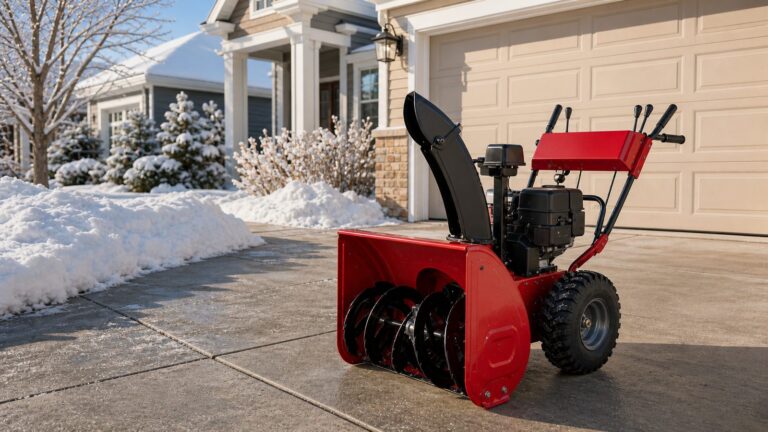
Choose a single-stage snow blower if you usually clear a small or medium smooth, paved driveway, sidewalks, decks, or narrow paths and typically receive light-to-moderate snow. It will usually be lighter, easier to store and maneuver, and better at cleaning close to pavement.
Choose a two-stage snow blower if you regularly deal with deep, wet, packed, or plow-compacted snow; loose gravel or uneven surfaces; a large driveway; meaningful slopes; or you want more reserve capacity for an unusually severe storm. Its powered wheels or tracks can also reduce pushing effort.
As an Amazon Associate I earn from qualifying purchases.
The important qualification: stage count is only the starting point. Compare the exact machine’s intake height, auger and impeller design, drive system, skid-shoe adjustment, surface instructions, battery or fuel system, and owner’s manual. A two-stage machine has a higher performance ceiling, but a single-stage machine is often the more efficient tool when the conditions fit it.
What’s actually slowing this PC down?
Pick the symptom - the matching free tool is one click away.
Single-Stage Snow Blower vs. Two-Stage: Which One Should You Buy?
For most homeowners, the decision comes down to three questions: how much snow must be moved, what surface is underneath it, and how much effort can the operator comfortably manage? A short, smooth, paved driveway that receives a few inches of ordinary snow does not automatically justify a large two-stage machine. A gravel driveway with a steep slope and a frozen plow berm can make a small single-stage machine frustrating or unsafe, even if the driveway itself is not especially long.
#1 Best Overall

- Peak Power technology combines the power of 2 EGO 56V ARC Lithium batteries
- Throws snow up to 40 ft.
- Steel auger cuts through ice & snow 50% faster
- High-efficiency brushless motor
- 21 in. clearing width
This guide is for U.S. homeowners comparing residential equipment. Product specifications, availability, warranties, and prices change, so verify the exact model and read its current operator’s manual before buying. The figures below are model specifications or independent-test categories, not universal limits for every machine.
Single-stage vs. two-stage at a glance
| Factor | Single-stage | Two-stage |
|---|---|---|
| How it moves snow | One auger or rubber-paddle assembly gathers and ejects the snow. | A slower auger gathers snow and feeds it to a separate high-speed impeller. |
| Best starting point | Small or medium smooth paved areas, walks, decks, and tight paths. | Large areas, deep or wet snow, gravel, uneven surfaces, slopes, and plow berms. |
| Surface finish | Usually leaves less snow on smooth pavement because the paddle or auger can operate very close to the surface. | Usually leaves a thin layer when skid shoes and the scraper bar hold the housing above the surface. |
| Snow capacity | Varies widely. Basic models suit lighter snow, while advanced models can handle substantially more. | Generally offers more intake and discharge capacity, but the exact model and conditions still control performance. |
| Wet or compacted snow | Can struggle, bog down, or clog when overloaded. | Usually the safer choice because the larger auger and separate impeller provide more reserve capacity. |
| Gravel | Usually unsuitable unless the specific model is expressly approved and adjusted for it. | Generally better, with skid shoes set high enough to keep the housing above loose stone. |
| Propulsion | Often moved by the operator, although some auger-driven designs help pull themselves forward. | Normally has powered wheels or tracks, multiple speeds, and sometimes power steering. |
| Handling and storage | Usually lighter, smaller, and easier to turn, carry, and store. | Usually heavier and bulkier, though powered drive makes deep snow easier to traverse. |
| Maintenance | Fewer systems, but paddles, scraper bars, belts, batteries, cords, or engines still require care. | More components to inspect, including the auger gearbox, impeller, drive system, skid shoes, and shear hardware where fitted. |
| Best user profile | A homeowner who values convenience, compact storage, and a clean pavement finish. | A homeowner who values storm capacity, traction, and the ability to handle difficult snow with one machine. |
This is a decision aid, not a substitute for the exact model’s instructions. A particular single-stage machine may outperform a basic two-stage unit in some conditions, and a poorly adjusted two-stage machine can perform badly on gravel or pavement.
What the stages actually mean
How a single-stage blower works
- A rotating auger or rubber paddle contacts and gathers snow.
- The same rotating assembly moves the snow toward the discharge opening.
- That assembly supplies the force that sends the snow through the chute.
Many single-stage machines use rubber-edged paddles. On suitable pavement, the paddles can contact the surface and help propel the blower while scraping away more of the remaining snow. For example, Ariens describes its Path-Pro as a single-stage machine with reinforced rubber paddles and an adjustable scraper bar intended to clean down to the pavement. See the Ariens Path-Pro product information.
Windows Errors? Fix Them Before They Spread
Repair common Windows errors and clear accumulated junk for a smoother, more stable PC - no reinstall needed.Free scan · no reinstallCrashes, No Sound, or Screen Glitches?
Random freezes, missing sound and display glitches usually trace back to one bad driver. Find and replace yours safely.Free scan · under a minuteThe design is mechanically simple and compact, but it has an important limitation: the same part must gather, move, and discharge the snow. If the intake is overloaded with dense snow, frozen chunks, or debris, the machine can lose momentum or clog.
How a two-stage blower works
- A serrated or steel auger breaks up and gathers the snow.
- The auger moves the material toward the center of the housing.
- A separate high-speed impeller accelerates the snow through the discharge chute.
Because gathering and discharge are handled by separate mechanisms, a two-stage design generally has more capacity for deep, dense, or compacted snow and can throw it farther. Two-stage machines commonly add powered wheels or tracks, adjustable skid shoes, and a scraper bar that controls how close the housing runs to the surface. Husqvarna’s buying guide explains the distinction between auger-driven one-stage machines and powered-wheel two-stage machines.
Simple mechanical picture: single-stage means auger or paddle → chute. Two-stage means auger → impeller → chute. The impeller is the additional high-speed discharge stage; it is not merely a second auger.
How much snow can each type handle?
Snow depth is useful for screening models, but it is not a universal single-stage-versus-two-stage cutoff. Snow density, moisture, temperature, wind, battery charge, intake height, forward speed, and whether the snow is fresh or compacted can matter as much as the ruler measurement.
Do these 3 things before closing this tab:
1Clear out junk files and repair common Windows errors2Scan for outdated or missing drivers - takes under a minute3Repair Windows errors before they cause bigger problemsAs a broad category description, Consumer Reports categorizes single-stage electric models around less than 6 inches, single-stage gas models around up to 9 inches, two-stage battery models as most effective around 12 inches or less, and two-stage gas models around up to 16 inches. Those are useful buying-guide ranges, not guarantees.
Manufacturer specifications demonstrate why a category-wide number can mislead. Toro’s current SnowMaster line is classified by Toro as single-stage, yet listed models are 24 inches wide, list an 18-inch maximum snow cut, and claim throwing distances of roughly 34 to 45 feet depending on model. Toro says the line is intended to approach two-stage snow-moving performance while remaining easier to maneuver, but also says it performs best on paved driveways and sidewalks. Review the Toro SnowMaster specifications for the exact model.
By contrast, Toro’s Power Clear single-stage models list approximately 12 to 12.5 inches depending on model, while EGO’s 24-inch battery two-stage model lists a 20-inch intake height. These figures are not directly comparable: a manufacturer’s maximum cut, intake height, and recommended operating depth describe different things. See the Toro single-stage range and EGO SNT2400 specifications.
Practical interpretation: if you normally clear snow after every storm and the snow is dry and manageable, a capable single-stage model may be enough even when a marketing chart suggests buying larger equipment. If you often wait, receive wet snow, or must break through a frozen pile, choose a two-stage machine before you reach its listed maximum rather than treating that maximum as a target.
Wet, heavy, and icy snow: which design is better?
Usually, a two-stage blower. The heavier auger and separate impeller generally give it more reserve capacity and better discharge assistance when snow is dense, wet, or partially frozen. This is particularly valuable when the snow has been compressed by tires or sits in a dense pile at the end of the driveway.
That does not make a two-stage machine clog-proof. Wet, sticky snow can clog either design when the intake is overloaded, the chute is obstructed, the machine is moving too slowly, or the snow has begun to melt and refreeze. The Consumer Product Safety Commission and OSHA both identify snow and debris clogs as serious hazards.
A strong single-stage machine may handle moderate wet snow if the operator takes smaller bites and clears early. It is a poor bet, however, if your normal routine includes deep wet snow or waiting for a municipal plow to leave a hard wall at the driveway entrance.
Gravel, pavers, concrete, asphalt, and mixed surfaces
Gravel: generally start with two-stage
A gravel driveway normally points toward a two-stage machine with properly adjusted skid shoes. The shoes hold the auger housing and scraper bar above the loose stone, reducing the chance that gravel will be pulled into the auger and thrown toward people, vehicles, windows, or the machine itself.
Free tools Windows power users keep installed
One-click scans. No signup required.
There is a trade-off: raising the housing protects against gravel ingestion but leaves more snow behind. The Ariens adjustment guidance gives an example of using a 1/8-inch spacer for paved surfaces and a 1/2-inch spacer for gravel, but the exact owner’s manual takes priority. Greenworks also warns that skid shoes must be raised for gravel; consult its 80V two-stage product guidance.
Do not convert that advice into a blanket rule that every two-stage blower is safe on every gravel driveway. Check the manual for surface restrictions, shoe adjustment, and any required hardware.
Can a single-stage machine be used on gravel?
Usually not unless the manufacturer specifically approves that model and provides a suitable clearance adjustment. Direct-contact paddles or augers are more likely to pick up loose stone. Troy-Bilt says its single-stage machines should be used only on solid pavement; see its snow-blower selection guidance.
There are model-specific exceptions. EGO sells skid shoes for certain single-stage machines intended for cracks, bumps, and gravel driveways. That does not make all single-stage blowers gravel-compatible. The manual and approved accessories for the exact model control.
Pavers, uneven pavement, and mixed surfaces
Mixed surfaces require more caution than a simple paved-versus-gravel label suggests. Raised skid shoes on a two-stage machine can help it cross uneven areas, but may leave residual snow. A direct-contact single-stage machine can clean smooth pavement well, yet may catch on abrupt paver edges, cracks, stones, or transitions. Read the manufacturer’s surface instructions and inspect the route for loose objects before every storm.
For a driveway that changes from asphalt to gravel, the relevant question is not merely which stage is more powerful. It is whether the machine can be adjusted quickly and safely for each surface without leaving the housing too low on stone or too high on pavement.
Which type cleans closer to pavement?
Usually, single-stage. A rubber paddle or other direct-contact assembly can operate close to smooth pavement, so a good single-stage machine often leaves less residual snow. That is useful when the surface is flat and the priority is a clean finish with less follow-up scraping or ice melt.
Rank #2

- Cordless 48-Volt Power: Dual 24-volt IONMAX lithium batteries deliver 48-volt output for consistent cordless snow removal without gas, extension cords, pull starts, or routine engine maintenance
- 18-Inch Clearing Width: Clears an 18-inch-wide by 10-inch-deep path to remove light to moderate snow from driveway, sidewalk, patio, deck, walkway, pathway, porch, pavement, and concrete
- 1200-Watt Brushless Motor: High-efficiency brushless motor moves up to 700 pounds of snow per minute, handling fresh snowfall and light accumulation with reduced vibration and wear
- 20-Foot Throw Distance: Adjustable 180-degree chute rotates for directional control and throws snow up to 20 feet, allowing targeted discharge placement away from cleared areas and edges
- LED Light and Steel Auger: 2-watt LED headlight supports early morning and evening clearing while rubber-tipped steel auger and scraper bar clear close to pavement without surface damage
Two-stage machines need clearance between the housing and the surface. This is essential on gravel and uneven ground, but it can leave a thin layer on asphalt or concrete that later freezes. Consumer Reports notes that two-stage models generally do not clean down to pavement as well as single-stage models.
The Tool Desk
Outbyte PC Repair FREERepair Windows errors before they cause bigger problemsFix Now →Outbyte Driver Updater FREEScan for outdated or missing drivers - takes under a minuteDriver Scan →Neither design guarantees bare pavement. Scraper-bar wear, skid-shoe height, surface flatness, snow temperature, and the individual model all affect the result. A two-stage machine can be adjusted more aggressively for pavement, but that setting may be unsuitable when the same route includes loose gravel.
Plow berms and end-of-driveway piles
A two-stage machine is the safer category recommendation for a plow berm. The pile left by a municipal plow may contain dense, wet, partially frozen chunks and road debris. A heavy auger can break up that material, while the impeller helps move it through the chute.
A powerful single-stage model may handle a fresh, soft berm, but that is a model-specific success rather than a dependable rule for the entire category. The Consumer Reports testing and reviews treat plow-pile removal as a separate performance category, which is a useful reminder that ordinary snowfall performance does not predict berm performance perfectly.
Serrated-auger single-stage machines are marketed for compacted end-of-driveway snow, so a buyer facing only occasional berms should compare the exact design rather than rejecting every single-stage option. If the berm is routinely frozen or contains large chunks, however, a two-stage blower provides more margin.
Driveways, slopes, and operator effort
Area size is more than driveway length
There is no universal driveway length at which a two-stage machine becomes necessary. Lowe’s uses a driveway longer than 60 feet as one reason to consider two- or three-stage equipment, but that is a retailer heuristic, not an engineering threshold. See the Lowe’s snow-blower buying guide.
Instead, consider:
- Clearing width and intake height.
- Snow depth and moisture.
- How many passes are needed.
- Whether the machine is self-propelled.
- Travel speed and reverse capability.
- Throw distance and chute direction.
- Whether the discharge direction prevents snow from falling back onto the cleared route.
- Battery runtime or fuel endurance.
- How far the snow must be thrown to reach a safe storage area.
A 21-inch single-stage blower can be entirely adequate for a short paved driveway and walkway. A 24-inch two-stage machine may be preferable on a much larger area because it handles deeper snow and reduces the need for the operator to push through it. Width alone does not determine capacity.
Slopes and traction
For a substantial slope, a powered-wheel or tracked two-stage model is generally the better starting point. An auger that helps pull some single-stage machines forward is not equivalent to a transmission driving the wheels or tracks.
Before buying for a slope, check:
- Whether the wheels are actually powered rather than merely free-rolling.
- Forward and reverse speeds.
- Power steering or trigger steering.
- Wheel versus track design.
- How easily the machine can be controlled while moving downhill.
- The manufacturer’s slope warnings and operating limits.
Tracks can improve traction but may be harder to pivot on flat ground. A large tracked machine can also be difficult to move up stairs, onto a ramp, or into storage. The right choice balances traction during clearing with the ability to transport the equipment safely afterward.
Quick wins for a faster PC:
Clear out junk files and repair common Windows errorsFree Scan →Fix the driver behind crashes, sound loss and screen glitchesFind Drivers →Repair Windows errors before they cause bigger problemsFix Now →Physical strength matters in both directions
A single-stage machine is usually easier to lift, turn, and reposition, but deep or wet snow can make it physically demanding because the operator supplies most of the forward force. A two-stage machine is heavier, yet its powered drive can reduce pushing effort in difficult snow.
If the operator has limited pushing strength, compare machine weight and powered drive together. A light single-stage blower may be easier to store but exhausting to force through a storm. A self-propelled two-stage blower may be easier to operate once on the ground but impossible to lift over a step or load into a vehicle without assistance.
Single-stage strengths and limits
Why choose one
- Easy maneuvering: Lower weight and a smaller footprint help on sidewalks, steps, decks, and narrow paths.
- Compact storage: It generally consumes less floor space in a garage or shed.
- Clean pavement: Direct-contact paddles or augers usually leave less residual snow on smooth, solid surfaces.
- Convenient frequent clearing: It is a practical tool when you clear after ordinary storms rather than waiting for a deep accumulation.
- Less machinery to manage: There is no separate impeller, two-stage auger-to-impeller transfer, or typical two-stage drive system.
Where one can fail
- Overloading: A full-depth bite of wet or compacted snow can bog down the motor or engine.
- Plow piles: A machine that handles ordinary snowfall may fail against a frozen end-of-driveway wall.
- Gravel ingestion: Direct-contact paddles can pick up and throw loose stone.
- Paddle wear: Worn rubber paddles can reduce both throwing performance and pavement contact.
- Slope fatigue: Auger-assisted movement is not the same as powered-wheel traction.
- Battery depletion: A machine can be capable on paper yet unable to finish a large storm on one charge.
- Surface mismatch: Never assume that a rubber-paddle or metal-auger model is suitable for pavers, gravel, grass, or decorative surfaces without checking the manual.
Also avoid the opposite overstatement: single-stage does not always mean light-duty. Ariens Path-Pro models and Toro SnowMaster models illustrate how much design, width, paddle construction, intake geometry, and power can vary within the category.
Two-stage strengths and limits
Why choose one
- More reserve for deep snow: The larger housing and separate impeller generally handle greater volumes.
- Better wet and compacted-snow capability: The auger breaks material up and the impeller assists discharge.
- Better fit for gravel and uneven routes: Adjustable skid shoes can hold the housing above loose stone and surface irregularities.
- Powered traction: Wheels or tracks reduce the need to push through deep snow and help on slopes.
- Better storm insurance: It is more likely to remain useful when an unusually severe storm exceeds the conditions a smaller machine normally sees.
- Greater throwing control: The impeller and chute design can provide more distance and directional control, subject to the exact model and snow conditions.
Where one can disappoint
- Residual snow: Skid-shoe clearance can leave a thin layer on pavement.
- Poor setup: Shoes set too low can scrape or ingest material; shoes set too high can leave too much snow.
- Weight and storage: Moving, lifting, transporting, and storing a large machine can be difficult.
- Turning: Tracks improve traction but can be cumbersome to pivot.
- Wet-snow clogs: The impeller improves discharge but does not eliminate clogs.
- Unnecessary capacity: A large machine may be slower and less convenient for repeated two-inch cleanups on a narrow walkway.
- More systems to service: The auger gearbox, impeller, drive transmission, wheels or tracks, steering, skid shoes, scraper bar, and shear hardware add inspection and adjustment points.
More components do not prove that two-stage machines are inherently unreliable. The defensible comparison is that they have more systems that may require inspection, adjustment, and eventual service.
Recommended Free Tools
Gas, battery, or corded electric?
Power source is a second decision, not a replacement for the stage decision. Both single-stage and two-stage machines are available with gas or battery power. Toro lists battery single-stage, battery in-line two-stage, and battery conventional two-stage products, and EGO sells a 24-inch battery two-stage blower. Compare the surface and snow requirements first, then select the power system that fits the property and your maintenance preferences.
Gas
Advantages:
- Long operating time without waiting for a battery to recharge.
- Strong performance during prolonged or heavy clearing.
- Wide availability among two-stage machines.
Trade-offs:
- Fuel storage and stale-fuel management.
- Oil and engine maintenance.
- More noise and exhaust.
- Cold-start procedures.
- More involved seasonal storage.
In its testing, Consumer Reports says gas models clear snow faster overall, while also noting that battery performance has improved. That is an independent test result, not a guarantee that every gas model beats every battery model.
Battery
Advantages:
- No fuel mixing, oil changes, or engine exhaust.
- Quieter operation and easy starting.
- Potential to share batteries with other outdoor tools.
- Increasing availability of capable two-stage machines.
Trade-offs:
- Runtime changes with snow depth, moisture, temperature, battery capacity, and operating technique.
- Heavy-duty two-stage models may require two or more batteries.
- Replacement battery cost can materially affect ownership cost.
- A depleted battery can stop the job unless a charged spare is available.
Do not compare a 56V, 60V, or 80V battery label directly with gasoline engine displacement. There is no universal voltage-to-horsepower conversion that predicts snow-clearing performance.
Corded electric
Corded machines can make sense for a short paved walk, deck, or patio where an extension cord is manageable. They are light and do not require fuel or battery charging, but range, cord handling, and cutting or entanglement hazards limit them to smaller-duty work.
Independent and retail guidance is not identical here. Consumer Reports says none of the corded electric models it tested performed well enough for it to recommend them, while manufacturers and retailers continue to market corded machines for light-duty areas. Treat that as a use-case decision rather than a universal ban. See the Consumer Reports buying guide and Home Depot overview.
What to compare on the exact model
Once you know which category fits, compare machines by the specifications that affect actual work. Do not choose solely by brand, engine size, clearing width, battery voltage, or stage count.
- Intake height: Compare the housing height with the depth of snow and the piles you actually face. Do not confuse intake height with a recommendation to wait for that much snow.
- Clearing width: A wider machine can reduce passes, but it may be harder to maneuver in narrow areas and does not automatically have more snow-moving capacity.
- Auger construction: Check rubber paddle design on single-stage units and auger material, shape, and diameter on two-stage units.
- Impeller design: On two-stage models, inspect the impeller size and the manufacturer’s discharge specifications.
- Drive system: Confirm whether the machine is operator-propelled, auger-assisted, wheel-driven, or track-driven. Check forward and reverse speeds.
- Steering: Power steering or trigger steering can matter more than a small difference in width when clearing a large area.
- Skid shoes and scraper bar: Look for adjustment range and whether the instructions address pavement, gravel, cracks, or uneven surfaces.
- Chute controls: Compare how easily the chute and deflector can be adjusted while wearing gloves, and whether the discharge can be directed safely.
- Power system: For battery models, check included batteries, required battery count, charger time, and compatibility with tools you already own. For gas models, check starting system, fuel requirements, and service access.
- Wear and replacement parts: Verify availability and cost of paddles, scraper bars, belts, shear bolts, batteries, skid shoes, and other service parts.
- Warranty and service: Confirm the warranty terms, authorized service access, and whether the retailer or manufacturer supports repairs in your area.
- Independent testing: When available, compare test results for clearing speed, plow-pile removal, throwing distance, and surface cleaning rather than relying only on manufacturer claims.
Claims such as up to 50 feet of throwing distance, a certain number of cars per charge, or a stated tons-per-hour capacity are manufacturer specifications or marketing claims unless independently tested. Snow moisture, wind, chute angle, operating speed, pile height, and battery state can produce very different results.
Consumer Reports says its comparisons use a standardized saturated-sawdust mixture to evaluate clearing speed, plow-pile removal, throwing distance, and surface cleaning. That makes its results useful for comparing tested models, but they should not be treated as interchangeable with a manufacturer’s maximum-depth or maximum-distance claim. The Consumer Reports buying guide explains the category guidance and testing context.
Quick wins for a faster PC:
Repair Windows errors before they cause bigger problemsFix Now →Scan for outdated or missing drivers - takes under a minuteDriver Scan →Clear out junk files and repair common Windows errorsFree Scan →A practical decision tree
- Is any part of the route loose gravel or substantially uneven?
If yes, start with a two-stage machine or a single-stage model explicitly approved and adjustable for that surface. If no, continue. - Do you regularly receive wet, packed, icy, or plow-compacted snow?
If yes, choose two-stage unless a specific high-capacity single-stage model has been independently shown to meet your conditions. If no, continue. - Is the area small, narrow, and easy to clear after ordinary storms?
If yes, a single-stage machine is usually the more efficient purchase. If no, continue. - Is the driveway meaningfully sloped or large enough that pushing would be tiring?
If yes, prioritize a powered-wheel or tracked two-stage model. If no, continue. - Do you want one machine for rare worst-case storms?
If yes, the extra capacity of a two-stage machine may justify its size and cost. If no, single-stage may avoid paying for capacity you rarely use. - Do you already own high-capacity outdoor-tool batteries?
If yes, compare compatible battery models before considering gas. The existing platform, battery count, charger capacity, and replacement cost may determine the practical choice.
How to operate either type effectively
- Clear earlier: Removing snow before it becomes deep, wet, or compacted reduces the load on either design.
- Take smaller bites: In deep or wet snow, do not force the full intake into a dense pile. Make partial passes and let the machine maintain its operating speed.
- Use the recommended travel speed: Moving too quickly can overload the intake; moving too slowly can allow wet snow to accumulate in the housing.
- Set the shoes for the actual surface: Use the pavement setting only where it is appropriate. Raise the housing for gravel as directed by the manual.
- Plan the discharge: Set the chute before approaching a wall, vehicle, window, road, person, or pet. Never direct snow where it can create a new hazard or immediately cover the area you just cleared.
- Inspect the route: Remove rocks, toys, hoses, wires, sticks, and other objects before operating.
- Do not force a category mismatch: Repeatedly pushing a light single-stage blower into frozen berms or operating a two-stage machine too low on loose gravel is a setup problem, not a technique challenge.
Safety: how to clear a clog
Never put a hand or foot into the auger housing or discharge chute. Clogged snow blowers can restart or release stored energy unexpectedly, causing severe injuries, including amputations. The CPSC and OSHA both instruct operators to shut down the machine and use a long stick or the supplied clean-out tool rather than their hands. See the CPSC snow-thrower safety guide, OSHA winter-weather guidance, and the CPSC unclogging warning.
Rank #3

- IDEAL FOR ANY AREA: Our WSnow22 electric snow thrower has a rubber-tipped steel auger that’s perfect for safe, easy and quick snow removal from driveways, sidewalks, walkways, porches and decks
- PLUG IN, POWER UP: The 120V 15A corded electric motor powerfully throws 840 pounds of snow per minute, clearing a 22-inch wide, 13-inch deep path in every pass, making short work of a long driveway
- EASY & EFFECTIVE: Light weight and easily maneuverable, yet powerful enough to throw snow; 7-inch snow grabbing wheels; soft grip handle; 180 degree adjustable snow thrower chute
- BRIGHT IDEA: Our corded snow thrower has dual LED headlights for winter nights
- PERFORMANCE & PEACE OF MIND: All Westinghouse snow blowers are functionally tested in the factory and have a 2-year limited warranty and lifetime technical support, backed by our nationwide Westinghouse Service Network
- Stop the engine or motor and disengage the auger and drive controls.
- Remove the ignition key where the machine uses one.
- Disconnect the spark-plug wire, battery, or power source as directed by the owner’s manual.
- Wait until every moving part has stopped.
- Use the supplied clean-out tool or a long stick to remove the obstruction.
- Keep hands and feet out of the housing and chute even after the machine appears stopped.
- Reconnect the required components, inspect for damage, and restart only when you are in a safe position.
Also wear eye protection and footwear with reliable traction. Keep people and pets away from the discharge path. Refuel a gasoline machine outdoors with the engine stopped and cool, and never run it in an enclosed garage or shed. On corded equipment, keep the extension cord visible and away from the auger and wheels. Follow the exact operator’s manual for spark-plug, battery, key, cord, belt, shear-bolt, scraper-bar, and skid-shoe procedures.
Maintenance and seasonal storage
Single-stage maintenance
- Inspect rubber paddles or the auger for wear and damage.
- Check the scraper bar, especially if the machine is used on abrasive pavement.
- Inspect belts and fasteners where the model uses them.
- Maintain the battery, power cord, or gasoline engine according to the power source.
Rubber paddles are wear parts. Pavement contact accelerates wear, and worn paddles can reduce throwing distance and surface contact. Troy-Bilt and Ariens both provide replacement paddle information, including the Troy-Bilt rubber paddle kit and Ariens auger paddle kit.
Two-stage maintenance
In addition to general inspection, a two-stage machine may require attention to the auger gearbox, impeller housing, drive transmission, wheels or tracks, steering controls, skid shoes, scraper bar, and shear bolts or other protective hardware. This does not mean it will necessarily cost more to maintain in every ownership situation; it means there are more systems and adjustments to understand.
Recommended Free Tools
Storage
For a gasoline model, follow the manual’s seasonal fuel, oil, cleaning, and storage instructions. Fuel stabilizer or draining may be specified, but the correct procedure depends on the engine. Store the machine dry and inspect it before the next storm.
For a battery model, remove and store batteries exactly as the battery manufacturer recommends, using the specified charge level and temperature conditions. Keep chargers and batteries dry, and confirm that the batteries are charged before a forecast storm. For a corded model, inspect the cord for damage and store it without sharp bends or moisture exposure.
Should you consider a three-stage blower?
A three-stage machine adds an accelerator to help move snow from the auger into the impeller. Consumer Reports says three-stage machines generally handle the deepest snow and can throw it 40 feet or more, while Lowe’s describes them as useful for large areas, icy snow, and plow walls.
For a typical small residential driveway, three-stage equipment is usually unnecessary. It is worth considering when the property is very large, dense plow piles are routine, or the owner wants substantial reserve capacity and accepts higher cost, weight, storage needs, and complexity. It is not automatically better for narrow paths, light snow, pavement finish, or easy maneuverability.
What’s actually slowing this PC down?
Pick the symptom - the matching free tool is one click away.
Bottom-line recommendations by situation
| Your situation | Better starting choice | Why |
|---|---|---|
| Short, smooth, paved driveway | Single-stage | Compact, maneuverable, and usually closer to pavement. |
| Sidewalks, steps, decks, or narrow paths | Single-stage or power shovel | Smaller footprint and easier repositioning. |
| Usually a few inches of dry snow | Single-stage | Usually avoids paying for capacity rarely used. |
| Frequent snow around 8 to 12 inches or more | Two-stage | More reserve intake and discharge capacity; confirm the exact model’s limits. |
| Frequent heavy or wet snow | Two-stage | Better suited to dense snow, although it can still clog. |
| Frozen plow berm at the driveway entrance | Two-stage | Better category fit for dense, compacted material. |
| Gravel driveway | Two-stage with correctly adjusted skid shoes | Raises the housing and reduces the chance of gravel ingestion. |
| Uneven or cracked pavement | Usually two-stage, or an explicitly approved single-stage model | Adjustable clearance can reduce scraping and impact. |
| Steep driveway | Powered-wheel or tracked two-stage | Provides traction and reduces pushing. |
| Very limited storage | Single-stage | Usually smaller and lighter. |
| Limited pushing strength | Powered-drive two-stage if it can be safely stored and transported | Self-propulsion helps in deep snow, but machine weight still matters. |
| One machine for rare worst-case storms | Two-stage | Offers a higher performance ceiling. |
| Clean pavement is the top priority | Single-stage | Direct-contact paddles generally leave less snow on smooth pavement. |
| Existing compatible high-capacity battery system | Compare models on that battery platform | Battery cost, runtime, and availability may dominate the purchase decision. |
Frequently asked questions
Frequently Asked Questions
Can a single-stage snow blower handle 12 inches of snow?
Sometimes, but there is no category-wide answer. A basic single-stage model may be intended for less, while some advanced models list substantially greater maximum cuts. Toro’s SnowMaster line, for example, lists an 18-inch maximum snow cut for current single-stage models, while its Power Clear line lists approximately 12 to 12.5 inches depending on model. Those are manufacturer specifications, not recommendations to wait for that depth. Wet, compacted, or plow snow may overwhelm a machine much sooner. Check the exact manual and clear earlier when possible.
Is a two-stage blower necessary for a two-car driveway?
Not necessarily. Driveway width and parking capacity do not determine the answer by themselves. A small, flat, paved two-car driveway that is cleared after ordinary storms may be well served by a capable single-stage machine. Choose two-stage if the driveway is gravel, steep, long, frequently wet or deep, or receives a dense plow berm.
Can I use a single-stage snow blower on gravel?
Usually not unless the exact model is expressly approved and equipped for gravel use. Direct-contact paddles or augers can pick up loose stone and throw it or damage the machine. Some models offer approved skid shoes or clearance adjustments, but the owner’s manual controls. A properly adjusted two-stage machine is generally the safer starting point for gravel.
Does a two-stage blower clean down to pavement?
Usually not as closely as a single-stage machine. Its skid shoes normally keep the housing above the surface, particularly when adjusted for gravel or uneven pavement. It may leave a thin layer that can freeze. Skid-shoe height, scraper-bar condition, surface flatness, snow temperature, and model design all affect the result.
Are battery two-stage snow blowers powerful enough?
Some are capable choices for large residential driveways, and current manufacturers offer battery two-stage models, including 24-inch machines. Suitability depends on battery count, capacity, temperature, snow depth, moisture, and whether you have a charged spare. Do not compare battery voltage directly with gas-engine displacement, and check independent testing where available.
Is gas better than battery for a snow blower?
Neither is universally better. Gas is useful for long, heavy clearing without recharging but brings fuel, oil, noise, exhaust, and seasonal-maintenance requirements. Battery machines start easily, are quieter, and avoid fuel maintenance, but runtime and replacement-battery cost matter. Consumer Reports currently says gas models cleared snow faster overall in its testing, while battery performance has improved.
What is better for a steep driveway?
A powered-wheel or tracked two-stage machine is generally the better choice because it supplies traction instead of relying mainly on the operator to push. Check the number of speeds, reverse control, steering system, track or wheel design, downhill control, and the manufacturer’s slope warnings. A heavy tracked model may still be difficult to move and turn when stored.
What handles the plow pile at the end of the driveway?
A two-stage blower is the safer general recommendation for a dense, wet, or frozen plow berm. Its auger and separate impeller are better suited to compacted material. Some powerful serrated-auger single-stage machines can handle a fresh or moderate berm, but that is model-specific and should not be assumed.
Do these 3 things before closing this tab:
1Scan for outdated or missing drivers - takes under a minute2Repair Windows errors before they cause bigger problems3Fix the driver behind crashes, sound loss and screen glitchesDo I need a three-stage snow blower?
Usually not for a typical small residential driveway. Three-stage machines add an accelerator and can make sense for very large properties, unusually deep snow, icy conditions, or routine plow walls. They are also generally heavier, more expensive, harder to store, and unnecessary for light frequent cleanups.
How often do single-stage paddles need replacement?
There is no universal interval. Inspect them before and during the season for wear, cracking, distortion, or loss of pavement contact. Abrasive pavement accelerates wear. Replace them according to the exact manual or when performance and clearance indicate that they are worn; verify that replacement parts are available before buying.
Why is my snow blower clogging?
Common causes include wet sticky snow, taking too large a bite, moving too quickly, using a machine beyond its design envelope, a damaged or obstructed chute, or worn components. Stop the machine and follow the safe unclogging procedure every time. Never clear the housing or chute with your hands, even when the engine appears to be off.
Can I use a snow blower on grass?
Only if the exact manufacturer instructions permit it and the housing can be kept clear of soil, stones, roots, and other debris. A raised two-stage housing may be more forgiving on an uneven route, but it can leave snow behind. Do not assume that a single-stage direct-contact machine is suitable for grass or that any two-stage machine is safe on every lawn.
How should I store a gas or battery snow blower?
Follow the exact engine, battery, and model manuals. Gas models may require specified fuel stabilization or draining, oil service, cleaning, and dry storage. Battery models should be stored with batteries removed and charged or discharged as the battery manufacturer directs, within its temperature limits. Inspect cords, paddles, scraper bars, skid shoes, belts, and fasteners before the next storm.
The Bottom Line
Buy the smallest machine that reliably matches your worst normal conditions, not merely your average snowfall. For a smooth paved driveway, frequent light-to-moderate clearing, tight storage, and a clean pavement finish, that is usually a single-stage blower. For gravel, slopes, wet or deep snow, frozen plow berms, large areas, or one-machine insurance against severe storms, the extra capacity and powered traction of a two-stage blower are usually worth the added weight and complexity.
Before purchasing, verify the exact model’s surface restrictions, intake height, drive system, skid-shoe adjustment, battery or fuel requirements, replacement-part availability, warranty, and owner’s manual. Stage count helps narrow the choice; the property and the model’s actual design make the final decision.
Quick Recap
Product prices and availability are accurate as of the date/time indicated and are subject to change. Any price and availability information displayed on Amazon at the time of purchase will apply.