You do not need to throw away every black plastic kitchen utensil immediately. But replacing old, damaged, unlabeled, or frequently high-heat utensils is a reasonable precaution. Researchers have found flame retardants in some black plastic products, while the viral exposure calculation used to promote an emergency warning was later corrected substantially downward.
Short answer: You do not need to panic or throw away every black plastic kitchen utensil immediately. However, replacing old, scratched, melted, unlabeled, or frequently high-heat black plastic tools is a reasonable precaution—especially spatulas and turners used in hot oil.
As an Amazon Associate I earn from qualifying purchases.
The concern behind the viral warning is real: researchers have found flame retardants in some black plastic household products and kitchen utensils. But the internet version has overstated what the evidence shows. Black color alone does not prove that a utensil contains flame retardants, and a widely repeated exposure calculation was corrected substantially downward.
What researchers actually found
The most relevant evidence comes from a 2024 study by Liu, Brandsma, and Schreder that examined 203 black plastic household products purchased in the United States. The products included food-service items, kitchen utensils, hair accessories, and toys.
#1 Best Overall

- FOOD GRADE SILICONE: Made of food-grade silicone, BPA-free, can use in any type of food. And it will probably last longer than the other plastic kitchen utensils. This silicone cooking utensils does not react with food or beverages, you don’t have to worry about the health of your families will not retain odors or colors, Before the first use, the original smell will disappear after the silicone soaking in water and exposed it to the air for about 3 hours
- NO BEND & NO BREAK & HEALTHY FOR COOKWARE: Our kitchen utensils are more sturdy than other usual wooden kitchen utensils, ensures daily use for a long time without being worn down. Designed not to bend, break or rust
- HIGH TEMPERATURE WITHSTAND: The Silicone Cooking Utensils can withstand high temperatures up to 446°F/230°C. All-around silicone added to the softness, no longer worry food will stick your cookware. Silicone head protect your pans, keep the cookware surface not scratched or dented. Extend the life of all your kitchen pans.They are scratch resistant, unlike plastic and rubber utensils that will easily melt or metal kitchen utensils harm your nonstick pots
- 33 DURABLE WOODEN HANDEL KITCHEN UTENSILS SET: Anti scalding protect your hand from burning, 33 professional silicon Kitchen utensil set includeshe set includes flexible spatula, soup ladle,serving spoons pasta server, spatula turner , tongs, mesuring cup and spoons, 10 hooks, silicone mat and so on. Meet your all kinds of kitchen needs, Because of the wooden handle, We don't recommend soaking in water for a long time or dishwasher cleaning
- BEST KITCHEN TOOLS: One- piece stainless steel core to enhance durability and toughness to keep the spatulas from bending or deformation. 33 Different shape for its unique function would be your great kitchen helper! A small holes on the handles for easy storage. extra 10 pcs hooks and utensils holder for convenient storage. A silicone mat provide you more convenience. Great presents for anyone who loves to cook, also good presents set for your friend,family
The researchers first used X-ray fluorescence screening to look for products likely to contain bromine. They then selected 20 products for more detailed flame-retardant analysis. Among the products analyzed in detail were food-contact articles and kitchen utensils. The study reported as many as nine flame retardants in some products, including decaBDE, also called BDE-209, as well as newer brominated and organophosphate flame retardants.
One product contained total flame-retardant concentrations of approximately 2.3% by weight. The researchers also reported a high concentration of a banned flame retardant in a sushi tray. Those findings are concerning because flame retardants are generally added to plastics used in electronics and other applications—not because black pigment itself is automatically hazardous.
The “85% of black utensils” claim is misleading
News and social-media posts often compress the study into a claim that 85% of black plastic kitchen utensils are toxic. That is not what the researchers tested.
The 85% figure refers to 17 of the 20 products selected for detailed chemical analysis. It does not mean that 85% of all black kitchen utensils contain flame retardants. It does not even mean that 85% of the 203 screened products contained them. The detailed-analysis group was deliberately selected from products that appeared more likely to contain brominated flame retardants, so it was not a random survey of the market.
The study provides evidence that contamination exists in some products. It cannot establish the contamination rate for all black plastic utensils sold in the United States.
Why black plastic may be involved
The researchers found higher total flame-retardant concentrations in acrylonitrile butadiene styrene, or ABS, and high-impact polystyrene or polystyrene than in polypropylene and nylon. ABS and polystyrene are commonly associated with electronics and other manufactured products.
One possible explanation is that black plastic products are sometimes made using mixed or recycled plastic streams. If plastic from electronics enters a recycling stream, additives originally used in that electronics plastic could be carried into a new product. The pattern observed in the study was consistent with that possibility.
Recommended Free Tools
But the study did not trace the manufacturing history of every product. It did not prove that every contaminated utensil was made from electronic waste, and it did not show that black pigment or black colorants necessarily contain flame retardants. The relevant risk question is the material’s composition and manufacturing controls—not its color by itself.
Rank #2
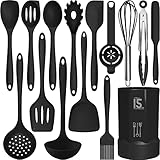
- Food Grade Safe Silicone: Made of food-grade silicone, BPA-free, safe for contact with all types of food, aothod silicone cooking utensils set can withstand temperatures up to 446 °F, even if used in high-temperature frying environments, there is no need to worry about melting, these silicone utensils do not react with food or jams, will not retain odors or colors when stirring food products
- Nonstick Cookware Friendly: The thickened silicone head of this silicone kitchen utensils set is soft and elastic, ideal for silicone utensils for cooking with nonstick pans, makes close contact with the pan surface without scratching the nonstick coating, thus extending the pan's service life, the silicone handle with moderate size offers a comfortable grip and blocks heat transfer; making it easy to flip, strain dishes or serve soup
- Seamless Design No Food Residue & Dishwasher Safe: Each piece in this silicone cooking utensils set is reinforced with stainless steel to maintain an initial optimal memory state, they never warp and are full of flexibility, one-piece molding has no gaps to capture food, making cleaning very easy, you can leave the cleaning job to the dishwasher, which frees your hands easily
- Complete and Practical Silicone Utensils Sets: Includes large Slotted Spoon, small Slotted Spoon, Turner, Deep Soup Ladle, Spatula, Solid Spoon, Basting Brush, Flexible Spatula,Slotted Turner, Pasta Server, Egg Whisk, Kitchen Tongs, Utensils Holder, Egg Separator, this silicone spatula set meets all daily cooking and baking needs, suits new homes and apartments for daily use
- Ideal Gift Choice: aothod silicone kitchen utensils set comes with elegant packaging, an ideal gift for anyone who loves silicone utensils for cooking, making it a thoughtful choice for housewarmings, wedding registries, birthdays or holidays, fits daily cooking needs, allows recipients whether family or friends to joyfully immerse in culinary exploration
The viral exposure number was corrected
The most alarming version of the story relied on an exposure estimate that appeared in the original 2024 paper. That paper estimated a median BDE-209 intake of 34,700 nanograms per day from contaminated kitchen utensils and compared it with an adult reference dose of 42,000 nanograms per day.
The authors later published a corrigendum correcting the exposure calculation and the comparison. The corrected estimated BDE-209 exposure is 7,900 nanograms per day—not 34,700 nanograms per day.
That corrected estimate was based on:
- a median BDE-209 concentration of 250,000 nanograms per gram in four contaminated utensils;
- an estimated 11.7% transfer rate from earlier simulated-cooking work; and
- an assumption of repeated use.
The U.S. Environmental Protection Agency’s IRIS assessment lists a decaBDE oral reference dose of 0.007 milligrams per kilogram of body weight per day. For a 60-kilogram adult, that is approximately 420,000 nanograms per day. The corrected 7,900-nanogram estimate is therefore about 1.9% of that reference-dose value—not approximately 80% or more, as the original comparison suggested.
Quick wins for a faster PC:
Scan for outdated or missing drivers - takes under a minuteDriver Scan →Clear out junk files and repair common Windows errorsFree Scan →Fix the driver behind crashes, sound loss and screen glitchesFind Drivers →What that comparison does—and does not—mean
A reference dose is a risk-assessment benchmark, not a guarantee that exposure below it is perfectly safe and not a threshold at which harm suddenly begins. The EPA assessment itself carries a low-confidence designation, and its basis includes neurobehavioral effects.
At the same time, the corrected comparison matters. It means the strongest viral claim—that ordinary use of a black plastic utensil puts an adult near the relevant reference dose—was based on an error. The corrected estimate is also assumption-dependent. It uses a transfer rate from a simulated cooking experiment, assumes repeated use, and does not fully resolve how much of a utensil actually contacts hot oil.
The corrigendum states that the central contamination finding remains unchanged, but the study was not designed to determine whether black plastic utensils create an unacceptable exposure for consumers.
What earlier utensil research found
A separate 2018 study examined 96 plastic kitchen utensils from the United Kingdom. Bromine was detected in:
Do these 3 things before closing this tab:
1Clear out junk files and repair common Windows errors2Fix the driver behind crashes, sound loss and screen glitches3Repair Windows errors before they cause bigger problems- 3 of 27 utensils purchased after 2011; and
- 31 of 69 utensils purchased before 2011.
The researchers chemically analyzed selected utensils and found several brominated flame retardants, with BDE-209 frequently prominent. In simulated cooking experiments, approximately 20% of the measured flame retardants transferred to hot culinary oil on average. The study estimated a median exposure of 60 nanograms per day for total flame retardants among the contaminated utensils examined.
Rank #3

- 33 COOKING UTENSILS - Utensil Set includes everything you need to cook that perfect dish,includes Slotted Spatula ,Slotted Spoon,Flexible Spatula,Slotted Turner, Solid Turner, Pasta Server,Solid Spoon, Kitchen Tongs, Draining Spoon, Whisk ,Deep Soup Ladle,Spatulas,Brush,Peeler,Pizza Cutter,Bottle Opener,Potato,Pusher,Ice-cream spoon,Can opener,Grater,Scissors,measuring cups and spoons set,Small Brush,,Small spatula,Spatula,Holder
- LASTS A LIFETIME: The most durable utensils set in the market features thick handles designed using top-grade 304 stainless steel, and utensil heads made out of durable silicone. Even with daily use, they’re designed to not bend like plastic utensils, not break like wooden kitchen tools, and not rust like other metallic utensils.
- PROTECT YOUR EXPENSIVE PANS: The non-scratch silicone heads pair great with your expensive non-stick pans, pots and bakeware, ensuring that the cookware surface is not scratched or dented; they’re the perfect tools to extend the life of all your kitchen pans.
- NO PLASTIC WHATSOEVER: There is no trace of plastic in the entire construction. It’s also usable for an effortless clean, with the elegant design sprucing up your kitchen. This kitchen utensils set is to be completely free of BPA and latex.
- EASY TO CLEAN & STORE: Our heat resistant utensils are fast, simple and easy to clean. Simply toss these in the dishwasher to wash off any grease or oil in seconds and feature small holes on the handles to let you hang these to store them without taking much space.
This earlier research supports the general possibility that contaminated plastic can transfer some flame retardants during contact with hot oil. It does not establish that current U.S. utensils are contaminated at the same rate. The sample came from the United Kingdom, included utensils purchased in different years, and used its own sampling and analysis methods.
Taken together, the studies support a limited conclusion: some plastic utensils have contained flame retardants, and at least some of those chemicals can transfer under simulated hot-oil conditions. They do not support the broader conclusion that all black plastic utensils are dangerous.
What food-contact regulations mean
The U.S. Food and Drug Administration regulates substances that come into contact with food. Each component of a food-contact material must be covered by an applicable authorization pathway, such as an FDA regulation, an effective Food Contact Substance Notification, a generally recognized as safe basis, a prior sanction, or another recognized authorization.
The Tool Desk
Outbyte Driver Updater FREEScan for outdated or missing drivers - takes under a minuteDriver Scan →Outbyte PC Repair FREERepair Windows errors before they cause bigger problemsFix Now →The manufacturer is responsible for complying with the authorized substance, specifications, and conditions of use. Those conditions can matter: a material may be evaluated differently depending on the food type, temperature, contact duration, and intended application.
For recycled plastics, the FDA identifies several specific concerns:
- contaminants from the original recycled material may remain in the finished article;
- plastic not authorized for food contact may enter the recycling stream; and
- additives in recycled plastic may not comply with food-contact requirements.
The FDA evaluates proposed recycled-plastic food-contact uses case by case, with attention to source controls, contaminant-removal testing, migration testing, and the intended conditions of use.
This regulatory context is another reason not to reduce the issue to “black plastic is toxic.” The important questions are whether the specific material is suitable for food contact, whether its composition is controlled, and whether it is being used within its intended temperature and contact limits.
Free tools Windows power users keep installed
One-click scans. No signup required.
Which black plastic utensils should you replace first?
You have a stronger practical reason to replace a utensil when several risk-relevant factors overlap. Prioritize black plastic tools that are:
Rank #4

- Premium 100% Food Grade Silicone: The silicone spatula set is made of healthy and friendly material, resistant to high temperatures up to 600 °F. No more melting, cracking and worrying
- One-Piece for Easy to Clean: With the unique Seamless One Piece Design, there is no crevices for food to stuck in, the handle will never enter the water. It is very easy to clean and dishwasher safe
- Best Balance of Flexible and Sturdy: Too stiff or too soft? Nobody wants that! SO we experimented over and over again to try to find the best balance of hardness and flexibility. Here it is! They are sturdy enough to bear pressure and soft enough to reach side of bowl
- Safe for Non-stick Cookware: Our Silicone rubber spatulas are gentle on cookware, leaving them unmarked, they're great for non-stick pans, you don’t have to worry about scratching your loving and new pots and pans
- Versatile for Everyday Task: The kitchen utensils set include 5 spatulas which can meet all your needs, the sizes and shapes cover a wide variety of uses. Color availability is a plus. Get ready to start a new recipe
- Old or of uncertain age: particularly if you do not know the manufacturer, material, or intended use;
- Scratched, gouged, melted, sticky, cracked, flaking, or visibly degraded;
- Used with hot oil or high heat; for example, a turner used while frying or a spatula left resting against a hot pan;
- Unlabeled or lacking temperature and food-contact information; or
- Made by an unknown seller with no meaningful material or compliance information.
A damaged utensil should be discarded regardless of whether it contains flame retardants. Degradation can make a tool less functional and can create a pathway for material to shed or transfer. Do not continue using plastic outside the temperature range stated by the manufacturer.
If an intact utensil is clearly identified as a food-contact product, has not been exposed to excessive heat, and is in good condition, the available evidence does not require an emergency disposal decision. Replacing it at the end of its useful life is a reasonable precaution; keeping it temporarily is not the same as ignoring a known contamination result.
How to choose a replacement
Stainless steel for high-heat tasks
A stainless steel kitchen utensil set is the most direct replacement for readers who want to remove plastic from high-heat cooking tasks. Stainless steel is a materially distinct choice from the black plastics discussed in the studies, so it avoids relying on the composition of a recycled plastic article for that particular concern.
What’s actually slowing this PC down?
Pick the symptom - the matching free tool is one click away.
Check the listing for the actual material, intended use, and care instructions. Stainless steel is not automatically a guarantee of perfect manufacturing or universal safety, and it may not be appropriate for every cookware surface. The useful claim is narrower: it is a non-plastic, readily available alternative for tasks such as turning, lifting, stirring, and serving.
If you do not want to replace a complete set, a single stainless steel spatula or turner can address the tool that receives the most heat and oil exposure first.
Wood for stirring and serving
Wooden cooking utensils are another non-plastic alternative for stirring, scraping, and serving. Choose tools from a seller that identifies the material and provides care instructions. Keep wooden utensils clean and dry them properly; replace any tool that develops cracks, splinters, or other deterioration.
Neither stainless steel nor wood should be marketed as proof that a particular product has been independently screened for flame retardants. They are simply practical replacement materials that avoid the specific black-plastic contamination pathway under discussion.
Windows Errors? Fix Them Before They Spread
Repair common Windows errors and clear accumulated junk for a smoother, more stable PC - no reinstall needed.Free scan · no reinstallOutdated Drivers Are Slowing You Down
One free scan finds every outdated or missing driver and matches the right update for your exact hardware.Free scan · exact hardware matchLabels that do not settle the question
“BPA-free”
BPA-free addresses bisphenol A. It does not establish that a utensil contains no flame retardants, that it was not made with recycled electronics plastic, or that it is suitable for every high-temperature use.
“Food-grade” or “non-toxic”
Generic marketing language is less useful than specific information about the material, intended food-contact use, temperature limits, and manufacturer. A responsible food-contact claim should correspond to an authorized use and the conditions stated for that product.
Black color
Color is not a chemical analysis. Two black utensils can be made from different polymers and supply chains, while a non-black plastic product can also have its own additives or manufacturing concerns. Do not use color as the sole basis for declaring an item safe or unsafe.
A proportionate decision checklist
- Inspect the utensil. If it is melted, cracked, deeply scratched, sticky, or shedding material, stop using it.
- Identify its use. A tool used in hot oil or directly against a hot pan deserves priority over a serving utensil used only with cool food.
- Look for information. Check the manufacturer, material, food-contact designation, and temperature limit.
- Consider its age and origin. Unusually old, unlabeled, or unknown-source items are reasonable candidates for replacement.
- Replace selectively if needed. Start with the high-heat tools rather than assuming every black plastic item must go in the trash today.
- Use the replacement as directed. Even a non-plastic tool should be used and maintained according to its manufacturer’s instructions.
Bottom line: should you toss them ASAP?
Not every black plastic kitchen utensil needs to be tossed immediately, but replacing questionable high-heat utensils is sensible. The research found flame-retardant contamination in a selected group of black plastic products, and earlier work showed that some chemicals could transfer to hot oil under simulated conditions. That is enough to justify caution—especially for old, damaged, unlabeled tools.
Best Value

- Durable & Heat-Resistant: Made from high-quality, food-grade silicone, this 39-piece utensil set can handle heat up to 446°F without melting or warping. Perfect for all your cooking needs—from simmering to stir-frying.
- Safe & BPA-Free: Our silicone utensils are BPA-free and odor-resistant, ensuring safe and healthy cooking for the whole family. No stains, no unwanted smells—just clean, reliable performance.
- Protects Non-Stick Cookware: Soft silicone heads prevent scratches on your pots and pans, while the seamless design makes cleaning effortless. Great for everyday cooking and baking.
- Sturdy & Stylish: Made with premium food-grade silicone and complemented by smooth wooden handles, each utensil blends strength and elegance for a comfortable grip and effortless control. Built to last, with easy-to-hang handles for convenient storage.
- Perfect Holiday Gift: This versatile utensil set is a great choice for kitchen enthusiasts or anyone starting their cooking journey. It makes an excellent holiday gift for family, friends, loved ones, and colleagues.
It is not enough to prove that all black utensils are toxic or that every household faces an emergency. The frequently repeated exposure comparison was corrected from 34,700 to 7,900 nanograms per day, and the corrected estimate was based on several assumptions. Treat the issue as a reason for informed replacement, not a reason for panic.
Evidence base: the 2024 Chemosphere study of black plastic household products; its 2025 corrigendum; the 2018 United Kingdom study of plastic kitchen utensils; FDA food-contact and recycled-plastic guidance; and the U.S. EPA IRIS decaBDE assessment.
Frequently Asked Questions
Does 85% of black plastic kitchen utensils contain flame retardants?
No. The 2024 study found flame retardants in 17 of 20 products selected for detailed analysis, but those products were deliberately chosen because they were more likely to contain bromine. The 85% figure does not represent all black kitchen utensils or even all 203 products screened.
What was corrected in the black-plastic utensil study?
No. The corrected estimate was 7,900 nanograms per day of BDE-209, based on a median concentration in four contaminated utensils, an assumed 11.7% transfer rate, and repeated use. The original 34,700-nanogram estimate and its comparison with a 42,000-nanogram reference dose were corrected.
Does a BPA-free label make a black plastic utensil safe?
No. BPA-free means the product does not contain bisphenol A under the applicable claim; it does not prove that the utensil contains no flame retardants or recycled electronics plastic. Material, food-contact authorization, temperature limits, and manufacturing information are more relevant to this specific concern.
Are all black plastic utensils dangerous?
No. Black color alone does not establish a utensil’s composition or manufacturing history. The concern involves possible additives and contamination in some plastic supply or recycling streams, not black pigment by itself.
The Bottom Line
Replace first: black plastic utensils that are old, damaged, unlabeled, or routinely used with hot oil. Stainless steel and wood are practical non-plastic alternatives. The evidence does not support throwing away every black plastic utensil immediately, and the viral exposure calculation was later corrected substantially downward.
Quick Recap
Product prices and availability are accurate as of the date/time indicated and are subject to change. Any price and availability information displayed on Amazon at the time of purchase will apply.

