Free tools Windows power users keep installed
One-click scans. No signup required.
Some links on this page are affiliate links: if you buy through them we may earn a commission, at no extra cost to you.
The DEWALT DW735X is the best benchtop planer in the cited tests for smooth, parallel stock with manageable snipe and practical dust collection. Fine Woodworking named it Best Overall, while WOOD magazine found the DW735X and DW734 among the smoothest cutters tested. The DW734, Ridgid R4331, and Makita 2012NB are credible alternatives for different shops.
A benchtop thickness planer is valuable because it turns rough lumber into repeatable stock thickness quickly, but the machine has a specific job: it makes the top face parallel to an already-flattened bottom face. The comparison below focuses on the outcomes that affect construction and woodworking work most—surface quality, parallelism, snipe, cutter maintenance, feed speed, dust collection, and noise.
As an Amazon Associate I earn from qualifying purchases.
Key takeaways
- The DEWALT DW735X is the strongest overall choice when surface quality, parallelism, two feed speeds, dust ejection, and snipe control matter more than purchase price.
- A thickness planer makes one face parallel to an already-flattened reference face; it does not replace a jointer or another method of flattening severely cupped or twisted stock.
- Fine Woodworking measured the DW735X at 0.000 inch out of parallel and 0.003 inch of snipe in its 2016 comparison, while treating more than 0.01 inch in either category as excessive.
- WOOD magazine found that the straight-knife DEWALT DW734 and DW735X produced the smoothest surfaces among 15 planers tested in 2022.
- Every planer in WOOD magazine’s test sniped from the factory, so table support, alignment, carriage setup, and feed technique remain important even on a machine with a carriage lock.
- Planers are loud and produce chips rapidly: WOOD measured the tested machines at 90–104 dBA, making dust collection and hearing protection essential shop equipment.
What is the best benchtop planer?
The DEWALT DW735X is the best benchtop planer in the cited testing when the priority is smooth, parallel stock with manageable snipe and practical dust collection. Fine Woodworking named the DW735X Best Overall, and WOOD magazine later ranked the DW735X among the smoothest cutters tested. The DW734 is a strong simpler alternative, while the Ridgid R4331 was the earlier Best Value.
The recommendation is not universal. The DW735X is a substantial, loud, corded machine, and a smaller shop may prefer the compact Makita 2012NB or the less expensive DW734. Prices, stock, warranty wording, and model packages change, so confirm those details at the time of purchase rather than relying on the historical prices in older tests.
Popular on Amazon

- Powerful 15 amp, 20,000 rpm motor (10,000 rpm cutterhead speed) handles larger cuts in wider materials with ease
- Three knife cutter head delivers 30% longer knife life and makes knife change faster and easier
- Two-speed gear box allows users to change feed speed to optimizing cuts per inch at 96 or 179 CPI
- Fan-assisted chip ejection vacuums chip off of the cutter head and exhausts them out of the machine
- 19-3/4 in. cast aluminum base is 2 times more rigid than a standard 10 in. base and folding tables
How a benchtop thickness planer works
A thickness planer references the already-prepared bottom face of a board and cuts the top face parallel to that reference face. The process brings rough lumber to a repeatable final thickness and gives you two usable, parallel faces.
A planer cannot reliably flatten a severely cupped, bowed, or twisted board by itself. If the first face is not flat, the planer can reproduce that error while making the opposite face parallel to it. Flatten one reference face with a jointer, sled, or an appropriate hand-tool method before using the thickness planer.
Do these 3 things before closing this tab:
1Repair Windows errors before they cause bigger problems2Fix the driver behind crashes, sound loss and screen glitches3Clear out junk files and repair common Windows errorsFine Woodworking summarized the central buying criteria this way: “The most important evaluations when it comes to a planer are whether it makes smooth cuts with both faces of the board parallel to one another.” Its comparison tested 11 benchtop planers on white pine, white oak, and curly maple, measuring surface quality, parallelism, and snipe.
How do the leading benchtop planers compare?
The following figures come from the cited editorial tests and are not current price or availability claims. The two tests used different methods and dates, so measurements should be compared as test results rather than as a laboratory ranking across every category.
| Model | Test evidence | Snipe | Out of parallel | Surface result | Useful trade-off |
|---|---|---|---|---|---|
| DEWALT DW735X | WOOD, 2022; Fine Woodworking, 2016 | 0.003 in. in Fine Woodworking | 0.000 in. in Fine Woodworking | Among WOOD’s smoothest; excellent on white pine and white oak, very good on curly maple in Fine Woodworking | Two speeds, three knives, carriage lock, fan-assisted chip ejection; loud and substantial |
| DEWALT DW734 | WOOD, 2022; Fine Woodworking, 2016 | 0.002 in. in Fine Woodworking | 0.000 in. in Fine Woodworking | Among WOOD’s smoothest; excellent on white pine and white oak | Three knives and strong finish for less complexity; 12-1/2-in. capacity and no two-speed feed in the cited comparison |
| Ridgid R4331 | Fine Woodworking, 2016 | 0.003 in. | 0.005 in. | Excellent on white pine and white oak | Earlier Best Value; historical price advantage must be rechecked |
| Makita 2012NB | Fine Woodworking, 2016; Makita product specification | 0.003 in. | 0.002 in. | Very good on white pine and white oak | Compact design and manufacturer-listed 83 dB no-load specification; editorial test measured 98 dB under different conditions |
WOOD magazine’s July 28, 2022 shop test compared 15 planers, including straight-knife and insert-cutterhead designs. The test graded walnut surfaces with white chalk to expose high and low spots. The DW734 and DW735X produced the smoothest surfaces, allowing sanding to begin with 150-grit abrasive; several other machines needed 80-grit sanding or scraping.
Fine Woodworking’s 2016 comparison considered more than 0.01 inch out of parallel or more than 0.01 inch of snipe troublesome. The DW735X and DW734 both measured 0.000 inch out of parallel, while the Ridgid R4331 measured 0.005 inch out of parallel.
What’s actually slowing this PC down?
Pick the symptom - the matching free tool is one click away.
Why is the DEWALT DW735X the best overall choice?
The DW735X combines the features that address the main shop problems: a three-knife cutterhead for a clean finish, two feed speeds, an automatic carriage lock, a material-removal gauge, a turret depth stop, infeed and outfeed tables, and fan-assisted chip ejection. DEWALT lists the DW735X as a 13-inch, 15-amp, two-speed thickness planer and includes an extra set of knives.
Also popular on Amazon

- Spiral cutterhead utilizes 26 staggered and rotatable HSS blades for a clean, smooth finish
- Onboard material removal gauge informs users about the cutting depth of each pass
- Plane boards up to 6 inches thick and 13 inches wide
- 15A motor generates 10,000 RPM at a 26 feet per minute feed rate
The slower feed setting is the important finishing feature. DEWALT documentation identifies speed 1 as the finest-finishing pass and speed 2 as the faster material-removal setting; DEWALT support lists the feed rates as 14 feet per minute on speed 1 and 26 feet per minute on speed 2. DEWALT’s manual states that speed 2 provides 96 cuts per inch. Use the slower setting for the final pass and the faster setting when removing material efficiently.
The test results support the feature list rather than merely suggesting it. Fine Woodworking measured 0.003-inch snipe, 0.000-inch out of parallel, and 102 dB for the DW735X in 2016. The publication rated the DW735X excellent on white pine and white oak and very good on curly maple. WOOD’s later test also placed the DW735X among the smoothest cutters.
For a buyer who wants a 13-inch machine and expects to process varied hardwoods, the DEWALT DW735X benchtop planer is the clearest primary recommendation. Check the current product page and retailer listing for live stock, package contents, warranty language, and price before ordering.
Is the DEWALT DW734 worth choosing instead?
The DW734 is worth choosing when a simpler 12-1/2-inch planer meets your capacity needs and you do not need two feed speeds. Fine Woodworking measured the DW734 at 0.002-inch snipe and 0.000-inch out of parallel, with excellent white-pine and white-oak surfaces. WOOD later identified the DW734 alongside the DW735X as one of the smoothest-cutting machines in its 2022 test.
The DW734 gives up the DW735X’s two-speed feed system and has a narrower stated capacity in the cited comparison. That makes the decision straightforward: choose the DW734 for strong three-knife performance and simpler operation; choose the DW735X if a 13-inch width, slower finishing feed, carriage lock, and fan-assisted ejection justify the additional cost and size.
Which planer is the best value or the most compact?
The Ridgid R4331 was Fine Woodworking’s Best Value in the 2016 comparison. Its 0.003-inch snipe and 0.005-inch out-of-parallel measurement remained within Fine Woodworking’s 0.01-inch excessive threshold, and its white-pine and white-oak surface quality was excellent. The publication’s price advantage is historical and should not be presented as a current bargain without checking present availability and price.
The Makita 2012NB is the compact alternative in the cited evidence. Fine Woodworking measured 0.003-inch snipe, 0.002-inch out of parallel, and 98 dB, with very good white-pine and white-oak surface quality. Makita lists a 12-inch capacity, a 1/8-inch maximum depth of cut, 6-3/32-inch thickness capacity, an Interna-Lok head clamp, and an 83 dB no-load specification. The 83 dB manufacturer figure and the 98 dB editorial measurement were produced under different conditions and should not be treated as directly interchangeable.
Also popular on Amazon
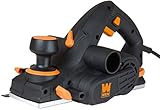
- 6 Amp motor provides up to 34,000 cuts per minute
- 16 positive stops adjust the cutting depth anywhere from 0 to 1/8 inches
- Make rabbets up to 1 inch in size with the 5/16 inch rabbeting guide
- Lightweight design weighs in at a mere 6 pounds
- Includes power planer, dust bag, a kickstand, a parallel fence bracket and a 2-year warranty
Do three knives or insert cutters produce a better finish?
In the cited tests, three straight knives produced the best surfaces, but insert cutters can reduce maintenance inconvenience and extend cutter life. WOOD’s 2022 test found that the straight-knife DEWALTs produced the smoothest surfaces and that no insert-cutterhead model earned an A cut.
Straight knives can be flipped, replaced, or sharpened when damaged. Insert cutters allow you to rotate or replace an individual nicked carbide cutter, usually by loosening one screw per cutter. Carbide inserts may dull more slowly and make smaller chips, but their maintenance advantage does not guarantee a smoother surface.
Keep replacement knives or approximately 10–20 replacement inserts available if downtime matters. For the DW735 family, DEWALT identifies DW7352 replacement knives as the replacement-blade part number. Confirm that the part matches the exact planer model before buying.
How much does feed speed matter?
Feed speed determines the balance between material removal and finish quality. Use the faster setting for a roughing pass when the board needs substantial stock removed, then switch to the slower setting for the final finishing pass when the machine provides that option.
| Task | Preferred approach | Reason |
|---|---|---|
| Remove stock efficiently | Faster feed speed | Moves the board through the machine more quickly for roughing |
| Improve the final surface | Slower feed speed | Places more cuts along the board and is intended for fine finishing on the DW735 |
| Take a heavy cut | Use shallow passes rather than forcing the machine | WOOD found that all tested machines handled a reasonable 1/32-inch full-width cut in red oak, while a 1/16-inch challenge stalled the Laguna and both Grizzly machines |
The cited test found that the DW735X, Rikon, and Triton models showed the most muscle during the 1/16-inch red-oak challenge. That result does not mean a user should routinely force a benchtop planer through heavy cuts; stock species, width, moisture, knife sharpness, and feed rate all affect load.
How do you reduce planer snipe?
Planer snipe is a slightly deeper cut near a board’s end, caused when only one feed roller is gripping the stock and the cutterhead can gouge the unsupported end. WOOD magazine describes snipe as occurring about 2–3 inches from each end of a board.
Do not expect a carriage lock to eliminate snipe automatically. WOOD found that every tested planer sniped from the factory. Longer infeed and outfeed tables, accurate setup, and correct feeding reduced the problem on some machines; after adjustments, WOOD brought five machines, including both DEWALTs, to no more than 0.0015 inch of snipe.
Also popular on Amazon

- Powerful Thickness Planer: 15 AMP 1800W Motor; Blade speed: 8000rpm; Feeding speed: 236"/min (6 m/min). With 2pcs double cutter blades, this high-efficiency wood planer adopts the complicated honing process to ensure the cutting edge is sharp and straight. It is served as an essential tool and workhorse for a wide range of professional and DIY woodworking projects–specifically designed to repurpose wood (old, weathered, and worn wood) while giving it an extraordinarily smooth finish.
- Infeed & Outfeed Tables: Max cutting width: 13" (330 mm); Cutting thickness: 0.2"-6.3" (6-160 mm). All-stainless steel & metal material workbench can ensure a smooth wood processing procedure. The HSS blade is not easy to break, extending the service life. A crank handle for easy adjustment of the cutter head height; A scale ruler for precise machining; An Automatic feeding design is available to auto-feed the material; 2 metal return rollers are provided to pass workpieces back effortlessly.
- Heavy-Duty Stand: There is a heavy-duty stand for a more strong fixation of the wood planer. This portable table planer is compact and space-saving with a detachable stand and foldable extension plates. ABS grooves on both sides are designed for easy mobility.
- Dust Exhaust Interface: Dust collection pot, inner diameter 1.8 inch/ 45 mm, outer diameter 2 inch/ 50 mm. The dust exhaust interface can connect to dust collectors for easy cleanup of the flying wood chips. Meanwhile, an iron dust cover is available to replace the collector. Both ways can keep your working place tidy and cultivate a pleasant working environment.
- Safety Precautions: Equipped with power-off protection electromagnetic switch, the over-current protector can be tripped when the motor is overloaded. This design dramatically improves security performance, ensuring a stable & reliable operation, extending the service life.
- Support the board continuously before it reaches the first roller and after it leaves the second roller. Set auxiliary tables or stands level with the planer tables.
- Check that the planer sits on a stable, level surface and that the tables align with the bed.
- Feed the board straight and keep it supported without lifting, pushing down, or allowing the board to pivot as the leading or trailing end loses roller support.
- Use sacrificial lead and trailing boards when the workpiece permits. The cutter can snipe the sacrificial pieces instead of the finished board.
- Take light finishing passes and inspect the first and last several inches before cutting valuable stock to final length.
- Use the carriage lock and follow the model’s adjustment instructions, but verify the result with a straightedge and feeler gauge rather than assuming the lock solved the problem.
For critical parts, leave enough extra length to remove the sniped ends after planing. Snipe is a setup and support problem as much as a machine-design problem.
Quick wins for a faster PC:
Fix the driver behind crashes, sound loss and screen glitchesFind Drivers →Repair Windows errors before they cause bigger problemsFix Now →What dust collection does a benchtop planer need?
A benchtop planer needs active dust collection because it ejects chips rapidly and can fill a shop with airborne debris. Fine Woodworking treated a dust port as essential, and the DW735X uses fan-assisted chip ejection and includes a dust-hose adapter.
Match the planer dust hose adapter and hose to the planer’s port and to the inlet of the shop vacuum or dust collector. A compatible adapter alone does not guarantee good collection: hose diameter, collector capacity, filter condition, chip ejection, hose length, and shop layout all affect performance.
- Use the machine’s supplied adapter where appropriate and verify the hose diameter before purchasing additional fittings.
- Keep the hose as short and direct as the shop allows, avoiding sharp bends that restrict airflow.
- Empty the collector before it loses useful capacity, and monitor the filter because chips can accumulate quickly during thicknessing.
- Do not rely on dust collection as a substitute for safe machine operation or cleanup; disconnect power before clearing a blockage.
Planer chips are larger than ordinary sanding dust, so a collector that works acceptably for a sander may not handle a planer equally well. Choose a dust-collection hose or shop vacuum or dust collector for a benchtop planer only after checking both the planer port and the collector’s airflow and hose connection.
Independent reader supportYour contribution helps us test, update, and keep practical guides available for everyone.How loud and hazardous are benchtop planers?
Benchtop planers are loud enough to require hearing protection. WOOD measured the tested machines at 90–104 dBA, while Fine Woodworking recorded 102 dB for the DW735X. Fine Woodworking states, “All the machines are loud. You’ll need hearing protection when using any of them.”
Recommended Free Tools
OSHA’s woodworking guidance says, “Given the nature of woodworking operations, production floor employees will almost certainly require hearing protection devices.” OSHA’s occupational noise standard uses an 85 dBA eight-hour time-weighted average as the threshold for a hearing-conservation program in covered workplaces. A home-shop user should not interpret a short exposure as harmless simply because the machine is used intermittently.
Wear hearing protection for woodworking, keep other people away from the machine while it is operating, use eye protection, secure loose clothing and hair, and follow the machine’s stock-size and operating instructions. Dust collection reduces airborne chips and dust but does not remove the need for appropriate respiratory and eye protection for the material and operation.
Also popular on Amazon

- High-quality 13" Widened Worktable: Plane boards up to 6" thick and 13" wide. Easily adjusted tables and extensions for coplanar with table pull-out extensions, supplying 35" of total length for better support on the long stock. Precision machined cast iron bed and steel plate assist in keeping boards flat. Get your boards cut the way you want in no time.
- High-precision Two-Knife Cutter: The bench planer features a quick change, solid steel two-knife cutter head, assuring smooth and consistent performance for long life. After quenching and hardening, the hardness reaches HRC55-60, which is desirable and durable.
- Intimate Current Overload Protection: For additional security, the built-in 20A over-current protector will automatically cut off the power supply when the total current exceeds 20A.
- An Unstoppable 2000W Motor: The 23500 rpm motor of the planer provides one of the finest finishes of any portable planer. The 15 Amp motor is powerful and reliable, providing high performance. Get ready to leave all your surfaces smoother than ever!
- Low Dust Planing: Features a vacuum port for convenient dust collection. The chip ejection can be connected with a vacuum cleaner to chip off the cutter head, expelling chips from the machine.
How should you choose between these planers?
| Your priority | Best fit from the cited evidence | Why |
|---|---|---|
| Best overall finish and broad capability | DEWALT DW735X | Strong surface results, perfect measured parallelism, low measured snipe, two speeds, and practical chip ejection |
| Smooth cuts with simpler operation | DEWALT DW734 | Three knives, 0.000-inch out-of-parallel result, and excellent tested surfaces without a two-speed feed |
| Value in the earlier comparison | Ridgid R4331 | Fine Woodworking’s Best Value with excellent tested surfaces, though the historical price must be rechecked |
| Compact footprint | Makita 2012NB | 12-inch capacity, compact design, and good measured parallelism and surface quality |
For most serious home shops, select the DW735X when the machine’s size, noise, corded operation, and current price are acceptable. Select the DW734 when the narrower capacity and single feed speed are not limitations. Consider the Ridgid or Makita only after confirming current support, availability, consumables, and the exact package offered in your market.
Pre-purchase and setup checklist
- Confirm whether the listing is for the DW735X or DW735; similar names can represent different packages and included accessories.
- Verify the machine’s width and maximum thickness against the stock you actually plane.
- Budget for knives, dust-collection fittings, a stable stand or support tables, and hearing protection.
- Plan a straight, level feed path with room for long boards on both sides.
- Connect dust collection before the first cut and test the hose connection for chip leakage.
- Make a test pass on scrap, measure thickness at several points, and inspect both ends for snipe.
- Keep the manufacturer’s instructions available for knife changes, carriage adjustments, and maintenance.
The evidence favors the DW735X because it combines excellent surface quality and parallelism with useful control over feed speed. The evidence does not support claiming that any benchtop planer eliminates snipe, that insert cutters always finish better, or that a thickness planer can flatten badly distorted stock without a prepared reference face.
The Tool Desk
Outbyte Driver Updater FREEScan for outdated or missing drivers - takes under a minuteDriver Scan →Outbyte PC Repair FREEClear out junk files and repair common Windows errorsFree Scan →Frequently Asked Questions
What is the best benchtop planer?
The DEWALT DW735X is the best benchtop planer in the cited comparisons for overall surface quality, parallelism, snipe control, feed-speed flexibility, and dust ejection. The DEWALT DW734 is a strong alternative if a 12-1/2-inch capacity and single feed speed are sufficient.
Which thickness planer has the least snipe?
The DEWALT DW734 had the lowest reported snipe in Fine Woodworking’s comparison at 0.002 inch, followed by the DW735X, Ridgid R4331, and Makita 2012NB at 0.003 inch each. No planer should be expected to eliminate snipe without careful support and setup.
Do I need a two-speed planer?
A two-speed planer is useful when you want faster stock removal and a slower finishing pass from the same machine. DEWALT lists the DW735 feed rates as 14 feet per minute on speed 1 and 26 feet per minute on speed 2, with the slower setting intended for fine finishing.
Can a benchtop planer flatten a cupped or twisted board?
A thickness planer does not replace a jointer because the planer makes the top face parallel to the already-flattened bottom face. Flatten or otherwise prepare one reference face before thickness planing severely cupped or twisted lumber.
Do I need hearing protection with a thickness planer?
Yes. Benchtop planers are loud: WOOD measured the machines in its 2022 test at 90–104 dBA, and Fine Woodworking measured the DW735X at 102 dB. Wear hearing protection and follow applicable workplace noise controls.
The Bottom Line
Bottom line: The DEWALT DW735X is the best benchtop planer in the cited tests for buyers who want the smoothest, most parallel stock and value two feed speeds, three knives, and fan-assisted chip ejection. The DW734 delivers remarkably similar tested finish and parallelism with less capacity and fewer features; the Ridgid R4331 and Makita 2012NB are reasonable value or compact alternatives. Whichever machine you choose, flatten one reference face first, support the stock carefully, connect dust collection, and wear hearing protection.
Quick Recap
Product prices and availability are accurate as of the date/time indicated and are subject to change. Any price and availability information displayed on Amazon at the time of purchase will apply.

