Neither is universally better. A safety sign is best when people need a visible warning or instruction at a particular location. A toolbox talk is best when a crew must discuss the work about to begin, changing conditions, controls, and questions. On many construction sites, the strongest system uses both: a sign provides a persistent reminder at the point of exposure, while a toolbox talk explains how the crew will control the risk today.
This comparison uses U.S. Occupational Safety and Health Administration (OSHA) guidance as legal examples. Requirements can differ by country, state, industry, contract, and worksite, so verify the rules that apply to your project.
As an Amazon Associate I earn from qualifying purchases.
The practical answer: match the communication to the risk
Signs and toolbox talks perform different jobs. A sign communicates a short message that must remain visible near a hazard, boundary, route, or piece of equipment. A toolbox talk is a live briefing that connects hazards and controls to a specific task, crew, location, and set of conditions.
Do these 3 things before closing this tab:
1Scan for outdated or missing drivers - takes under a minute2Clear out junk files and repair common Windows errors3Fix the driver behind crashes, sound loss and screen glitchesUse a sign when the message needs to be seen repeatedly by anyone approaching a location. Use a toolbox talk when workers need explanation, questions answered, roles assigned, or a plan for conditions that may change. Use both when the work requires a continuing visual reminder and a shared discussion.
#1 Best Overall

- Aluminum Materials: this large construction sign is made of reliable metal aluminum, which provides reliability in adverse weather conditions; This sturdy structure ensures long life, keeping the sign intact for many years
- Oversized High and Visibility Design: the construction sign for jobsites measures about 22.5 x 46 inches/ 57 x 117 cm; The metal safety sign feature bold text/ icons; The bright fonts significantly improve visibility and are easier to see from a distance
- Easy to Install: the construction site safety sign comes with pre drilled holes and can be directly installed on a variety of surfaces, including U-channel posts and fences; This design simplifies setup and can promptly display signs that are not responsible for accidents or injuries; It is suitable for outdoor, construction sites, factory areas, parking lots and other long sighted environments
- Protective Coating: the transparent protective film covers the construction sign to prevent weather, graffiti and UV rays; The coating keeps the aluminum warning sign fresh and ensures consistent visibility every season
- Six in One Jobsite Board: combines essential safety signs: [authorized personnel only], [falling materials], etc.; Ideal for centralized construction site safety management
Neither method removes a hazard by itself. Communication supports the risk-management process; elimination, substitution, engineering controls, administrative controls, and personal protective equipment still have to be selected and implemented.
What a safety sign can do
OSHA describes signs as surfaces used to warn people who may be exposed to hazards or to provide safety instructions. In general industry, 29 CFR 1910.145 distinguishes danger signs, caution signs, and safety-instruction signs. Workers must be instructed about what those signs mean.
Danger signs
Danger signs identify an immediate hazard and the special precautions needed. OSHA’s regulation states: “All employees shall be instructed that danger signs indicate immediate danger and that special precautions are necessary.” The statement appears in 29 CFR 1910.145(c)(1)(ii).
Caution signs
Caution signs identify a potential hazard or an unsafe practice that could result in a less immediate, but still serious, injury if people do not take precautions. The sign should make the required behavior clear rather than merely naming a danger.
Safety-instruction signs
Safety-instruction signs provide general instructions or suggestions about safety measures. Examples include directions to wear required protective equipment, use a designated access route, or follow a shutdown procedure.
Where signs are strongest
- Fixed hazards: unguarded edges, electrical rooms, chemical-storage areas, overhead-load zones, and restricted plant rooms.
- Point-of-exposure reminders: hearing protection at a noisy operation, eye protection at a cutting station, or a prohibition on entry beyond a barrier.
- Information for people who arrive later: visitors, delivery drivers, subcontractors, and workers from another shift may not have attended the latest briefing.
- Boundaries and routes: exclusion zones, emergency exits, traffic directions, muster points, and temporary changes to access.
What signs cannot do
A sign cannot explain why a control was selected, test whether a worker understands it, assign a spotter, or adapt when weather and sequencing change. A sign that is hidden, damaged, written in unfamiliar language, or left in place after a hazard is gone can create false confidence instead of control. OSHA employer guidance lists signs, labels, posters, and color codes as ways to warn employees, but also calls for procedures and training in language and vocabulary employees can understand; see OSHA’s Employer Responsibilities.
What a toolbox talk can do
A toolbox talk—also called a tailboard or job briefing—is a short, focused discussion about the work and its hazards. OSHA’s electric-power guidance says: “Job briefings, also known as ‘tailboards’ or ‘toolbox talks,’ communicate any existing or potential hazards to workers before a job begins or if hazards or potential hazards are discovered while working.” The guidance is sector-specific, but the communication principle is useful on construction projects.
Quick wins for a faster PC:
Repair Windows errors before they cause bigger problemsFix Now →Scan for outdated or missing drivers - takes under a minuteDriver Scan →Clear out junk files and repair common Windows errorsFree Scan →Rank #2

- OPTIMAL SIZE | Each sign measures 14x10 inches, designed to capture attention without overwhelming the site aesthetics.
- HIGH VISIBILITY | Bright and bold text on a contrasting background ensures the warning message is noticeable from a distance.
- BUILT TO LAST | Constructed from durable PVC material, these signs resist weathering and fading in outdoor environments.
- READY TO MOUNT | Pre-drilled holes make these signs easy to install on fences, walls, or stakes, simplifying the setup process.
- MULTI-PACK OFFERING | Comes in a pack of four, allowing consistent signage across different areas of the construction site.
Before work starts
The briefing can walk the crew through the sequence of work, identify hazards at each step, confirm controls, allocate responsibilities, and check that tools, access, permits, and personal protective equipment are ready. Workers can ask questions before exposure occurs.
When conditions change
Construction conditions can change when another trade moves into the area, a lift path is revised, excavation conditions deteriorate, rain makes a surface slippery, a utility is exposed, or the planned sequence no longer works. In the electric-power example, an unexpected hazard requires stopping work, reassessing, and holding a new briefing before work resumes. That stop-and-rebrief discipline is a useful model for other high-risk tasks, even where a different rule applies.
Participation and feedback
A talk gives workers a way to report a near miss, identify a missing control, or explain a condition that supervisors cannot see from the plan. OSHA’s Safety Management—Education and Training guidance recommends involving workers in hazard identification, teaching them to recognize hazards and understand controls, and providing further training when changed facilities, equipment, processes, materials, work organization, or a new task could increase risk.
Limits of a toolbox talk
A talk is temporary and easy to miss. A worker who joins the site later may not hear it; a long or generic presentation may not be remembered; and a signed attendance sheet does not prove understanding. A briefing also does not replace a required sign, label, safety data sheet, permit, competent-person inspection, or formal training.
Signs versus toolbox talks: a decision table
| Decision factor | Safety sign | Toolbox talk | Best practical choice |
|---|---|---|---|
| Duration | Persists while posted and maintained | Covers a work period or specific change | Use a sign for continuing exposure; a talk for today’s task |
| Location | Seen at a hazard, boundary, route, or equipment | Delivered to the crew before or during work | Use both when workers need a point-of-exposure reminder and explanation |
| Hazard stability | Works well for fixed, predictable conditions | Works well for variable, emerging, or weather-dependent conditions | Dynamic hazards favor a talk; fixed hazards favor a sign |
| Message length | Short warning, prohibition, or instruction | Sequence, rationale, controls, roles, and contingencies | Do not force a multi-step plan onto a small sign |
| Worker interaction | One-way unless paired with another process | Questions, confirmation, and worker observations are possible | Use a talk when understanding or input matters |
| Audience | Anyone who can see and understand it | People who attend, plus documented make-up briefings | Use signs to reach late arrivals and visitors; brief every exposed worker |
| Response to an unexpected hazard | May be added or changed, but cannot by itself reassess the job | Supports stop-work, reassessment, and a revised plan | Stop, reassess, and rebrief; add or update signs when the location requires it |
| Evidence of completion | Inspection of placement, condition, and legibility | Attendance plus evidence of discussion and understanding | Verify both in the field, not only on paper |
This table is a practical synthesis of the cited OSHA guidance, not a controlled study or a quantified ranking. OSHA materials identified here do not establish that one method reduces incidents by a particular percentage or is statistically superior.
How to decide which method a task needs
Ask whether the message must stay at the location
If someone needs to be warned every time they approach the area, start with a sign or other physical communication. This applies to a restricted electrical room, a chemical store, a lifting exclusion zone, or a designated pedestrian crossing. Check that the sign remains visible from the approach path and is not blocked by plant, materials, dust, lighting glare, or temporary works.
Ask whether the hazard changes with the job
If the risk depends on the day’s sequence, crew, nearby operations, weather, ground conditions, or equipment configuration, a toolbox talk is usually necessary. A sign can mark the area, but the crew still needs to discuss who controls the interface and what triggers a pause.
Rank #3

- DURABLE ALUMINUM CONSTRUCTION: Made from .063″ white rust-free aluminum, ensuring long-lasting performance and weather resistance.
- INTERNATIONAL SYMBOLS: Includes internationally recognized symbols for warning hazards, mandatory actions, hard hat requirements, and unauthorized access prohibition, enhancing clarity and understanding.
- BOLD TEXT: Features clear, bold text to ensure the message is easily readable from a distance.
- EASY INSTALLATION: Pre-drilled holes allow for easy mounting on walls, fences, or posts, ensuring visibility at key entry points of the construction site.
- BRIMAR GUARANTEE: Made in the USA. Our products are manufactured in our state-of-the-art facility located in Garfield, NJ.
Ask whether workers need to explain or demonstrate anything
Use a talk when workers must identify a hazard, select a control, demonstrate a signal, confirm a rescue plan, or decide what to do if the original method becomes unsafe. A sign is not a substitute for competence training.
Ask who may be exposed
Include employees, agency workers, subcontractors, visitors, delivery personnel, and anyone who could enter the area. A sign can reach people who were not present for the briefing, while a talk can address language, literacy, and task-specific questions more effectively.
Use a simple rule of thumb
- Point-of-exposure warning: sign.
- Task preparation or changing conditions: toolbox talk.
- Persistent reminder plus shared plan: both.
This rule helps choose a communication method; it does not replace a hazard assessment or a legal review.
How to deploy safety signs effectively
- Identify the actual hazard and required behavior. Write the message around what a person must do or avoid. “Wear eye protection beyond this point” is more useful than a vague “Be careful.”
- Select the appropriate sign category. Use a danger sign for an immediate hazard, a caution sign for a potential hazard, and a safety-instruction sign for general safety measures, consistent with the applicable rule and site standard.
- Place the sign before exposure. Position it where a person can read and act before entering the hazard area, not after passing the point of no return.
- Make it understandable. Use plain language, readable type, high contrast, and symbols that the workforce recognizes. Provide equivalent communication for workers who do not understand the sign’s language or vocabulary.
- Control the physical condition. Inspect for fading, tears, dirt, glare, poor lighting, and obstruction. Replace temporary signs that no longer communicate accurately.
- Brief workers on meaning. OSHA’s sign rule requires instruction about the meanings of danger and caution signs in its general-industry context. Explain the sign during induction and when a new sign is introduced.
- Remove or cover obsolete signs. For construction, 29 CFR 1926.200 says required signs and symbols must be visible while work is being performed and removed or covered promptly when the hazards no longer exist. That construction requirement should not be generalized to every workplace.
- Recheck after site changes. Reposition signs when access routes, hoardings, scaffolds, plant, or work fronts move. A sign that was correct yesterday may be misleading today.
How to run a toolbox talk that changes behavior
- Define the job and boundaries. State the task, location, crew, shift, interfaces with other trades, and expected start and finish conditions.
- Walk the sequence. Break the work into steps and ask what could cause harm at each step. Include loading, access, setup, operation, isolation, cleanup, and handover.
- Confirm controls. Discuss elimination or substitution where feasible, then engineering controls, administrative controls, and personal protective equipment. Name the person responsible for each control.
- Cover changing conditions. Agree on trigger points for stopping: weather deterioration, ground movement, loss of exclusion-zone control, unexpected services, equipment defects, or interference from another operation.
- Check equipment and emergency arrangements. Confirm inspections, permits, communications, rescue or recovery arrangements, first-aid access, and the route for reporting a problem.
- Invite worker input. Ask open questions such as “What has changed since the last shift?” and “Where could someone be struck, caught, or exposed?” Workers should be able to raise a concern without being treated as delaying production.
- Verify understanding. Have workers repeat critical controls, demonstrate a signal, point out the exclusion boundary, or explain the stop-work trigger. Do not treat a signature alone as proof.
- Record useful facts. Document date, task, location, attendees, hazards discussed, controls agreed, unresolved actions, and the person responsible for follow-up. Keep the record where the project’s management system requires.
- Rebrief after change. If an unanticipated hazard appears, pause the activity, reassess, revise controls, and brief affected workers before restarting. Update location-based signs when the changed condition warrants a new warning.
Using both methods in one communication plan
A combined approach works when the sign and the talk have different, complementary purposes. For example, a temporary excavation can have signs and barriers marking the edge and access rules, while the morning briefing explains the planned sequence, spoil-pile location, plant movements, inspection status, and what to do after rain. If the excavation changes, the crew is rebriefed and the perimeter communication is updated.
For a lifting operation, signs and barriers can keep people out of the exclusion zone. The toolbox talk can cover the lift plan, signals, weather limits, communication failure, suspended-load rules, and each person’s role. The sign remains useful to a delivery driver who arrives after the briefing; the talk remains necessary because the lift plan is not captured by a short warning.
Free tools Windows power users keep installed
One-click scans. No signup required.
For a chemical task, a sign can identify a restricted store or required protective equipment, but chemical-specific information must come from the label and safety data sheet as well as required training. A toolbox talk may explain the day’s handling and spill response, but it must not be presented as replacing those formal information sources.
U.S. OSHA requirements and their limits
The following are U.S. examples, not a universal construction code. Check federal or state OSHA coverage, local law, client requirements, and the rules for the specific industry and task.
Rank #4

- Construction sign follows OSHA signs guidelines for signal word and message text format (size, color, etc.) per OSHA CFR 29 Part 1926.200 and 1910.145 regulations.
- Danger sign alerts workers and visitors that construction hat, eye protection, and safety shoes are required.
- .0200" thick rigid white high-impact polystyrene (HIPS). 3/16" (5.0mm) mount hole in each corner.
- Safety sign designed for light-duty indoor rigid signage applications, impact resistant.
- Surface printed with UV inks and "anti-graffiti" UV top coating.
General-industry signs
29 CFR 1910.145 sets specifications for accident-prevention signs and tags in general industry, including sign categories and instruction about their meaning. It is not a blanket statement that every construction project follows the same requirements.
Construction signs
29 CFR 1926.200 addresses accident-prevention signs and tags in construction. Required signs and symbols must be visible while work is being performed and removed or covered promptly when the hazards no longer exist; danger signs are for immediate hazards. Apply the provision within its construction context and confirm how it interacts with the project’s jurisdiction and standards.
What’s actually slowing this PC down?
Pick the symptom - the matching free tool is one click away.
Employer communication and training
OSHA’s Employer Responsibilities page lists color codes, posters, labels, or signs among ways employers warn employees of potential hazards. It also says employers should communicate procedures and provide safety training in language and vocabulary employees can understand. OSHA’s education and training guidance emphasizes hazard recognition, understanding controls, worker involvement, and additional training when changes could increase risk.
Hazard communication for chemicals
Under OSHA’s Hazard Communication Standard, 29 CFR 1910.1200, effective information and training are required at initial assignment and when a new chemical hazard is introduced. Labels and safety data sheets must convey chemical-specific information. A toolbox talk can supplement that system, but cannot replace required labels, safety data sheets, or training.
Finding and assessing hazards
OSHA’s Hazard Identification Training Tool provides a starting point for identifying hazards. Use a tool such as this alongside a site-specific assessment, worker input, inspections, and the project’s control plan; a communication choice is only as good as the hazard identification behind it.
Independent reader supportYour contribution helps us test, update, and keep practical guides available for everyone.Common failures and corrective actions
| Failure | Why it fails | Corrective action |
|---|---|---|
| A generic “Safety First” sign at every entrance | It does not identify the hazard or required behavior | Name the specific exposure, location, and action; add a briefing for task controls |
| Sign hidden behind materials or plant | People cannot see it before exposure | Move it to the approach path and inspect visibility after each site change |
| Old sign left after the hazard is removed | It creates confusion and weakens trust in site information | Remove or cover it promptly and update the site inspection record |
| Toolbox talk copied from a generic template | It may omit today’s sequence, interfaces, and conditions | Rewrite the discussion around the actual task and ask workers what has changed |
| Attendance sheet treated as proof of learning | A signature does not show comprehension or competence | Use questions, demonstrations, or teach-back for critical controls |
| No rebrief after a changed condition | The original risk assessment no longer matches the work | Stop, reassess, revise controls, and brief affected workers before resuming |
| Language or literacy mismatch | Workers may not understand the warning or instruction | Use understandable language and vocabulary, interpreters, translated material, symbols, and verbal checks as appropriate |
| Talk used instead of a required label or safety data sheet | Temporary discussion cannot replace chemical-specific information | Maintain the required label, safety data sheet, and formal training; use the talk only as reinforcement |
How supervisors can verify that communication worked
Verification should test the control, not merely the delivery method. During a site walk, ask a worker to point out the hazard, identify the control, and explain the stop-work trigger. Check that the sign is visible from the direction people approach, that the boundary matches the current work, and that the crew’s actions match the briefing.
Windows Errors? Fix Them Before They Spread
Repair common Windows errors and clear accumulated junk for a smoother, more stable PC - no reinstall needed.Free scan · no reinstallOutdated Drivers Are Slowing You Down
One free scan finds every outdated or missing driver and matches the right update for your exact hardware.Free scan · exact hardware matchReview unresolved actions from talks at the next coordination meeting. If the same misunderstanding appears repeatedly, change the control or the way it is communicated rather than simply delivering another identical talk. A recurring need for reminders may indicate that the physical layout, equipment, sequencing, or supervision requires improvement.
Best Value
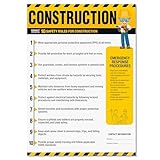
- Ensure Compliance: This OSHA construction safety poster is essential for any job site, featuring vital construction safety rules sign information to keep workers informed and compliant with safety regulations.
- Waterproof & Tear-Resistant: Our laminated construction site safety signs are designed to withstand harsh conditions, ensuring long-lasting visibility of critical construction safety signage, even in tough environments.
- Promote Awareness: These construction safety posters effectively communicate important safety protocols, making them ideal for enhancing awareness of construction site safety practices among all team members.
- Easy to Read: With bold text and clear visuals, our construction safety rules sign ensures that all workers can quickly understand essential information, promoting a safer work environment on every construction site.
- Versatile Use: Perfect for various settings, these construction site safety posters can be displayed indoors or outdoors, making them ideal construction safety signs for job sites, warehouses, and industrial facilities.
Examples by common construction risk
Vehicle and pedestrian interface
Use signs and physical barriers to mark crossings, one-way routes, speed restrictions, and no-entry areas. Brief drivers, banksmen, and pedestrians on the day’s route, reversing controls, blind spots, delivery windows, and what happens when the route changes.
Work at height
Signs can identify restricted areas below overhead work and required access rules. A toolbox talk should cover the specific platform or edge protection, dropped-object controls, inspection status, rescue arrangements, weather limits, and how workers will stop the job if protection is compromised.
Excavation and underground services
Signs and barriers warn people away from edges and identify access points. The briefing should address drawings and permits, service-location information, spoil placement, plant stand-off, water ingress, inspection arrangements, and the conditions that require evacuation or reassessment.
Electrical work
Location signs can restrict access and identify energized areas. The task briefing should address isolation, verification, approach boundaries, authorized roles, test equipment, nearby work, and emergency arrangements. Use the requirements that apply to the electrical task and jurisdiction; do not assume the electric-power eTool’s briefing schedule is a general rule for every industry.
Hot work and fire risk
Signs can identify no-smoking zones, fire points, and hot-work areas. The talk should cover the permit, combustible-material control, gas-cylinder handling, fire watch, ventilation, adjacent trades, and the inspection period after the work ends.
What the evidence can—and cannot—establish
The OSHA sources cited here provide definitions, duties, examples, and practical principles. They do not provide a named statistic or controlled comparative efficacy figure showing that signs or toolbox talks reduce incidents by a particular percentage. Therefore, claims that one method is statistically better, or that either method guarantees safer outcomes, are not supported by this evidence.
The defensible conclusion is functional: signs are suited to persistent, location-based warnings and instructions; toolbox talks are suited to task-specific discussion, changing conditions, and worker participation. Selecting the method that fits the message—and combining them when necessary—is more credible than declaring a single winner.
The Tool Desk
Outbyte PC Repair FREEClear out junk files and repair common Windows errorsFree Scan →Outbyte Driver Updater FREEScan for outdated or missing drivers - takes under a minuteDriver Scan →A site-ready decision checklist
- Have we identified the hazard and the behavior required to control it?
- Must the message remain visible at a particular location?
- Can the hazard change with task sequence, weather, nearby work, or equipment?
- Do workers need explanation, questions, demonstrations, or assigned roles?
- Will people who did not attend the briefing still be exposed?
- Are the sign, label, barrier, permit, safety data sheet, and training requirements all being met?
- Can every worker understand the language, symbols, and instructions?
- What event will trigger a stop, reassessment, and renewed briefing?
- Who will inspect the communication and close any follow-up action?
Conclusion
For construction sites, the better question is not “Which method wins?” but “What does this hazard and this work period require?” Put a clear, maintained sign where people need a persistent warning. Hold a focused toolbox talk when the crew must understand a task, controls, roles, and changing conditions. When both needs exist, use both—and treat communication as one part of a broader system that actually controls the hazard.
Quick Recap
Product prices and availability are accurate as of the date/time indicated and are subject to change. Any price and availability information displayed on Amazon at the time of purchase will apply.

