Start with a mortise and tenon about one-third the thickness of the stock being joined. In a typical frame joint made from equal-thickness members, that means a 3/4-inch-thick stile and rail would usually begin with a tenon about 1/4 inch thick and a mortise about 1/4 inch wide.
That one-third proportion is a balancing rule, not a universal specification. A tenon made much thicker can leave the mortise cheeks weak; one made much thinner may not provide enough strength. The final dimensions also depend on the mortised member, joint length, grain direction, loading, available tooling, and whether the joint is blind, through, wedged, pegged, or structural.
As an Amazon Associate I earn from qualifying purchases.
The basic one-third rule
For ordinary furniture and cabinet frame joints, use this as the starting calculation:
What’s actually slowing this PC down?
Pick the symptom - the matching free tool is one click away.
Tenon thickness ≈ thickness of the tenoned member ÷ 3
#1 Best Overall

- Premium Blades: Drop forged CR-V steel with heat-treated edges ensures sharp precision and long-lasting durability, can be used to make finish or paring cuts on wood surfaces, as well as cut mortises
- Beveled Edge for Versatility: 25° Bevel edge for woodworking multi-purpose use, ideal for soft wood, hard wood, and laminated wood products
- Ergonomic PVC Handle: HURRICANE wood chisel set with Lightweight yet durable regular size impact PVC Handle, feels natural in your hand for everyday fixes, yet tough enough for mallet strikes—great for door locks or DIY use
- Safety & Portability: This four sizes (1/4"; 1/2"; 3/4"; and 1") chisel set with blade guards protects edges during storage
- Widely Function: this HURRICANE wood chisel set empowers beginners to tackle DIY projects while meeting the demands of hobbyists & Home use
When the mortised and tenoned pieces are the same thickness, the mortise is commonly laid out at approximately the same one-third proportion. The remaining material on either side of the mortise forms the cheeks:
- Approximately one-third of the stock remains as one mortise cheek.
- Approximately one-third becomes the tenon.
- Approximately one-third remains as the opposite mortise cheek.
This arrangement spreads the joint’s material relatively evenly. Increasing the tenon does not automatically make the joint stronger because the extra tenon thickness comes from the cheeks surrounding the mortise.
Quick sizing table
| Stock thickness | Starting tenon thickness | Typical equal-stock mortise width |
|---|---|---|
| 1/2 inch | About 1/6 inch | Use the closest practical chisel or bit size |
| 3/4 inch | About 1/4 inch | About 1/4 inch |
| 1 inch | About 1/3 inch | About 1/3 inch, adjusted to tooling |
| 1-1/2 inches | About 1/2 inch | About 1/2 inch, or consider multiple tenons |
| 2 inches | About 2/3 inch | Evaluate whether two smaller tenons are preferable |
These are layout starting points, not dimensions to follow blindly. In practice, the available mortise chisel or router bit often determines the mortise width. A robust 5/16-inch chisel may be a better choice than a fragile nominal 1/4-inch setup for a particular joint, even when the arithmetic result is close to 1/4 inch.
What the one-third proportion is actually balancing
Mortise cheek strength
The mortise removes material from the receiving member. If the mortise is too wide, the cheeks become thin and vulnerable to splitting, crushing, or breaking out—especially near the end of a workpiece or where the grain and loading put the cheek under stress.
Tenon strength
If the tenon is made too thin, the tenon itself becomes the weak part. It may split, shear, or bend during assembly or service. A very thin tenon also provides less useful bearing area for the joint’s shoulders and glue surfaces.
Shoulder support
The shoulders around a tenon help register the parts, resist racking, and create a clean visual transition. Do not use every available fraction of the member’s width for the tenon if doing so leaves inadequate shoulders or makes the joint difficult to assemble accurately.
A practical 3/4-inch example
For matching 3/4-inch-thick stile and rail stock, a reasonable first layout is:
- Tenon thickness: approximately 1/4 inch.
- Mortise width: approximately 1/4 inch, or the closest suitable chisel or router-bit width.
- Mortise length: around 1-1/2 inches in a representative furniture-frame example.
- Blind-mortise depth: around 1 to 1-3/8 inches, depending on the design.
- Tenon length: slightly shorter than the mortise depth so it does not bottom out.
For a blind mortise, leave roughly 1/16 inch of clearance at the bottom in the type of example described by WOOD Magazine. The clearance prevents the tenon from seating prematurely and leaves room for glue instead of trapping it at the bottom of the mortise.
Rank #2
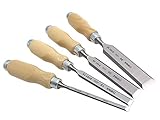
- Blades are made from highly alloyed Cr-Mn steel, hardened up to Rc 59.
- Meets DIN 5139 requirements.
- Handles are ergonomic with oval cross-section.
- Blade sizes: 6 mm (1/4"), 12 mm (1/2"), 20 mm (13/16") and 26 mm (1 1/32").
- Made in the Czech Republic.
The tenon should enter with firm, controlled pressure. It should not require heavy hammering. A joint that must be forced together can split a cheek, damage the shoulders, distort the surrounding work, or squeeze out too much glue from the intended bond line.
How long should the tenon be?
Tenon length depends more on the joint and its loading than tenon thickness does. Common furniture guidance places a tenon at approximately one-half to two-thirds of the width of the mortised workpiece. Another useful minimum relationship is at least twice the tenon’s thickness.
Some guidance for stopped tenons uses substantially greater minimum lengths. That is not a contradiction so much as a reminder that a small cabinet-frame joint, a door joint, and a heavily loaded structural joint do not have the same requirements.
For a blind mortise, the tenon should be long enough to provide useful long-grain glue surface and resistance to racking, but shorter than the mortise depth. For a through tenon, the design may instead prioritize visible appearance, wedges, drawboring, or mechanical locking at the far face.
Mortise width is usually a tooling decision
The one-third rule gives you a proportion; it does not require an exact decimal dimension. A mortise chisel has a fixed cutting width, and the mortise is normally made to match that tool. The tenon is then cut to fit the completed mortise.
A mortise marking gauge can make the layout easier by registering both mortise edges from a common reference face. A dual marking gauge can also be set to the chisel width and used to transfer consistent mortise-and-tenon dimensions. The gauge is not required for the one-third rule, but it helps keep the mortise centered and the shoulders consistent across multiple parts.
A sensible cutting sequence is:
- Choose the mortise tool first. Select the mortise chisel or router bit that suits the stock and the joint.
- Lay out the mortise from a reference face. Keep the gauge registration consistent on every mating component.
- Cut the mortise. Its width is now fixed by the tool and the actual cut.
- Cut the tenon slightly oversize. Remove material gradually until it fits the finished mortise.
- Test the fit dry. Confirm that the shoulders close without gaps and that the joint aligns correctly.
When the nominal one-third dimension falls between practical tool sizes, select the soundest available tool rather than weakening the joint to satisfy the fraction exactly. A mortise chisel should be sturdy enough for the stock and narrow enough to leave adequate cheeks.
Free tools Windows power users keep installed
One-click scans. No signup required.
How wide should the tenon be?
Tenon width is the dimension along the length or face of the rail, stile, apron, or other tenoned component. Make it wide enough to provide useful long-grain glue surface and good resistance to racking, while retaining sound shoulders and surrounding wood.
Rank #3

- EZARC premium set of wood chisel includes a variety of sizes, 1/4”(6mm), 3/8”(10mm), 1/2”(12mm), 5/8”(16mm), 13/16”(20mm), and 1”( 25mm), to cater to all your woodworking needs. Whether you're a seasoned woodworker or just starting out, this set is sure to impress.
- All chisels were made from fine-grained, nicely tempered chrome-vanadium steel with a hardness of HRC60 for long-lasting sharpness and ensuring a smooth finish.
- Beech wooden is a hard and dense wood species, making it highly resistant to wear and tear. This means that your chisel handle will last for years to come, even with frequent use. Finally, beech wood is a renewable resource, making it a more environmentally friendly option compared to synthetic materials.
- The carpentry chisel is precisely beveled ground at 25 degrees with an extremely sharp edge which can be used immediately after opening the package, easily cut mortises, shave rough surfaces, chop out corners and scrape off the glue with effortless.
- Professional chisel carefully packed in a wooden box, easy to store and transport. Ideal gift for beginners, hobbyists and professional wood artists.
A single wide tenon is not always the best design. When a tenon becomes more than roughly 3 inches wide, seasonal movement across the grain becomes a greater concern. Two or more smaller tenons can preserve more wood between the mortises, reduce the risk of splitting, and accommodate movement more effectively than one very broad tenon.
Multiple tenons are particularly useful in thick or broad components. They can also provide better resistance to racking without requiring one oversized mortise that leaves thin cheeks or a vulnerable central area.
When the one-third rule changes
Unequal-thickness members
Do not apply one-third mechanically to both pieces when the members have different thicknesses. The tenon is primarily sized in relation to the member from which it is cut, while the mortise must preserve adequate material in the receiving member.
The Tool Desk
Outbyte Driver Updater FREEScan for outdated or missing drivers - takes under a minuteDriver Scan →Outbyte PC Repair FREEClear out junk files and repair common Windows errorsFree Scan →For example, an apron may be thinner than a substantial leg. If the leg is wide enough to allow the mortise to be set back from its edges, the tenon can sometimes be increased to as much as half the thickness of the piece from which it is cut. That is an exception based on the geometry of the joint, not a replacement for the ordinary one-third starting point.
Mortises close to an end
A mortise near the end of a member leaves less wood beyond it to resist splitting. In that situation, increasing the tenon proportion may make the surrounding end weaker rather than stronger. Keep more material around the mortise and assess the grain, end distance, and direction of the expected load.
Traditional guidance sometimes allows a tenon approaching one-half the stock thickness where the mortise is well away from the end and the surrounding material is substantial. Treat that as an upper-bound exception, not as a general recommendation.
Broad or thick parts
On a wide door rail, bed component, workbench part, or other broad member, one large tenon may create unnecessary movement and splitting risks. Use multiple tenons or another joint arrangement when the dimensions and loading call for it.
Rank #4
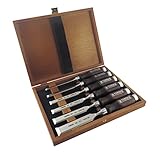
- 6 piece set comes on a wooden presentation box
- Blades are made from fine-grained, nicely tempered chrome-manganese steel and hardened to Rc 59
- Contains the following sizes: 6, 10, 12, 16, 20 and 26 mm
- Bevel ground at a 25 degree bevel.
- Handles are made from stained European Beech
Through, wedged, pegged, and drawbored joints
A through tenon, wedged tenon, pegged joint, or drawbored joint has mechanical features that change the design. The tenon may need additional material for a wedge or peg, and the joint must be laid out so those features do not split the surrounding wood.
The one-third rule is most useful as a furniture-joint starting point. It is not an engineering specification for structural framing, safety-critical assemblies, timber structures, or joints carrying unusually large loads or long lever arms. Those applications require a design based on the species, grade, grain, fasteners, loading, dimensions, and applicable building requirements.
A simple layout method
For equal-thickness stock, begin by measuring the actual thickness of the member being tenoned and dividing it by three. Use that result to establish a target tenon thickness. Then select the nearest suitable mortise-tool width that leaves cheeks at least approximately as thick as the tenon in ordinary frame construction.
Register the layout from one consistent face. A mortise or dual marking gauge can mark the two sides of the mortise from that reference, while a square transfers the mortise length and shoulder lines. Mark the tenon from the same reference logic so the joint does not accumulate small layout errors.
Recommended Free Tools
Before cutting a finished component, make a test joint from matching offcuts. This lets you verify the chosen chisel width, cheek thickness, shoulder position, mortise depth, and fit without sacrificing the project part.
Independent reader supportYour contribution helps us test, update, and keep practical guides available for everyone.Fit checklist before applying glue
- The tenon enters the mortise fully with firm hand pressure or only light tapping.
- The shoulders close evenly without a visible gap.
- The tenon does not bottom out in a blind mortise.
- The mortise cheeks show no splitting, crushing, or breakout.
- The joint aligns correctly when dry-assembled.
- The tenon is not so loose that the parts move noticeably before glue is applied.
- The glue has room to spread rather than being hydraulically trapped at the mortise bottom.
If the joint is too tight, pare or plane the tenon gradually and test again. If it is too loose, do not assume extra glue will compensate for a poor fit; remake the tenon, add an appropriate repair, or revise the joint design.
Common sizing mistakes
Making the tenon as thick as possible
This can leave dangerously thin mortise cheeks. Strength is determined by the complete joint, not the tenon alone.
Best Value

- 【 Professional Wood Chisel Set 】- Includes 6-50mm(1/4"-2") 8 sizes of wood chisels, 6mm, 10mm, 13mm, 19mm, 25mm, 32mm, 38mm, 50mm(¼", 3/8", ½", ¾", 1", 1-¼", 1-½", 2"), 1 honing guide and 1 alumina sharpening stone (120/200 grit), to meet various woodworking projects.
- 【Precision Pregrinding Chisel Heads】 - All woodworking chisel heads undergo precise 25 degree bevel pre grinding to ensure accuracy and sharpness, making it easy to cut mortises, scrape rough surfaces, cut corners, and scrape off glue.
- 【High Quality CR-V Blade】 - Our chisels for woodworking is made from chrome vanadium steel, hardened to Rockwell C60 for a long lasting sharp edge and durability. These wood chisels are durable and sharp enough for tough wood, fine carving and a variety of woodworking projects.
- 【Comfortable Wood Handle】 - The solid wood handle of our wood carving chisels are comfortable and beautiful to hold, sturdy and durable, and the end of the chisel handle is hooped with a metal ring, which is hammer-resistant and not easy to be deformed and broken, but it is still recommended to use a mallet or plastic hammer instead of an iron hammer.
- 【Sturdy Wooden Box】 - These 8 wood chisels are neatly organized in a wooden case that features double panels, padded hinges, and a protective EPE liner that ensures the woodworking chisels are safely stored and transported, Convenient for beginners and experts.
Applying one-third to the wrong member
Tenon thickness is normally related to the thickness of the tenoned member. Mortise width must also account for the thickness and strength of the receiving member and the width of the available cutting tool.
Quick wins for a faster PC:
Fix the driver behind crashes, sound loss and screen glitchesFind Drivers →Repair Windows errors before they cause bigger problemsFix Now →Scan for outdated or missing drivers - takes under a minuteDriver Scan →Letting a blind tenon bottom out
A tenon that reaches the bottom before its shoulders close can prevent proper assembly and trap glue. Leave the appropriate end clearance.
Forcing the assembly
Excessive force can split cheeks, bruise the tenon, damage the shoulders, and create a joint that is less accurate after glue-up.
Using one oversized tenon in a broad joint
Multiple tenons may preserve more surrounding wood, improve racking resistance, and reduce stress from seasonal movement.
Ignoring grain and loading
A proportion suitable for a small cabinet frame may be unsuitable for a door, bed, workbench, structural timber, or any joint subjected to high shock or leverage.
PC Slower Than It Used to Be?
A free scan shows the junk files, broken settings and background clutter dragging Windows down - then fixes them in one click.Free scan · Windows 10 & 11Crashes, No Sound, or Screen Glitches?
Random freezes, missing sound and display glitches usually trace back to one bad driver. Find and replace yours safely.Free scan · under a minuteFrequently Asked Questions
Is a mortise-and-tenon joint always one-third the thickness of the wood?
No. One-third is the standard starting proportion for many furniture and cabinet frame joints. The final size must also preserve strong mortise cheeks, suit the cutting tool, account for unequal stock, and reflect the joint’s loading and construction.
Should the mortise and tenon be the same width?
For equal-thickness frame members, the mortise width and tenon thickness commonly begin at the same approximate one-third proportion. The mortise width is normally set by the chisel or router bit, and the tenon is fitted to that finished mortise.
How much shorter should a blind tenon be than its mortise?
Leave clearance so the tenon cannot bottom out before the shoulders close. Roughly 1/16 inch is used in the WOOD Magazine example, although the appropriate clearance depends on the joint and cutting accuracy.
Is a thicker tenon stronger?
Not necessarily. A thicker tenon can weaken the mortise cheeks by removing more material from the receiving member. In many ordinary frame joints, about one-third balances tenon strength and cheek strength better than simply making the tenon as large as possible.
Do these 3 things before closing this tab:
1Clear out junk files and repair common Windows errors2Fix the driver behind crashes, sound loss and screen glitches3Repair Windows errors before they cause bigger problemsThe Bottom Line
Bottom line: For a typical equal-thickness furniture joint, start with a tenon and mortise about one-third the thickness of the stock—about 1/4 inch for 3/4-inch material. Then adjust for the actual mortise tool, preserve cheeks and shoulders, leave blind-mortise clearance, and switch to multiple tenons or a separately engineered design when the parts are broad, heavily loaded, unequal, or close to an end.
Quick Recap
Product prices and availability are accurate as of the date/time indicated and are subject to change. Any price and availability information displayed on Amazon at the time of purchase will apply.

