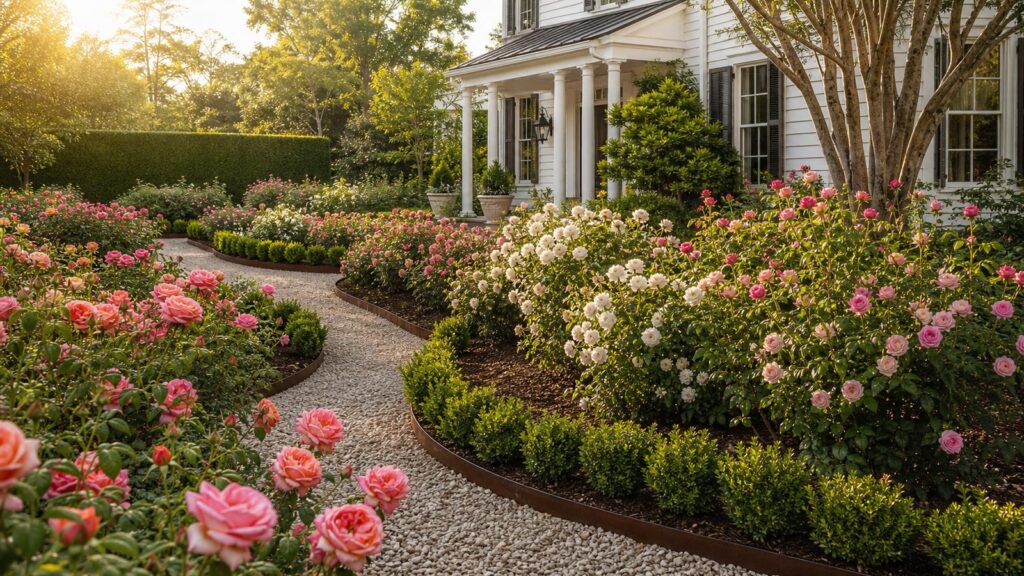
A good rose garden starts with a simple test: will it still look intentional after the first bloom cycle is over? The best designs do not rely on flowers alone. They use structure, spacing, irrigation, edging, paths, and companion planting so the garden looks finished in spring, summer, and winter.
For most homes, a practical rose garden needs at least 6 hours of direct sun per day, well-drained soil, room for airflow, and a way to reach every plant for pruning and deadheading. Installed costs in 2026 usually range from a few hundred dollars for a small DIY bed to $1,500 to $5,000 for a professionally built, edged, irrigated rose garden. Add stone paths, retaining walls, lighting, drainage, arbors, or pergolas, and the project can move into the $6,000 to $15,000 range or higher.
As an Amazon Associate I earn from qualifying purchases.
On our job sites, the rose gardens that hold up best are planned like small landscape construction projects, not weekend plant collections. Here are 12 rose garden ideas that look beautiful and are buildable for real American yards.
What’s actually slowing this PC down?
Pick the symptom - the matching free tool is one click away.
1. A Front Yard Rose Border for Curb Appeal
A rose border along the front walk, driveway, or foundation can make a plain yard look established quickly. The trick is keeping it wide enough to breathe. A 2-foot strip is usually too narrow for most shrub roses. Plan on a bed that is 4 to 6 feet deep for compact roses and 6 to 8 feet deep if you want larger shrub roses with companion plants.
#1 Best Overall
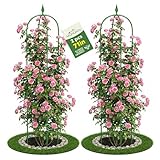
- 【6 Ft Adjustable Height】This 4-tier garden trellis for climbing plants provides ample space to plant thrive. With removable 4-way connectors, you can easily adjust the height as your plants grow—reaching up to 6 feet tall. It offers the flexibility needed for healthy vertical development
- 【Rustproof & Durable】This garden tower trellis is made of PVC-coated iron, so it is rust resistance. It stands up to sun exposure not easy to fading and is gentle on plant stems. The sturdy yet lightweight design holds up well indoors or outdoors, giving you reliable durability and stability
- 【Easy to Assemble】No tools required—one person can set up this tower obelisk garden trellis in minutes. The detachable design also allows quick disassembly for compact off-season storage. Tip: For best stability, insert the four longest tubes at the bottom for deeper soil anchoring
- 【Supports Various Climbing Plants】The durable steel frame of the obelisk trellis offers strong support for climbing plants: roses, clematis, vines, tomatoes, cucumbers. Whether indoors or outdoors, this trellis keeps climbing plants organized, healthy, and beautifully displayed
- 【Space-Saving】This outdoor climbing plant trellis features a three-dimensional structure that guides plants upward, making the most of your garden space. Perfect for small yards, balconies, or patios—ideal for apartment renters and gardeners to create a greener garden without clutter
Use roses as the main color layer, then hold the edge with low evergreen shrubs, steel edging, brick, stone, or a clean mulch line. If the bed sits against the house, leave at least 18 to 24 inches between mature plant growth and the siding for airflow, cleaning, and pest inspection. Avoid planting thorny roses where people step out of cars or carry groceries.
Best for: Traditional homes, cottage-style homes, and front yards needing stronger street presence.
Cost driver: Turf removal, edging, soil amendment, and the number of roses. A simple pro-installed front bed often fits the $1,500 to $3,500 range; a deeper bed with stone edging and irrigation can run $4,000 to $7,500.
Outdated Drivers Are Slowing You Down
One free scan finds every outdated or missing driver and matches the right update for your exact hardware.Free scan · exact hardware matchWindows Errors? Fix Them Before They Spread
Repair common Windows errors and clear accumulated junk for a smoother, more stable PC - no reinstall needed.Free scan · no reinstallMaintenance note: Add stepping stones every 5 to 6 feet so pruning does not require walking through mulch and compacting soil around roots.
2. A Modern Rose Garden With Gravel and Steel Edging
Roses do not have to look old-fashioned. A modern rose garden works well when the layout is restrained: fewer varieties, repeated colors, clean lines, and strong contrast. Use white, coral, red, or soft pink roses in blocks rather than scattering one of everything across the bed.
For a modern build, we like 3/16-inch to 1/4-inch steel edging, compacted gravel paths, drip irrigation under mulch, and simple companion plants such as ornamental grasses, catmint, salvia, or lavender where climate allows. Keep the rose spacing honest. Many shrub roses need 3 to 5 feet on center. Climbers and large landscape roses may need more.
Best for: Contemporary homes, low-clutter landscapes, and homeowners who want roses without a formal garden look.
Cost driver: Gravel base preparation and edging. Softscape alone may be $5 to $15 per square foot, while hardscape portions such as gravel paths, stone borders, and compacted base often fall closer to $15 to $45 per square foot.
Maintenance note: Gravel looks clean but collects petals and leaves. Keep a blower or rake path in mind before installing narrow, hard-to-reach bands.
3. A Rose Arch at the Garden Entry
A rose-covered arch creates an immediate focal point, but it has to be built for weight, wind, and maintenance. A mature climbing rose can become heavy, especially after rain. Use a steel, cedar, redwood, or pressure-treated wood structure with posts set plumb and firmly anchored. For many residential arches, a clear opening of 42 to 48 inches wide and 84 to 96 inches tall feels comfortable.
Train climbing roses horizontally across the arch or along side rails when possible. Horizontal canes often produce more flowering laterals than canes left to grow straight up. Tie with flexible plant ties, not wire that cuts into canes.
Best for: Garden entrances, side yards, gates, and transitions between lawn and patio areas.
Cost driver: Structure quality and installation. A light kit may cost a few hundred dollars before labor; a custom wood or metal arbor with footings can reach $1,500 to $5,000 depending on size, finish, and site access.
Maintenance note: Leave room on both sides for a ladder or stable step platform. If you cannot safely reach the top, the arch will become difficult to prune.
4. A Raised Rose Bed for Poor Drainage
Roses dislike wet feet. If water stands after rain, or if the soil is heavy clay, a raised bed is often the difference between a garden that thrives and one that declines slowly. For roses, a raised bed should usually be 12 to 18 inches high at minimum, with 18 to 24 inches preferred where drainage is poor.
Build the bed wide enough for root development and maintenance. A 4-foot-wide bed works if accessible from both sides. If it is against a fence or wall, keep it closer to 3 feet deep unless you add access stones. Use a soil blend that drains well but still holds moisture: quality topsoil, compost, and mineral content suited to your region. Do not fill the bed with pure compost or lightweight potting mix.
Best for: Clay soils, low areas, compacted builder-grade yards, and small gardens that need clean definition.
Rank #2

- Versatile garden arch, perfect for event, wedding, and garden decoration. A must-have for your special occasions.
- Approximately 55 inches Width x 94 inches Height, this real size arbor creates a stunning entrance to your garden, patio or walkway.
- Easy assembly and disassembly, praised by customers. Suitable for both indoor and outdoor use.
- Decorate with vibrant flowers, tulle, balloons, foliage, lights or anything else to create a beautiful arch backdrop stand.
- Not just a garden trellis for climbing plants, but also a balloon arch stand for birthdays and a decorative arch for weddings.
Cost driver: Wall material and soil volume. Timber beds are usually cheaper than masonry. Stone, brick, or concrete block beds cost more but last longer and look more permanent.
Maintenance note: Test drainage before planting. A raised bed still fails if the bottom acts like a bathtub with no outlet.
The Tool Desk
Outbyte PC Repair FREERepair Windows errors before they cause bigger problemsFix Now →Outbyte Driver Updater FREEFix the driver behind crashes, sound loss and screen glitchesFind Drivers →5. A Formal Rose Parterre With Low Hedges
A parterre rose garden uses geometry to make roses look orderly. Think four square beds around a central path, a circle with cross paths, or rectangular beds framed by low evergreen hedging. The roses bring color; the hedge gives the garden shape after petals drop.
Keep the layout measurable. A common residential version is a 20-by-20-foot garden divided by 3-foot paths, with four planting quadrants. Use compact shrub roses, floribundas, or hybrid teas depending on the level of maintenance you are willing to take on. Low boxwood, inkberry, germander, or regionally suitable evergreen edging can frame the beds.
Best for: Traditional homes, larger front yards, courtyards, and homeowners who enjoy a maintained garden.
Cost driver: Layout labor, hedging plants, path material, and irrigation. A small formal rose garden can start around $4,000 to $8,000 installed; premium stone paths and mature plants can push it much higher.
Maintenance note: Formal gardens show neglect quickly. Budget time for pruning, hedge trimming, deadheading, and path cleanup.
6. A Mixed Border That Hides Bare Rose Canes
Many roses are beautiful at eye level and awkward near the ground. A mixed border solves that by planting lower perennials and small shrubs in front of the roses. This gives the bed fullness even when roses are between bloom cycles.
Good companion plants depend on climate, but the goal is consistent: shallow competition, good airflow, and contrasting texture. Use plants that stay below the rose bloom height and do not smother the crown. Common choices include salvia, catmint, allium, nepeta, yarrow, lavender in dry climates, ornamental grasses, and low evergreen shrubs.
Best for: Long fence lines, backyard borders, and homeowners who want a natural but maintained look.
Free tools Windows power users keep installed
One-click scans. No signup required.
Cost driver: Plant count. Companion plants can double or triple the number of plants in a bed, even if each one costs less than a rose.
Maintenance note: Do not crowd for instant fullness. Air movement helps leaves dry faster and reduces disease pressure.
7. A Patio Rose Garden in Large Containers
Container rose gardens are useful where soil is poor, space is limited, or the patio needs color. Use large containers, not decorative bowls. Most patio roses need containers at least 18 to 24 inches wide and deep. Bigger is better in hot climates because small pots dry out quickly.
Choose compact shrub roses, miniature roses, or patio roses bred for containers. Use a high-quality potting mix, drainage holes, and pot feet or risers where needed. Drip irrigation on a timer is worth considering if containers sit in full sun. A pot that looks fine in April can need daily water during a July heat wave.
Do these 3 things before closing this tab:
1Clear out junk files and repair common Windows errors2Scan for outdated or missing drivers - takes under a minute3Repair Windows errors before they cause bigger problemsBest for: Patios, decks, balconies, townhomes, and renters who can move containers later.
Cost driver: Container quality. A durable frost-resistant planter can cost more than the rose itself.
Maintenance note: Container roses need more frequent watering and feeding than in-ground roses. They may also need winter protection in cold regions.
Rank #3

- 【Tool-Free Quick Assembly】 No extra tools or complex instructions needed! Just insert the 11.8-inch reinforced ground spike into soil, and your plant trellis is ready to use in 5 minutes. Perfect for busy gardeners—no professional skills required. Unit Dimension: 2 Pack, 86.7" H x 19.7" W. Note: Vines and plants are not included.
- 【Heavy-Duty Rustproof Construction】YOBAZAN garden trellis for climbing plants Crafted with thickened steel tubes (2mm thicker than ordinary trellises). High-temperature black powder coating, this climbing plant trellis is weatherproof. It withstands rain, snow, and intense sunlight without fading or bending, maintaining stability for years in outdoor gardens, patios, or balconies.
- 【Elegant Bird Pattern & Versatile Style】 Unique laser-cut bird motifs add a charming, nature-inspired touch to your outdoor space—blending seamlessly with modern, cottage, or rustic garden styles. The open wire lattice design not only supports climbing growth but also creates a decorative screen to hide unsightly areas (like utility boxes or fence gaps) while keeping your yard visually appealing.
- 【Multi-Scene Support for All Climbers】 Ideal for supporting small to medium potted plants and various climbing flowers (roses, ivy, clematis, jasmine, morning glories) as well as vine vegetables (tomatoes, peas, cucumbers, beans). Use it as a standalone plant stand, wall-mounted trellis, or fence extender—adds vertical interest to your garden and maximizes growing space.
- 【Reliable After-Sales & Quality Guarantee】 If your 2-pack trellis arrives damaged, missing parts, or fails to meet expectations, contact us anytime for a free replacement . Our 24/7 customer service team is ready to assist—shop with confidence for your garden upgrade.
8. A Rose Walkway With Thorn Clearance
A rose-lined walkway can be stunning, but clearance matters. Roses should not grab clothing, scratch arms, or block a stroller, mower, or trash bin route. For a main walk, keep at least 36 inches of clear walking width after mature plant growth. For comfortable two-person passing, 48 inches is better.
Quick wins for a faster PC:
Scan for outdated or missing drivers - takes under a minuteDriver Scan →Repair Windows errors before they cause bigger problemsFix Now →Set shrub roses back 24 to 36 inches from the path edge, depending on mature spread. For climbers on a fence or trellis, keep canes tied back and do not let thorny growth lean into the walkway. If space is tight, choose compact, lower-thorn varieties or use roses only at wider landing areas.
Best for: Side yards, front walks, garden paths, and routes to patios or gates.
Cost driver: Path construction. Mulch paths are affordable; compacted gravel, pavers, brick, and natural stone increase cost substantially.
Maintenance note: Plan access from the path side and the back side if the bed is deeper than 4 feet.
Recommended Free Tools
9. A Fence-Line Climbing Rose Garden
A fence-line rose garden can soften privacy fencing and add vertical color without taking over the lawn. The key is using the right support. Do not expect a rose to cling like ivy. Climbing roses need to be tied to wires, trellis panels, or rails.
Install horizontal stainless wire, powder-coated trellis panels, or wood lattice with enough standoff from the fence for airflow. A 2-to-4-inch gap between support and fence helps reduce trapped moisture and makes tying easier. Space climbers according to mature spread, often 6 to 10 feet apart depending on variety.
Best for: Backyard fences, privacy screens, garage walls, and long blank elevations.
Cost driver: Support system and fence condition. If the fence is already leaning or rotted, fix that before adding roses.
Maintenance note: Annual training matters. Tie main canes horizontally and remove dead, crossing, or congested growth.
10. A Wildlife-Smart and Deer-Resistant Rose Garden
No rose is fully deer-proof when deer pressure is high, but design can reduce damage. Use more disease-resistant landscape roses, place vulnerable roses inside fenced areas, and combine them with plants deer tend to browse less in your region. In high-pressure areas, physical protection is more reliable than sprays.
For vegetable gardens, orchards, and serious rose collections, deer fencing often needs to be about 7 to 8 feet tall to be consistently effective. For front yards where that is not practical, use roses closer to the house, near active entries, or behind lower ornamental fencing that discourages casual browsing.
Best for: Suburban edges, rural homes, and properties where deer damage is common.
Crashes, No Sound, or Screen Glitches?
Random freezes, missing sound and display glitches usually trace back to one bad driver. Find and replace yours safely.Free scan · under a minuteWindows Errors? Fix Them Before They Spread
Repair common Windows errors and clear accumulated junk for a smoother, more stable PC - no reinstall needed.Free scan · no reinstallCost driver: Fencing, gates, and plant replacement. Deer protection can cost more than the original roses if it is added after damage starts.
Maintenance note: Choose regionally proven roses first. Disease resistance, cold hardiness, and mature size matter more than catalog photos.
11. A Low-Water Rose Garden With Drip Irrigation
Roses need consistent moisture, but they do not need wasteful overhead watering. A practical baseline is about 1 inch of water per week during the growing season, adjusted for heat, rainfall, soil type, and plant age. Drip tubing or soaker hoses under mulch put water near the root zone and keep foliage drier.
For new rose beds, we prefer installing irrigation before mulch and planting the final companion layer. Use pressure-regulated drip components, flushable line ends, and a controller that can adjust for weather. WaterSense-labeled controllers are a smart upgrade, especially in regions where outdoor watering is a major part of the utility bill.
What’s actually slowing this PC down?
Pick the symptom - the matching free tool is one click away.
Rank #4
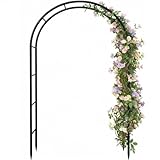
- Superior Rust Resistance with Galvanized Metal: Forged from premium galvanized steel, this garden arbor endures intensive salt spray trials, proving its rust resistance surpasses standard metal designs by over 200%. A robust zinc finish guards against weather wear, ensuring lasting resilience. Whether dressing weddings, seasonal fêtes, or anniversary gatherings, it seamlessly weaves romance or festive spirit into every celebration.
- Thicker & heavier for extra strength: We have made our garden arch thicker and heavier to deliver greater strength and stability.Thickness: 0.3mm → 0.4mm, Weight: 4lbs → 5.54lbs.Better quality at the same price—your satisfaction and approval are all we aim for.
- Effortless One-Person Assembly: Engineered for user-friendly setup, this arch arrives with pre-drilled holes and crystal-clear instructions. Also comes with a screwdriver.Its lightweight-yet-robust build lets a single person assemble or disassemble it swiftly, making both setup and storage a breeze.
- Dual-Purpose Design: Backdrop & Plant Support. Beyond event decor, this structure doubles as a thriving trellis for climbing vines, roses, or morning glories—infusing your outdoor space with organic charm. Customize it too: deck with blooms, greenery, fairy lights, or balloons to craft romantic wedding frames, lively party focal points, or cozy holiday displays. Indoor/outdoor versatility ensures it elevates any setting or theme.
- Worry-Free Ownership: Complimentary Replacement Guarantee. Backed by our commitment to quality, this galvanized iron arbor comes with peace of mind. Should you face missing/damaged parts or assembly hiccups, reach out anytime—we’ll promptly replace components or provide supportive solutions. Shop confidently, whether prepping for a special day or enhancing your garden year-round.
Best for: Hot climates, water-conscious homeowners, and larger beds where hand watering is inconsistent.
Cost driver: New irrigation zones, controller upgrades, trenching, and access to an existing hose bib or mainline.
Maintenance note: Inspect emitters at the start of each season. Mulch can hide clogged lines until plants show stress.
12. A Rose Garden With Seating, Lighting, and a Focal Point
If the rose garden is meant to be enjoyed up close, give people a place to stand or sit. A small bench pad, gravel terrace, bistro area, birdbath, urn, or sculpture can turn a flower bed into a destination. Keep the focal point proportional. A 3-foot urn can anchor a 20-foot bed; it can overwhelm a 6-foot corner.
Lighting should be restrained. Use low-voltage path lights for safety and one or two uplights for an arbor, small tree, or focal point. Avoid placing fixtures where rose canes will grow over them or where maintenance crews will hit them with trimmers.
Best for: Backyards, courtyards, side gardens, and homes where the garden is viewed from windows or outdoor rooms.
Cost driver: Electrical work, fixture quality, seating pad construction, and hardscape base preparation.
Maintenance note: Keep seating at least 2 to 3 feet away from thorny mature growth, more if the rose variety arches outward.
Do these 3 things before closing this tab:
1Scan for outdated or missing drivers - takes under a minute2Clear out junk files and repair common Windows errors3Fix the driver behind crashes, sound loss and screen glitchesRose Garden Cost Guide for 2026
Rose garden pricing depends on site conditions more than plant count. A flat, sunny lawn with decent soil is straightforward. A shaded, compacted, poorly drained side yard with roots, slope, and no water access is a different project.
| Project Type | Typical 2026 Cost | What It Usually Includes | Best Fit |
|---|---|---|---|
| Budget DIY rose bed | $300 to $1,500 | 6 to 10 roses, compost, mulch, basic edging, soaker hose or simple drip kit | Small sunny area with decent soil and easy water access |
| Professional flower bed | $1,500 to $5,000 | Design, turf removal, soil prep, 10 to 20 roses, companion plants, mulch, edging, cleanup | Front yard curb appeal or backyard border |
| Designed rose garden with hardscape | $6,000 to $15,000 | Paths, steel or stone edging, irrigation zone, trellis or arbor, lighting, drainage corrections | Permanent garden room or major landscape upgrade |
| Premium or complex installation | $15,000 to $45,000+ | Large garden renovation, retaining walls, pergola, masonry, extensive planting, grading, electrical, drainage | Large properties, slopes, courtyards, and high-end outdoor living areas |
As a national benchmark, professional flower-bed installation commonly averages around $2,000 to $2,370, with many projects landing between roughly $1,000 and $3,175. Per-square-foot pricing often falls around $10 to $20 for flower-bed work, while broader softscape work may be $5 to $15 per square foot and hardscape-heavy garden work may run $15 to $45 per square foot.
Individual shrub planting is a useful proxy for roses. Installed shrub planting often runs about $25 to $85 each for standard material and labor, while the plant alone may be $5 to $35 for common shrubs. Roses vary more. Bare-root or smaller roses may be around $35 to $40, while 1-gallon specialty roses can be around $60, and larger branded container roses can cost more.
Site Planning Before You Plant
Before buying roses, mark the garden on the ground. Use flags, marking paint, or a garden hose and live with the shape for a few days. Look at it from the street, the driveway, the kitchen window, and the patio. A rose garden should improve the view from the places you already use.
Check sun first. Most roses need at least 6 hours of direct sun daily. In hot climates, morning sun is especially valuable because it dries foliage early and can reduce disease pressure. Afternoon shade can help in very hot regions, but heavy shade usually means weak bloom, leggy growth, and more fungal issues.
Check drainage second. Dig a test hole about 12 inches deep, fill it with water, and watch how quickly it drains. If water sits for many hours, consider raised beds, soil correction, or drainage work. Roses prefer well-drained, near-neutral soil. A practical pH target is around 6.0 to 7.0, with about 6.5 being a strong middle ground in many areas.
Then map the working parts: hose bibs, irrigation lines, downspouts, utilities, windows, gates, mower routes, trash-bin routes, and places where children or pets run. A beautiful rose bed in the wrong traffic lane becomes a maintenance problem.
Independent reader supportYour contribution helps us test, update, and keep practical guides available for everyone.Soil, Spacing, and Irrigation Details That Matter
Good rose gardens are built from the soil up. Remove turf and perennial weeds completely. Loosen compacted soil, incorporate compost where appropriate, and correct drainage before planting. If a soil test shows pH or nutrient issues, fix those first instead of compensating with fertilizer later.
Quick wins for a faster PC:
Clear out junk files and repair common Windows errorsFree Scan →Fix the driver behind crashes, sound loss and screen glitchesFind Drivers →Repair Windows errors before they cause bigger problemsFix Now →Spacing should follow mature plant size, not the size of the nursery pot. Compact roses may be fine at 2 to 3 feet on center. Many shrub roses need 3 to 5 feet. Climbers may need 6 to 10 feet along a fence or wall. Crowding roses for a full first-year look usually creates poor airflow by year three.
Best Value

- One Trellis for All Growth Stages: Adjustable from 23.8" to 71" - Unlike fixed-height trellises, ours adapts to your plants’ entire life cycle—from delicate seedlings to towering vines. One trellis supports it all, season after season
- Reinforced with 10mm Metal Frame Tubing: Built with a heavy-duty 10mm metal tube frame and 11.8" extra-long stakes, this trellis for climbing plants outdoor provides a rock-solid foundation for cucumbers, roses, tomatoes, and more
- Quick Screw Assembly & Flat Storage: Simple, tool-free assembly with included screws. This modular garden trellis can be easily disassembled for off-season storage, giving you convenience that grows with your needs
- Design Your Dream Garden with Height Flexibility: Includes two 47"x17" trellis panels that can be used individually or freely combined to achieve adjustable heights from 23.8" to 71". Create custom fencing, patio dividers, or decorative privacy trellis walls with modular flexibility. Freestanding, potted, or wall-leaned, these supports fit balconies, decks, lawns, porches, or flower beds with ease
- Rustproof & All-Weather Durable: Powder-coated metal resists rust, fading, and peeling in sun, rain, or snow. This metal garden trellis for climbing plants is your year-round garden partner, designed to last through all seasons
Mulch beds 2 to 3 inches deep, keeping mulch pulled back a few inches from the crown. Use drip or soaker irrigation where possible. Overhead watering late in the day keeps leaves wet and raises disease pressure. New roses need more frequent watering while roots establish; mature roses generally do better with deeper, less frequent watering than daily shallow watering.
Permits, Structures, Walls, and Safety Notes
Most simple rose beds do not need permits. The permit questions usually begin when the design includes structures, retaining walls, electrical work, or attachments to the house.
For arbors, trellises, and pergolas, local rules vary. Freestanding decorative trellises may be exempt in some areas, while larger pergolas, structures attached to the house, or structures near property lines may require review. Before building, check height limits, setback rules, wind requirements, and whether footings are required.
Retaining walls deserve extra caution. Many jurisdictions start requiring permits or engineering once walls reach certain heights, commonly around 4 feet, though local thresholds vary and some areas count the buried footing or surcharge loads. Walls supporting driveways, slopes, fences, patios, or structures may need professional design even when they are shorter.
In wildfire-prone regions, use noncombustible edging, gravel, or rock mulch near the home where appropriate, keep dead canes and leaves cleaned out, and avoid dense combustible planting against siding, decks, vents, or fences. Roses can be part of a maintained landscape, but dead material and dry mulch near structures raise risk.
When to DIY and When to Hire a Pro
DIY makes sense for a small, flat rose bed with good sun, decent soil, no drainage issue, and no structures. A homeowner can usually remove sod, amend soil, plant 6 to 10 roses, install a soaker hose, and mulch over one or two weekends. Expect more time if roots, clay, buried debris, or irrigation changes are involved.
Hire a pro when the garden affects drainage, grade, retaining walls, irrigation zones, electrical work, masonry, large arbors, pergolas, or high-visibility curb appeal. Professional layout also helps when the bed must look good from multiple angles or connect to existing hardscape.
Recommended Free Tools
A phased approach works well. Build the permanent pieces first: soil correction, drainage, edging, irrigation, and paths. Plant the anchor roses next. Add companion plants, lighting, seating, or decorative structures after the first growing season if the budget needs breathing room. That sequence avoids tearing up new plants to fix infrastructure later.
Common Rose Garden Mistakes to Avoid
The biggest mistake is choosing roses by flower photo alone. Check USDA zone, disease resistance, mature size, thorniness, heat tolerance, humidity performance, and local pest pressure. Regionally proven varieties beat fragile showpieces in most residential landscapes.
Do not plant in too much shade. Fewer than 6 hours of sun often means fewer blooms and more disease. Do not crowd roses for instant impact. Airflow is part of the design. Do not plant thorny varieties directly against narrow walks, driveways, play areas, or seating without clearance.
Do not skip soil testing if you are investing in a larger garden. Roses tolerate a range, but they perform best when drainage, pH, and organic matter are right. Finally, do not install a trellis, arbor, or retaining wall as an afterthought. Those pieces need proper anchoring, layout, and sometimes permits.
The Tool Desk
Outbyte Driver Updater FREEScan for outdated or missing drivers - takes under a minuteDriver Scan →Outbyte PC Repair FREEClear out junk files and repair common Windows errorsFree Scan →The Bottom Line
The most eye-catching rose garden is not always the most expensive one. It is the one that fits the site: enough sun, clean drainage, correct spacing, reliable water, durable edges, and room to maintain the plants. Start with the view you want, then build the conditions that let roses perform for years.
For a small DIY bed, plan on a few hundred dollars to $1,500. For a professionally installed rose garden with edging, irrigation, soil prep, and companion planting, $1,500 to $5,000 is a realistic 2026 planning range. For a true garden room with paths, walls, lighting, and structures, price it like a landscape construction project, not just a plant purchase.
Frequently Asked Questions
How much does it cost to install a rose garden in 2026?
A small DIY rose bed often costs about $300 to $1,500. A professionally installed rose garden with soil prep, edging, mulch, irrigation, 10 to 20 roses, and companion plants commonly falls around $1,500 to $5,000. Larger gardens with paths, arbors, lighting, drainage, or retaining walls can run $6,000 to $15,000 or more.
Where is the best place to plant a rose garden?
Choose a spot with at least 6 hours of direct sun, good airflow, and well-drained soil. Morning sun is especially helpful because it dries foliage early. Avoid low, wet areas unless you build raised beds or correct the drainage first.
Do roses need full sun or can they grow in shade?
Most roses perform best in full sun, usually at least 6 hours of direct sun per day. Some roses tolerate light afternoon shade, especially in hot climates, but too much shade usually leads to fewer blooms, weaker growth, and more disease pressure.
Do I need a permit for a rose arbor, pergola, trellis, or retaining wall?
Simple planting beds usually do not need permits, but structures may. Larger arbors, pergolas attached to a house, structures near property lines, electrical lighting, and retaining walls may trigger local permit or engineering requirements. Many areas pay special attention to retaining walls around 4 feet tall or walls supporting slopes, driveways, patios, or fences.
What should I plant with roses to make the bed look full?
Use lower companion plants that add texture without blocking airflow. Common options include salvia, catmint, allium, yarrow, ornamental grasses, low evergreens, and lavender in suitable dry climates. Keep companions below the main rose bloom height and avoid crowding the rose crown.
Is drip irrigation or a soaker hose better for roses?
Both can work well. Drip irrigation is cleaner and easier to zone for permanent beds, while soaker hoses are affordable for smaller DIY beds. Either option is better than frequent overhead watering because it keeps foliage drier and delivers water near the root zone.
Free tools Windows power users keep installed
One-click scans. No signup required.
Quick Recap
Product prices and availability are accurate as of the date/time indicated and are subject to change. Any price and availability information displayed on Amazon at the time of purchase will apply.

