The Tool Desk
Outbyte Driver Updater FREEScan for outdated or missing drivers - takes under a minuteDriver Scan →Outbyte PC Repair FREEClear out junk files and repair common Windows errorsFree Scan →Some links on this page are affiliate links: if you buy through them we may earn a commission, at no extra cost to you.
Neither fuel is universally better. Rice husk is often easier to manage for fireside corrosion and sintering, while its silica-rich ash can be highly abrasive and abundant. Rice straw can be attractive where it is plentiful, but its reported chlorine and alkali levels create greater potential for fouling, slagging and corrosion. The sound choice depends on representative local fuel tests, preparation and storage costs, boiler design, emissions limits, steam demand, maintenance capability and ash disposal or reuse.
This guide explains what changes when a plant is designed or converted for each fuel, then gives a practical comparison method for a construction or industrial project. When someone asks, “Which is better for a boiler, rice husk or rice straw?”, the technically correct first response is: better for which site, boiler, fuel supply and operating duty?
As an Amazon Associate I earn from qualifying purchases.
Free tools Windows power users keep installed
One-click scans. No signup required.
Why the fuel choice changes the boiler
Rice husk and rice straw are both agricultural residues, but they are not interchangeable fuels. Husk is the hard outer shell removed during milling. Straw is the stalk and leaf residue left after harvesting. Their mineral content, moisture, particle form, bulk handling behavior and seasonal supply can differ substantially between regions and rice varieties.
Those differences affect the entire plant: receiving equipment, storage, metering, furnace geometry, air distribution, heat-transfer surfaces, sootblowing, ash extraction, emissions control and maintenance planning. A boiler that performs well on clean, dry husk may require major changes to burn chopped or baled straw reliably. Conversely, a straw-capable furnace may be unnecessarily complex if a mill can supply consistent husk next door.
Popular on Amazon

- Direct readout for 40 different grain scales
- Test high moisture grain up to 40%
- Illuminated multilingual display - English, Spanish, French, German, Italian, Portuguese, Swedish
- Includes Protective carrying case with shoulder strap
- Single-point or Precision multi-point calibration to match local elevator
Fuel and ash certificates should therefore be treated as design inputs, not paperwork. Obtain samples representing different suppliers and seasons, and test them on the same basis before selecting a boiler or approving a retrofit.
Fuel and ash properties to compare
DP CleanTech’s 2023 version 1.3 supplier guide provides useful indicative ranges, but it also notes regional and varietal variation. The figures below are not universal specifications for every shipment.
What’s actually slowing this PC down?
Pick the symptom - the matching free tool is one click away.
| Property | Rice husk | Rice straw | Why it matters |
|---|---|---|---|
| Ash content | 15–25% of dry solids, according to DP CleanTech’s guide | Not stated in the guide as a matched value | Determines grate or bed loading, ash-conveyor capacity, disposal volume and the amount of combustible material that can reach the heat-transfer surfaces. |
| Silica in ash | More than 75%, sometimes more than 90%, according to the guide | Not stated as a matched value | High silica can produce refractory, abrasive ash and influences ash-fusion behavior. |
| Approximate ash melting temperature | About 1,500 °C in the guide | Not stated as a matched value | Fusion temperature helps indicate slagging risk, but actual deposits also depend on composition, local furnace temperature and residence time. |
| Chlorine | Commonly below 0.1% by weight in the guide | Up to 0.7% by weight in the guide | Chlorine can participate in high-temperature corrosion and sticky deposits, particularly with alkali metals. |
| Potassium and calcium in ash | Lower potassium and calcium than the straw values reported by the guide | Up to 15% K2O and 3.5% CaO in the guide | Alkali and alkaline-earth content can lower deposit-melting temperatures and increase fouling, sintering or corrosion potential. |
| Particle form and delivery | Measure at the mill and at the boiler receiving point | Measure whether deliveries are loose, chopped, shredded or baled | Form controls conveyors, metering devices, bridging risk, dust control and the need for preprocessing. |
The 2005 Energy & Fuels study adds an important qualification for husk: in the fluidized-bed conditions it examined, ash particles were large, nearly millimeter-sized and almost pure silica, with a very high initial melting temperature when husk was fired alone. That combination can mean low tendency to melt while still causing erosion. “High ash-melting temperature” should never be read as “no ash problem.”
Rice husk: operating advantages and penalties
Potentially lower fireside chemistry risk
DP CleanTech’s supplier guide describes rice husk as tending to produce comparatively lower corrosion, fouling and sintering concerns than herbaceous fuels such as rice straw. The guide links those differences to ash chemistry, especially the balance of SiO2, K2O, Na2O and CaO. This is supplier guidance rather than an independent, universal ranking; a contaminated or unusually mineral-rich husk supply can behave differently.
Silica creates an erosion duty
Silica-rich ash can wear moving parts, furnace linings, tube shields, superheater components and downstream gas-path equipment. The design review should identify high-velocity turns, tube banks, bends, expansion joints, screw flights and ash valves that will see the greatest particle impact. Specify inspection access and thickness-monitoring points before commissioning rather than adding them after a failure.
Thermax currently describes special ferrules to protect smoke tubes on its rice-husk boiler. Ferrules are a manufacturer design feature, not independent proof of a particular service life or maintenance saving. Ask the supplier for material specifications, erosion allowances, inspection intervals and references operating on a fuel with the same ash analysis.
Large ash volumes are part of the process design
At the 15–25% dry-solids ash range reported by DP CleanTech, a husk plant must move and contain a substantial solid stream. Specify bottom-ash and fly-ash collection separately, account for dust-tight transfer, and prevent ash recirculation from overloading fans or fouling heat-transfer surfaces. Storage silos need a plan for bridging, moisture ingress and safe truck loading.
Rice straw: why preparation and chemistry are harder
Chlorine and alkali require a risk assessment
The supplier guide reports chlorine commonly below 0.1% by weight for rice husk and as high as 0.7% for rice straw. It also reports up to 15% K2O and 3.5% CaO in rice-straw ash. These constituents can combine with furnace deposits and raise the potential for fouling, sintering and fireside corrosion.
Also popular on Amazon

- 𝟐𝟐 𝐆𝐑𝐀𝐈𝐍𝐒 𝐒𝐔𝐏𝐏𝐎𝐑𝐓 – The grain moisture meter is specifically designed to measure the moisture content of 22 different grains, including wheat, maize, japonica rice, and soybean. This device ensures high accuracy with its advanced multi-point calibration system, which guarantees reliable results.
- 𝐋𝐎𝐖 𝐏𝐎𝐖𝐄𝐑 𝐂𝐎𝐍𝐒𝐔𝐌𝐏𝐓𝐈𝐎𝐍 – Our seed moisture tester is engineered for long-lasting use, operating on a 9V battery that lasts up to one year. It features an automatic shutdown function to conserve battery life, making it an economical choice for continuous use. Whether testing flaxseed, almonds, or cashews, this tester ensures that users can efficiently manage their resources while obtaining precise moisture readings with minimal power consumption.
- 𝐀𝐔𝐓𝐎𝐌𝐀𝐓𝐈𝐂 𝐓𝐄𝐌𝐏𝐄𝐑𝐀𝐓𝐔𝐑𝐄 𝐂𝐎𝐌𝐏𝐄𝐍𝐒𝐀𝐓𝐈𝐎𝐍 – This moisture meter for seeds comes equipped with automatic temperature compensation, ensuring that readings remain accurate regardless of environmental changes. This feature makes it especially useful in varying weather conditions, providing reliable moisture data for seeds like jute seed, raspberry seed, and red bean.
- 𝐋𝐀𝐑𝐆𝐄 𝐑𝐀𝐍𝐆𝐄 𝐄𝐑𝐑𝐎𝐑 𝐂𝐎𝐑𝐑𝐄𝐂𝐓𝐈𝐎𝐍 – The automatic moisture analyzer is built with large range error correction to deliver highly accurate moisture readings across a broad spectrum of grains and seeds. This feature ensures that even extreme moisture content variations are correctly measured, reducing the possibility of errors.
- 𝐋𝐂𝐃 𝐃𝐈𝐒𝐏𝐋𝐀𝐘 – The MT-22 moisture tester is designed with an easy-to-read LCD display, providing a quick and clear view of the moisture content of grains and seeds such as sorghum, millet, and rapeseed. This straightforward interface allows for fast results, making it ideal for users who need to make rapid decisions. Whether for field or lab use, this moisture tester offers simplicity and efficiency, streamlining moisture measurement processes.
Those outcomes are not inevitable. Actual damage depends on fuel variability, furnace temperature, gas composition, residence time, tube-metal temperature, cleaning frequency and the boiler’s geometry. Treat the figures as triggers for testing and design safeguards, not as a prediction of a fixed failure rate.
Feeding consistency is a project requirement
Straw can arrive in forms that require different receiving and metering equipment. The fuel specification should define maximum length, oversize fraction, foreign material, bale wire or twine, fines, moisture range and allowable variation between loads. If chopping, shredding or debaling is required, include that equipment in the mass and power balance, dust-control design, fire protection and maintenance budget.
Crashes, No Sound, or Screen Glitches?
Random freezes, missing sound and display glitches usually trace back to one bad driver. Find and replace yours safely.Free scan · under a minuteWindows Errors? Fix Them Before They Spread
Repair common Windows errors and clear accumulated junk for a smoother, more stable PC - no reinstall needed.Free scan · no reinstallBridging, wrapping around shafts and uneven feed can disturb the air-to-fuel ratio and create local reducing zones or temperature peaks. A stable metering system, surge capacity and reliable interlocks are usually more valuable than simply increasing furnace volume.
Combustion technology and boiler geometry
Grates
Grate-fired systems can accept a range of solid biomass forms, but grate speed, air zoning, fuel-distribution depth and ash discharge must match the material. A straw design may need provisions for long pieces, bridging and low-density pockets. A husk design must tolerate continuous abrasive ash and prevent fine particles from being carried out before burnout.
Fluidized beds
Fluidized-bed combustion offers strong mixing and temperature control, but bed material, air velocity, particle carryover and ash chemistry must be evaluated for the chosen fuel. A 2005 pilot and full-scale study measured fouling in a 157 MWth bubbling fluidized-bed boiler firing rice husk and eucalyptus bark in different ratios. That work demonstrates that blend and boiler configuration matter; it is not a direct rice-husk-versus-rice-straw trial and should not be used as a universal performance guarantee.
Temperature control is not a single set point
A rice-husk boiler case-study record examined temperature control, the maximum-temperature setting, airflow capacity and grate movement while also assessing ash silica solubility. The available record does not provide universal optimum settings. For a new project, require the supplier to state controllable ranges, alarm limits, response to fuel swings and commissioning tests rather than copying a setting from another plant.
Do these 3 things before closing this tab:
1Clear out junk files and repair common Windows errors2Fix the driver behind crashes, sound loss and screen glitches3Repair Windows errors before they cause bigger problemsStorage, moisture and fuel preparation
Compare fuels on the condition in which they are actually delivered. Request moisture on an as-received basis and on a dry basis, bulk density, particle-size distribution, fines, foreign matter and seasonal variation. A moisture meter can be useful at receiving, but verify that the instrument is rated for the actual loose or processed biomass form and measurement range; a meter intended for grain may not represent a heterogeneous straw stream.
Storage design should address rain exclusion, floor drainage, self-heating, dust accumulation, fire detection, vehicle access and stock rotation. Keep a retained sample from each delivery lot so a sudden change in ash chemistry or moisture can be linked to operating data. Separate lots when a supplier, harvest period or preprocessing method changes.
Also popular on Amazon
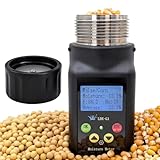
- AGRICULTURAL GRAIN CHECKS: This portable corn moisture tester and grain moisture meter supports on-farm reference checks for farmers, grain handlers, and grain or feed processors
- 25 CROP PROFILES: Select the matching profile for corn, wheat, soybeans, paddy rice, barley, oats, sorghum, and other supported crops before each measurement
- CONSISTENT SAMPLE PREPARATION: Use a representative sample, fill the clean and dry chamber evenly, and tighten the cap securely without overtightening for more consistent readings
- AUTOMATIC TEMPERATURE COMPENSATION: Built-in ATC adjusts the displayed result for sample temperature; for better consistency, let the meter and sample reach similar temperatures before testing
- USER-ADJUSTABLE CORRECTION: When a trusted reference method shows a consistent difference, use the correction setting to adjust the displayed value; the setting remains saved after power-off
Fuel preparation adds cost and failure points. Include conveyors, screens, magnets, shredders, choppers, debalers, dust collectors and spare parts in the availability calculation. A fuel that is cheap at the field or mill can become expensive after preparation, rejected loads, labor and downtime are included.
Ash handling, disposal and possible reuse
Ash management is a design stream, not an afterthought. Determine expected bottom-ash and fly-ash quantities, particle size, temperature, moisture, leachability and contamination. Size conveyors, drag chains, rotary valves, hoppers, silos and truck-loading systems for upset conditions rather than average flow.
Husk ash’s high silica content may create a potential market in selected cement, ceramic or materials applications, but value depends on burn quality, carbon content, fineness, chemical purity, local specifications and a buyer’s logistics. Do not put ash revenue into the financial model until a qualified buyer accepts representative samples.
Straw ash may require different handling because alkali and chlorine concentrations can affect deposit behavior and disposal classification. Obtain local regulatory advice before land application, construction use or off-site disposal. A reuse route is not established merely because the ash contains silica or mineral nutrients.
Emissions and compliance
Particulate emissions are a central issue for both fuels because agricultural ash can be fine, abundant and easily entrained. Select the particulate-control device, fan capacity and stack-monitoring approach from measured ash loading and particle-size data. Do not assume that a boiler’s nameplate efficiency or a supplier’s emissions statement applies to a different fuel, moisture range or local limit.
Evaluate carbon monoxide, nitrogen oxides, acid gases and visible emissions under normal and upset conditions. Chlorine-rich straw may warrant closer review of acid-gas formation and corrosion-resistant downstream materials, subject to the jurisdiction’s rules. The permit basis should state fuel boundaries, blending limits, startup fuel, testing frequency and consequences of out-of-specification deliveries.
How to compare delivered economics
No matched, common-geography comparison of husk and straw delivered cost, heating value or emissions was established for this topic. Build the comparison for the named site and plant configuration instead of importing a price or efficiency from another country or boiler.
| Cost block | Questions to answer |
|---|---|
| Delivered fuel | What is the contracted price per tonne, delivery distance, seasonal surcharge, minimum load and escalation formula? |
| Usable heat | What is the measured moisture and heating value of each delivery, and how much heat remains after preparation and stack losses? |
| Preparation and storage | What capital, electricity, labor, dust control, fire protection and spare parts are required? |
| Ash | How many tonnes of ash are produced, what does collection cost, and is disposal or reuse legally and commercially available? |
| Maintenance | What inspection, tube protection, refractory, grate, fan, conveyor and cleaning costs follow from abrasion or deposits? |
| Availability | How many operating hours are lost when fuel quality, preprocessing equipment or ash systems fail? |
| Compliance | What particulate, acid-gas or monitoring equipment is required, and what are the testing and reporting costs? |
Use a cost per unit of useful steam or useful heat, not only a cost per tonne. Run at least three cases: typical fuel, wet or high-ash fuel, and a worst credible seasonal case. Include the value of backup fuel and the cost of a forced outage.
Also popular on Amazon

- Professional Grain Moisture Meter: Quickly measure moisture (%), weight (g), density (g/L), and temperature (℃) of 20+ grains. Featuring a 3~35% moisture range, ±0.5% accuracy, and ≤0.2% repeatability, results are precise in just 10 seconds;
- Easy Calibration for Accurate Weighing: Use the 200g weight to quickly verify before each weighing. The simple calibration process guarantees precise, dependable results every time;
- Enhanced Temperature Compensation: This grain tester utilizes advanced variable frequency capacitive technology with automatic thermistor compensation for precise measurements during grain procurement and storage;
- Dual Power Options: Our Grain Moisture Meter can be powered by either 4 AA batteries or via USB plug, providing flexibility for short or long-term use whether you are on the go or need extended measurement sessions;
- Package Contents: 1 Grain Moisture Meter, 1 Portable Aluminum Case, 1 x 200g Calibration Weight, 4 AA Batteries, 1 Power Adapter, 1 Small Brush, 1 Chute Bucket, 1 Sampler;
Maintenance planning by fuel
For husk
- Inspect smoke tubes, superheater surfaces, bends and fan impellers for silica erosion.
- Track ash-conveyor wear, valve leakage, screw-flight thickness and silo discharge reliability.
- Trend furnace draft, gas-side pressure drop and heat-transfer performance to detect buildup.
- Check that protective ferrules, shields and refractory remain correctly installed.
For straw
- Inspect superheaters, economizers and high-temperature surfaces for sticky deposits and chlorine-related corrosion.
- Trend deposit growth, cleaning effectiveness and tube-metal temperatures as fuel lots change.
- Verify grate and feeder performance after changes in chop length, moisture or bulk density.
- Keep a contingency plan for blending, derating or switching fuel when ash chemistry exceeds the design envelope.
For either fuel, link maintenance records to laboratory fuel results. Without that connection, operators may treat a chemistry-driven problem as a mechanical fault and repeat the failure after a repair.
Example of a rice-husk boiler specification
Thermax’s current HuskPac Ultra product page lists rice husk as its fuel, bubbling-bed combustion, 2–6 tonnes per hour of steam output and design pressures of 10.54 or 17.5 kg/cm²(g). It lists 74% efficiency and describes tube ferrules and air-distribution features for rice-husk operation. These are manufacturer specifications or claims, not an independent guarantee for a particular site.
Recommended Free Tools
Thermax states: “HuskPac™ Ultra is a rice husk-fired boiler delivering cost-effective steam with stable, efficient combustion.” That is marketing language. During procurement, require guaranteed performance at the contract fuel’s measured moisture and ash range, a defined test code, emissions limits, availability assumptions, refractory and ferrule life expectations, and references from comparable installations.
Procurement checklist for a new boiler or retrofit
- Define the fuel envelope. Specify moisture, ash, chlorine, potassium, calcium, silica, particle form, fines, oversize and foreign material, with sampling and rejection rules.
- Test representative samples. Obtain proximate and ultimate analyses, higher or lower heating value as appropriate, ash elemental analysis, ash-fusion temperatures, bulk density and particle-size data.
- Map the site logistics. Confirm supplier distance, truck access, unloading rate, storage days, fire protection, preprocessing space and backup-fuel arrangements.
- Select combustion technology. Match grate or bed design, air staging, furnace volume, temperature control and ash discharge to the fuel envelope rather than to a generic biomass label.
- Design the ash system. Separate bottom and fly ash where useful, provide dust-tight transfer, allow inspection and state the disposal or reuse route.
- Set emissions guarantees. Put fuel boundaries, load range, startup conditions, particulate controls and test methods in the contract.
- Require maintainability evidence. Ask for erosion allowances, corrosion-resistant materials, cleaning equipment, access doors, spare parts and planned inspection intervals.
- Validate with commissioning tests. Test normal, wet and high-ash fuel conditions; record steam output, efficiency, emissions, draft, deposit formation and ash discharge.
- Plan operator training. Cover fuel sampling, feeder response, bed or grate control, sootblowing, ash safety, alarms and controlled shutdowns.
Choosing between the fuels for common project situations
A rice mill with steady husk production
Husk is usually the first candidate when a mill controls a consistent supply and can provide covered storage. The engineering focus shifts to high ash throughput, silica abrasion, dust control and reliable ash removal. Confirm that the mill’s actual husk, including seasonal moisture and contamination, matches the boiler guarantee.
A plant near extensive straw production
Straw can make sense when collection and preprocessing are organized and year-round supply is contractually credible. Budget for receiving and size-reduction equipment, chemistry-driven deposit control, more intensive inspection and a robust plan for out-of-specification loads.
A site considering co-firing
Blending can moderate fuel variability, but it does not automatically average every risk. Test blend ratios in the intended boiler, monitor deposits and emissions, and set operating limits for chlorine, alkali, moisture and particle form. The 157 MWth bubbling-bed study involving husk and eucalyptus bark illustrates why blend and configuration must be evaluated together.
Decision rule
Select rice husk when its local supply is consistent, its high ash and silica burden can be handled economically, and the plant can protect equipment from erosion. Select rice straw when its delivered advantage remains after collection, preprocessing, ash management, corrosion controls and downtime are costed, and when the boiler is designed for its physical form and chemistry. If neither fuel has a tested, contractible supply envelope, postpone the final boiler choice until those data exist.
The practical winner is the fuel that delivers the lowest cost per unit of dependable steam while staying inside the boiler’s feed, ash, emissions and maintenance limits. A local test program and site-specific guarantee are more reliable than a universal husk-versus-straw ranking.
Quick Recap
Product prices and availability are accurate as of the date/time indicated and are subject to change. Any price and availability information displayed on Amazon at the time of purchase will apply.

