The Tool Desk
Outbyte Driver Updater FREEFix the driver behind crashes, sound loss and screen glitchesFind Drivers →Outbyte PC Repair FREERepair Windows errors before they cause bigger problemsFix Now →Some links on this page are affiliate links: if you buy through them we may earn a commission, at no extra cost to you.
Infrared thermography can screen an accessible retaining-wall surface for temperature patterns associated with moisture movement or leakage. It cannot, by itself, prove that a waterproofing membrane was installed incorrectly, identify which waterproofing layer failed, or establish a universal temperature threshold. Treat a thermogram as a map of apparent surface-temperature differences, then verify any repeatable anomaly with direct moisture measurements, visual inspection and, where consequences are serious, a qualified retaining-wall or geotechnical engineer.
What a heat signature can—and cannot—tell you
A thermal camera records infrared radiation and converts it into an apparent temperature image. The image shows relative differences across the wall surface, not a direct view of a membrane, drainage board or buried leak. Surface temperature is influenced by the wall and water temperatures, heat transfer through the assembly, surface emissivity and other characteristics, ambient weather, solar exposure, wind, camera angle and the sensor itself. ISO 6781-1:2023 describes thermograms as representations affected by surface-temperature distribution, surface characteristics, ambient conditions and the measuring instrument; its general procedures are available from the International Organization for Standardization.
As an Amazon Associate I earn from qualifying purchases.
Recommended Free Tools
That means neither “hot spot” nor “cold spot” is a universal synonym for wet concrete. A localized contrast that repeats when viewed from a consistent position and corresponds with staining, seepage, a joint, crack, penetration or drainage feature is a reason to investigate—not a diagnosis.
What the strongest retaining-wall evidence shows
Hu and colleagues studied a diaphragm wall serving as both a retaining structure and a waterproof curtain. In laboratory simulations and a field application, leakage areas produced a different thermal field from surrounding wall areas. Their field test reported a maximum difference of 4.5 °C between the leakage area and adjacent wall. That value belongs to the study’s site, construction, weather and measurement conditions; it is not an alarm limit for other retaining walls.
Popular on Amazon

- 【Enhanced Thermal Clarity】Start with 128x128 thermal imaging and enhance to 240x240 resolution with TISR technology for greater details. The wide 40°x 30° field of view and a 25Hz refresh rate deliver accurate, smooth thermal images—ideal for detailed inspections in homes and on electrical systems and machinery
- 【Wide Application with Smart Alerts and Photograph】From underfloor heating to leak detection and electrical inspections, the TC004 Mini adapts to every challenge. When temperatures exceed preset levels, an on screen warning alerts you instantly while automatically capturing a photo to streamline your diagnostics. In addition, TC004 Mini also supports manual photo taking to help you record and solve problems, and the built-in 512MB eMMC storage can store up to 8,000 photos
- 【Effortless Temp Measurement with Alerts】Easily measure temperatures between -4°F to 842°F (-20°C to 450°C), with an accuracy error within ±3.6°F/2%, the thermal camera automatically pinpointing the highest, lowest, and central spots. Plus, you can choose from 5 different color palettes - White Hot, Black Hot, Iron, Rainbow, and Red Hot - to meet your specific work needs. Instant warnings will alert you when the temperature exceeds your preset level, making your job more efficient
- 【Longer Runtime, Fewer Charges】Designed for efficiency, this thermal imaging camera gives you 15 hours of power and automatic shut-off options at 5, 10, and 20-minute intervals to extend battery life. Keep going without the hassle of frequent charging, no matter how long your inspections last. A charging cable is given with the machine, but no charging head.
- 【Portable, Durable & Hassle-Free】Take this thermal imaging camera anywhere with its mini, pocket-friendly design. The ergonomic design makes it easier for you to hold during use, and the lightweight design is more suitable for long-term use. Engineered for durability, it can survive drops up to 2 meters without skipping a beat. Supports IP54 waterproof rating to ensure worry-free daily use. Get peace of mind with TOPDON's lifetime technical support to keep it running smoothly
The same study reported potential-leakage laboratory readings of 23.4 °C at a penetration point with an initial water pressure of 10 kPa and 21.8 °C at 30 kPa. Those are experimental observations, not field criteria. The full article, Mechanism of Detecting the Construction Quality of a Diaphragm Wall by an Infrared Thermal Field and Engineering Application, is available in Materials.
ASTM E3216-26 describes infrared thermography as a diagnostic aid for water intrusion and accumulation, while requiring direct measurements at representative locations to confirm indicated conditions. Its scope and current listing (updated February 9, 2026) are on the ASTM International site. The practical conclusion is simple: thermography is a screening and localization method, not stand-alone proof of improper waterproofing.
Why moisture can create a visible thermal pattern
Water changes how heat is stored, conducted and released at the surface. A damp zone may warm or cool at a different rate from drier concrete, and evaporation can alter apparent temperature. The direction and size of the contrast depend on whether water is warmer or cooler than the wall, how deep it is, the wall’s thickness and finish, and how the surface has been heated or cooled.
Other features can create the same visual effect. Reinforcing steel, formwork changes, repairs, voids, insulation differences, fasteners, shadows, wet soil, pipework and reflected radiation may all appear as thermal anomalies. A wall joint or crack can also change heat flow without an active leak. For this reason, interpretation must combine the infrared image with construction details and visible evidence.
What counts as a useful anomaly
- Localized: It is materially different from nearby, comparable wall areas rather than simply following a broad sunlit or shaded zone.
- Repeatable: It remains apparent in repeat images or from a slightly different viewing position after camera settings and distance are controlled.
- Coherent: Its shape follows a plausible path such as a crack, construction joint, penetration, outlet or damp patch.
- Correlated: It coincides with staining, efflorescence, seepage, musty conditions, dampness or a drainage symptom.
- Actionable: It is large or persistent enough to justify a direct moisture check at that location.
A single isolated pixel, a sharp edge caused by a change in finish or a broad temperature gradient across the entire wall is weak evidence by itself.
Before scanning: define the wall and the question
Write down what you are trying to establish. “Is there evidence of moisture movement on this accessible face?” is answerable by a screening survey. “Which waterproofing layer failed?” generally is not, because a surface thermogram cannot identify a concealed membrane or installation detail.
Free tools Windows power users keep installed
One-click scans. No signup required.
Record the context before taking images:
- Whether the structure is an exposed above-ground retaining wall, basement wall or underground diaphragm wall.
- Which face is accessible and whether the soil-side face can be inspected.
- Wall finish, paint, render, cladding, insulation and any recent repairs.
- Recent rainfall, irrigation, snowmelt, washing, pumping or changes in groundwater.
- Drainage outlets, weep holes, collector drains, joints, cracks, penetrations and service entries.
- Visible staining, efflorescence, dampness, seepage, mold, erosion, movement or bulging.
- Date, time, weather, wind, cloud cover, surface condition and camera settings.
These notes let you distinguish a moisture-related pattern from normal environmental variation and provide the context a professional will need later.
Step-by-step infrared screening procedure
1. Check safety and access
Do not enter an excavation, stand beneath an unstable wall or approach energized equipment simply to obtain a better image. If there is bulging, a new crack, rapidly increasing seepage, soil loss, undermining or movement near a building, road or utility, keep people clear and arrange an engineering assessment. A thermal survey does not replace a stability inspection.
Also popular on Amazon

- 【Dual Mode Inspection】Combines conventional thermal imaging (Center/Hot/Cold spot modes) with thermometer mode for flexible temperature analysis. Use full-screen thermal imaging to monitor moving animals, machinery, automotive, or HVAC systems in real time, ensuring continuous observation with no detail loss. When you need exact numbers such as kitchen use, thermometer mode provides quick, point-and-shoot readings with a clear digital display.
- 【User-Friendly Operation】Weighing just 240g, this compact thermal imager offers a balanced feel with a non-slip grip even during extended use. Intuitive button controls let you power on, navigate menus, capture images, and switch between seven color palettes effortlessly—so you can start inspecting right away.
- 【Multi-Scenario Application】Built with high-precision sensors (NETD < 50mK), it detects subtle temperature differences down to 0.05°C. The -4°F to 1022°F temperature range handles everything from household inspections to high-heat diagnostics, including home kitchens, insulation checks, and automotive maintenance.Adjustable emissivity and distance settings help improve accuracy across materials like cement, ceramic,etc.
- 【Fast Anomaly Detection with Instant Alerts】A 50° wide field of view lets you scan larger areas in less time. Set custom high and low temperature alarms for instant alerts when temperatures exceed your limits. Adjustable level and span settings enhance thermal contrast, making it easier to identify issues such as insulation gaps and floor heat loss.
- 【All-Day Battery Life 】The built-in 2500mAh rechargeable battery provides up to 14 hours of continuous use for uninterrupted inspections. Backed by a 1-year warranty for added peace of mind.
2. Establish comparable reference areas
Choose apparently dry sections with similar orientation, finish, shading and construction. A suspicious area should be compared with nearby controls, not with a sunlit section on the opposite side of the site. Mark the image location using a plan, grid, tape measure or fixed landmarks.
3. Capture a consistent whole-wall survey
Take visible-light and infrared images covering the entire accessible wall. Keep distance, angle, focus, emissivity assumptions and scale as consistent as practical. Avoid standing where your body, the sky or a hot vehicle is reflected in a glossy finish. Photograph the same area from a second position when safe, and save the original radiometric files if the camera provides them.
What’s actually slowing this PC down?
Pick the symptom - the matching free tool is one click away.
4. Record environmental and instrument information
For each sequence, record the date and time, air and surface conditions if measured, recent weather, shading, camera model, lens, distance, angle, focus, palette and temperature range. A report that omits these details makes later comparison difficult. ISO 6781-1:2023 emphasizes equipment, operator competence, interpretation and reporting as parts of a thermographic service.
5. Examine patterns, not isolated colors
Review the infrared image alongside the visible photograph. Look for a localized, repeatable contrast that follows a crack, joint, penetration, outlet or other plausible water path. Compare the same feature with adjacent dry controls and with images taken from another angle. Do not infer “wet” solely from the color selected by the display palette; the palette is a visualization choice.
6. Map and rank anomalies
Give each candidate area an identifier and record its dimensions, apparent temperature range, neighboring reference temperature, visible symptoms and likely confounders. Rank areas for confirmation according to persistence, correlation with moisture symptoms and potential consequence—not simply by the largest displayed temperature difference.
7. Confirm at representative points
Use a direct moisture method appropriate to the wall assembly at both anomalous and control locations. ASTM E3216-26 specifically calls for direct measurements at representative points to confirm indicated conditions. Follow the instrument manufacturer’s limits and understand that many handheld meters are affected by salts, reinforcement, wall thickness and material type. If the wall is coated or insulated, a reading may represent the surface layer rather than the concrete behind it.
8. Inspect the water-management system
Check outlets, collector drains, discharge points, filters, joints, penetrations, coping, backfill interfaces and accessible membrane terminations. Clear evidence of blocked drainage or an open crack may explain the thermal pattern without proving a membrane installation defect. Conversely, a dry surface does not rule out water trapped behind a finish or a leak that is intermittent.
9. Decide whether specialist investigation is needed
Persistent ingress, repeated moisture readings, efflorescence, erosion, movement, cracking, bulging or changes around foundations justify a qualified waterproofing and retaining-wall assessment. Ask the investigator to relate findings to the wall’s design, drainage and structural loads rather than issuing a thermal-only conclusion.
Also popular on Amazon

- 【Enhanced Thermal Clarity for Precise Inspections】The RT280 handheld thermal imaging camera features a 2.8-inch 320×240 LCD screen for smooth, detailed thermal visuals. Equipped with TISR technology, it enhances thermal image effective resolution from 120×90 to 240×180, enabling the capture of tiny temperature differences. Its 50°x 38° FOV and 25Hz frame rate deliver clear, smooth images, making it ideal for home inspections, electrical checks, mechanical fault diagnosis, and automotive engine inspections.
- 【Smart PC Analysis with 2D/3D & Temperature Insights】Easily transfer images from this thermal imager to Windows PC(Not compatible with Mac) for advanced analysis. The included software supports point, line, and area temperature analysis, 2D/3D thermal imaging, and automatic report generation. Complex thermal data from this infrared cameras thermal imaging device is instantly transformed into actionable, shareable insights, helping you solve problems efficiently and professionally.
- 【Built-in 8GB eMMC Storage for Over 20,000 Images】Capture and store more than 20,000 images and videos with this thermal camera, preserving every detail of your inspections. The 8GB eMMC storage ensures all critical thermal imaging data is saved securely and easily accessible. Whether documenting electrical panels, HVAC systems, or machinery, your ir camera keeps all inspection records organized and ready for analysis.
- 【Accurate Temperature Measurement with Smart Alerts】Measure temperatures from –4°F to 1022°F with ±3.6°F / ±2% accuracy. The RT280 thermal imaging camera automatically detects the highest, lowest, and central temperature points. High/low alarms instantly alert you to anomalies, making it easy to prevent overheating, insulation gaps, or mechanical faults. Clear visual and auditory warnings improve efficiency and safety in every inspection.
- 【9 Color Palettes, Laser Targeting & LED Light】Switch between 9 color palettes to visualize subtle temperature differences with clarity. The built-in laser pointer and LED light allow precise targeting in dark or confined spaces. This infrared camera makes it easy to locate hotspots, leaks, or irregular temperature patterns, delivering professional-grade thermal imaging for electrical, HVAC, plumbing, or mechanical diagnostics.
How to interpret hot and cold areas without overclaiming
| Observed pattern | Possible explanations | What it supports | What it does not prove |
|---|---|---|---|
| Localized cooler or warmer patch that repeats and aligns with seepage | Moisture movement, evaporation or a water-filled defect; also possible surface or construction variation | Priority for direct moisture confirmation | A failed membrane, exact leak path or installation error |
| Linear anomaly at a joint, crack or penetration | Water path, changed material, reinforcement or geometric heat-flow effect | Targeted visual and moisture inspection | That the joint detail was improperly waterproofed |
| Broad gradient across the wall | Sun, shade, wind, wall orientation, soil temperature or changing ambient conditions | Need for better-controlled repeat imaging | Localized leakage |
| Small isolated spot with no visible symptom | Reflection, sensor noise, fastener, patch repair or moisture | Recheck from another angle and compare with controls | Any diagnosis without confirmation |
| No visible anomaly | Dry surface, insufficient thermal contrast, unfavorable timing, concealed moisture or camera limitations | Only that the screen was non-indicative under those conditions | That waterproofing is sound |
The 4.5 °C difference reported in the diaphragm-wall field study should be read in this context. It demonstrates that a leakage-related contrast was measurable in that setting; it does not establish that a 4.5 °C difference—or any other number—diagnoses a different wall.
Conditions that can make a survey misleading
Daylight, shading and timing
Solar heating can dominate the signal on an exposed face. A 2024 field study of levee leakage detection found infrared detection less effective during daytime than visible-light recognition in its investigated case and reported that measurement altitude affected accuracy. The result is a planning caution, not a universal retaining-wall timetable. Read the study in Scientific Reports, and choose timing based on the wall’s orientation, weather, access and the thermal contrast you need.
PC Slower Than It Used to Be?
A free scan shows the junk files, broken settings and background clutter dragging Windows down - then fixes them in one click.Free scan · Windows 10 & 11Crashes, No Sound, or Screen Glitches?
Random freezes, missing sound and display glitches usually trace back to one bad driver. Find and replace yours safely.Free scan · under a minuteDistance, angle and altitude
Increasing distance reduces the number of pixels covering a small defect; oblique viewing changes the apparent area and can introduce reflections. Keep the camera as close as safety permits, maintain a consistent angle for comparisons and document the geometry. Do not treat a measurement made from a different altitude or distance as directly comparable without accounting for those changes.
Surface properties and reflections
Glossy paint, wet coatings, metal trim and standing water can reflect surrounding radiation. Dirt, biological growth and patch repairs can have different emissivity from the original wall. A thermal camera may display a reflected hot sky or nearby object as if it were a surface-temperature change. Visible photographs and repeat views help identify these artifacts.
Intermittent or concealed water
A leak that occurs only during rainfall, irrigation or a high groundwater level may not be active during the survey. Water behind insulation, cladding or a thick finish may produce a weak or delayed surface response. A negative screen therefore means “no actionable anomaly under the recorded conditions,” not “waterproofing verified.”
Thermography compared with confirmation options
No source establishes a universal ranking of moisture meters or other confirmation tools for every retaining-wall assembly. Select the follow-up method according to access, material, safety and the question being asked.
Do these 3 things before closing this tab:
1Repair Windows errors before they cause bigger problems2Fix the driver behind crashes, sound loss and screen glitches3Clear out junk files and repair common Windows errors| Method | Primarily observes | Best use | Key limitations | Engineer involvement |
|---|---|---|---|---|
| Infrared thermography | Surface-temperature contrasts over a broad area | Rapid screening, mapping and prioritizing locations | Sensitive to weather, timing, surface properties, distance and interpretation; does not identify a concealed layer | Needed when structural or excavation consequences are possible |
| Direct moisture measurement | Moisture-related response at a test point or within the instrument’s sensing zone | Confirming representative thermal anomalies and comparing controls | Results depend on material, salts, reinforcement, thickness and instrument method | Needed to select locations or interpret consequences in complex walls |
| Visual inspection | Seepage, staining, efflorescence, dampness, cracks, erosion and drainage symptoms | Correlating thermal patterns with physical evidence | Cannot see concealed or intermittent moisture; access may be limited | Needed for movement, bulging, erosion or safety concerns |
| Water-management and construction-detail review | Drains, joints, penetrations, outlets, membrane terminations and site history | Finding plausible causes and maintenance defects | Records may be incomplete and concealed work may remain inaccessible | Often required to assess design and repair implications |
Common mistakes and how to correct them
- Using a universal color rule: Replace “red equals wet” or “blue equals wet” with comparisons to adjacent controls and recorded conditions.
- Calling a temperature difference a failure threshold: Report the measured contrast and its context; do not convert the 4.5 °C study result into a pass/fail rule.
- Scanning only the suspected spot: Image the whole accessible wall first so broad gradients and normal construction features are visible.
- Ignoring the visible image: Pair every candidate thermogram with a visible photograph and location reference.
- Changing camera settings between areas: Keep settings consistent where possible and document every change.
- Testing only after a dry spell: Note recent weather and recognize that an intermittent leak may require a survey during or after representative wetting.
- Assuming a negative scan clears the wall: State the environmental limits and arrange direct checks when the consequence of missing water is high.
- Drilling or excavating based on a color patch: Confirm first and obtain appropriate engineering, utility and excavation controls.
When to call a retaining-wall engineer
Thermal screening is not a substitute for structural or geotechnical assessment. Escalate promptly when you observe:
- New or widening cracks, bulging, rotation, settlement or displacement.
- Persistent or rapidly increasing seepage, soil loss, piping or erosion.
- Water near foundations, occupied spaces, roads, utilities or excavation faces.
- Blocked drains, failed outlets or pressure conditions that could load the wall.
- Changes after heavy rainfall, flooding, construction, excavation or surcharge loading.
The UK government’s guidance on Construction and maintenance of boundary and retaining walls discusses safe design, construction and maintenance, but its scope is England; it is available at GOV.UK. Elsewhere, use the applicable local building, geotechnical and excavation requirements. A suitably qualified engineer can determine whether the observed water condition affects stability, nearby facilities or the safe sequence of investigation and repair.
Also popular on Amazon
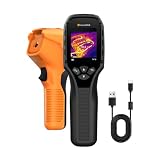
- 【Dual Mode Inspection】Combines thermal imaging with Center/Hot/Cold spot modes for real-time visual temperature display, and integrates thermometer mode for fast point-and-shoot readings with precise digital output. Full-screen thermal imaging enables continuous monitoring of moving targets,ensuring stable observation without loss of detail during dynamic inspections.
- 【User-Friendly Operation】 At just 240g, this compact thermal imager features a non-slip grip and balanced handheld design for comfortable long-duration inspections or mobile use. It offers intuitive button controls for power on/off, menu navigation, and image capture, and supports 7 selectable color palettes, enabling fast switching.
- 【Multi-Scenario Application】It supports a broad measurement range from -4°F to 1022°F with enhanced with adjustable emissivity and distance settings,making it suitable for applications.Equipped with a high-sensitivity sensor (NETD < 50mK), the thermal camera can detect extremely subtle temperature differences as small as 0.05°C.
- 【Quick Anomaly Detection with Alerts 】Featuring a 50° wide field of view, the device enables faster scanning of large surfaces and broader inspection coverage. It supports custom high/low temperature alarms for instant notification when abnormal thermal conditions are detected. Level and span adjustment functions make it easier to clearly identify localized issues.
- 【All-Day Battery Life】Built-in 2500mAh rechargeable battery provides up to 14 hours of continuous operation, supporting full-day inspection without frequent recharging. The device also includes a 1-year warranty, ensuring long-term reliability and peace of mind for using.
What equipment is appropriate for preliminary screening?
A generic infrared thermal imaging camera is suitable as an equipment category for preliminary screening. Thermal imaging cameras were used in the diaphragm-wall laboratory and field work, but the evidence does not select a brand, model or minimum specification. Choose equipment and an operator capable of producing documented, repeatable images and, where possible, retaining the underlying temperature data. The camera remains a screening aid; buying a higher-specification instrument does not turn a thermogram into proof of waterproofing failure.
For a professional report, request the camera and lens information, image files, environmental notes, reference areas, anomaly map, direct confirmation results and a clear statement of uncertainty. A credible report should distinguish observed thermal contrast from inferred moisture and from any conclusion about structural performance.
How to write a defensible finding
Use language that matches the evidence. A defensible statement might read: “A repeatable localized surface-temperature anomaly was recorded at the construction joint on the north face under the stated conditions. Visible staining and elevated direct moisture readings were also found at representative points. The findings are consistent with moisture movement; they do not, without opening-up or further investigation, identify the failed waterproofing layer.”
Avoid statements such as “the membrane has failed because the area is cold” or “the wall passed because no hot spots were found.” The first overstates a correlation; the second treats a limited screen as a guarantee.
Answers to practical reader questions
Can a thermal camera detect water behind a retaining wall?
It can sometimes reveal a surface-temperature pattern associated with moisture movement behind or through a wall, especially when the contrast is repeatable and the wall conditions are favorable. It cannot directly see the water or establish its depth, volume or route. Direct moisture checks and inspection are required.
Does a hot or cold spot mean the waterproofing failed?
No. Either direction can result from water, weather, surface properties, construction details or reflections. A spot is evidence to investigate, not proof of an installation defect.
Quick wins for a faster PC:
Scan for outdated or missing drivers - takes under a minuteDriver Scan →Repair Windows errors before they cause bigger problemsFix Now →Fix the driver behind crashes, sound loss and screen glitchesFind Drivers →How do I confirm a suspected leak shown on a thermal image?
Record the location and conditions, compare it with similar dry areas, inspect for seepage and staining, and take direct moisture measurements at representative anomalous and control points. Use additional diagnostics or opening-up only when justified by the assembly and risk.
When should I call a retaining-wall engineer?
Call one when water ingress is persistent or consequential, or when it occurs with movement, cracking, bulging, erosion, soil loss or risk to nearby structures, roads, utilities or excavation safety.
Quick Recap
Product prices and availability are accurate as of the date/time indicated and are subject to change. Any price and availability information displayed on Amazon at the time of purchase will apply.

