Free tools Windows power users keep installed
One-click scans. No signup required.
Some links on this page are affiliate links: if you buy through them we may earn a commission, at no extra cost to you.
Reclaimed timber is not automatically cheaper, stronger or greener than new timber. It can avoid much of the manufacturing energy associated with virgin material, but its real value depends on usable yield, preparation, transport, condition, documentation and the job’s approval requirements. New graded timber usually offers more predictable dimensions, supply and structural paperwork. Choose between them by comparing like-for-like delivered cost and verified performance for the intended application.
What the two materials mean
Reclaimed timber
Reclaimed timber is wood recovered from an earlier building, structure, product or use and prepared for a second application. Typical sources include dismantled barns, warehouses, bridges, industrial buildings, old floors and roof structures. The material may retain saw marks, nail holes, oxidation, stains, weathering, paint or an irregular patina. Those features can be desirable in visible work, but they also record the timber’s previous exposure and loading.

As an Amazon Associate I earn from qualifying purchases.
Terminology varies by country and procurement system. The UK Government’s Timber Procurement Advice Note (TPAN), 7th edition, places reclaimed timber within recycled-timber categories: recovered wood that had a prior end use and would otherwise have been discarded. Its evidence requirements focus on proving previous use and independent verification, rather than proving the forest source used for virgin timber. That is a UK procurement definition, not a universal legal definition.
New or virgin timber
New timber is sawn and manufactured for the current market, generally from a known species, grade, moisture class and dimension. Depending on the product, it may be kiln-dried, strength-graded, treated, planed or engineered. Its regularity makes estimating quantities, machining, connections and installation simpler. “New” does not by itself mean sustainably sourced or suitable for every structural purpose; the relevant grade, treatment and certification still have to be checked.
Popular on Amazon
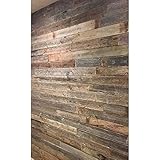
- RECLAIMED WOOD ACCENT: Real reclaimed and recycled wood, naturally-weathered wood paneling adds a beautiful, rustic accent to your walls
- Each plank is approximately 1/4-inch thick and 3.50 inches wide, lengths may vary by box, sample pack - 12" long
- NATURALLY WEATHERED COLOR: Each piece of wood has aged individually, providing varied, weathered colors that look great on any wall
- EASY INSTALLATION: Easily installs utilizing construction adhesive or trim nails; Calculate square footage by multiplying height x width, example 10'x10' = 100 square feet, 2'x4' = 8 square feet
- Each box has a different coverage amount based on square footage, order accordingly, let us know if you need help to calculate how much you need
Cost: compare the installed material, not the advertised price
There is no universal price winner. A Government of Canada workshop report records examples in which reclaimed construction, renovation and demolition wood was cost-competitive with new material, while noting that supply is generally not yet competitive with virgin materials. It identifies type and quality as major value drivers: barn boards, heavy timber and old-growth lumber can command higher prices than ordinary recovered boards. Local availability, species, dimensions and the amount of preparation often matter more than the label “reclaimed.”
| Cost item | Reclaimed timber | New timber | Question to put in the quote |
|---|---|---|---|
| Material price | Varies with history, species, appearance, section size and scarcity; no general discount or premium is established. | Usually priced from a published grade, species, section and treatment, but market and regional fluctuations still apply. | What is the price for the exact species, dimensions, grade and quantity? |
| Usable yield | Can fall after removing rot, splits, excessive holes, metal, paint or warped sections. | More predictable when the specified grade and tolerances are supplied. | How many linear metres or pieces are usable after inspection and cutting? |
| Preparation | May require de-nailing, metal detection, brushing, sawing, planing, kiln treatment or sorting. | Usually limited to normal cutting, drilling and finishing. | Which preparation operations are included, and who pays for rejected pieces? |
| Transport and handling | Irregular loads, mixed lengths or remote salvage sites can increase haulage and unloading time. | Standard packs are easier to schedule and handle. | What is the delivered-to-site cost and lead time? |
| Installation | Irregularity may increase setting-out, shimming, trimming and fixing time. | Consistent dimensions generally reduce fitting time. | Has the labour allowance been based on actual tolerances? |
| Documentation and testing | Structural use may require additional inspection, grading or engineering assessment. | Recognised grade stamps and supplier documentation may already be available. | What evidence is supplied for the proposed use and jurisdiction? |
Request a written quote that states quantity, dimensions, species if known, condition, preparation, delivery, taxes, expected wastage and replacement policy. Compare it with new timber of the same required section, grade, treatment and delivery terms. A reclaimed board that costs less per piece can be more expensive per usable metre after defects and machining are removed; the reverse can also occur when a salvage lot is local and requires little preparation.
PC Slower Than It Used to Be?
A free scan shows the junk files, broken settings and background clutter dragging Windows down - then fixes them in one click.Free scan · Windows 10 & 11Outdated Drivers Are Slowing You Down
One free scan finds every outdated or missing driver and matches the right update for your exact hardware.Free scan · exact hardware matchEnvironmental trade-offs and what the numbers actually show
Reusing an existing piece of wood can avoid part of the energy and emissions associated with producing a replacement. The scale of the benefit depends on what is included: dismantling, transport, sorting, de-nailing, machining, drying, treatment, installation, maintenance, service life and end-of-life disposal. A short local haul and light preparation produce a different result from shipping heavy beams long distances for extensive remanufacture.
A life-cycle inventory by Richard Bergman, Hongmei Gu, Robert H. Falk and Thomas R. Napier, indexed by the USDA Forest Products Laboratory, modelled reclaimed framing lumber and wood flooring against virgin equivalents. It reported that cumulative energy for virgin production was about 11 times that of reclaimed framing lumber and about 13 times that of reclaimed wood flooring; modelled global-warming potential was about three times and five times greater, respectively. These are results from that 2010 study’s system boundaries and assumptions, not universal conversion factors for every species, route or building.
| Modelled comparison in the 2010 inventory | Reported result for virgin versus reclaimed | How to use it |
|---|---|---|
| Framing lumber, cumulative energy | About 11 times greater for virgin production | Illustrates potential manufacturing-energy avoidance; it is not a project-specific guarantee. |
| Wood flooring, cumulative energy | About 13 times greater for virgin production | Applies to the study’s flooring scenario and assumptions. |
| Framing lumber, global-warming potential | About 3 times greater for virgin production | Use only with the study’s defined inventory boundary. |
| Wood flooring, global-warming potential | About 5 times greater for virgin production | Do not generalise to another species, transport distance or processing route. |
The UK Department for Environment, Food & Rural Affairs explains in its Timber in Construction Roadmap 2025 that embodied carbon includes manufacture, maintenance and disposal. It calls for more consistent assessment and better environmental-product-declaration data. For a current project, define the life-cycle boundary before comparing options and account for avoided manufacture alongside salvage, transport, processing, maintenance and the end-of-life scenario. A claim that reclaimed timber is “carbon neutral” or always has lower embodied carbon is not supported without that project-level accounting.
Reclaimed material can also preserve existing carbon in a long-lived product and reduce demand for newly processed stock. Those benefits may be reduced if usable yield is low, if material is kiln-dried or heavily machined again, or if a long-distance supply chain is required. New timber may have documented forest-origin certification, efficient modern processing and reliable service-life data; those attributes belong in the same whole-life comparison rather than being assumed from the word “new.”
Recommended Free Tools
Performance: age is not a strength rating
There is no universal reclaimed-to-new strength ratio or service-life ranking. A sound-looking beam may have experienced decades of loading, vibration, moisture cycling or concealed biological attack, while a newer piece may have defects or an unsuitable grade. Performance must be established from the individual material and the proposed use.
Also popular on Amazon

- RECLAIMED WOOD ACCENT: Real reclaimed and recycled wood, naturally-weathered wood paneling adds a beautiful, rustic accent to your walls
- Each plank is approximately 1/4-inch thick and 3.50 inches wide, lengths may vary by box, sample pack - 12" long
- NATURALLY WEATHERED COLOR: Each piece of wood has aged individually, providing varied, weathered colors that look great on any wall
- EASY INSTALLATION: Easily installs utilizing construction adhesive or trim nails; Calculate square footage by multiplying height x width, example 10'x10' = 100 square feet, 2'x4' = 8 square feet
- Each box has a different coverage amount based on square footage, order accordingly, let us know if you need help to calculate how much you need
Condition factors to investigate
- Previous mechanical loading: long-term stress can produce deformation, crushing at bearings, fatigue damage or creep that is not obvious from a quick visual inspection.
- Moisture history: repeated humidity changes create internal stresses and can open checks, splits or warping.
- Insects and fungi: old members may contain active or historic insect galleries, decay pockets or fungal damage. Identify whether deterioration is superficial, inactive or structurally significant.
- Connections and alterations: nail holes, bolt holes, notches, saw cuts and removed joints reduce the effective section or create stress concentrations.
- Dimensional stability: twisted, bowed or tapered stock may not fit standard connectors or maintain the tolerances required by doors, floors and stairs.
- Contamination: unknown coatings, preservatives, oils, smoke residues or embedded metal can affect machining, indoor air quality and disposal.
The 2025 ECOS report, Laying the foundations to safely reuse timber in Europe, identifies long-term mechanical stress and creep, humidity-related internal stresses, cracking or warping, and insect or fungal degradation as assessment concerns. Its guidance supports evaluating condition and history rather than treating age as a proxy for quality.
Structural acceptance
For load-bearing work, obtain a documented grading or engineering route that is recognised where the project is located. The USDA Forest Products Laboratory record for Robert H. Falk, Steven Cramer and James W. Evans’ 2013 paper notes that reclaimed lumber’s acceptance was hampered by a lack of formal recognition in grading and engineering design standards at that time. Standards and regulations have changed and differ by jurisdiction, so the statement should not be read as a universal description of current law. It does mean that a reclaimed beam should not be assumed interchangeable with a new, graded beam simply because its dimensions match.
Ask the project engineer, building-control authority or equivalent approving body what evidence is required. Possible routes include visual or machine grading by an authorised party, species and section identification, moisture measurement, defect mapping, non-destructive testing, laboratory testing, calculation using an accepted design value, and a site-specific engineering assessment. Keep the assessment linked to the actual member and its planned loads, spans, connections, fire exposure and environment.
Match the material to the application
Decorative and lightly loaded uses
Reclaimed boards are often easiest to justify for wall cladding, ceilings, feature panels, furniture, doors, shelving and other applications where appearance is central and failure would not threaten occupants. Confirm that the finish, contamination history, splinters, fasteners and fire requirements are acceptable. A nonstructural label does not remove every obligation: stairs, guards, suspended ceilings and some wall systems can still have safety or fire performance requirements.
Floors and stairs
Flooring must meet the project’s wear, flatness, moisture and slip expectations. Sort boards by thickness and stiffness, check the substrate and allow for movement. Stair treads and landings receive concentrated loads and require consistent geometry, secure fixing and adequate strength; do not select them solely for patina.
Framing, beams and other load-bearing work
Use reclaimed structural members only when their condition, grade and design capacity can be documented through the applicable local process. The engineer may reject a member with excessive holes, checks, decay, unknown treatment or inadequate section. New graded timber can be the lower-risk choice where the programme requires repeatable sizes, a high quantity or rapid inspection.
Exterior work
Weather exposure accelerates moisture movement, checking and biological decay. Establish the timber’s durability class or treatment suitability, detail drainage and ventilation, and specify a maintenance plan. Reclaimed appearance does not prove exterior durability; conversely, a weathered surface may conceal a sound interior or active decay.
Do these 3 things before closing this tab:
1Fix the driver behind crashes, sound loss and screen glitches2Clear out junk files and repair common Windows errors3Scan for outdated or missing drivers - takes under a minuteAlso popular on Amazon
A project-by-project comparison method
Use the following sequence before accepting either option. It prevents an attractive unit price or sustainability claim from hiding an unusable supply.
- Define the performance brief. Record the application, spans, loads, exposure, fire requirements, appearance, dimensions, quantity, tolerances and completion date. Separate decorative, nonstructural and load-bearing elements.
- Specify the new-timber baseline. State species, section, strength grade, moisture condition, treatment, certification requirements, delivery location and installation assumptions. Without this baseline, “cheaper than new” has no consistent meaning.
- Obtain a reclaimed inventory. Ask for source and previous use where known, species identification, dimensions, available quantity, photographs, defect records, moisture information, contamination history and preparation method.
- Inspect representative pieces. Check ends, bearing zones, fastener holes, splits, rot, insect galleries, twist, bow, stains and embedded metal. Sample enough stock to understand the whole lot, not just the best-looking board.
- Calculate usable yield. Deduct pieces and lengths that will be rejected, trimmed or downgraded. Include de-nailing, metal detection, machining, treatment, sorting and disposal in the estimate.
- Confirm the approval pathway. Before purchase, ask the engineer or local authority whether reclaimed material is acceptable and what grading, testing, fire, moisture or chain-of-custody evidence is required.
- Price delivery and labour together. Compare delivered cost, unloading, storage, handling, installation time, replacement allowance and schedule risk with the equivalent new-timber package.
- Document the decision. Keep supplier declarations, inspection photographs, test or grading reports, batch identification, invoices and installation records with the project file.
Questions to ask a supplier
- Where was the timber recovered, and what was its previous use?
- Is the species confirmed, probable or unknown?
- What nominal and actual dimensions, lengths and quantities are available?
- How much stock is expected to be rejected after de-nailing and defect removal?
- Has the timber been inspected for decay, insects, moisture and embedded metal?
- What coatings, preservatives, oils or other contaminants are known?
- Has it been kiln-dried, heat-treated, fumigated, planed or otherwise processed?
- Is there a recognised grade, test report or engineer’s assessment for the intended application?
- What tolerances and colour variation should the installer expect?
- What quantity is available now, and can matching material be supplied later?
- What are the delivered cost, lead time, packaging, storage requirements and return terms?
Documentation, procurement and chain of custody
For reclaimed timber, evidence normally follows the material’s previous use and recovery route: demolition records, invoices, batch identifiers, photographs, inspection reports and independent verification can establish what the product is and where it came from. For new timber, documentation commonly centres on species, grade, treatment and forest-origin or product certification. These are different evidence chains, so one cannot substitute automatically for the other.
If a public contract or planning condition applies, read the project’s exact procurement rules. The TPAN guidance is relevant to UK government procurement, but private projects and other jurisdictions may use different definitions, approved schemes or evidence thresholds. Record any exception or approval in writing rather than relying on a supplier’s general description.
Common failure modes and practical fixes
The cheapest quote produces too little usable material
Why it happens: the quote is based on gross board length, while rot, holes, warped ends and trimming reduce the installed quantity.
Fix: require a usable-yield allowance, inspect a representative batch and price replacement stock before signing.
The reclaimed timber cannot be approved structurally
Why it happens: the material has no recognised grade, the history is unknown or defects are not documented.
Fix: involve the engineer and approving authority at design stage. If the evidence route is disproportionate, use reclaimed material decoratively and specify graded new timber for the structure.
Also popular on Amazon

- 🪵 Authentic Reclaimed Barnwood: Made in the USA from 100% genuine, naturally weathered barn wood salvaged from American farms and homesteads.
- 🎨 Perfect for Crafts & DIY Projects: Ideal for rustic signs, farmhouse décor, art projects, woodworking, and school crafts.
- 🌾 Rustic Farmhouse Aesthetic: Each plank features a unique weathered finish, showcasing authentic nail holes, grain, and aged color variations.
- ✂️ Unfinished & Ready to Customize: Sand, cut, stain, or paint to fit your creative vision — or leave natural for a raw rustic look.
- 📏 Convenient Size: Each board measures approximately 12" x 3.5" x 0.25", perfect for craft projects and easy handling. Pack of 12.
Hidden metal damages tools or causes injury
Why it happens: old nails, screws, bolts and fragments remain below the surface.
Fix: use systematic metal detection and de-nailing, isolate suspect pieces, wear appropriate personal protective equipment and agree who bears tool damage and waste costs.
The appearance changes after installation
Why it happens: boards continue to equalise moisture, and cleaning, planing or finishing reveals different colours and marks.
Fix: approve a representative mock-up, define acceptable variation, acclimatise stock as specified and order a matching reserve if future repairs are likely.
The environmental claim ignores transport and processing
Why it happens: avoided manufacturing is counted, but salvage, long-distance haulage, kiln-drying, machining or disposal is omitted.
Fix: state the life-cycle boundary and compare both options using the same assumptions, quantities and service-life period.
Independent reader supportYour contribution helps us test, update, and keep practical guides available for everyone.Decision guide
| Project condition | Usually the more practical starting point | Reason |
|---|---|---|
| Visible feature where irregular character is valuable and loads are low | Reclaimed timber | Appearance can justify sorting and preparation costs when structural approval is not the controlling issue. |
| Large repeat order with tight dimensions and programme | New graded timber | Consistent supply, tolerances and documentation reduce schedule and installation risk. |
| Local salvage stock with confirmed condition and modest preparation | Either; price both installed options | Short transport and good yield can make reclaimed material competitive, but only a like-for-like quote establishes that. |
| Load-bearing member with uncertain history or extensive defects | New graded timber unless an approved assessment succeeds | Unknown capacity and an unavailable grading route can outweigh any material saving. |
| Project pursuing measured embodied-carbon reduction | Whichever option wins on a stated whole-life calculation | The result depends on processing, transport, maintenance, service life and end-of-life assumptions. |
The UK roadmap captures the procurement challenge succinctly: “Timber systems, therefore, need to demonstrate cost effectiveness alongside reduced environmental impact.” That means a credible specification should show both the financial calculation and the environmental boundary, not present one as a substitute for the other.
Also popular on Amazon

- Reclaimed Wood Panels: Reclaimed wood paneling for walls is designed to create accent walls, feature walls, and interior spaces; these wall board panels feature a barnwood look with rustic color variations, reflecting the unique story of each piece
- Durable Construction: Made from genuine reclaimed wood, these decorative wood wall panels are designed to create accent walls, feature walls, and decorative spaces; the barnwood appearance of these reclaimed wood wall panels enhances the look of the walls
- Easy to Install: Fix these barnwood wall planks with a pin or brad nail with a hammer to nail them directly onto your wall; these barn wood planks create a rustic accent wall with minimal effort
- Perfect Fit for Any Wall: Each wooden wall panels measure 6" L × 3" W × 0.25" H these reclaimed wood panels for wall feature cracks, wood knots, nail holes, and a coarse surface for a natural rustic look
- Affordable DIY: These barn wood wall planks offer a cost-effective alternative to peel-and-stick panels; these barnwood wall wood panels help you create rustic accent walls without relying on adhesives
Bottom-line recommendation
Choose reclaimed timber when its previous use and condition can be documented, the usable yield is acceptable, preparation and delivery remain competitive, and the application suits the available evidence. Choose new timber when you need predictable grade, dimensions, volume, lead time or a straightforward structural approval path. For mixed projects, using reclaimed stock in visible nonstructural elements and new graded timber where capacity and repeatability govern can be a rational solution. In every case, make the decision from delivered, installed performance rather than from the material’s marketing label.
USDA Forest Products Laboratory: Using reclaimed lumber and wood flooring in construction (2010)
The Tool Desk
Outbyte PC Repair FREERepair Windows errors before they cause bigger problemsFix Now →Outbyte Driver Updater FREEScan for outdated or missing drivers - takes under a minuteDriver Scan →USDA Forest Products Laboratory: Framing Lumber from Building Removal (2013)
ECOS: Laying the foundations to safely reuse timber in Europe (2025)
What’s actually slowing this PC down?
Pick the symptom - the matching free tool is one click away.
Quick Recap
Product prices and availability are accurate as of the date/time indicated and are subject to change. Any price and availability information displayed on Amazon at the time of purchase will apply.

