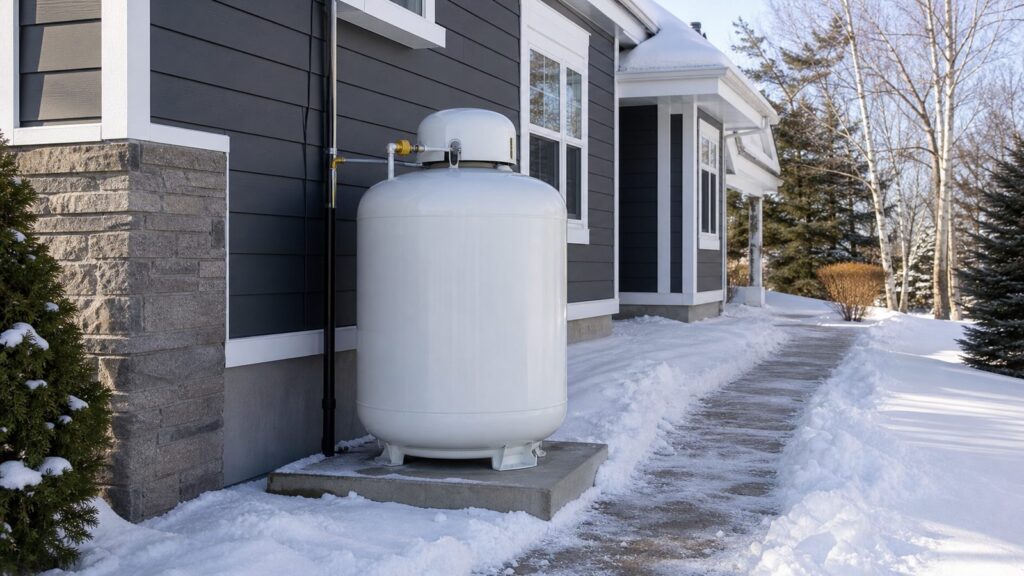
Yes, it is generally safe to leave a propane tank outside in the cold. In fact, for most homeowners, outside is where propane tanks belong. The mistake is not leaving the tank outdoors in winter. The mistake is bringing a cylinder into a garage, basement, enclosed shed, vehicle, or mechanical room because the weather got cold.
Propane tanks are built for outdoor service. The steel tank does not fail just because temperatures drop below freezing. Propane itself boils at about -44 degrees F, so in most U.S. winter conditions the fuel is not freezing solid. What cold weather does change is pressure. As the temperature drops, the propane produces less vapor pressure inside the tank. If the tank is undersized, nearly empty, iced over at the regulator, buried in snow, or trying to feed too many BTUs at once, appliances can starve for fuel even when there is propane left in the container.
As an Amazon Associate I earn from qualifying purchases.
On our job sites, we treat propane like any other fuel system: location, ventilation, access, support, and code compliance matter more than guesswork. A tank that is upright, outdoors, properly placed, protected from impact, and accessible for delivery is normal. A tank shoved into an attached garage for the winter is a safety problem.
Recommended Free Tools
Short Answer: Cold Is Fine, Enclosure Is the Problem
A propane tank can sit outside through freezing temperatures, snow, and ordinary winter weather. Portable grill cylinders, 100-lb cylinders, and larger residential ASME tanks are commonly stored and used outdoors year-round. The safe winter setup is simple: keep the tank upright, keep the valve closed when not in use, keep the regulator and relief valve clear, and keep the tank in a ventilated location away from ignition sources.
#1 Best Overall

- Easy Installation - simply plug-in to a standard, 120V outlet in your home
- 9-volt battery backup provides protection during a power outage
- Digital LED display shows the level of carbon monoxide the CO alarm is sensing or states "GAS" when explosive gas is present
- 85-decibel alarm announces when carbon monoxide or explosive gas is detected
- Peak Level Memory records the last time carbon monoxide was detected or when the unit was last tested
Propane is heavier than air. If it leaks inside a garage, basement, or shed, it can settle low and collect near a water heater, furnace, appliance pilot, light switch, outlet, or power tool. That is why propane cylinders should not be stored inside homes, basements, attached garages, enclosed porches, enclosed sheds, or vehicles. Cold weather does not make indoor storage safer. It makes the temptation more common.
For a homeowner, the practical rule is this: if the tank is outside, upright, ventilated, protected, and code-compliant, winter is expected. If the tank is inside an enclosed space, lying on its side, buried under snow, sitting in wet soil, or placed where a plow or falling roof ice can hit it, the installation needs attention.
What Actually Happens to Propane in Cold Weather
Propane inside the tank exists as both liquid and vapor. Appliances burn vapor, not liquid. The liquid propane boils inside the tank and produces vapor pressure. In warmer weather, vapor pressure is higher. In colder weather, vapor pressure drops.
Windows Errors? Fix Them Before They Spread
Repair common Windows errors and clear accumulated junk for a smoother, more stable PC - no reinstall needed.Free scan · no reinstallOutdated Drivers Are Slowing You Down
One free scan finds every outdated or missing driver and matches the right update for your exact hardware.Free scan · exact hardware matchThat pressure drop is why a grill, patio heater, construction heater, generator, or home heating appliance may act weak in very cold weather. The tank may still contain fuel, but it may not be producing vapor fast enough to serve the load.
Propane does not usually freeze in U.S. winters
Propane’s boiling point is roughly -44 degrees F. That is far colder than most winter days in the continental U.S. Some industry guidance uses -40 degrees F as a practical lower storage reference. For most homes, the concern is not frozen propane. The concern is reduced vaporization capacity.
Tank size and fill level matter
A larger tank has more wetted surface area and more fuel mass, so it can vaporize propane more effectively in cold weather. A fuller tank also performs better than a nearly empty one. That is why a small 20-lb grill cylinder may struggle to feed a high-BTU heater below freezing, while a properly sized 500-gallon residential tank can run a furnace, water heater, range, or generator in the same weather.
If propane serves your home heat, water heater, or standby generator, we like to see the tank at least one-third full before severe cold or a winter storm. For a 500-gallon tank, remember that propane tanks are normally filled to about 80 percent capacity to allow for expansion. So a 500-gallon tank holds about 400 gallons when full. One-third of usable capacity is roughly 130 gallons. That gives you better vaporization capacity and a safer delivery cushion.
Safe Outdoor Storage for Portable Propane Cylinders
Portable DOT cylinders include common 20-lb grill tanks, 30-lb RV cylinders, 40-lb cylinders, and 100-lb cylinders. These should be stored upright outdoors on a firm, level surface. Do not lay them on their side. Upright storage keeps the relief valve and service valve oriented correctly and helps prevent liquid propane from reaching places intended for vapor.
For a 20-lb grill cylinder, a good winter storage spot is outside on a concrete patio, paver, or stable noncombustible platform, with the valve closed and the protective cap or plug installed if required by the cylinder design. Keep it away from doors, crawlspace openings, dryer vents, basement windows, ignition sources, and places where snow slides off the roof.
Do not wrap a cylinder in a tight tarp or place it in an unvented box. A loose weather cover that does not trap gas around the valve area is different from an enclosure. If gas leaks, it needs to dissipate into open air.
Rank #2

- Effective Gas Leak Detector: The TOPTES PT520A natural gas detector detects leaks of methane, propane, natural gas, LPG, butane, and more in tight spaces
- Flexible Probe: The 17-inch gooseneck allows easy access to hard-to-reach areas like pipelines, storage tanks, gas fireplaces, and basements, ideal for both indoor and outdoor leak detection. During use, point the probe toward the suspected leak source and move as close as 1–5 cm
- Visual and Audible Alarm: PT520A responds in 0.5 seconds, with 7 colored bars and a 75dB alarm that increase with gas concentration. Detection range: 50-10,000 ppm (Methane)
- User-Friendly Functions: Enable or disable Auto Power-Off with the APO button to save power after 10 minutes of inactivity. The Mute button silences the alarm, and the non-slip, wear-resistant design ensures a secure, comfortable grip for easy handling
- What You Get: 1×PT520A Gas Leak Detector, 3×AAA Batteries, 1×Protective Case, and 1×User Manual. Allow 30 seconds of warm-up in clean air before starting detection
Check the cylinder date
Portable propane cylinders have manufacturing date markings stamped into the collar or handle area. Many common grill cylinders require periodic requalification before they can be refilled, often discussed as 10 or 12 years depending on cylinder type, jurisdiction, and refiller policy. If your cylinder is rusty, dented, has a damaged foot ring, has a questionable valve, or is out of date, do not argue with the refill station. Exchange it or have it inspected by a propane professional.
Safe Winter Setup for Residential Propane Tanks
Stationary residential tanks are a different category than portable grill cylinders. These are usually ASME tanks installed above ground or underground and connected to fixed piping. Common residential sizes include 120-gallon, 250-gallon, 500-gallon, and 1,000-gallon tanks. The right size depends on connected BTU load, climate, refill access, appliance mix, and whether the tank serves heat, domestic hot water, cooking, fireplaces, pool heat, or a generator.
From a construction standpoint, the winter details are straightforward but often missed: the tank needs a stable base, drainage, clearance, protection from vehicle impact, service access, and regulator protection that does not block ventilation.
Base and support
An above-ground tank should not sit directly on wet soil. Moisture, freeze-thaw movement, and poor bearing can create corrosion and settlement problems. For smaller cylinders, pavers or a manufactured cylinder base may be enough. For larger tanks, installers commonly use concrete pads, precast blocks, or compacted stone with proper supports depending on tank size and local requirements.
In cold regions, frost heave matters. A tank pad that rides up unevenly can stress piping. When we are coordinating a propane location on a project, we want positive drainage, stable bearing, and enough room for the supplier to service the tank without climbing through landscaping or snow piles.
Quick wins for a faster PC:
Repair Windows errors before they cause bigger problemsFix Now →Scan for outdated or missing drivers - takes under a minuteDriver Scan →Clear out junk files and repair common Windows errorsFree Scan →Regulator and vent orientation
The regulator is one of the most important winter components. Its vent must remain open and correctly oriented. Snow, ice, insects, debris, and wind-driven slush can block the vent. A blocked regulator vent can cause poor appliance performance or unsafe pressure conditions.
Never hit a frozen regulator with a hammer, shovel, boot, torch, or heat gun. Use a broom to clear loose snow. If ice is bonded to fittings, call the propane supplier. Approved regulator covers and protection devices exist, but they need to be installed without creating a tight enclosure or blocking venting.
How Far Should a Propane Tank Be From the House?
Clearance depends on tank size, container type, openings, property lines, ignition sources, and the authority having jurisdiction. NFPA 58 and local fire or building codes are the usual reference points, and local rules can be stricter. Some states and municipalities adopt fuel gas, fire, or mechanical code provisions that affect placement, permits, and inspections.
For planning purposes, homeowners should expect larger tanks to need more separation than small cylinders. A common residential 500-gallon above-ground tank is often placed at least 10 feet from buildings, property lines, and ignition sources, but you should not use that number as permission to install one yourself. Site-specific details matter: doors, windows, vents, crawlspace openings, generators, electrical equipment, driveways, retaining walls, and property boundaries can all change the layout.
What’s actually slowing this PC down?
Pick the symptom - the matching free tool is one click away.
For portable grill cylinders, common-sense placement still applies. Keep the cylinder outdoors, upright, away from open flames and ignition sources, and away from places where leaking gas could enter the structure. If you are connecting a cylinder to a fixed appliance or piping system, stop and call a licensed propane professional. That is no longer simple storage.
Rank #3

- Combustible Gas Leak Detector: The TopTes PT199 detects natural gas, methane, propane, butane, LPG, and more, pinpointing leaks to reduce the risk of explosion, keeping your family and property safe
- Visual and Audio Gas Alarm: Visual and audio alarms trigger within 0.5 seconds of gas detection. The alarm intensifies with gas concentration, and the LCD screen turns red when gas levels are high
- Batteries Included and Easy to Use: The TopTes PT199 includes 2x AAA batteries and is ready after a 30-second warm-up. The low battery indicator activates below 2.4V, and it auto-powers off after 5 minutes without operation or gas detection
- Compact Design: Pocket-sized, non-slip, and easy to carry or store in the included bag. Ideal for RV owners, DIYers, and homeowners with gas appliances. Saves you from paying hundreds of dollars in diagnostics or wasting gas in an undetected leak
- What You Get: 1x PT199 Gas Leak Detector, 1x Storage Bag, 2x AAA Batteries, 1x User Manual. Detection range: 50-1,000 ppm (based on methane). Detection distance: 1-5cm
Winter Propane Costs Homeowners Should Expect in 2026
Propane costs vary widely by region and service arrangement. EIA residential propane price data pauses outside the October-March heating season. The latest 2026 heating-season weekly national average shown was about $2.674 per gallon on March 30, 2026. In that same reporting period, regional prices were much higher in the Northeast: East Coast around $3.596 per gallon, New England around $3.766 per gallon, and Connecticut about $4.116 per gallon.
That EIA number is residential delivered propane, not the same thing as a 20-lb cylinder exchange at a retail cage. Cylinder exchange pricing includes retail handling, labor, convenience, and often less than a full 20-lb fill by weight. Treat grill cylinder pricing as local retail pricing, not a direct match to bulk residential fuel.
| Item | Typical 2026 Cost Range | What Changes the Price |
|---|---|---|
| Residential propane fuel | About $2.67/gal U.S. average on March 30, 2026; Northeast often $3.50-$4.10+/gal | Region, season, delivery volume, taxes, dealer competition, automatic vs will-call delivery |
| Above-ground tank installation | About $300-$3,000 | Tank size, leased vs owned tank, pad, gas line distance, permits, access |
| Underground tank installation | About $1,500-$5,000 for many standard residential jobs | Excavation, soil or rock, cathodic protection, drainage, inspection, restoration |
| 500-gallon tank installation | Often about $1,000-$2,500; higher on difficult sites | Long trenching runs, first fill, owned tank purchase, permits, bollards, difficult access |
| Winter service add-ons | Varies by site and supplier | Regulator replacement, leak test, emergency delivery, snow access, impact posts, pad work |
Emergency delivery is where winter propane gets expensive. Will-call customers who wait until the gauge is low before a storm may pay premiums or may not get immediate service. Automatic delivery programs, budget billing, prebuy contracts, and remote tank monitors can reduce runout risk, but the right choice depends on your usage and supplier terms.
Free tools Windows power users keep installed
One-click scans. No signup required.
Common Cold-Weather Propane Problems We See
The most common winter propane problems are practical site problems, not mysterious fuel problems. They usually come down to access, pressure, venting, or damage.
The tank is too low
A low tank has less liquid surface area and less thermal mass. During high demand, especially in very cold weather, that can reduce vaporization capacity. If a furnace, boiler, water heater, and generator all draw at the same time, a marginal system can show pressure problems.
The appliance load is too high for the cylinder
A 20-lb cylinder can run a grill in normal weather, but it may not keep up with a high-BTU construction heater or patio heater in cold conditions. The tank can frost heavily and the flame can weaken. That does not automatically mean the tank is empty. It may mean the cylinder cannot vaporize fuel fast enough for that load and temperature.
The regulator vent is blocked
Snow, ice, or debris around the regulator can cause poor performance. Keep the dome and regulator area visible. Clear snow with a broom. Do not chip ice from valves or fittings.
The tank is buried or inaccessible
Delivery drivers need a clear, walkable path. Emergency responders need to find the shutoff. Before winter, photograph the tank, regulator, shutoff, and buried line route. Use driveway markers or stakes where appropriate so snow removal crews do not hit the tank, piping, or line path.
Roof snow or icicles can fall onto the tank
A tank under a roof edge, eave, or valley can be hit by sliding snow and ice. That can damage regulators, piping, gauges, or valves. The fix is not a tight homemade box. Ask the propane supplier about approved protection, relocation, or a compliant cover.
Should You Cover a Propane Tank When It Snows?
You can protect parts of the system, but you should not trap the tank in an unvented enclosure. For portable cylinders, a loose cover that keeps snow off the valve area while allowing ventilation may be acceptable. For residential tanks, the supplier may install a dome, regulator cover, or approved protection where needed.
Rank #4

- 3X THE DETECTION: Model COPDLG detects low levels of CO, natural gas, propane and sounds a loud 85-dB alarm; backlit digital display indicates level of CO presence or the word "GAS" when explosive gas is present; replaces model 900-0113, KN-COEG-3
- ADVANCED LOW-LEVEL CO TECHNOLOGY: Alerts earlier at 30-70ppm with distinct light & sound pattern, helping safeguard young children, older adults, pregnant women, and pets*; at 70ppm a separate alarm pattern signals dangerous levels for all occupants
- PLUG-IN + AA BATTERY BACKUP: Simply plug into a standard, 120V outlet with two included AA backup batteries for coverage during power outages; rotating plug fits vertical or horizontal outlets; sleep peacefully with no low battery chirps
- TESTED & TRUSTED: This carbon monoxide alarm is rigorously tested to meet UL 2034, 5th Edition standards, and is ETL Listed; includes a 7-year limited warranty on the alarm
- BUILT FOR EVERY HOUSEHOLD: Designed to help provide dependable carbon monoxide monitoring for everyday home use; supports renters, homeowners, and pet owners seeking added awareness and detection from CO and explosive gas hazards
The tank itself can be exposed to snow. What needs attention is access to the valve, gauge, fill connection, relief valve, regulator, and delivery path. Keep the dome lid usable. Keep the regulator vent clear. Keep appliance exhaust and combustion-air openings clear too. Many winter propane emergencies are tied to blocked furnace vents, unsafe temporary heat, or carbon monoxide risk, not the outdoor tank simply being cold.
The Tool Desk
Outbyte Driver Updater FREEFix the driver behind crashes, sound loss and screen glitchesFind Drivers →Outbyte PC Repair FREEClear out junk files and repair common Windows errorsFree Scan →Every home using combustion appliances should have working carbon monoxide alarms. Put them on each level and near sleeping areas according to the alarm manufacturer’s instructions and local code. Replace alarms on their listed schedule, often every 5 to 10 years depending on model.
When to DIY vs. When to Hire a Pro
There is a narrow lane of propane work that homeowners can handle. There is a much larger lane that belongs to licensed propane professionals, mechanical contractors, or the propane supplier.
Reasonable DIY tasks
Homeowners can store portable cylinders outdoors and upright. They can close cylinder valves after use. They can brush loose snow away from a tank dome, gauge, or regulator cover. They can keep a delivery path shoveled. They can check the visible cylinder date stamp before a refill. They can install fresh batteries in carbon monoxide alarms and make sure appliance vents are not buried.
For a grill cylinder, you can also check for obvious damage: heavy rust, dents, bent collars, damaged foot rings, missing caps, or a valve that does not operate normally. If you see those issues, take the cylinder out of service and exchange it or have it inspected.
Call a propane professional
Hire a pro for tank installation, relocation, buried tanks, underground gas lines, regulator replacement, pressure testing, leak checks, appliance conversion, generator fuel supply, or any suspected leak. Also call if appliances repeatedly lose flame in cold weather, if the regulator is iced, if you smell gas, if the tank has been hit by a plow or vehicle, or if roof ice damaged the piping.
If you smell propane, do not use switches, phones, lighters, garage door openers, or appliances in the area. Leave the building or area, shut off gas only if it is safe to do so, and call the propane supplier or emergency services from a safe location.
Independent reader supportYour contribution helps us test, update, and keep practical guides available for everyone.Permits, Inspections, and Code Notes
Propane systems are regulated because they combine fuel storage, pressure, combustion, and building safety. Depending on location, installing or moving a residential tank may require a permit, inspection, separation distances, approved piping materials, pressure testing, and documentation from the propane supplier. The authority having jurisdiction, often the local building department or fire marshal, has the final say.
Do not assume a tank location is legal because it fits physically. We have seen proposed tank locations that looked convenient but failed because they were too close to a property line, window, crawlspace opening, ignition source, generator, driveway, or future addition. We have also seen homeowners forget delivery access. A beautiful screened location is not useful if the hose cannot reach it safely in January.
Do these 3 things before closing this tab:
1Repair Windows errors before they cause bigger problems2Fix the driver behind crashes, sound loss and screen glitches3Clear out junk files and repair common Windows errorsFor underground tanks, the professional scope is even clearer. Excavation, bedding, backfill, corrosion protection, anode installation where required, riser protection, drainage, and inspection all matter. A buried tank is not just an above-ground tank placed in a hole.
Practical Winter Checklist
Before the first hard freeze, walk the propane system like a contractor would. Confirm the tank is upright or properly supported, the base is stable, and the tank is not sitting in pooled water or wet soil. Check that the dome opens, the gauge is visible, and the regulator vent is clear. Look for rust, dents, settlement, stressed piping, or signs that vehicles could strike the system.
Best Value

- Combustible Gas Leak Detector: PT177 is a useful little tool that helps every household with gas appliances to quickly and easily pinpoint the leakage of combustible gas including LPG, methane, ethane, propane, butane, natural gas, coal gas, etc. Important Warm-Up Notice: Before use, the PT177 must be powered on and warmed up for 30 seconds in a clean, gas-free environment to ensure accurate detection results
- Visual and Audible Alarms: PT177 gas detector requires a 30-second auto-calibration after powering on and can detect gas and trigger an alarm within 0.5 to 3 seconds. Five red LEDs and a 75 dB audible alarm intensify as gas concentration increases
- Pocket sized with a pocket clip that allows you to carry it in your shirt pocket. The included storage bag makes the natural gas detector easy to store. It is a convenient tool for RV enthusiasts, DIYers, homeowners with gas appliances, etc
- User Friendly Features: When the battery voltage is below 2.4 volts, the power indicator light will flash to remind you to replace the battery in time. If inactive for 5 minutes without operation or detecting gas, the PT177 will automatically turn off
- What You Get: PT177 Gas Leak Detector, a drawstring storage bag, two AAA batteries, and a user manual
Mark the tank and buried line route before snow season. Keep a broom near the service area. Ask snow removal crews not to push piles against the tank, gas line, meter, or regulator. Keep at least a walkable path for delivery drivers. If your home depends on propane heat, avoid going into a storm with a low tank. One-third full is a practical minimum target; automatic delivery customers should still verify the gauge before major weather.
For generators, test the system before storm season. Standby generators can use a large amount of propane under load, and a tank sized only for ordinary heat may not be adequate for heat plus generator demand during an outage. If a generator was added after the original propane installation, have the supplier verify tank size, regulator capacity, and line sizing.
Bottom Line
Leaving a propane tank outside in cold weather is not just safe in normal circumstances; it is the correct storage approach. Propane tanks need outdoor ventilation, upright positioning, code-compliant placement, and clear access. The real winter risks are low vapor pressure, low tank level, blocked regulators or vents, corrosion from poor support, impact damage, buried equipment, and unsafe indoor storage.
If you are dealing with a grill cylinder, store it upright outside and keep it ventilated. If propane serves your furnace, boiler, water heater, or generator, treat the tank as part of the home’s mechanical system. Keep it accessible, keep it supplied, and have licensed propane professionals handle installation, relocation, regulator work, leak checks, and code questions.
Frequently Asked Questions
Can a propane tank freeze outside in winter?
Propane boils at about -44 degrees F, so it does not usually freeze in U.S. winter conditions. The more common problem is reduced vapor pressure, especially with a small, low, or undersized tank.
Can I store a propane tank in my garage during winter?
No. Propane cylinders should not be stored in garages, basements, homes, vehicles, or enclosed sheds. Store them upright outdoors in a ventilated location.
Should I cover my propane tank when it snows?
Do not use a tight tarp or unvented box. It is fine to use approved protection that keeps snow off the dome or regulator area while allowing ventilation. Clear loose snow gently with a broom.
Why does my propane heater stop working when it is very cold?
Cold lowers vapor pressure. A small cylinder or low tank may still contain propane but may not vaporize it fast enough for a high-BTU heater. A blocked or iced regulator can also cause problems.
How full should I keep my propane tank before a winter storm?
If propane serves heat, hot water, or a generator, keep the tank at least one-third full before severe cold. For a 500-gallon tank filled to the usual 80 percent limit, that means roughly 130 gallons or more.
Do I need a permit to install or move a propane tank?
Often, yes. Requirements vary by local authority, tank size, placement, piping, and whether the tank is above ground or underground. Use a licensed propane professional and confirm local code requirements before installation or relocation.
Free tools Windows power users keep installed
One-click scans. No signup required.
Quick Recap
Product prices and availability are accurate as of the date/time indicated and are subject to change. Any price and availability information displayed on Amazon at the time of purchase will apply.

