What’s actually slowing this PC down?
Pick the symptom - the matching free tool is one click away.
There is no universal winner. Underground power lines usually cost more to build and can take longer to repair, but they avoid many overhead hazards such as wind, ice, lightning and falling trees. Overhead lines are generally less expensive and easier to inspect and repair, yet require visible structures, vegetation management and wider route considerations. The right choice depends on voltage class, whether the work is new construction or conversion, local hazards, soil and flood conditions, outage consequences, and the specific route.
What the comparison actually involves
“Power lines” covers two different infrastructure categories. Distribution lines deliver electricity through neighborhoods and rural areas, typically using poles or buried ducts. Transmission lines move large amounts of power over longer distances at higher voltages and use larger structures, conductors, substations and rights-of-way. Costs, clearances, construction methods and failure modes differ substantially between them.
As an Amazon Associate I earn from qualifying purchases.
A new underground distribution extension is not financially equivalent to burying an existing transmission corridor. Likewise, converting a pole line to underground service can require new duct banks, transformers, switching equipment, service connections and road restoration rather than simply placing the same wire below grade. Any comparison should identify the voltage class and project type before quoting a cost or reliability figure.
Five questions provide a useful starting framework:
#1 Best Overall

- Liquid Tight Conduit Kit: Our liquid-tight conduits are made of antioxidant PVC material, featuring a smooth interior for easier wire pulling. Length: 25 feet, Comes with 4 straight and 3 90-degree conduit connectors
- Safety and Reliability: Our electrical conduits resist corrosion, wear, oil, water, acid, and metal chips, making them ideal for harsh environments. They offer excellent tensile and compressive strength and are suitable for outdoor, UV-resistant, and direct burial applications
- Easy Installation: No disassembly required, simplifying wire installation. Just push the conduit onto the ferrule and tighten the dome sealing nut. Easily cut to the desired length with a utility knife or PVC cutter
- Flexible and Light: Our non metalic liquid tight conduits are suitable for tight spaces, lightweight, 50% lighter than metal conduits, more flexible and lightweight,and lower installation costs
- Wide Application: Liquid-tight electrical conduits are suitable for AC equipment, machine tools, marine equipment, motors and controls, printing equipment, pumps, refrigeration systems, transformer connections, and outdoor lighting
- What are the construction, maintenance, repair and replacement costs over the line’s life?
- How often are interruptions expected under the area’s wind, ice, lightning, wildfire, flood, vegetation and earthquake hazards?
- How quickly can crews locate a fault, reach it and restore service?
- What land, visual, ecological and right-of-way effects will each construction method create?
- Are the lines distribution or transmission, and is this new construction or a conversion?
Construction and life-cycle cost
Why underground construction usually costs more
The U.S. Department of Energy’s 2017 distribution baseline estimated that moving an overhead distribution line into concrete-encased underground ducting could cost three to four times as much as overhead construction. That is a historical distribution estimate, not a universal multiplier or a current bid. The actual direct cost depends on location, engineering details, labor, utility standards and the construction method, as the DOE’s 2024 guide emphasizes.
Underground work commonly includes trenching or directional drilling, conduit or concrete-encased duct banks, manholes and vaults, cable installation, drainage, jointing and specialized terminations. Crews may also need to relocate water, sewer, gas, telecommunications and other utilities. Traffic control, pavement cutting, restoration, easements and environmental mitigation can dominate the budget in a developed corridor.
Overhead construction generally requires poles or towers, foundations, conductors, insulators, crossarms, grounding, access roads and a cleared corridor. It can still be expensive where rock, steep terrain, wetlands, dense development or difficult access require special foundations or helicopters. Overhead is not automatically cheap; it is simply less excavation-intensive in many settings.
Conversion costs are different from new construction
A conversion must account for both the new underground system and removal or modification of the existing overhead system. The project may need temporary power, new pad-mounted equipment, service reconnections, pole removal, tree work and restoration of streets, driveways or private property. If an existing right-of-way cannot accommodate the duct bank, acquiring additional easements can add schedule and cost.
For a new route, designers can select a corridor and construction method before other utilities and paved surfaces are in place. That can reduce conflicts, although a greenfield project may involve larger land-acquisition and environmental costs. Request separate estimates for new construction and conversion rather than applying a burial percentage to the existing line’s cost.
Maintenance, repair and replacement
Overhead assets are visible, so utilities can patrol them by vehicle or air and often identify damaged poles, conductors, insulators or vegetation before a failure. Routine inspection and tree trimming are recurring costs. Storms can create emergency work involving broken poles, downed conductors and blocked access.
Rank #2

- Liquid Tight Conduit Kit: Our liquid-tight conduits are made of antioxidant PVC material, featuring a smooth interior for easier wire pulling. Length: 100 feet. Comes with 6 straight and 5 90-degree conduit connectorsconnectors.
- Safety and Reliability: Our electrical conduits resist corrosion, wear, oil, water, acid, and metal chips. They offer excellent tensile and compressive strength and are suitable for outdoor, UV-resistant, and direct burial applications
- Easy Installation: No disassembly required, simplifying wire installation. Just push the conduit onto the ferrule and tighten the dome sealing nut. Easily cut to the desired length with a utility knife or PVC cutter
- Flexible and Light: Our non-metalic liquid tight conduits are suitable for tight spaces, lightweight, 50% lighter than metal conduits, more flexible and lightweight, and lower installation costs
- Wide Application: Liquid-tight electrical conduits are suitable for AC equipment, machine tools, marine equipment, motors and controls, printing equipment, pumps, refrigeration systems, transformer connections, and outdoor lighting
Underground systems avoid routine line-clearance work along the conductor route, but they still require inspection of vaults, manholes, switches, transformers, drainage and cable condition. Water intrusion, corrosion, cable-joint degradation and equipment failures can require specialized crews and traffic control. A buried fault may involve excavation, pumping, cable testing, replacement sections and surface restoration.
Free tools Windows power users keep installed
One-click scans. No signup required.
The DOE’s 2024 guide gives estimated service-life ranges of 20–40 years for underground lines and 30–50 years for overhead lines. These are estimates, not guarantees; heat, moisture, loading, materials, installation quality and maintenance affect actual life. A life-cycle model should include the timing and cost of replacement, not only initial installation.
What a project estimate should show
Ask the utility or engineer to separate costs into comparable categories rather than presenting one total:
| Cost category | Overhead items | Underground items |
|---|---|---|
| Initial construction | Poles or towers, foundations, conductors, insulators, access and clearing | Trenching or drilling, ducts, vaults, cable, terminations, drainage and restoration |
| Land and permitting | Right-of-way, structure sites, visual mitigation and environmental permits | Construction easements, utility-conflict work, road occupancy and environmental restoration |
| Routine maintenance | Inspection, pole work, hardware and vegetation management | Vault, switch, transformer, drainage and cable-condition maintenance |
| Storm and failure response | Pole and conductor replacement, debris removal and access clearing | Fault locating, excavation, pumping, cable repair and surface restoration |
| Replacement | Structure and conductor replacement at the end of service life | Cable, duct, vault and accessory replacement, often with difficult access |
Include financing, outage-related business losses where relevant, customer compensation rules, and the cost of temporary generation or switching. These items can change the preferred option even when the construction estimate points in one direction.
Reliability: fewer failures does not always mean faster restoration
How overhead lines fail
Overhead conductors and poles are exposed to wind, ice loading, lightning, falling trees and branches, vehicle impacts and animal contact. Vegetation is a particularly important factor because trees can strike lines or cause protective devices to operate. Wildfire, hurricanes and severe thunderstorms can damage multiple structures at once, making restoration dependent on road access, replacement materials and crew availability.
How underground lines fail
Buried conductors are shielded from many direct wind, ice and tree impacts. They are not immune to damage: excavation by third parties, cable-joint failures, insulation breakdown, overheating, corrosion, flooding and water intrusion can interrupt service. Coastal storm surge and high groundwater are material concerns, and earthquake effects are discussed in DOE resilience sources.
Rank #3

- Premium Liquid-Tight Conduit: Length: 100Ft,ID: 0.63inch,OD: 0.83inch,Thick: 2.5mm. The flexible liquid tight electrical conduit kit is constructed with resists corrosion PVC, featuring a smooth interior for easier wire pulling, to ensure quality and service life
- Complete Accessories: 1/2 inch 100ft flexible electrical conduit with 5 straight and 3 90-degree conduit connector fittings. Whether you are setting up outdoor lighting, security systems, or any other electrical project, this conduit is the perfect choice
- Safety & Sturdiness: Our pvc conduit resists to corrosion, water, oil, abrasion, acid, metal shavings and rough environment. They offer excellent tensile and compressive strength and are suitable for outdoor, UV-resistant, and direct burial applications
- Easy to Install: You can simply tighten the dome sealing nut by pushing the conduit or pipe onto the ferrule, only one person can complete the work in a few minutes. Flexible conduit connector is safe to use and does not require any tools
- Wide Application: PVC electrical conduit is widely used in HVAC equipment, machine tools, marine equipment, motors and controls, printing equipment, pumps, refrigeration equipment, transformer connections, outdoor lighting etc
Flood exposure must be evaluated for the entire system, not just the cable. Substation yards, pad-mounted transformers, switchgear, vaults and network equipment can be vulnerable even when the conductor itself is below grade. Sealed equipment, elevation, drainage and flood barriers may be needed.
Evidence from a North Carolina comparison
A five-year comparison reported by the U.S. Department of Energy in 2017 found 50 percent fewer outages on underground systems but a 58 percent longer average outage duration in one North Carolina utility’s experience. Those figures describe that utility’s comparison; they are not a prediction for every service territory. They illustrate why reliability must be measured with at least two metrics: interruption frequency and restoration duration.
| Reliability measure | Question to ask | Why it matters |
|---|---|---|
| Interruption frequency | How often do customers lose power? | Buried circuits may reduce exposure to recurring wind, tree and ice events. |
| Average interruption duration | How long does each outage last? | Fault location and excavation can make underground repairs slower. |
| Major-event performance | What happens in a hurricane, ice storm, flood or wildfire? | Multiple failures, access restrictions and crew logistics can dominate restoration. |
| Critical-load continuity | How are hospitals, water systems, data centers or emergency facilities served? | Redundant feeds, sectionalizing and backup generation may matter more than line placement alone. |
Fault detection and repair time
Why overhead faults are usually easier to locate
A visible broken conductor, leaning pole or damaged insulator can identify an overhead fault during patrol. Protective relays and reclosers can isolate sections, and crews can often reach equipment with standard bucket trucks if roads are open. Repairs still take time when several poles are down or debris blocks access.
Crashes, No Sound, or Screen Glitches?
Random freezes, missing sound and display glitches usually trace back to one bad driver. Find and replace yours safely.Free scan · under a minuteWindows Errors? Fix Them Before They Spread
Repair common Windows errors and clear accumulated junk for a smoother, more stable PC - no reinstall needed.Free scan · no reinstallWhy underground faults can take longer
A buried cable may fail without a visible surface clue. Utilities use relays, sectionalizing devices, cable-testing equipment and fault-locating methods to narrow the search. The DOE’s 2024 guide notes that monitoring can affect how quickly faults are located. Once a likely section is identified, crews may need to open pavement or soil, dewater a vault, expose the cable, replace a joint or cable section, test it and restore the surface.
Design can reduce restoration time. Accessible manholes, spare ducts, sectionalizing switches, looped feeders, remote monitoring and standardized cable accessories allow operators to isolate a smaller section and avoid excavating an entire route. These features add capital cost but can improve operational resilience.
Questions for a restoration plan
- What fault-location equipment and monitoring are installed?
- How many spare cables, joints, transformers and switches are stocked locally?
- Can crews reach every vault during heavy rain, flooding or a road closure?
- How will the utility isolate a failed section while keeping other customers energized?
- Who restores pavement, landscaping and private property after excavation?
- What is the assumed repair duration for a single fault and for several simultaneous faults?
Land, environmental and visual impacts
Underground construction concentrates disturbance during installation
Buried lines remove permanent poles and conductors from view, but installation can disturb a broad linear work zone. Trenching may remove topsoil, compact farmland, cross drainage features and affect tree roots. Directional drilling reduces open excavation in some locations but still requires launch and receiving pits, equipment staging and access.
Rank #4

- Complete Accessories:3/4 liquid tight conduit, 25 ft flexible electrical conduit with 5 straight and 3 90-degree conduit connector fittings.Flexible electrical conduit length:25ft,,Id:0.813inch(20.6mm,Od:1.03 inch(26.4mm),thick: 2.5mm,fittings install directly onto conduit for waterproof joints
- Safety and Sturdiness:Ansgery liquid tight conduit 3/4 resists to corrosion,water,oil,abrasion,acid,metal shavings and rough environment;Resistance to pulling and crushing;Fully adaptable to outdoor environments such as direct sunlight,direct burial.Stays flexible in extreme hot and cold temperatures
- Premium Liquid-Tight Conduit:3/4 flexible conduit made from anti-oxidation virgin PVC.Smooth inside for easier wire pulling,no hazardous sharp edges or burrs.Integral rigid and flexible PVC construction will not damage conductors,and 50% lighter than metallic conduits.Costs less to install
- Effortless Installation:3/4 flex conduit fits is fast,length can be cut to size,only one person can complete the work in a few minutes.flexible conduit connector is safe to use and does not require any tools.You can simply tighten the dome sealing nut by pushing the conduit or pipe onto the ferrule
- Wide Applications:PVC electrical conduit has very good durable, pulling and squeezing;Flex conduit 3/4 widely used in HVAC equipment, machine tools,marine equipment,motors and controls,printing equipment,pumps, refrigeration equipment,transformer connections,outdoor lighting
For transmission, the DOE’s 2023 National Transmission Needs Study reports that the volume of soil excavated for undergrounded cable can be over 14 times that required for an equivalent overhead line, attributing the comparison to National Grid (2017). This is a scoped transmission comparison, not a universal result for every voltage or construction method. The study highlights why spoil handling, haul routes, dewatering and restoration should be assessed early.
Underground routes can cross farmland, forests, wetlands and conservation areas. Temporary construction effects may include habitat clearing, sediment runoff, noise, dust and disruption to agricultural drainage. After restoration, land-use restrictions over the duct bank may limit deep-rooted planting, buildings or future excavation.
Overhead routes create permanent corridor and visual effects
Overhead lines require poles or towers, structure foundations and a corridor that provides electrical clearances and access for inspection. Selective tree trimming or removal may be needed throughout the operating life. Structures can affect views, property values and community acceptance, and new corridors may fragment forests or cross wetlands just as an underground route can.
Overhead construction usually leaves less continuous excavation, but each structure creates a foundation site and access requirements. In steep or remote terrain, roads and crane pads can become a major part of the land footprint. The environmental comparison should therefore use an actual route and construction plan, not a generic assumption that one method always disturbs less land.
Rights-of-way and future land use
Both systems need easements. An overhead easement may restrict building height, tree growth and activities near conductors. An underground easement may restrict excavation, foundations, deep planting and access to vaults or equipment. Review property boundaries, agricultural operations, drainage, forestry plans, future roads and development before selecting a route.
Quick wins for a faster PC:
Fix the driver behind crashes, sound loss and screen glitchesFind Drivers →Repair Windows errors before they cause bigger problemsFix Now →Safety, appearance and community acceptance
Underground conductors are less exposed to public contact and storm debris, and removing poles can improve streetscapes. However, pad-mounted transformers, cabinets, vault covers and warning markers remain visible, and excavation creates short-term traffic and pedestrian hazards. Water-filled or damaged underground equipment can present safety risks if improperly accessed.
Best Value
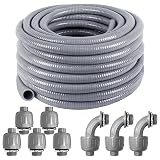
- 𝐏𝐫𝐞𝐦𝐢𝐮𝐦 𝐋𝐢𝐪𝐮𝐢𝐝 𝐓𝐢𝐠𝐡𝐭 𝐂𝐨𝐧𝐝𝐮𝐢𝐭: 1 inch flexible conduit made from anti-oxidation virgin PVC.Smooth inside for easier wire pulling,no hazardous sharp edges or burrs.Integral rigid and flexible PVC construction will not damage conductors,and 50% lighter than metallic conduits.Costs less to install
- 𝐒𝐚𝐟𝐞𝐭𝐲 𝐚𝐧𝐝 𝐒𝐭𝐮𝐫𝐝𝐢𝐧𝐞𝐬𝐬: Ansgery 1 inch liquid tight conduit resists to corrosion,water,oil,abrasion,acid,metal shavings and rough environment;Resistance to pulling and crushing;Fully adaptable to outdoor environments such as direct sunlight,direct burial.Stays flexible in extreme hot and cold temperatures
- 𝐂𝐨𝐦𝐩𝐥𝐞𝐭𝐞 𝐀𝐜𝐜𝐞𝐬𝐬𝐨𝐫𝐢𝐞𝐬: 1/2 inch 50ft flexible electrical conduit with 5 straight and 3 90-degree conduit connector fittings.Flexible electrical conduit length:50 ft,id:1inch,od:1.1 inch,thick: 3 mm,fittings install directly onto conduit for waterproof joints
- 𝐄𝐟𝐟𝐨𝐫𝐭𝐥𝐞𝐬𝐬 𝐈𝐧𝐬𝐭𝐚𝐥𝐥𝐚𝐭𝐢𝐨𝐧:Liquid-tight conduit fits is fast,length can be cut to size,only one person can complete the work in a few minutes.Flexible conduit connector is safe to use and does not require any tools.You can simply tighten the dome sealing nut by pushing the conduit or pipe onto the ferrule
- 𝐖𝐢𝐝𝐞 𝐀𝐩𝐩𝐥𝐢𝐜𝐚𝐭𝐢𝐨𝐧𝐬: PVC electrical conduit has very good durable, pulling and squeezing;Widely used in HVAC equipment, machine tools,marine equipment,motors and controls,printing equipment,pumps, refrigeration equipment,transformer connections,outdoor lighting
Overhead lines make electrical clearances obvious but expose the public to downed-wire hazards after storms. Utilities use grounding, protective devices, warning signs and vegetation programs to manage those risks. Community preference for a cleaner view must be balanced against the project’s cost, construction disruption and emergency-repair requirements.
When each option tends to fit
Overhead may fit better when
- The route is rural or lightly developed and has manageable vegetation and storm exposure.
- Upfront capital is constrained and the project needs the lowest initial construction cost.
- Fast visual inspection and truck access are important for the operating plan.
- Soil, rock, groundwater, contamination or dense existing utilities make excavation unusually difficult.
- A transmission corridor can use existing rights-of-way with acceptable visual and environmental effects.
Underground may fit better when
- Wind, ice, falling trees or lightning cause frequent overhead interruptions.
- The route is in a dense urban area where poles, clearances or visual effects are unacceptable.
- Critical loads justify higher construction cost and the design includes sectionalizing and monitoring.
- A new development can install ducts before paving and other utilities are in place.
- Vegetation management, aircraft clearance or wildfire exposure makes an overhead corridor especially difficult.
These are screening conditions, not automatic answers. Flood-prone or surge-exposed locations may require elevated or hardened equipment regardless of whether the conductor is overhead or underground. A route with difficult access may also make underground fault repair slower than expected.
A project-level decision process
- Define the system. Record voltage class, circuit length, capacity, number of customers, critical loads and whether the work is new construction or conversion.
- Map hazards and constraints. Analyze wind, ice, lightning, wildfire, vegetation, flooding, storm surge, groundwater, earthquakes, rock, contamination, wetlands, protected areas and existing utilities.
- Develop matched designs. Price an overhead alternative and an underground alternative with equivalent capacity, redundancy, protection, access and service quality.
- Obtain itemized estimates. Separate materials, labor, permitting, easements, traffic control, restoration, temporary power, utility relocations and contingency.
- Model reliability. Use local outage history and expected interruption frequency, duration, major-event performance and critical-load consequences. Do not substitute the North Carolina figures for local data.
- Test restoration assumptions. Document fault-location methods, crew access, spare parts, switching, excavation, dewatering and surface restoration for both single and multiple failures.
- Compare land impacts. Quantify permanent easements, temporary work areas, tree removal, soil excavation, spoil, habitat effects, visual exposure and future land-use restrictions along the actual route.
- Calculate life-cycle value. Include maintenance, vegetation management, inspections, expected repairs, replacement timing, outage consequences and financing over the selected analysis period.
- Engage affected parties. Coordinate with landowners, road authorities, farmers, environmental agencies, emergency managers and customers before final design.
- Document the trade-off. State which assumptions drive the recommendation and identify conditions that would change it, such as a revised flood map, higher outage cost or a new route.
Common mistakes to avoid
- Applying the three-to-four-times figure universally. It is a 2017 historical estimate for a particular underground distribution construction approach, not a current price for every project.
- Mixing transmission and distribution evidence. A transmission excavation comparison cannot be used as a distribution cost estimate, and vice versa.
- Calling underground systems storm-proof. Flooding, surge, water intrusion, earthquakes and equipment failures remain possible.
- Counting outages but not outage duration. Fewer interruptions can coexist with longer repairs.
- Ignoring restoration access. A buried cable beneath a busy road, river crossing or flooded area may be difficult to reach.
- Comparing only visible land use. Underground construction may have a large temporary excavation footprint; overhead systems may impose decades of vegetation and visual constraints.
- Using a single average service life. The DOE ranges are estimates influenced by heat, moisture, loading and maintenance.
- Leaving equipment out of the design. Transformers, switches, vaults, substations, monitoring, drainage and spare capacity affect both cost and reliability.
What to request from a utility or engineer
A decision-quality proposal should include an alignment map and cross-sections, voltage and capacity assumptions, construction sequence, schedule, itemized capital cost, annual maintenance cost, replacement assumptions, reliability metrics, hazard analysis, environmental permits, easement requirements and a restoration plan. Request confidence ranges and the assumptions behind them rather than a single precise number.
Recommended Free Tools
For underground options, ask for duct-bank details, burial depth, thermal ratings, groundwater treatment, vault spacing, cable-joint strategy, flood protection, monitoring and fault-location procedures. For overhead options, ask for structure types, wind and ice design criteria, conductor configuration, vegetation-clearance standards, access roads, wildfire measures and storm-repair logistics.
Finally, require the analysis to show what happens when a key assumption changes. A sensitivity test for higher labor costs, a longer outage, a flood event, difficult rock or a delayed permit often reveals more than a single headline estimate.
Quick Recap
Product prices and availability are accurate as of the date/time indicated and are subject to change. Any price and availability information displayed on Amazon at the time of purchase will apply.

