Choose an oscillating multitool for close, controlled, flush, or multi-operation work. Choose a reciprocating saw for rough material removal, frequent heavy cutting, and demolition. Neither tool is a universal substitute for the other. The right choice depends on access, the finish you need, the material, how you start the cut, and whether the job also involves scraping or sanding.
The comparison below is based on Lowe’s guidance and Bosch manufacturer manuals. It is an application guide, not a controlled model-versus-model test; no general speed, vibration, noise, runtime, or price advantage has been established for one tool type.
As an Amazon Associate I earn from qualifying purchases.
What is the practical difference?
An oscillating multitool moves its accessory through a short oscillating arc and accepts a broad range of attachments. With the appropriate accessory, it can cut, scrape, grind, prepare a surface, or sand a detail. A reciprocating saw drives a saw blade through a back-and-forth stroke and is primarily a material-removal tool.
The Tool Desk
Outbyte PC Repair FREERepair Windows errors before they cause bigger problemsFix Now →Outbyte Driver Updater FREEFix the driver behind crashes, sound loss and screen glitchesFind Drivers →| Job requirement | Better starting choice | Reason |
|---|---|---|
| Cut close to a finished surface | Oscillating multitool | Its saw blades are intended for precise cuts near edges and flush to a surface. |
| Work in a cramped opening | Oscillating multitool | The compact accessory and controlled cut suit tight access. |
| Remove a large amount of material | Reciprocating saw | It is the more suitable of these two tools for frequent rough, heavy-duty cutting and demolition. |
| Scrape adhesive or caulk | Oscillating multitool | Scraper attachments handle work a reciprocating saw is not designed to perform. |
| Detail-sand after cutting | Oscillating multitool | Sanding accessories let one tool handle the follow-up surface work. |
| Plunge into softer wood or light building material | Reciprocating saw, if the model manual permits it | The cited Bosch manual describes this procedure for softer materials. |
| Plunge directly into metal or thick, hard material | Neither by default | The cited Bosch reciprocating-saw manual says not to plunge-cut these materials; start at an edge or use a sufficiently large pre-drilled hole. |
A short rule is useful on site: multitool for close, controlled, flush, or multi-operation work; reciprocating saw for rough removal and demolition.
#1 Best Overall

- 3-speed selector allows users to choose their speed setting based on the application. A brushless motor delivers up to 57% more runtime over brushed
- Dual-Grip variable-speed trigger gives users ultimate speed and application control. Universal accessory adaptor for use with most oscillating tool accessory brands
- Quick-Change accessory system allows blades and attachments to be changed quickly without wrenches
- Bright LED illuminates dark worksurfaces for accurate cutting
- 3 Year Limited Warranty
When an oscillating multitool is the better choice
Flush cuts beside finished work
A multitool is useful when the blade must enter beside something that stays in place. Bosch describes flush-cutting door jambs, window sills, toe kicks, and excess copper or PVC pipe. The blade can be held against the adjoining surface so the unwanted portion is removed without bringing a large saw body into the opening.
This is especially valuable during remodeling. A door jamb can be trimmed to slide flooring underneath; a toe kick can be notched for a new cabinet floor; or a short section of pipe can be cut back where surrounding finishes limit clearance. The objective is a controlled, localized cut rather than the fastest possible removal.
Precise cuts in tight areas
Bosch’s GOP18V34 manual states that saw blades are suited to “precise cuts in tight areas, close to edges or flush to a surface.” That description captures the multitool’s main advantage over a reciprocating saw: access and control matter more than removing the maximum amount of material per stroke.
Free tools Windows power users keep installed
One-click scans. No signup required.
Use a plunge-cut blade when the cut must start in the middle of a workpiece rather than at an exposed edge. Lowe’s identifies plunge-cutting blades as a way to begin in the middle of a workpiece. Mark the cut, verify what is behind the surface, and let the accessory establish the opening gradually.
Scraping and surface preparation
The same tool can remove carpet backing, adhesive, and caulk with the appropriate scraper. It can also prepare a surface before a repair or installation. This avoids changing to a separate hand scraper when a powered, controlled pass is appropriate.
Scraping is not a reason to fit a saw blade and force it through residue. Select an attachment intended for the material and keep the tool moving so heat and gouging do not damage the substrate.
Detail sanding
A sanding attachment makes the multitool useful after the cut or scrape. Bosch lists detail sanding among its applications. It is suited to small areas, edges, and corners where a larger random-orbit or sheet sander cannot reach easily.
Rank #2
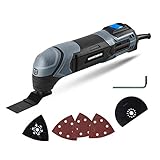
- Powerful Motor - The 2. 2-Amp motor delivers up to 20, 000 OPM for easy cutting, sawing, trimming, grinding and sanding
- Ergonomic Design - Compact size and ergonomic soft grip provides optimal handling and control of the tool
- Variable Speed Dial – Adjust the speed for different applications
- Universal Collet System - Compatible with standard oscillating multi-tool blades and accessories on the market
- Bright LED Light – Light where you need it
The multitool is therefore a strong choice when one task includes several operations: make a localized cut, remove adhesive, prepare the surface, and smooth a detail. Its value is not that it replaces every saw; it is that the same compact platform accepts different accessories.
When a reciprocating saw is the better choice
Rough cutting and demolition
Lowe’s recommends a reciprocating saw when rough, heavy-duty cutting or demolition is frequent. Choose it when the priority is removing material and the cut does not need to be flush or cosmetically precise.
Typical work includes opening up an assembly for removal, cutting through framing during demolition, or separating material where the surrounding finish will be replaced. A reciprocating saw’s role is to get through the unwanted material efficiently enough for the project, not to leave a finished edge.
Longer or less controlled cuts
When there is room to approach from an exposed edge and the cut line can tolerate a rougher result, the reciprocating saw is generally the more natural tool of these two. It is also the practical choice when the job involves repeated heavy cuts rather than one careful notch.
That recommendation is about use case, not a universal claim that every reciprocating saw cuts faster than every oscillating multitool. Blade type, material, access, power source, and the specific model all affect results.
Plunge cutting: material limits matter
The cited Bosch reciprocating-saw manual describes plunge cutting in softer materials such as wood or light building materials. It does not permit the same approach in metal or other thick or hard materials.
For metal, thick material, or hard material, start from an edge or make a sufficiently large pre-drilled hole. Do not treat a procedure permitted for soft wood as a general permission to plunge into every material. The manual for the particular saw and blade controls.
Rank #3

- The 3-speed selector of DEWALT 20V tools allows users to choose their speed setting based on application.
- Brushless motor of DEWALT oscillating tool delivers up to 57% more run time over brushed
- Dual-Grip variable speed trigger of DEWALT cordless tools gives users ultimate speed and application control
- Universal accessory adapter for use with most oscillating tool accessory brands. Oscillations/min: 0-13,000/ 0-17,000/ 0-20,000 OPM
- Quick-Change accessory system allows blades and attachments to be changed quickly without wrenches
How to choose for a specific job
Make the decision before selecting a blade. Walk through these questions in order.
Do these 3 things before closing this tab:
1Clear out junk files and repair common Windows errors2Scan for outdated or missing drivers - takes under a minute3Repair Windows errors before they cause bigger problems- Can you reach the cut comfortably? If the opening is narrow, the cut is close to a wall or finished surface, or a larger saw body would collide with adjacent work, favor the oscillating multitool.
- Must the cut be flush or precise? For a jamb, sill, toe kick, pipe end, or other cut that must finish close to a surface, favor the multitool.
- Are you removing a lot of material? For recurring rough cuts, heavy cutting, or demolition, favor the reciprocating saw.
- Where does the cut begin? A multitool with a plunge-cut blade can start in the middle of a workpiece. A reciprocating saw may plunge in softer material only when its manual permits it; for metal and thick or hard material, approach from an edge or a sufficiently large hole.
- Does the job continue after the cut? If scraping, surface preparation, or detail sanding follows, the multitool can reduce tool changes.
- What finish is acceptable? If the edge will be hidden or the assembly is being demolished, the reciprocating saw’s rough-cut role is appropriate. If the adjoining finish remains, use the more controlled multitool approach.
If both categories of work recur, owning both tools is reasonable. They cover different parts of a construction workflow rather than duplicating one another.
Accessory selection and compatibility
Oscillating multitool accessories
- Plunge-cut or flush-cut saw blades: for starting in the middle of a workpiece, cutting close to an edge, or trimming flush.
- Scraper blades: for carpet backing, adhesive, caulk, and related removal work.
- Sanding accessories: for detail sanding and localized surface preparation.
Match the accessory to the material and the cut. A blade intended for a particular material is not automatically suitable for every substrate, and the interface must fit the tool.
Reciprocating-saw blades
Select a blade suited to the material and the type of cut. The Bosch manual’s plunge-cut warning applies to the saw procedure, but blade selection remains essential for wood, metal, and building materials. For hard or thick material, plan an edge entry or pre-drilled starting hole instead of forcing a plunge.
Check the interface before buying
The phrase oscillating multitool is the useful search term when looking for the tool category and its accessories. Compatibility depends on the specific tool and accessory interface. Check the model specification before purchase rather than assuming that every oscillating blade or reciprocating blade fits every tool.
Outdated Drivers Are Slowing You Down
One free scan finds every outdated or missing driver and matches the right update for your exact hardware.Free scan · exact hardware matchWindows Errors? Fix Them Before They Spread
Repair common Windows errors and clear accumulated junk for a smoother, more stable PC - no reinstall needed.Free scan · no reinstallOne published model specification illustrates why generalizing can mislead: Bosch’s GOP55-36B product page, accessed in 2026, lists up to 20,000 oscillations per minute and a 3.6-degree oscillating arc. Those figures describe that Bosch model only; they are not category-wide specifications and are not a head-to-head performance test.
Safe operating practices for an oscillating multitool
Bosch’s oscillating-tool manual gives several operating limits that are particularly important during flush and plunge work:
Rank #4
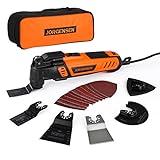
- 5° Oscillating Angle: 5° oscillating angle makes working more efficient. Compared with normal oscillating tool, 4-5 times
- 16-piece Electric Multitool Accessories: Includes 1-5/16" Flush-Cut Wood Sawblade, 1-5/16" Bi-Metal Flush-Cut Universal Sawblade, 2-11/16" Flush-Cut Wood Sawblade, 3-1/2'' Flush Cut Oscillating Tool Blade, Oscillating Scraper Blade, Oscillating Sanding Pad, 10 Pcs Sanding Paper: 60 / 80 / 120 / 180 / 240 grit x 2 Pcs
- Quick Change: JORGENSEN vibrating saw achieve quick change of the blades. Additional locking bracket protects your finger from clipping in the blade-change-process. Quick-Change Attachments design provides you higher efficiency by saving time
- 7 Variable Speed & Wide Applications: 6-speed switches allow users to; JORGENSEN oscillating tool has 7-speed position with 8,000-16,000 OPM, that appropriate output speed can be easily customized to your needs while working. With versatile accessories, you can use this tool to do various household projects, such as cutting, scraping, sanding, cleaning, polishing and more
- Ergonomic Design: Slim body engonomic design soft grip provides the best cutting performance for long-time usage, in the meantime provides convenient and stable operation for users; Universal fit system matches most brands of blades or other accessories
- Keep the accessory away from your body.
- Never place a hand near or directly in front of the working area.
- Hold the tool with both hands.
- Wear protective gloves.
- Do not force the tool during a flush-cut plunge.
Before starting, identify the cut line and check the hidden side of the workpiece for wiring, plumbing, fasteners, or other hazards. Secure the work where practical. Let the accessory cut rather than levering the tool sideways, which can damage the blade, the surface, or your control of the tool.
Flush-cut procedure
- Mark the section to remove and confirm that the adjoining jamb, sill, toe kick, or pipe is the part that must remain.
- Install a compatible flush-cut or plunge-cut blade and verify that it is secured according to the tool manual.
- Grip the multitool with both hands and position your hands away from the accessory’s path.
- Start at a controlled speed and let the blade establish the kerf without forcing the plunge.
- Keep the blade aligned with the marked line and stop before contacting hidden material that has not been identified.
- Remove the offcut, inspect the edge, and use a scraper or sanding accessory only after the saw blade is stopped and changed safely.
Safe operating practices for a reciprocating saw
The Bosch reciprocating-saw manual’s plunge procedure begins with the saw’s footplate against the material and the blade tip positioned on the marked line before engaging the blade. Follow that model-specific sequence only for materials the manual allows.
What’s actually slowing this PC down?
Pick the symptom - the matching free tool is one click away.
Plunge cutting in permitted soft material
- Confirm that the material is a softer material such as wood or light building material and that the saw manual permits a plunge cut.
- Mark the opening and check the area behind it.
- Place the footplate against the material.
- Set the blade tip on the marked line.
- Engage the blade and pivot the saw under control until the blade enters the material.
- Continue the cut while maintaining stable contact and control.
Metal, thick, or hard material
Do not use that plunge procedure in metal or other thick or hard material. Start from an exposed edge or drill a hole large enough for the blade to enter safely, then proceed with the cut. The exact blade, speed, and setup must follow the saw and blade manufacturers’ instructions.
Independent reader supportYour contribution helps us test, update, and keep practical guides available for everyone.Common mistakes and how to correct them
Using a reciprocating saw for a flush finish
A reciprocating saw can remove material, but it is the wrong first choice when the adjoining finish must remain clean and the cut must terminate flush. Switch to an oscillating multitool with a suitable blade for the final controlled cut.
Expecting a multitool to perform demolition duty
A multitool can make a difficult localized cut, but repeated heavy removal is the reciprocating saw’s stronger application. If progress is slow because the task is fundamentally demolition, use the tool intended for rough material removal rather than applying more force.
Plunging into hard material without checking the manual
The Bosch reciprocating-saw instructions specifically rule out plunge cutting in metal and thick or hard material. Correct the setup by exposing an edge or drilling a sufficiently large starting hole. Never transfer a soft-material procedure to a different substrate without confirmation.
Choosing an accessory by shape alone
Two blades may look similar while being intended for different materials or interfaces. Verify both the attachment system and the blade’s stated application before installation.
Best Value

- Powerful Oscillating Saw: The 3.0 Amp motor of the WORKPRO Oscillating Power Tool provides excellent power. The 3° oscillation angle of the blade significantly improves work efficiency. This tool is suitable for cutting, sawing, polishing, and dressing various materials, including medium and low-hardness metal pipes, wood, nails, screws, and more
- Multi-Speed Adjustment: With 7 speed settings ranging from 15,000 RPM to 23,000 RPM, this tool can meet the needs of various renovation projects. Adjusting the speed allows for efficient and high-quality work
- Tool-Less and Universal Fit: Replacing accessories is quick and easy with just three simple steps. Move the flip button, change the saw blade, and press the button to complete the process—no spanner required, saving you time and effort. The WORKPRO Multifunctional Oscillating Saw features a universal accessory interface compatible with most accessory brands
- Comfortable and Convenient to Use: Activating the oscillating tool is as simple as pressing the on/off switch at the top. The ergonomic design allows for easy control of vibration and straightforward operation to complete tasks efficiently
- 17 pcs Accessories: 2 pcs wood/metal blades, 3 pcs wood and plastic saw blades, 1 pc scraper, 1 pc sanding pad, 10 pcs sanding sheets, 1 pc user manual, 1 pc oscillating tool kit
Using one tool because it is already in your hand
Tool convenience can create rework. Decide whether the priority is access and finish or material removal first; then choose the tool that matches that priority.
Which tool should a contractor keep on site?
For renovation and finish-sensitive work, an oscillating multitool earns its space through access, flush trimming, scraping, surface preparation, and detail sanding. It is particularly useful when one small area requires several different operations.
For demolition-heavy work, a reciprocating saw is the more appropriate primary tool for rough and heavy cutting. It is the better fit when the surrounding material is being removed anyway and the project values throughput over a finished edge.
Quick wins for a faster PC:
Repair Windows errors before they cause bigger problemsFix Now →Scan for outdated or missing drivers - takes under a minuteDriver Scan →Clear out junk files and repair common Windows errorsFree Scan →A two-tool setup is the most flexible answer when both patterns are common: use the reciprocating saw to remove bulk material, then use the oscillating multitool for the controlled cut, flush trim, scrape, or detail finish that follows. This is a division of labor, not a claim that one model will always outperform another.
What the available specifications do—and do not—tell you
The Bosch GOP55-36B specification of up to 20,000 oscillations per minute and a 3.6-degree oscillating arc provides useful information about that individual model’s operating range. It does not establish the speed, power, vibration, runtime, or cutting ability of all oscillating multitools, and it does not compare that model with a particular reciprocating saw.
Likewise, Lowe’s recommendation of a reciprocating saw for frequent rough cutting and demolition is a use-case recommendation, not a universal timed comparison. Actual results depend on the model, blade, material, access, operator control, and condition of the accessory.
Quick Recap
Decision checklist
- Choose the oscillating multitool when the cut is tight, flush, precise, or close to a finished surface.
- Choose the oscillating multitool when scraping, surface preparation, or detail sanding is part of the same task.
- Choose the reciprocating saw when rough, heavy-duty cutting or demolition is frequent.
- Use a reciprocating-saw plunge cut only in materials and circumstances allowed by that model’s manual.
- For metal and thick or hard material, start at an edge or use a sufficiently large pre-drilled hole rather than plunge cutting.
- Verify blade material rating and attachment compatibility before purchase.
- Do not infer category-wide performance from the Bosch GOP55-36B’s published specification.
Product prices and availability are accurate as of the date/time indicated and are subject to change. Any price and availability information displayed on Amazon at the time of purchase will apply.
Recommended Free Tools

