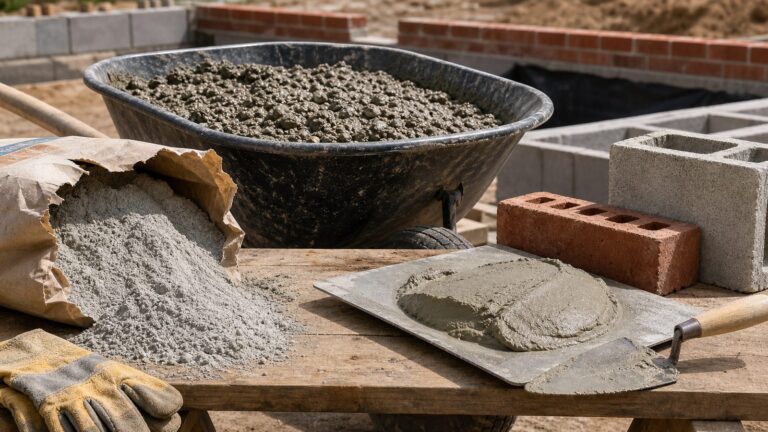
Choose cement by the project specification, exposure conditions and required construction schedule—not by the abbreviation alone. In India, the relevant product standards are IS 269:2015 for Ordinary Portland Cement (OPC), IS 1489 (Part 1 or Part 2):2015 for Portland Pozzolana Cement (PPC), and IS 455:2015 for Portland Slag Cement (PSC). BIS describes OPC for general construction and lists PPC applications including hydraulic, mass-concrete and marine structures; it also identifies situations requiring specially high early strength as an exception to its general PPC guidance. These are starting points, not substitutes for the project’s cement specification or an engineer’s decision.
This guide compares the standards, constituent information and application examples in BIS material, then sets out checks to make before buying or proposing a substitution. It does not claim a universal performance or price winner: the right choice depends on the specific product and the requirements of the job.
| # | Preview | Product | Price | |
|---|---|---|---|---|
| 1 |

|
Tech Mix Portland-Limestone Cement, 15 Pounds | $30.99 | Buy on Amazon |
| 2 |

|
White Portland Cement 10 Pound Bag | $22.74 | Buy on Amazon |
| 3 |

|
Quikrete Concrete Mix Bag 10 Lbs. | Buy on Amazon | |
| 4 |

|
Tahikem 3 Pack 12x24 Inch Heavy Duty Grout Mortar Bags with Tip-Blue | $18.99 | Buy on Amazon |
| 5 |
|
White Portland Cement 5 Pound Bag | $14.82 | Buy on Amazon |
As an Amazon Associate I earn from qualifying purchases.
OPC, PPC and PSC at a glance
The three names identify different cement types and standards. They do not, by themselves, specify a particular product’s grade, test results, suitability for an exposure condition or performance on a construction schedule. Use the applicable Indian Standard and the product’s declared grade as part of the comparison. The project specification remains the controlling reference for what can be used.
The Tool Desk
Outbyte PC Repair FREERepair Windows errors before they cause bigger problemsFix Now →Outbyte Driver Updater FREEScan for outdated or missing drivers - takes under a minuteDriver Scan →| Type | Indian Standard | Constituent information in BIS material | BIS application guidance |
|---|---|---|---|
| OPC — Ordinary Portland Cement | IS 269:2015 | No constituent percentage is stated here for comparison. | General construction, including building construction, concrete pavements, flooring and plastering. |
| PPC — Portland Pozzolana Cement | IS 1489 (Part 1):2015 for fly-ash-based PPC; IS 1489 (Part 2):2015 for calcined-clay-based PPC | Part 1 specifies fly ash at 15–35% by mass. BIS material does not give a comparable constituent range for Part 2. | Applications include hydraulic, mass-concrete and marine structures; the compendium also lists building construction, highways and infrastructure for calcined-clay PPC. |
| PSC — Portland Slag Cement | IS 455:2015 | Granulated slag at 25–70% by mass. | The cited compendium identifies the cement and its constituent range but does not establish a universal application ranking against OPC or PPC. |
The PPC and PSC percentages above are specification composition ranges reported in the BIS Compendium of Cement Standards, surfaced in 2025. They describe permitted constituent proportions, not a particular bag’s test result, strength ranking or proof that one cement is right for a given structure. PPC Part 1 and Part 2 should not be treated as interchangeable formulations.
#1 Best Overall
- MULTIPURPOSE: Basic building material for crafts, pavement, sidewalks, reinforced concrete buildings, masonry units, and more
- MIX AND USE: Use to create concrete, mortar, and stucco mixes
- GREAT FOR DIY PROJECTS: Ideal for small crafts with forms and silicone molds
- HIGH STRENGTH: Solid once dry, dry in 48 hours
- LESS IS MORE: One bag yields approximately .16 cu. ft.
In practical terms, the first useful comparison is not “which abbreviation is best?” but “which standard, part and grade does the project require, and what evidence does the proposed product provide?” Then consider whether the application examples are relevant to the structure and whether the product is actually approved under the project documents.
What each cement type means for a project
OPC: a general-construction option
BIS describes OPC under IS 269:2015 for general construction work, including buildings, concrete pavements, floors and plastering. The compendium’s wording is broad: it says OPC is used in “all types of general construction work such as building construction, concrete pavements, flooring, plastering, etc.” That makes OPC a relevant candidate where it matches the specified grade and project requirements. It does not mean every OPC product is suitable for every structural element or exposure.
OPC is often the simplest category to identify by its standard, but the type name still does not tell you everything needed for a purchase or a design decision. Confirm the applicable grade and product declaration, check the standard marking and compare the documents for the actual cement being supplied. If a specification names OPC, do not assume that a different cement type is automatically acceptable just because it is also a cement used in construction.
Free tools Windows power users keep installed
One-click scans. No signup required.
PPC: distinguish the two standard parts
PPC is covered by IS 1489 in two parts: Part 1 is fly-ash-based and Part 2 is calcined-clay-based. For fly-ash-based PPC, BIS gives a fly ash content range of 15–35% by mass. That range is useful for understanding the standard’s description of this cement; it is not a guarantee of the behavior of a particular mix and does not itself establish a performance ranking.
BIS lists hydraulic structures, mass concrete such as dams, bridge piers and foundations, and marine structures among applications for fly-ash-based PPC. It also describes use in other situations where OPC is used, except where high early strength is a special requirement. This qualification matters: if the schedule or design has a specific early-strength need, the general application statement does not answer whether a given PPC product is appropriate. The requirement must be interpreted by the project’s qualified engineer using the specification and product evidence.
Rank #2
- WHITE PORTLAND CEMENT FOR SWIMMING POOL REPAIRS AND MOLD CASTING
- TYPE 1 CEMENT FOR CONCRETE PROJECTS
- USE TO MAKE COLORED CONCRETE AND GROUT
- USE IN ALL CONCRETE MIXTURES FOR POURING MOLDS
- MIX WITH SAND AND GRAVEL TO MAKE CONCRETE
For calcined-clay-based PPC, the compendium’s examples include building construction, marine and coastal structures, mass concrete, highways and infrastructure. These examples are useful context, but they are not blanket approvals for all such works. Check which part of IS 1489 the product claims to meet, since Part 1 and Part 2 indicate different pozzolana bases. Do not treat “PPC” as a sufficiently precise description when the relevant project or product information distinguishes the part.
PSC: identify the slag-based product
PSC is covered by IS 455:2015. BIS gives granulated slag as a constituent at 25–70% by mass. That range helps identify the standard’s composition requirements; it does not establish a general strength, durability, heat or curing-time advantage over a specific OPC or PPC product. The source material used for this comparison does not provide a universal application ranking for PSC against the other two types.
Recommended Free Tools
If PSC is proposed for a project, treat it as a product to be checked against the written requirements, not as a substitute justified solely by its slag content. Confirm the standard and grade declared for the product, review the available product or test information, and obtain the necessary project approval before purchase or substitution.
How to decide which cement is right
Start with the written project requirements, then check the product and local supply against them. The cement type should follow the design and specification, not replace them. This sequence also helps avoid comparing products that are not equivalent in the first place.
- Read the project specification. Identify the required cement type, applicable standard, grade and any restrictions. Check whether the documents name a particular cement type or standard, or set conditions for approving a proposed alternative. If the specification names a type or standard, do not substitute another solely because it is locally available or marketed for a similar use. A change should be reviewed through the project’s approval process.
- Confirm the exposure and structural application. Give the engineer the relevant conditions and element details. BIS application examples for PPC can inform the discussion, but BIS material does not establish suitability for every exposure class, mix design or structural element. An example such as marine work or a foundation is a reason to consult the design documents, not a stand-alone selection rule.
- Check whether early strength is a specific requirement. BIS’s general PPC guidance expressly excludes cases where high early strength is specially required. Ask the project’s qualified engineer to interpret the schedule and specification; the cement label alone does not show how a particular mix will perform at a required age. Do not infer a universal early-strength ranking for OPC, PPC and PSC from their names.
- Verify the cement bag and product documents. Check the applicable IS number and the product’s declared grade and standard marking. Request the manufacturer’s product and test information for the specific cement being supplied, and have it checked against the specification. A general product description is not a substitute for evidence for the actual product.
- Confirm project acceptance before ordering. If the available product differs from what is named in the specification, take the proposed standard, grade and product documentation to the responsible engineer or project authority. A broad BIS application example does not approve a substitution for a particular design.
- Compare delivered quotes only after confirming equivalence. For products that satisfy the project requirement, compare current local quotes for the same bag size, grade, brand, delivery terms and date. There is no established general price winner among OPC, PPC and PSC. A quote for a different grade, package size or delivery arrangement is not a like-for-like comparison.
For a homeowner or buyer assembling a materials checklist, write down the required type and standard rather than shopping from an abbreviation alone. A checklist might identify “OPC cement,” “PPC cement” or “PSC cement,” but it should direct the buyer to verify the standard and grade against the project documents. The cement bag is the central physical product; do not treat a product listing, label shorthand or marketing phrase as proof that it meets the job’s requirements.
Rank #3
- Quikrete Concrete Mix Bag 10 Lbs.
Which type should you consider for common situations?
The examples below are orientation based on BIS’s described applications. They are not design instructions or a substitute for approval under the project specification. The examples say where a type is described as used; they do not say that it must be selected in every project of that kind.
Outdated Drivers Are Slowing You Down
One free scan finds every outdated or missing driver and matches the right update for your exact hardware.Free scan · exact hardware matchWindows Errors? Fix Them Before They Spread
Repair common Windows errors and clear accumulated junk for a smoother, more stable PC - no reinstall needed.Free scan · no reinstall| Project situation | What the BIS guidance indicates | What to confirm before selection |
|---|---|---|
| General building work, flooring, plastering or concrete pavement | BIS describes OPC for general construction, including these uses. Its PPC descriptions also include building construction. | Required cement standard and grade, element-specific requirements and approval in the project specification. |
| Hydraulic or mass-concrete work, such as dams, bridge piers or foundations | BIS lists these among applications for fly-ash-based PPC; calcined-clay PPC examples also include mass concrete. | Which PPC part, if any, is specified; the design’s exposure and mix requirements; and whether the proposed product is approved. |
| Marine or coastal work | BIS lists marine structures for fly-ash-based PPC and marine and coastal structures among calcined-clay PPC examples. | Project-specific exposure requirements and the engineer’s approved cement and mix specification. An application example alone does not establish suitability. |
| Highways or infrastructure | The compendium’s calcined-clay PPC examples include highways and infrastructure. | The standard part, grade and product acceptance specified for the actual project. Do not assume that the example overrides the design or procurement documents. |
| Work with a special high-early-strength requirement | BIS flags this as an exception to its general PPC application guidance. | The specified strength development and timing requirements, and the engineer’s selected cement and mix. No universal OPC/PPC/PSC strength ranking is established here. |
These examples can help frame a conversation with the designer, but they cannot answer every project-specific question. For example, BIS material does not determine which cement to use for every concrete element, exposure category, mix design or construction schedule. Nor does it identify one universally preferred choice for all buildings or infrastructure. Those decisions belong in the project’s engineered specification.
What the standards and bag marking can—and cannot—tell you
The standard number tells you which product specification the cement is represented as meeting. For OPC, BIS’s standard-details listing identifies IS 269:2015 as a mandatory-certification product specification and reports December 2025 as its reaffirmation year. Because listings and applicable requirements can change, confirm the current BIS listing and the product marking when purchasing. The IS number alone is not a complete project specification: also verify the declared grade, product documentation and project acceptance.
Use a simple evidence check:
- Standard: IS 269:2015 for OPC; IS 1489 Part 1 or Part 2:2015 for PPC; IS 455:2015 for PSC. For PPC, identify the part rather than recording only the broad type name.
- Grade and product declaration: confirm what the specific product declares rather than assuming that a type name supplies all needed details. Match the declaration to the project’s stated requirement.
- Standard marking: examine the bag and product information for the applicable standard mark and details. For OPC in particular, check the current BIS listing and applicable product certification context rather than relying on an old listing reference.
- Test information: use information for the actual product and supply, not a broad type-level claim or a manufacturer’s general description. Ask the supplier or manufacturer for the relevant product/test information if it is needed for the project review.
- Project approval: have the proposed cement checked against the engineer’s specification before ordering or substituting. If the product is different from the specified one, do not assume the change is acceptable without review.
Composition ranges are another point that can be misunderstood. The 15–35% fly-ash figure applies to fly-ash-based PPC under IS 1489 Part 1, and the 25–70% granulated-slag figure applies to PSC under IS 455, according to the BIS compendium. These are ranges in standards, not a report of the constituents in a particular delivery or a direct predictor of the project’s concrete behavior. The cited material does not give a corresponding Part 2 constituent range for calcined-clay PPC in the information used here, so avoid inventing one.
Claims that cannot settle the choice on their own
The available BIS material does not provide a directly comparable strength-development curve for every OPC, PPC and PSC product. Nor does it establish a universal ranking for early strength, final strength, heat evolution, durability or curing time. Those properties cannot responsibly be inferred from the type name or constituent range alone; they depend on the specific product and project conditions and must be evaluated using applicable specifications and test information.
Rank #4
- 🏘️Great Value Masonry Tools: Includes 3 pcs grout bag + 1 pcs brick jointer + 1 pcs tuck pointers. The grout bag set is well suited for fitting-out works such as grouting, masonry and tile juncture, caulking, projects of stone bricks or floor tiles, mortar and cement, etc.
- 🏘️ Professional Tuck-Pointing Tools: Whether you're a professional mason or a DIY enthusiast, use Tahikem brand tile tile bag to fill with grout to get the job done quickly and protect your hands from dirty mess and other harsh substances. Brick jointer can make a professional finish to joints between bricks, and tuck pointers help tuck mortar between bricks and blocks.
- 🏘️ How to Use: Soak the grout bags masonry in water for 5 minutes before use, which can make your grouting process smoother, and then you can start working. You will find that you have never used such a useful grouting mortar tool.
- 🏘️ Easy to Clean Up and Money-saving: Designed for easy-cleaned and convenient for application of grouting. The concrete grout bag can be cleaned and is reusable depending on the material of application. As a decorator, the Tahikem brand mortar bag will save you a massive expense on materials. Tip: it is recommended to use warm water to clean the grout bag.
- 🏘️ High-Quality Material: Masonry bags are made from heavy duty canvas with heat sealed seam and waterproof vinyl. This PVC canvas is tear and puncture resistant so you can do your work without unnecessary interruptions. this mortar piping bags with molded in tip is designed to help you carry out your tasks efficiently, it can be applied as an applicator for a variety of materials such as cement, grout, mortar, and concrete.
That limitation is especially important when a project has a deadline or a specified strength at a particular age. BIS’s PPC guidance recognizes high early strength as a special requirement, but BIS material does not supply a numeric age-by-age comparison or establish which product will satisfy a particular schedule. Use the engineer’s performance requirements and the relevant test evidence for the actual product and mix rather than relying on a generalized claim.
Likewise, no general price winner is established. Prices vary by location, supply and quotation date, so compare equivalent delivered products locally. Include the same bag size, grade, brand, delivery terms and date in the comparison. Avoid treating a broad marketing description as independent, project-specific test evidence. Industry or manufacturer descriptions can provide context, but they should be identified as such and should not replace product-specific verification.
The BIS material used for this guide also does not establish comparative market shares, project-specific emissions, or a universal advantage for one cement type. If a supplier makes a claim in one of these areas, request the relevant product-specific evidence and check whether it addresses the same project conditions and comparison basis.
Independent reader supportYour contribution helps us test, update, and keep practical guides available for everyone.Sources and scope
This guide uses Indian Bureau of Indian Standards material: the Indian Standards on Cement Specifications (Compendium of Cement Standards) for standards, composition ranges and application examples, and BIS’s standard-details listing for IS 269:2015 certification and reaffirmation context. The selection guidance is limited to that Indian standards context; verify the applicable requirements for the project’s location and specification.
What’s actually slowing this PC down?
Pick the symptom - the matching free tool is one click away.
The BIS material provides useful orientation, not a substitute for structural design. It does not settle which cement is suitable for every exposure, element, mix design or schedule, and it does not support a universal price or performance winner. Confirm the actual product standard, grade, marking and test information, then follow the project specification and qualified engineer.
Best Value
- WHITE PORTLAND CEMENT FOR MOLD CASTING
- TYPE 1 CEMENT FOR CONCRETE
- USE TO MAKE COLORED CONCRETE AND GROUT
- USE IN ALL CONCRETE MIXTURES FOR POURING MOLDS
- MIX WITH SAND AND GRAVEL TO MAKE CONCRETE
Frequently Asked Questions
Which is better: OPC, PPC or PSC?
There is no universal winner in the BIS material used here. Compare the project specification, exposure and schedule with the product’s applicable standard, declared grade and available test information. Have the proposed cement approved by the qualified engineer.
What is the difference between PPC Part 1 and Part 2?
IS 1489 Part 1:2015 covers fly-ash-based PPC, while Part 2:2015 covers calcined-clay-based PPC. BIS gives a fly ash range of 15–35% by mass for Part 1. Do not assume the two parts are the same formulation.
What do the PPC and PSC percentages mean?
The BIS compendium gives fly ash at 15–35% by mass for fly-ash-based PPC under IS 1489 Part 1, and granulated slag at 25–70% by mass for PSC under IS 455. These are specification composition ranges, not test results for a particular bag or a direct strength ranking.
Is PPC suitable when a project needs high early strength?
BIS describes PPC applications generally but identifies specially required high early strength as an exception. BIS material does not provide a universal strength-development ranking or curve for every product. Ask the project engineer to assess the specified timing and product/test information.
Can I use PPC for marine work, foundations or mass concrete?
BIS lists marine structures and mass-concrete applications, including dams, bridge piers and foundations, for fly-ash-based PPC; it also lists marine/coastal work and mass concrete for calcined-clay PPC. These are examples, not blanket approvals. Follow the project’s exposure requirements, mix specification and engineer’s approval.
Does OPC have mandatory BIS certification?
The BIS standard-details listing cited in this article identifies IS 269:2015 for OPC as a mandatory-certification product specification and reports December 2025 as its reaffirmation year. Listings and requirements can change, so check the current BIS listing and product marking at purchase time.
Which cement type is cheapest?
BIS material does not establish a general price winner. Compare current local quotes for products that meet the project requirement, using the same bag size, grade, brand, delivery terms and quotation date.
Quick wins for a faster PC:
Clear out junk files and repair common Windows errorsFree Scan →Scan for outdated or missing drivers - takes under a minuteDriver Scan →Repair Windows errors before they cause bigger problemsFix Now →The Bottom Line
Bottom line: Use the cement type, standard and grade required by the project—not a general claim that OPC, PPC or PSC is always best. BIS identifies OPC for general construction, distinguishes fly-ash and calcined-clay PPC under separate parts of IS 1489, and specifies a granulated-slag range for PSC. Treat application examples and constituent ranges as guidance, verify the actual product and its test information, and let the project specification and qualified engineer decide suitability.
Quick Recap
Product prices and availability are accurate as of the date/time indicated and are subject to change. Any price and availability information displayed on Amazon at the time of purchase will apply.