Windows Errors? Fix Them Before They Spread
Repair common Windows errors and clear accumulated junk for a smoother, more stable PC - no reinstall needed.Free scan · no reinstallCrashes, No Sound, or Screen Glitches?
Random freezes, missing sound and display glitches usually trace back to one bad driver. Find and replace yours safely.Free scan · under a minuteA linear actuator converts energy into controlled straight-line motion. It can push, pull, lift, lower, slide, tilt, clamp, or position a load. In construction and building projects, actuators are commonly used for automated hatches, access panels, vents, doors, adjustable fixtures, lifting mechanisms, and equipment controls.
“Linear actuator” describes a function rather than one particular machine. The category includes electric screw-driven actuators, pneumatic and hydraulic cylinders, rodless systems, precision screw axes, and linear motors. This guide focuses primarily on the self-contained electric rod actuator while explaining when another technology is the better choice.
As an Amazon Associate I earn from qualifying purchases.
What is a linear actuator?
A linear actuator produces movement along a straight path. This distinguishes it from a rotary actuator or ordinary motor, which produces angular rotation.
The Tool Desk
Outbyte PC Repair FREERepair Windows errors before they cause bigger problemsFix Now →Outbyte Driver Updater FREEFix the driver behind crashes, sound loss and screen glitchesFind Drivers →An electric actuator normally combines a motor, gearbox, screw mechanism, bearings, housing, and end-of-travel protection in one assembly. The motor itself usually produces rotation; the actuator converts that rotation into useful linear travel. A linear guide or rail, by contrast, guides movement but does not necessarily create it.
#1 Best Overall

- 1000N/220lbs Heavy Duty 100mm: Our linear motion actuator is equipped with a maximum push-pull load of 220lbs (1000N). The high-quality aluminum alloy construction of this linear actuator 12v 4 inch stroke offers exceptional durability for long-term use
- Powerful & Speedy Performance: This high speed linear actuator boasts a travel speed of 14mm/s, which make our heavy duty 12v linear actuator tackles demanding tasks with ease
- Quiet & Secure Operation: Upgraded low-noise design (under 50dB) ensures our 12v actuator's smooth operation. Built-in limit reverse polarity switches 12v and safety locks prevent overruns and guarantee users' safety
- Waterproof & Versatile: IP54-rated waterproof linear actuator allows use in various environments, from homes to farms. Our electric actuator is ideal for furniture, medical equipment, automation projects, and more
- Easy Installation: The electric actuator includes a mounting bracket and a polarity reversing switch for simple installation. This makes it easy and convenient to connect and set up your actuator 12v
Typical construction-related uses include:
- Opening and closing roof hatches, doors, louvers, and access panels.
- Raising or lowering equipment and work surfaces.
- Tilting lids, platforms, or adjustable fixtures.
- Moving gates, dampers, clamps, and sliding mechanisms.
- Replacing repetitive manual adjustment.
- Keeping operators away from hazardous or difficult-to-reach machinery.
How an electric linear actuator works
A typical DC rod actuator contains:
- An electric motor.
- A gearbox that reduces speed and increases torque.
- A lead screw or ball screw.
- A nut or screw follower.
- An extension tube and output rod.
- Bearings and a protective housing.
- Internal limit switches or electronic end-of-travel protection.
- Optional feedback, including a potentiometer, Hall sensor, encoder, clutch, brake, or integrated controller.
The motor turns the screw through the gearbox. As the screw rotates, the nut travels along it, extending or retracting the rod. On many two-wire DC models, reversing polarity reverses direction, although the wiring and control method must always be checked against the specific model.
Lead screws and ball screws
Lead screws are generally simple, economical, and suitable for moderate-speed lifting, positioning, and push-pull applications. Depending on screw pitch, friction, gearbox design, and load, they may resist backdriving when power is removed. That behavior must be confirmed in the manufacturer’s documentation; not every lead-screw actuator is self-locking.
Ball screws use rolling balls between the screw and nut. They typically offer higher efficiency, lower friction, greater speed, and improved positioning performance. They can also be more susceptible to backdriving and may require a brake or separate mechanical restraint.
Major types of linear actuators
| Type | Best suited to | Main advantages | Important limitations |
|---|---|---|---|
| Electric rod actuator | Simple lifting, opening, pushing, and pulling | Clean, self-contained, easy electrical control | Often limited duty cycle; sensitive to side loading |
| Precision screw actuator | Repeatable industrial positioning | Accuracy, feedback, and higher-duty options | Higher cost and stricter alignment requirements |
| Rodless actuator | Long horizontal travel or restricted installation depth | Carriage travels along the body without an extending rod | Requires attention to guidance, moments, sealing, and load distribution |
| Linear motor | High-speed, high-accuracy automation | Direct electromagnetic motion and rapid acceleration | Expensive and electronically sophisticated |
| Pneumatic cylinder | Fast repetitive end-position movement | Simple and economical where compressed air already exists | Needs compressor, valves, tubing, and air preparation; precise positioning is harder |
| Hydraulic cylinder | Heavy construction equipment and very high force | High force density and robust industrial performance | Requires pump, reservoir, valves, hoses, seals, and maintenance |
Electric rod actuators
For many small construction automation projects, a 12 VDC or 24 VDC electric rod actuator is the practical starting point. It avoids a compressed-air system or hydraulic power unit and often includes internal limit switches.
Its disadvantages matter just as much: speed normally falls as load increases, startup and stall current can be high, many units are intended for intermittent operation, and the rod should not be expected to carry bending loads. A low-cost hobby actuator, a medical actuator, and an industrial OEM actuator may all look similar while having very different duty cycles, certifications, and safety documentation.
Linear actuator specifications explained
Force: dynamic, static, and peak ratings
Force is usually stated in newtons (N), pounds-force (lbf), or kilonewtons (kN). The most important question is what the number means.
- Dynamic force is the load the actuator can move.
- Static force is the load it can hold while stationary under specified conditions.
- Peak or stall force may describe a short-duration maximum rather than a continuously usable operating load.
- Push and pull ratings may differ.
- Force at speed is often different from maximum force at a slower speed.
A 400 lbf rating does not automatically mean the actuator can safely lift a 400 lb object. Geometry, friction, leverage, acceleration, shock, mounting, and safety margin can increase the required actuator force substantially. Manufacturer guidance distinguishes dynamic and static actuator loads.
Stroke and overall length
Stroke is the distance the rod or carriage travels. Selection also requires the retracted length, extended length, mounting-hole dimensions, pivot angles, and clearance around the actuator.
Do not measure only the visible movement of a hatch or door. A pivoting mechanism may require a longer or shorter actuator stroke depending on where the mounting points are located. Confirm that the actuator reaches the intended position before the structure reaches an external hard stop.
Rank #2

- 14MM/S High Speed: This 6 inch (150MM) length 12v linear actuator is equiped with a high speed motor to make the travel speed reach 14mm/s, and max push pull load reaches 220lb/1000N, which makes the linear motion actuator fast and heavy duty enough to meet a variety of demands
- Low Noise & Safe: The motor of this electric actuator 12v is upgraded design with low noise (≤50dB sound), large self-locking force and strong durability. The built-in limit switch makes it automatically cut off the power when the linear actuator 12v reaches top/bottom. In addition, there is also a built-in safety lock to make the stroke stop at any position, which makes it much safer when use
- Sturdy & Durable: The 12v actuator is made of high quality aluminum alloy, which is stable and sturdy for most cases use, makes this 12v electric actuator durable and long lasting for use
- IP54 Waterproof: This heavy duty linear actuator is IP54 waterproof protection, can withstand harsh working environments, enabling automation in home, outdoor, medical, agricultural and other fields. Could widely be applied to window opener, electric sofa, electric wheelchair, electric nursing bed, automatic door opener, industrial electric lifting system, solar tracker, etc
- Easy to Install: The box of this waterproof linear actuator will include a set of mounting brackets and a polarity reversing switch for use, makes it easy and convenient to install and connect this fast linear actuator
Speed under load
Speed may be listed in millimetres per second, inches per second, or travel per minute. Datasheets may show no-load speed, full-load speed, speed at a particular voltage, or separate extension and retraction speeds.
Use loaded speed for cycle-time planning. For example, a 300 mm stroke completed in 10 seconds requires an average speed of:
Recommended Free Tools
v = 300 mm ÷ 10 s = 30 mm/s
The selected actuator must deliver approximately 30 mm/s at the actual load, voltage, temperature, and mounting condition—not merely at no load. The Thomson Electrak E050 data illustrates the difference between no-load and full-load speed.
Duty cycle
Duty cycle describes how long the actuator may operate before it needs to cool. A 25% duty cycle is often expressed as roughly 15 seconds running followed by 45 seconds resting, but the manufacturer’s definition controls. Load, ambient temperature, stroke, orientation, and operating pattern all affect thermal performance.
Some manufacturers specify duty cycle as a percentage; others use cycles per hour or travel per hour. Do not assume that running continuously at one-quarter speed makes a 25% duty-cycle actuator suitable for continuous service. For frequent operation, consider a purpose-built industrial actuator or another technology. Duty-cycle definitions and limits vary with load and product design.
Voltage and current
Small electric actuators commonly use 12 VDC or 24 VDC, with 48 VDC and AC-input industrial options also available. The supply and controller must tolerate running, startup, maximum-load, inrush, and stall current. A supply sized only for average running current may trip or overheat when the actuator starts or encounters resistance.
Limit switches and feedback
Limit switches stop travel at one or both ends. They may be factory-set, adjustable, external, or electronically programmed. A limit switch is not full position feedback: it normally indicates only that an endpoint has been reached.
Potentiometers, Hall sensors, encoders, analogue outputs, and digital bus interfaces can report intermediate position. Feedback supports repeatable positioning, fault detection, and synchronization. Two actuators receiving the same voltage should not be assumed to remain level or synchronized. Use matched feedback-equipped units and a suitable controller when parallel lifting must stay aligned. LINAK’s selector identifies load, speed, stroke, IP rating, voltage, and interface as key selection inputs.
IP rating and environmental protection
IP codes classify enclosure protection under IEC 60529. The first digit concerns solids; the second concerns water.
Rank #3
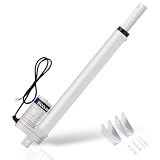
- 330lbs High Duty - All-steel shaft and metal gears deliver up to 330lbs of thrust. With a compatible controller, the actuator enables precise forward and reverse control, meeting heavy-duty industrial load requirements.
- Quiet Operation - Operates at noise levels below 55 dB for smooth and quiet performance, ideal for noise-sensitive environments. Built-in safety lock allows accurate and instant stopping during travel.
- 6-Point Safety Protection - Features over-current, over-load, over-voltage, over-discharge, short-circuit, and anti-shock protection. CE certified for enhanced safety, suitable for a wide range of automation applications.
- IP54 Weatherproof Durability - Aluminum alloy housing with IP54 protection resists dust, water, and corrosion. Built-in limit switches prevent motor idling and extend service life, perfect for outdoor and harsh environments.
- High Performance & Easy Installation - 10mm/s high-speed operation handles heavy-duty tasks efficiently. Equipped with mounting brackets and polarity reversal switch, powered by 12V for plug-and-play use, easy to install in furniture, medical, and automation projects.
- IP54: protection against dust sufficient for operation and splashing water.
- IP65: dust-tight and protected against water jets.
- IP66: dust-tight and protected against powerful water jets.
- IP67: dust-tight and protected against temporary immersion under specified test conditions.
- IP69K: associated with high-pressure, high-temperature washdown testing; verify the exact test conditions.
IP is not a general durability score. It does not by itself establish corrosion resistance, chemical compatibility, impact resistance, food-grade suitability, or safe operation while submerged. One IP level does not necessarily imply compliance with every other water-rating test. Operating conditions can differ from static laboratory test conditions.
Also check temperature range, vibration, condensation, salt exposure, connectors, cable sealing, and chemicals used during cleaning.
Backdriving and load holding
When power is removed, an actuator may hold mechanically, backdrive under load, or require a brake or external lock. The result depends on the screw, gearbox, friction, orientation, load, and product design.
Do not use a motor gearbox as the sole safety restraint for a suspended load or any application supporting people unless the manufacturer explicitly approves it. Use a brake, mechanical lock, safety latch, counterbalance, or other application-specific restraint where required.
How to size a linear actuator
1. Define the movement
Record the object being moved, direction, required travel, cycle time, cycles per hour, starting and ending positions, mounting locations, and whether intermediate stops are needed.
Free tools Windows power users keep installed
One-click scans. No signup required.
2. Calculate the real load
Include the moving object, payload, friction, gravity, acceleration, shock, wind, cable or hose drag, and uneven loading. For a direct vertical lift:
F = m × g
Here, F is force in newtons, m is mass in kilograms, and g is approximately 9.81 m/s2. This is only a starting point; it does not include mechanism losses or safety margin.
3. Account for leverage and changing geometry
For a hinged hatch, the actuator force changes throughout the arc. The worst position is often where the actuator’s line of action creates the smallest effective moment arm.
The basic torque relationship is:
T = F × r
where T is torque, F is actuator force, and r is the perpendicular moment arm. Draw a free-body diagram, measure the actuator angle at several positions, or use the manufacturer’s sizing calculator for nontrivial mechanisms.
Do these 3 things before closing this tab:
1Scan for outdated or missing drivers - takes under a minute2Repair Windows errors before they cause bigger problems3Fix the driver behind crashes, sound loss and screen glitchesRank #4
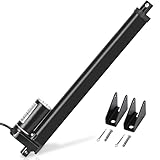
- Specification: stroke length: 12 inches(305mm); travel speed: 0.55in/sec(14mm/sec); retracted length: 370mm(15"); extended length: 620mm(25"); current draw: 3amps.
- Material: aluminum alloy housing, IP54-rated protection sealed against dust, water, and corrosion suitable for outdoor use. The internal limit switch automatically switches off when it reaches in case of the motor idling.
- Low noise: the low noise design, noise level below 50 dB; with reliable performance, stable running, the same characteristics of push and pull, and good environment adaptability, etc.
- Application: widely used in many industries, such as electric power, machinery, metallurgy, mining, petroleum, chemical industry, transportation, lifting, construction, food and feed processing, and so on.
- Professional team: DC HOUSE has been manufacturing linear actuators for many years, passing several technical tests.
Illustration brief: show a hinged lid with the lid’s centre of gravity, hinge, actuator attachment points, force arrow along the actuator, and the perpendicular moment arm. Add a second position showing that the angle—and therefore required force—changes as the lid opens.
4. Add an appropriate safety margin
Allow for friction variation, misalignment, wear, shock, temperature, tolerances, unexpected payload, and changes in geometry. There is no universal safety factor for every construction application; the appropriate value depends on risk, standards, manufacturer guidance, and whether failure could cause injury or property damage. THK treats static safety factor, service life, load ratings, and accuracy as separate selection considerations.
5. Confirm stroke and mounting envelope
Check retracted and extended lengths, clevis or trunnion orientation, bracket-hole size, pivot range, interference, side load, and access for maintenance. The frame, hinges, fasteners, and brackets must withstand the actuator’s forces as well.
6. Confirm loaded speed
Compare the required average speed with the manufacturer’s loaded-speed table or curve at the actual voltage and force. A no-load figure is not a reliable construction cycle-time estimate.
Quick wins for a faster PC:
Clear out junk files and repair common Windows errorsFree Scan →Fix the driver behind crashes, sound loss and screen glitchesFind Drivers →7. Check duty cycle and heat
Calculate movement time, rest time, cycles per hour, total travel, load profile, and ambient temperature. If the actuator runs frequently, choose a higher-duty product, reduce the load, change the motion profile, or consider a guided industrial axis, pneumatic system, or hydraulic system.
8. Select controls and protection
Determine whether you need a reversing switch, relay or H-bridge, motor controller, current limiting, fuse or breaker, emergency stop, feedback input, synchronization, brake, external limits, or mechanical lock. A two-wire DC actuator may reverse polarity, but the switching device must be rated for peak current and the motor’s inductive load.
9. Verify the complete mechanism
A correctly sized actuator can still destroy weak brackets, hinges, frames, pivots, or fasteners. The actuator should provide motion, not compensate for an underdesigned structure or missing guide.
Independent reader supportYour contribution helps us test, update, and keep practical guides available for everyone.Wiring and controlling a 12 V actuator
A basic two-wire 12 VDC actuator commonly extends and retracts when polarity is reversed. In a practical installation, the actuator circuit normally needs:
- A suitably rated 12 V supply.
- A fuse or circuit breaker close to the supply.
- A reversing switch, relay arrangement, or H-bridge controller rated for startup and stall current.
- Wiring sized for peak current and cable length.
- End-of-travel protection appropriate to the model.
- Emergency-stop and guarding arrangements where the mechanism creates a hazard.
Actuators with potentiometers, Hall sensors, or encoders need compatible controller inputs and wiring. Feedback wiring is not interchangeable across all brands. Always follow the model-specific wiring diagram; a generic diagram can be unsafe if the actuator has separate limit, brake, sensor, or controller leads.
Best Value

- 3000N Heavy Duty: The 12V linear actuator is equipped with a strong 3000N motor. With 5.9 inch (150mm) stroke length, 5 mm/s travel speed, this 12 volt actuator could enable much bigger thrust force tasks compared to other 3000N actuators
- Low Noise: The electric actuator 12V is made of aluminum alloy material. The internal gear of the actuator motor is upgraded to high-strength engineering plastic worm gear with low noise (≤50dB sound), large self-locking force, and strong durability
- Flexible Motion: The linear actuators kit comes with 3 position & momentary reverse polarity toggle switch, and push the switch to the"UP" or "DOWN", realizing the flexible retract & extend of the liner actuator. Furthermore, as the switch is released, the 12V linear actuator will be locked at your wanted position. Therefore, the motion control can be easily and safely implemented to meet your specific needs
- Wide Application: The electric actuator could perform tasks much efficiently and safely compared to manual operation. All in all, this actuator 12V could widely applied to window opener, electric sofa, electric wheelchair, electric nursing bed, automatic door opener, industrial electric lifting system, etc
- With Controller: The package of this electric actuator 12V will also includes a polarity reversing switch to meet special need. In addition, the switch will also be equiped with all necessary parts for use, such as mounting panel to adapt different hole size, waterproof cap to make it suitable for outdoor use, terminal connectors to make it convenient for connecting
Long, thin wiring can cause voltage drop, resulting in slower movement, reduced force, controller faults, poor synchronization, or overheating. Protect cables from sharp edges, crushing, water entry, and repeated flexing.
Common linear actuator mistakes
- Side loading the rod: Use external guides or a guided stage to carry bending loads.
- Exceeding duty cycle: Intermittent operation limits are thermal limits, not suggestions.
- Using no-load speed: Size to the speed available at the actual force.
- Confusing static and dynamic force: A holding rating is not automatically a lifting rating.
- Driving into hard stops: Repeated stalls can damage gears, screws, brackets, and motors.
- Ignoring backdriving: Add a brake, latch, lock, or counterbalance where gravity or inertia can move the load.
- Assuming parallel actuators synchronize: Equal voltage does not guarantee equal position.
- Relying on limit switches for machine safety: They provide end-of-travel protection, not complete guarding or risk control.
- Ignoring the structure: Brackets and hinges may fail before the actuator reaches its rated force.
- Mounting without service access: Leave room to remove the actuator, inspect pins, and replace cables.
Electric vs pneumatic vs hydraulic
Electric actuators are usually the cleanest and simplest choice for a self-contained installation. Pneumatics can be fast and economical where compressed air already exists, but the compressor, valves, filtration, tubing, exhaust, and air losses are part of the system. Hydraulics provide high force density for heavy equipment, but require a pump, reservoir, hoses, seals, valves, filtration, and leak management.
Efficiency is a system-level comparison, not a universal property of one actuator type. Consider duty cycle, load, control precision, existing infrastructure, maintenance, noise, cleanliness, and safety. Hydraulic systems are not automatically the best choice for every high-force application, and electric systems are not automatically maintenance-free.
What’s actually slowing this PC down?
Pick the symptom - the matching free tool is one click away.
When a basic rod actuator is the wrong choice
- Use a linear rail or guided axis when the load needs accurate guidance or creates substantial side force.
- Use a ball-screw stage or servo axis for repeatable high-precision positioning, acceleration control, and closed-loop operation.
- Use a rodless actuator for long travel where an extending rod would interfere with the surrounding structure.
- Use pneumatics for fast, repetitive end-position motion when a suitable air system is already available.
- Use hydraulics for heavy machinery and very high force density.
- Use a lifting column for guided height adjustment of furniture, platforms, or workstations.
- Use a gas strut, counterbalance, or mechanical linkage when the main requirement is assistance rather than powered positioning.
Buying checklist
Complete this specification before comparing products:
- Required dynamic push and pull force.
- Static holding requirement and backdriving behavior.
- Required stroke.
- Retracted and extended mounting lengths.
- Loaded speed and cycle time.
- Cycles per hour and duty cycle.
- Supply voltage and peak current.
- Limit-switch type.
- Position feedback and synchronization requirements.
- IP rating plus temperature, chemicals, corrosion, vibration, and connector requirements.
- Mounting brackets, clevises, pins, guides, and anti-rotation provisions.
- Brake, lock, latch, or counterbalance.
- Fuse, controller, emergency stop, and guarding.
- Required certifications, drawings, CAD files, spare parts, and service support.
For orientation, Thomson publishes product-family ranges including 25–1,000 mm strokes, 100 N–16 kN dynamic loads, 5–50 mm/s speeds, and IP65–IP69K options. These are family-level ranges, not specifications for one universal actuator.
Choosing a supplier and complete system
For occasional DIY use, a retail 12 V actuator with fixed limits may be adequate. A project needing intermediate positioning should add compatible potentiometer or Hall feedback and a controller. Small robotics may benefit from a miniature feedback actuator.
Industrial or OEM construction equipment generally benefits from a supplier offering formal sizing support, drawings, selection tools, documentation, and application engineering. Thomson, LINAK, and THK publish industrial selection resources; retail marketplaces such as RobotShop can be useful for small-quantity comparison and prototyping.
Observed retail examples on August 18, 2026 included a Phidgets 100 mm, 60 N unit at $61.87, an Actuonix L16 100 mm model with potentiometer feedback at $99.35, Firgelli 150 lbf and 400 lbf models at $129.99, and a ServoCity 1,010 lbf model at $399.99. Prices, stock, shipping, tariffs, and regional availability change, and the actuator is only part of the system cost. Add brackets, guides, power supply, wiring, fusing, controller, feedback equipment, and safety hardware.
Quick Recap
Product prices and availability are accurate as of the date/time indicated and are subject to change. Any price and availability information displayed on Amazon at the time of purchase will apply.




