Free tools Windows power users keep installed
One-click scans. No signup required.
DOE’s 2017 analysis found that a typical modeled conversion from high-pressure sodium (HPS) streetlights to LED reduced the streetlighting contribution to sky glow when the result was measured without visual weighting. When the same modeled light was weighted to approximate human night-sky sensitivity, near-observer results ranged from a decrease to an increase. The practical answer is conditional: LED technology alone does not determine sky glow; spectrum, lumen output, uplight, atmospheric conditions and observer location work together.
For a municipal retrofit or a construction project specifying outdoor lighting, the defensible goal is not simply “install LEDs.” It is to choose a fixture and operating level that deliver the required illumination with no unnecessary uplight and a documented spectral distribution.
As an Amazon Associate I earn from qualifying purchases.
What the DOE study actually compared
A modeled HPS-to-LED conversion
The U.S. Department of Energy (DOE) published An Investigation of LED Street Lighting’s Impact on Sky Glow, prepared by Pacific Northwest National Laboratory (PNNL), in April 2017. It used the SkyGlow Simulator to compare typical U.S. conversions from high-pressure sodium (HPS), a common high-intensity-discharge (HID) streetlight, to several LED products.
Crashes, No Sound, or Screen Glitches?
Random freezes, missing sound and display glitches usually trace back to one bad driver. Find and replace yours safely.Free scan · under a minuteWindows Errors? Fix Them Before They Spread
Repair common Windows errors and clear accumulated junk for a smoother, more stable PC - no reinstall needed.Free scan · no reinstallThis was not a field trial and it was not a universal prediction for every city. The model varied the source spectrum, total light output, uplight, atmospheric conditions, city size and observer location. Results were reported relative to an HPS baseline, so they describe the incremental contribution of the modeled streetlighting system rather than all of the light over a real city.
#1 Best Overall

- 𝐁𝐮𝐢𝐥𝐭-𝐢𝐧 𝐏𝐡𝐨𝐭𝐨𝐜𝐞𝐥𝐥 - 𝐏𝐥𝐞𝐚𝐬𝐞 𝐧𝐨𝐭𝐞: 𝐃𝐢𝐟𝐟𝐞𝐫𝐞𝐧𝐭 𝐟𝐫𝐨𝐦 𝟑𝟎𝟎𝐖, 𝐢𝐭𝐬 𝐩𝐡𝐨𝐭𝐨𝐜𝐞𝐥𝐥 𝐢𝐬 𝐚𝐥𝐫𝐞𝐚𝐝𝐲 𝐝𝐞𝐬𝐢𝐠𝐧𝐞𝐝 𝐢𝐧𝐬𝐢𝐝𝐞, 𝐬𝐨 𝐭𝐡𝐞𝐫𝐞 𝐢𝐬 𝐧𝐨 𝐧𝐞𝐞𝐝 𝐭𝐨 𝐜𝐨𝐧𝐟𝐢𝐠𝐮𝐫𝐞 𝐚𝐧 𝐚𝐝𝐝𝐢𝐭𝐢𝐨𝐧𝐚𝐥 𝐩𝐡𝐨𝐭𝐨𝐜𝐞𝐥𝐥 𝐜𝐚𝐩.
- BRIGHT AND ENERGY SAVING - HYPERLITE 200W parking lot lights has an efficiency of up to 150LM/W (equivalent to 800W HPS/HID), which can produce 30,000LM of 5000K daylight brightness, easily illuminate your entire area, compared with traditional metal halide lights, our led parking lot lights save 85% energy.
- 2025 UPGRADED All-IN-1 MOUNT BRACKETS - Wall Mounted parking lot led pole light comes with a 2-in-1 bracket (Arm Mount and Slip Fitter in 1). 2 installation ways (slip into round pole, fix on wall). Note: Not included Installation screws.
- SOLID HOUSING & IP65 WATERPROOF - Parking lot lighting has a hard die-cast aluminum housing, which provides strong protection for the light. The radiator uses a hollow design to speed up air circulation and heat dissipation to protect the chip, and the service life is as long as 50,000+ hours. IP65 protection level and built-in 6kv surge protection device in the driver, it is completely suitable for rain, snow, freezing or other extreme environments.
- SMART PHOTOCELL CONTROL - Parking lot light pole with dusk to dawn photocell sensor automatically turn ON at sunset/night and automatically turn OFF at sunrise/day, Ideal outdoor street light for yard, parking lots, stadiums, driveways, sidewalks, main road, country road, squares, parks, gas stations, highways, schools, basketball courts, tennis courts, residential areas, gardens, farms and other outdoor lighting fields.
Why “HID” is not a single technology result
HID describes a family of lamps. The DOE comparison used HPS as its baseline, not every HID lamp type. A statement that “LEDs beat HID” therefore needs the baseline identified: these numerical results are specifically about modeled LED products compared with modeled HPS streetlights under the study’s assumptions.
The numerical results, separated by metric
The answer changes depending on what “sky glow” means. DOE reported both an unweighted optical result and a scotopically weighted result that gives greater emphasis to wavelengths to which dark-adapted human vision is more sensitive.
| Comparison | DOE modeled result | How to read it |
|---|---|---|
| Near observer, unweighted | LED products were about 0.4–0.8 times the unweighted HPS baseline | Every modeled LED product reduced the streetlighting contribution on this metric; the range is a modeled ratio, not a guaranteed citywide percentage. |
| Near observer, scotopically weighted | About 0.2–1.6 times the scotopically weighted HPS baseline | Some modeled products reduced the result, while others increased it. Spectrum and the other fixture variables determined which outcome occurred. |
| Distant observer, unweighted | All modeled LED products reduced the streetlighting contribution | The report’s summary establishes the direction of change; it does not provide one universal ratio for every distant-observer case. |
| Observer 40 km from the city center, uplight eliminated | At least 95% reduction in the modeled streetlighting contribution | This applies to the modeled streetlight component under the stated conditions, not to total urban sky glow. |
DOE’s summary states: “A key finding is that, in a typical U.S. conversion, all of the LED products reduce sky glow when the results are unweighted, for both the near and distant observers.” The same report shows why that sentence cannot be extended to every visual metric or every installation.
Why unweighted and scotopic results diverge
Unweighted irradiance
An unweighted calculation treats the modeled optical energy according to its physical distribution rather than applying the sensitivity curve of dark-adapted human vision. It is useful for comparing how much light the atmosphere receives from different fixture configurations, but it does not represent exactly how bright the sky appears to an observer.
Scotopic weighting
Scotopic weighting gives more influence to wavelengths that are prominent in night vision. An LED spectrum can therefore produce a lower unweighted optical result while producing a higher scotopically weighted result than HPS. In DOE’s near-observer cases, that is why the modeled range extends from 0.2 to 1.6 times the HPS baseline.
The report did not evaluate health effects of short-wavelength light. Its scotopic calculation is a visibility metric, not a medical conclusion. A city should not use the numerical range as evidence that a particular color of lamp is safe or unsafe for health.
Rank #2
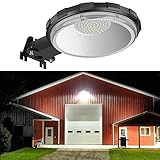
- DUSK TO DAWN PHOTOCELL : This LED barn light with the more sensitive and accurate photocell, turn on the lights automatically at night and turns off at daytime. 5000K daylight white perfect matches the brightness of illuminating backyard, barns, farms, parking lots, garages and alleyways.
- EXCELLENT PERFORMANCE: Karjoefar LED barn light with 104pcs upgraded top-quality chips, create a stunning 100W and 10000 lumens brightness output, bright as a small sun. This outdoor barn lights has a long-lasting 50,000 hours lifespan.
- ENERGY SAVING: With AC100-120V input, which makes this yard lights more adaptable to a larger application range and cuts down unnecessary wastage caused by voltage instability. Our 100W security light provides 10000LM brightness, which is more effective than other 400W 10000LM HPS/halogen bulbs to help you save more than 80% of your electricity bill.
- EASY INSTALL: It can be fixed on the wall or various types of mounting arms, 82ft x 82ft large light coverage when mounted at 30 feet. Works as yard light, outdoor street light, area light, security light, barn light and perimeter Lighting.
- RELIABLE QUALITY: This dusk to dawn outdoor lighting adopts die-cast aluminum structure, has excellent corrosion resistance and heat dissipation performance, professional IP65 waterproof design, and has been listed by ETL and DLC, high quality, safe operation. We also provide 2-years warranty, you can feel assured to use. If you have any quality problem, pls email us.
The three fixture variables that control sky glow
1. Spectral power distribution
Spectral power distribution (SPD) describes how a luminaire’s output is distributed across wavelengths. Two fixtures with the same nominal color-temperature label can have different SPDs and therefore different modeled sky-glow behavior. DOE specifically cautions that correlated color temperature (CCT) is not a reliable standalone predictor.
Do these 3 things before closing this tab:
1Fix the driver behind crashes, sound loss and screen glitches2Clear out junk files and repair common Windows errors3Scan for outdated or missing drivers - takes under a minuteRequest the manufacturer’s complete photometric and spectral documentation, not only a CCT such as “3000 K” or “4000 K.” Compare the actual spectrum, the intended operating current and any controls that alter output.
2. Total lumen output
More emitted lumens can increase the amount of light available to scatter in the atmosphere. A retrofit that replaces an HPS fixture with an LED at unnecessarily high output may erase the benefit of a more controlled spectrum. Set the target light level from the applicable roadway, pedestrian or site standard, then select the lowest output that meets it after accounting for mounting height, spacing, pavement reflectance and maintenance.
3. Distribution and uplight
Distribution determines where the light goes. Uplight is light emitted above the horizontal plane, at an angle greater than 90 degrees from directly below the source. DOE’s TM-37 program summary states that any light source permitting uplight contributes more to sky glow than downward-directed streetlighting.
Full-cutoff or otherwise well-shielded optics can limit direct uplight, but they do not automatically prevent reflected light from pavement, walls or other surfaces. The photometric file, shielding details and installed aiming must be reviewed together.
What the 95% figure does—and does not—mean
In the model, eliminating uplight nearly removed the streetlighting contribution for an observer 40 kilometers from the city center, with a reported reduction of 95% or more. That is a powerful illustration of the importance of fixture distribution.
Rank #3

- High Efficiency & Super Brightness - Powered by 𝙖𝙙𝙫𝙖𝙣𝙘𝙚𝙙 𝟐𝟎𝟐𝟓 𝙇𝙀𝘿 𝙘𝙝𝙞𝙥𝙨, Pvilub 150W parking lot light emits a bright, daylight-like glow at 5000K. With an impressive efficacy of 𝟏𝟓𝟎𝐖/𝐋𝐌, it delivers 22,500 lumens of brightness, making it a highly efficient replacement for traditional 𝟔𝟒𝟓𝐖 𝐇𝐏𝐒/𝐌𝐇 light while 𝐫𝐞𝐝𝐮𝐜𝐢𝐧𝐠 𝐞𝐧𝐞𝐫𝐠𝐲 𝐜𝐨𝐧𝐬𝐮𝐦𝐩𝐭𝐢𝐨𝐧 𝐛𝐲 𝐨𝐯𝐞𝐫 𝟗𝟓%.
- 50,000+ Hours Long Lifespan - Designed for durability, the parking lot lights features a robust die-cast aluminum housing for superior protection. Its back-vented design ensures optimal heat dissipation, while 6KV surge protection ensures reliable performance in even the harshest environments. These features extend the light's lifespan and maintain consistent efficiency over time.
- Flexible Installation & Dimming - Designed for quick and easy installation 𝙗𝙮 𝙖 𝙨𝙞𝙣𝙜𝙡𝙚 𝙥𝙚𝙧𝙨𝙤𝙣, this led shoebox light can be mounted on walls (wall-mount screws not included), poles (mounting plate not included), or any other desired location. The adjustable 0°-180° arm pole mount bracket allows precise control over the light direction to meet your specific illumination needs.
- Smart Photocell - The Security light includes a built-in photocell sensor that automatically turns on at dusk and off at dawn. The sensor can be manually disabled by covering it, offering flexibility in operation. This outdoor light provides dependable security lighting, ideal for barns, farms, garages, driveways, walkways, houses, entrances, patios, pathways, parks, building, entryways, farms, churches, shopping centers, school.
- 𝟓 𝐘𝐞𝐚𝐫 𝐖𝐚𝐫𝐫𝐚𝐧𝐭𝐲 - Our Led parking lot lights outdoor have 𝙐𝙇 certification to ensures safety and quality, while its IP65 waterproof rating makes it suitable for all weather conditions, including sunny days, rain, snow, and storms. 𝐖𝐞 𝐰𝐢𝐥𝐥 𝐝𝐞𝐥𝐢𝐯𝐞𝐫 𝐚 𝐧𝐞𝐰 𝐩𝐚𝐫𝐤𝐢𝐧𝐠 𝐥𝐨𝐭 𝐥𝐢𝐠𝐡𝐭 𝐭𝐨 𝐲𝐨𝐮 𝐢𝐟 𝐚𝐧𝐲 𝐝𝐞𝐟𝐞𝐜𝐭𝐬 𝐢𝐧 𝟏 𝐲𝐞𝐚𝐫 𝐚𝐧𝐝 𝐪𝐮𝐢𝐜𝐤 𝐭𝐞𝐜𝐡 𝐬𝐨𝐥𝐮𝐭𝐢𝐨𝐧 𝐟𝐨𝐫 𝟓 𝐲𝐞𝐚𝐫𝐬.
It does not mean a city’s total sky glow fell by 95%. The calculation excluded other urban sources and did not remove light that those sources send into the atmosphere. Building windows, architectural and landscape lighting, signs, parking lots, sports and recreational facilities and vehicle lights all contribute. The study did not establish which source dominates any particular city.
How the model differs from a real site
The SkyGlow Simulator compared defined combinations of source spectrum, output, uplight, atmosphere, city size and observer location. A real project can differ in several material ways:
- City shape and the geographic distribution of sources may not match the model’s assumptions.
- Particle size and particle distribution in the local atmosphere can vary from the modeled conditions.
- The study modeled single scattering, not multiple scattering.
- Buildings, trees and terrain can block some paths of light or redirect it.
- Actual fixture spacing, aiming, dimming schedules, surface reflectance and maintenance can change delivered light.
These limitations do not invalidate the comparison. They mean the results should be used to frame a site-specific photometric design rather than to promise a fixed percentage reduction for an entire municipality.
The Tool Desk
Outbyte Driver Updater FREEFix the driver behind crashes, sound loss and screen glitchesFind Drivers →Outbyte PC Repair FREERepair Windows errors before they cause bigger problemsFix Now →A practical evaluation process for an LED streetlight project
Use the following sequence when writing a specification, reviewing a submittal or comparing a conversion design.
- Define the required illumination. Identify the road classification, pedestrian areas, intersections, security requirements and applicable local or professional lighting criteria. Record target illuminance or luminance and uniformity before looking at fixture wattage.
- Request comparable documents. Obtain the LED fixture’s tested photometric file, SPD or spectral report, lumen output at the proposed drive current, mounting height, optic, shielding and control settings. Ask for the HPS baseline assumptions if the project claims a reduction.
- Check uplight and aiming. Confirm the percentage of uplight in the proposed configuration and whether the installed orientation preserves the tested distribution. Review backlight, uplight and glare characteristics, not just a “full cutoff” label.
- Model the actual layout. Use the planned pole spacing, mounting height, road geometry, surface reflectance, obstructions and dimming schedule. A simplified comparison based on DOE’s dataset can help screen options, but it is not a substitute for site-specific photometric design.
- Evaluate both metrics where visibility matters. Compare unweighted optical results and, where appropriate, a scotopically weighted result. State which metric supports each conclusion so a lower physical output is not presented as a guaranteed lower perceived sky glow.
- Check the complete lighting inventory. List nearby facade, sign, parking, sports, landscape, window and vehicle lighting. If the objective is a darker night sky, reducing those sources may matter as much as changing streetlights.
- Set controls and verification requirements. Specify dimming levels, curfews or adaptive controls where allowed, require commissioning of aiming and shielding, and document delivered light after installation.
How to compare proposed fixtures
| Specification to compare | Questions for the design team | Why it matters |
|---|---|---|
| Spectral power distribution | Is a complete spectrum supplied for the operating condition? Are two products being compared on more than CCT? | Different spectra can produce different scotopically weighted outcomes even at similar output. |
| Lumen output | What is the initial and maintained output, and what light level does the layout actually require? | Overlighting adds atmospheric scatter and wastes energy. |
| Uplight and shielding | What percentage is emitted above horizontal? Does the installed optic preserve the tested cutoff? | Direct uplight has a disproportionate effect on distant sky glow in the DOE model. |
| Distribution | Does the beam place light on the roadway rather than beyond it or onto facades? | Spill light can increase the system’s atmospheric and nuisance-light contribution. |
| Site and atmosphere | What observer locations, terrain, obstructions and atmospheric assumptions were used? | Sky appearance depends on distance and local conditions; a laboratory-style ratio is not a citywide guarantee. |
Common claims that need correction
“LEDs always reduce light pollution.”
Too broad. DOE found reductions for all modeled products on the unweighted metric, but near-observer scotopic results ranged from a reduction to an increase. The fixture system and operating level matter.
“A lower CCT proves a lower sky-glow impact.”
Not established. CCT is a shorthand description, not a complete spectrum. Use SPD, output and uplight data.
Rank #4

- High Efficiency & Brightness: With 250 lm/W efficacy, this 240W LED parking lot light delivers 60,000 lumens of 6000K daylight illumination while consuming about 90% less energy and costing 90% less than typical HID/HPS light fixtures.
- Automated Dusk to Dawn Operation: The integrated photocell sensor ensures the outdoor street light turns on automatically at sunset and off at sunrise. No timers, no switches, no hassle – it reduces energy waste and eliminates manual intervention for commercial and residential properties alike.
- Durable for Extreme Conditions: Built with a die-cast aluminum housing and a hollow ventilation design, this IP65 waterproof street light withstands harsh conditions nationwide—from Alaskan ice to Arizona heat. It operates reliably in temperatures ranging from -40°F to 140°F and has a 50,000-hour lifespan—about 11 years when used 12 hours daily.
- Wide Coverage & Easy Installation: When mounted at 19.6 feet, this parking lot light provides a lit area of up to 59 feet in diameter. The universal bracket (fits 2.5"-diameter poles) and 180° adjustable head allow for quick installation and optimal aiming. This commercial area light supports wall, square-pole, or round-pole mounting to suit various installation needs.
- Versatile Applications: Ideal for commercial, industrial, and residential settings, including parking lots, loading docks, stadiums, highway rest areas, warehouse yards, home gardens, farmhouses, garages, and barns. Note: This LED parking lot light is not solar-powered and must be hardwired to an electrical connection.
“A 95% reduction means the city’s sky will be 95% darker.”
Incorrect. The 95% or greater figure applies to the modeled streetlighting contribution at 40 kilometers when uplight is eliminated. Other sources and reflected light remain.
What’s actually slowing this PC down?
Pick the symptom - the matching free tool is one click away.
“The DOE result was measured in a city after a retrofit.”
No. It was a model-based comparison using defined scenarios. A real project needs local photometric analysis and, if a performance claim is important, an appropriate pre- and post-installation measurement plan.
What this means for construction and retrofit specifications
For a new roadway, subdivision, campus or public-realm project, write performance requirements around delivered light and skyward emissions instead of naming LED technology as the sole objective. Require a documented distribution, a stated output, an SPD, shielding information and a calculation showing compliance at the actual mounting geometry.
For a conversion, do not assume that replacing each HPS lamp with an equal or higher LED lumen package is equivalent. Recalculate spacing and uniformity, review whether existing poles create glare or spill, and include controls that prevent the installed system from operating above the designed level. Coordinate streetlight changes with parking, facade, sign and landscape-lighting decisions so one source is not reduced while another is expanded.
DOE later described a simplified Sky Glow Comparison Tool derived from more than 215,000 sky-glow model runs. The tool lets stakeholders vary spectral content, light output and percent uplight. DOE directs users seeking the tool to PNNL and points to ANSI/IES TM-37 for describing, measuring and estimating sky glow. Those resources can support option screening, while the project engineer remains responsible for site-specific calculations and code compliance.
Quick wins for a faster PC:
Clear out junk files and repair common Windows errorsFree Scan →Scan for outdated or missing drivers - takes under a minuteDriver Scan →Bottom line
DOE’s evidence supports a careful conclusion: typical modeled LED conversions from HPS can reduce the streetlighting contribution to sky glow, especially when the result is unweighted and uplight is controlled. The same analysis does not guarantee a reduction in human-perceived sky brightness for every LED product; near-observer scotopically weighted results ranged from 0.2 to 1.6 times the HPS baseline. Choose the spectrum, lumen level and optical distribution as one system, eliminate unnecessary uplight and overlighting, and evaluate the complete set of urban light sources before claiming a citywide improvement.
Quick Recap
Product prices and availability are accurate as of the date/time indicated and are subject to change. Any price and availability information displayed on Amazon at the time of purchase will apply.

