Do these 3 things before closing this tab:
1Clear out junk files and repair common Windows errors2Fix the driver behind crashes, sound loss and screen glitches3Repair Windows errors before they cause bigger problemsSome links on this page are affiliate links: if you buy through them we may earn a commission, at no extra cost to you.
Yes—two correctly connected centrifugal pumps in parallel will usually increase the total flow in litres per minute (l/min), but they will not normally double the pressure or head. Parallel pumps share approximately the same head while their flows combine. If higher pressure or lifting height is the main requirement, pumps are generally connected in series instead.
The actual flow increase must be calculated from the pumps’ combined performance curve and the system curve. It is usually less than twice the flow from one pump because pipe friction and other system losses rise as flow increases.
As an Amazon Associate I earn from qualifying purchases.
What’s actually slowing this PC down?
Pick the symptom - the matching free tool is one click away.
What does “pumps in parallel” mean?
Pumps are connected in parallel when their suction sides draw from a common source or suction header and their discharge sides connect to a common discharge header. Each pump feeds the same downstream pipework.
                         ┌── Pump 1 ── check valve ──┐
Source or suction ──────┤                             ├── Common discharge ── System
                         └── Pump 2 ── check valve ──┘
This is different from series operation, where the outlet of one pump feeds the inlet of the next. The distinction matters because the two arrangements affect a pump system in different ways.
#1 Best Overall

- Adjustable Pressure & Speed: Smart 45 is a fully integrated and intelligent water pump designed for domestic boosting. It automatically monitors and adjusts performance according to water demand, ensuring perfect pressure at your faucets. The smart pump control maintains constant pressure across all taps in the house, with a maximum flow rate of 1500 GPH and a maximum head of 150 ft. The pressure setting range is 1.5-5.5 bar (22-80 PSI), with a preset of 3 bar (44 PSI).
- All-in-One Robust Design: Smart 45 is built with a durable stainless steel impeller, designed to withstand hot water temperatures up to 175℉ while effectively preventing leaks. This robust water booster pump features a maintenance-free pressure tank, stainless steel connectors, and an outlet equipped with a check valve. The precision aluminum motor housing is made from rustproof eco-friendly materials, ensuring both durability and health safety.
- High Efficiency & Low Noise: Smart 45 features an air-cooled permanent magnet motor and inverter technology, operating quietly at just 55 dB(A) in typical use, ideal for residential and light commercial settings. It provides over 50% energy savings compared to standard pumps, resulting in significant annual cost savings. The pump works efficiently in a water temperature range of 32℉-175℉, reaching a maximum speed of 5200 RPM with a rated power of 550W (max. 750W). It can run 24/7 for a long service life.
- Intelligent Protection Features: This small self-priming pump is easy and safe to install and operate. The control panel includes fault indicators and protections, such as power supply failure, pump block protection, pipeline leakage, dry-running protection, overheating protection, and pressure-sensor failure. If the pump becomes blocked or overloaded, the built-in automatic thermal switch will cut power to protect the motor.
- Wide Applications: Smart 45 is versatile for both domestic and light commercial water supply, enhancing pressure for city mains, roof tanks, water tanks, shallow wells (up to 26 ft), garden irrigation, and clean water transfer. Aquastrong provides professional advice on installation and maintenance to keep your water system stable and worry-free.
This explanation applies primarily to centrifugal or rotodynamic water pumps. Positive-displacement pumps require separate analysis, pressure-relief arrangements and manufacturer-specific controls. They should not be connected using centrifugal-pump rules alone.
Parallel pumps: more flow, not twice the pressure
| Arrangement | What is added? | Typical purpose |
|---|---|---|
| Parallel | Flow capacity at approximately the same head | More l/min, variable demand or redundancy |
| Series | Head or pressure at approximately the same flow | More lift or pressure capability |
For two identical pumps operating in parallel, both pumps work against approximately the same discharge head. Their individual flow rates are added together. At a particular head, if one pump can supply 100 l/min, the ideal combined pump curve may show about 200 l/min from two pumps.
That does not mean the final installation will necessarily deliver 200 l/min. The operating point changes when the second pump starts, and the pipework generally requires more head as flow rises.
Why the actual flow is usually less than double
A pump does not deliver one fixed flow under all conditions. Its pump curve shows the head it can produce at different flow rates. The system also has a curve showing how much head is required at each flow.
The pump operates where those two curves intersect:
- The manufacturer’s curve shows the head available from one pump at different flows.
- For identical pumps in parallel, add the flows of both pumps at each common head. This creates the combined parallel-pump curve.
- Calculate the system curve, including static lift, pipe friction, fittings, valves, filters, heat exchangers and required outlet pressure.
- The intersection of the combined pump curve and system curve gives the new total flow and head.
In many water systems, friction losses increase approximately with the square of flow. Consequently, pushing more water through the same pipework causes disproportionately greater losses. The new flow is therefore normally less than twice the original system flow. The Hydraulic Institute’s pump-curve guidance explains why the steepness of the system curve determines the real increase.
PC Slower Than It Used to Be?
A free scan shows the junk files, broken settings and background clutter dragging Windows down - then fixes them in one click.Free scan · Windows 10 & 11Crashes, No Sound, or Screen Glitches?
Random freezes, missing sound and display glitches usually trace back to one bad driver. Find and replace yours safely.Free scan · under a minuteRank #2
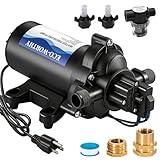
- Diaphragm Pump: 110V AC water diaphragm pump provides 4.0GPM flow capacity. Turns on and off using water pressure at 50PSI, 1.3 Max amps. AC power supply, no need to carry marine battery with you
- Smart Pressure Switch: Turns on and off on demand. It’s quiet, shuts itself off when the faucets are closed and runs when the faucets are opened. It also can adjust according to your needs, adjustable pressure range is 45-70PSI
- Reliable Performance: Self-Priming up to 9.8 vertical feet, lift up to 131 feet. Thermal overload protection is built into the water pump to make it safe to use. When the temperature is above 95℃/ 203℉, it will automatically disconnect the circuit to protect the motor
- Multipurpose: The nemesis of low water pressure. Support continuous operation for more than 1 hour. The water transfer pump is suitable for many fields, like RV, Marine, Boat, Irrigation, Sprinkler, Faucet and so on
- Your First Choice: We always pay attention to customer shopping experience. If you have any questions during use, please feel free to contact with us at the first time. We will always be here
Illustrative example
Suppose one pump delivers 100 l/min at the existing operating point. Two identical pumps might offer 200 l/min at that same head on the combined pump curve. Once the higher flow increases friction, the actual system flow might be 150–180 l/min instead.
That range is only an illustration, not a standard result. The exact answer requires the pump model, operating speed, pipework and system resistance.
Does the pressure remain exactly the same?
“Pressure does not increase” is a useful first approximation, but it is too absolute for a real installation. Parallel pumps do not add their heads together as series pumps do. However, a pressure gauge may show a different reading after the second pump starts because:
- the system operating point moves;
- flow and friction losses increase;
- the pump’s head changes as its flow changes;
- the gauge may be at a different elevation or pipe location;
- valves, filters and downstream equipment affect the measured pressure; and
- the reading may be gauge pressure rather than absolute pressure.
Pump engineers normally specify head, which is energy per unit weight of liquid, rather than treating pressure as universal. Head can be converted approximately to pressure using:
p = ρ × g × H
For water near room temperature, 10 metres of water head is approximately 98 kPa or 0.98 bar. The exact pressure depends on the liquid’s density. See the Grundfos pump-curve explanation for the head and pressure relationship.
How is the flow divided between the pumps?
With identical pumps and symmetrical suction and discharge pipework, the total flow may divide approximately equally. If the common discharge flow is 160 l/min, each pump might provide roughly 80 l/min.
Rank #3

- 【Diaphragm Pump Performance】110V AC water pump provides 5.0 gallons per minute water flow. Self-Priming up to 9.8 vertical feet, lift up to 164 feet. Low power consumption, high performance and strong suction.
- 【Automatic Start/Stop】This water pressure booster pump is self-priming, automatically turns on when the tap is turned on and stops when the tap is turned off. The optimal pressure is set at the factory (70PSI), but you can still adjust it according to your needs in any special cases.
- 【Safe and Durable】Our electric water booster pump is made of high quality pure copper motors for improve the service life. It has passed CE certification, comes with corrosion-resistant valves and offers overload and overheat protection. Support run dry without damage. Anti-vibration iron plate mounting bracket and rubber feet, which can reduce the working noise more greatly. When the motor generates too much heat, the circuit can be automatically disconnected to protect the motor.
- 【Wide Application】Water pressure pumps are the nemesis of low water pressure, easy to use. Meet the water needs of different scenarios, such as kitchen, bathroom, camper and lawn. It is also the great partner of RV, Marine, Boat, Irrigation, Sprinkler, Faucet as you like.
- 【What's in The Package💕 】1 x AC Diaphragm water Pump, 1 x Filter(includes 50 mesh stainless steel screen), 2 x 1/2 inch Hose Fittings, 1 x User manual, 1 x Teflon Tape, 1 x Spanner, 1 x Box Container. We promise 100% factory tested quality assurance. Provide 180 days worry-free warranty and friendly customer service. If you have any questions, please contact us in time.
A 50:50 split is not guaranteed. Unequal flow can result from:
- different branch-pipe lengths or fittings;
- unequal valve positions;
- a poorly sized or unbalanced header;
- different suction conditions;
- different impeller diameters or motor speeds;
- manufacturing tolerances or pump wear;
- air entrainment, blockage or a dirty strainer; or
- a sticking or incorrectly installed check valve.
A flow meter on the common discharge measures total flow, not the contribution of each pump. Individual flow meters, pressure measurements or a pump-curve calculation are needed to establish the split. ASHRAE guidance on centrifugal pumps describes parallel pumps as operating at a common head while supplying their respective shares of system flow.
The Tool Desk
Outbyte Driver Updater FREEScan for outdated or missing drivers - takes under a minuteDriver Scan →Outbyte PC Repair FREERepair Windows errors before they cause bigger problemsFix Now →What if the two pumps are different?
Dissimilar pumps can sometimes operate in parallel, but selecting them is considerably more complicated. The larger pump may dominate the system, while the smaller pump contributes little useful flow. In some conditions, a pump with lower generated head can experience flow pushed backwards through it.
Different pumps can also produce a combined curve with an undesirable shoulder or unstable region, and one or both pumps may operate far from their best efficiency point. Constructing a composite curve for dissimilar pumps requires special care, as noted by ASHRAE.
For most installations, use identical pumps or a pump combination specifically approved by the manufacturer. If different pumps are unavoidable, have the combined curves, controls, motor loading and minimum-flow conditions checked by a qualified pump engineer.
When should pumps be connected in series?
Use series operation when the system needs more head or pressure capability—for example, a high static lift or a system with substantial resistance. In series, the same flow passes through both pumps and their heads are added at that flow. Two pumps producing 30 metres of head each may provide approximately 60 metres of combined head at a selected flow, subject to the actual curves and system operating point.
Rank #4

- Diaphragm Pump Specifications: 110V AC water pump features 5.5 gallons per minute water flow, the pressure switch is set to 70PSI, Self-Priming up to 9.8 vertical feet, lift up to 131 feet. 1.6 Max amps; excellent performance in all aspects
- Upgraded Pressure Switch: It lasts longer. For any pressure switch problems, we will provide all effective after-sales service. Water supply when the faucet is opened, and power off when the faucet is closed, 70PSI. Pressure enough for daily use, it also can adjust according to your needs
- Quieter & Safer Design: Thermal overload protection is built into the water pump to make it safe to use. When the temperature is above 70℃/ 158℉, it will automatically disconnect the circuit to protect the motor
- Widely Compatible: Continue running for more than 1 hour. This pump is a high pressure pump and used for spraying down items, such as boat decks, driveways, and cleaning off parts
- Your First Choice: We always pay attention to customer shopping experience. If you have any doubts, you can always talk to us through the order form. We will always be here
The result is not automatically double the final pressure or flow. The system operating point still changes, and all pumps, seals, pipes, valves, tanks and downstream equipment must tolerate the combined pressure. The Grundfos series-pump guidance and KSB’s series-operation guidance cover these requirements.
Installation requirements for parallel pumps
Joining two pump outlets with a simple tee is not enough. A practical installation commonly requires:
- A suitable common suction header: size and arrange it to avoid excessive velocity, turbulence and unequal inlet conditions.
- A suitable common discharge header: it must carry the combined flow without excessive friction.
- A check valve on each discharge: this helps prevent an operating pump from forcing water backwards through a stopped pump.
- Isolation valves: each pump should be capable of being isolated for maintenance where the design permits.
- Pressure gauges or transducers: measure suction and discharge conditions at useful locations.
- Flow measurement: particularly important during commissioning or when diagnosing unequal contribution.
- Strainers and air-release provisions: where required by the fluid and system design.
- Motor protection: provide appropriate overload protection and verify electrical capacity when both motors start or run.
- Controls: use lead/lag alternation, staged starting, variable-frequency drives or fault detection where the demand requires them.
- Protection against dry running and cavitation: confirm adequate source capacity, suction pressure and net positive suction head available (NPSHA).
Check valves add pressure loss and must be selected for the flow, fluid, pressure, temperature, closing behaviour and water-hammer risk. The exact valve arrangement must follow the pump manufacturer’s instructions and applicable local codes. ASHRAE discusses check valves, isolation valves, strainers and instrumentation for parallel pump arrangements.
Independent reader supportYour contribution helps us test, update, and keep practical guides available for everyone.Can one pump run while the other is switched off?
Often yes, but this must be checked rather than assumed. The idle pump must not be driven backwards by flow from the operating pump. A suitable check valve and, where necessary, isolation arrangement should prevent this.
Recommended Free Tools
Running one pump alone also changes its operating point. It may move to a much higher flow than when both pumps operate. That can increase motor power demand, exceed the pump’s recommended operating range or create cavitation and vibration. Check the pump curve and motor loading for:
- both pumps operating;
- each pump operating alone;
- startup and shutdown conditions; and
- the lowest and highest expected system resistance.
Do not extrapolate beyond the manufacturer’s published pump-curve endpoint. Operation outside the stated range can cause instability, cavitation, poor efficiency and premature failure. The Xylem/Bell & Gossett technical bulletin discusses reverse flow, motor overload and operating beyond a published curve.
Best Value

- Note : Our products can be upgraded via OTA technology. If there are any fault code issues during the product's usage, please upgrade the MCU firmware in the SmartFarintl APP program to the latest version. Maintain the superior performance of the product
- Powerful Water Pressure Booster System : V3-45 PRO variable speed water pressure booster pump is equipped with 1.35HP motor 110–120V, 60Hz. With a Max head of 180 feet and an adjustable pressure range of 1 to 6 bar (15–90 PSI). Depending on the different water supply methods, different maximum pressure values can be achieved. Mains water Max.80PSI, Water tank Max.58PSI. It delivers a maximum flow rate of 1,600 GPH, it provides a complete constant pressure boosting solution for kitchens, bathrooms, and whole house water systems
- Energy Efficient Permanent Magnet Motor : This water booster pump for house built with a high speed 8000 RPM permanent magnet motor, this unit offers up to 50% greater energy efficiency compared to traditional pumps, resulting in significant annual cost savings. The motor is lightweight, compact, and designed for quiet, smooth operation with an extended service life
- Stainless Steel Construction : The water pump outer shell is made of thickened stainless steel. Internally, the pump body is constructed from 304 stainless steel to ensuring clean and safe water delivery. This is a major upgrade over traditional cast iron pumps, which often lead to cloudy water and potential health risks
- Wireless App Control For Real Time Monitoring : The SmartFarintl app combined with this V3-45 PRO booster pump allows you no matter where you are for example,at home, going to work or on a business trip, traveling you can always control and monitor the operating status of the water pump at any time and OTA upgrad on line. This is especially useful when the water pressure booster pump for home is installed in tight or hard to reach spaces where physical access is limited
Submersible pumps in parallel
Two submersible pumps can be arranged in parallel, but the design must account for more than the discharge connection. Important considerations include wet-well level, minimum submergence, solids handling, turbulence, discharge check valves, starting current, alternation controls and whether the discharge header can accept the combined flow.
Submersible pumps should be selected and installed according to the manufacturer’s wet-well, cable, control-panel and discharge requirements.
Quick wins for a faster PC:
Repair Windows errors before they cause bigger problemsFix Now →Fix the driver behind crashes, sound loss and screen glitchesFind Drivers →Clear out junk files and repair common Windows errorsFree Scan →If the goal is higher pressure at a tap or fixture
Adding a second pump may not address the real restriction. Before changing the pump arrangement, check for:
- a blocked filter or strainer;
- an undersized or damaged pipe;
- a partially closed valve;
- excessive elevation;
- a leaking or incorrectly set pressure regulator;
- insufficient tank pressure;
- an inadequate water source; or
- a pump operating away from its intended duty point.
Depending on the diagnosis, the appropriate solution may be a correctly selected higher-head pump, a series or multistage pump, a packaged booster set, larger pipework or an adjustment to the pressure-control system. Do not simply install a larger pump without checking maximum system pressure, pipe and equipment ratings, relief protection and source capacity.
How to calculate the expected l/min
- Obtain the manufacturer’s head-versus-flow curve for each pump, including the impeller diameter, speed and motor configuration.
- Confirm the fluid, temperature and density.
- Calculate static head, elevation, pipe friction, fittings, valves, filters and equipment losses.
- Build the system curve across the expected flow range.
- For identical pumps, add their flows at equal head to create the parallel curve.
- Find the intersection of the combined curve and system curve.
- Read the total flow at that intersection.
- Assess how the flow divides between pumps, allowing for branch-pipe imbalance.
- Check each pump’s best efficiency region, minimum flow, maximum flow, motor power, NPSH required and manufacturer’s operating limits.
The pump count alone cannot provide a reliable new l/min figure. You need the pump model and speed, existing flow and pressure, pipe sizes and lengths, elevation, fittings and restrictions, pump similarity, and the intended operating point.
Troubleshooting: the second pump does not increase flow as expected
- Verify that both pumps are actually running at the correct speed and rotation.
- Confirm the suction and discharge arrangement is truly parallel.
- Check that every isolation valve is fully open where it should be.
- Inspect filters, strainers, foot valves and suction lines for blockage or air.
- Check that each discharge check valve is installed in the correct direction and is not sticking.
- Confirm that the water source can supply the combined demand.
- Compare suction and discharge pressures for each branch.
- Check individual pump flow if the pumps appear unbalanced.
- Compare the measured operating point with the manufacturer’s curve.
- Recalculate system resistance, including pipework or equipment added since the original installation.
- Check for cavitation, vibration, overheating or motor overload, and stop the system if unsafe symptoms occur.
Before buying a second pump
Compare equipment at the required flow and head, not at a pump’s free-delivery flow. Check:
Free tools Windows power users keep installed
One-click scans. No signup required.
- manufacturer-approved parallel operation;
- pump curve and allowable operating region;
- fluid compatibility and temperature rating;
- maximum pressure;
- voltage, phase and starting current;
- motor power and efficiency;
- minimum flow and NPSH requirements;
- noise and duty cycle;
- replacement parts and service support;
- check-valve and control requirements; and
- whether a packaged lead/lag or variable-speed controller is included.
For domestic work, a single correctly sized replacement pump or packaged booster set may be simpler than building a parallel arrangement. Parallel pumps are more attractive where higher capacity, staged operation or redundancy justifies the extra pipework, valves, controls and maintenance. Commercial, high-pressure, hot, hazardous or critical systems should be designed or reviewed by a qualified engineer.
Quick Recap
Product prices and availability are accurate as of the date/time indicated and are subject to change. Any price and availability information displayed on Amazon at the time of purchase will apply.

