What’s actually slowing this PC down?
Pick the symptom - the matching free tool is one click away.
Windows can lower a building’s environmental impact when they are designed as part of the whole façade, not treated as decorative holes in the wall. Useful daylight, controlled solar heat, suitable insulation, purposeful ventilation and comfortable operation must be balanced for the site’s climate, orientation and use.
The central trade-off is simple: more glazing may admit more daylight, but it also creates more area through which heat can escape or enter. A greener window is therefore not necessarily the largest, darkest or most technologically elaborate option. It is the option that performs well in the building’s actual operating context and can be controlled, maintained and verified after construction.
As an Amazon Associate I earn from qualifying purchases.
What makes a window greener?
A window affects several building systems at once. It changes how much electric lighting is needed, how much heat enters on sunny days, how quickly indoor heat is lost, whether outdoor air can be used for ventilation and how occupants experience glare, drafts, temperature swings and connection to the outside.
Those effects can point in opposite directions. A larger glazed area may improve daylight availability while increasing thermal losses. In some designs, the additional lighting benefit is smaller than the heating or cooling penalty. The useful question is not “How much glass can this façade hold?” but “What combination of glass, opaque wall, shading, controls and ventilation gives this building the best performance at this location?”
#1 Best Overall

- Double-Pane Insulated Glass: Our Vinyl Single Hung Windows feature energy-efficient double-pane construction. Enjoy reduced noise from outside and better temperature control inside, helping to lower energy costs year-round
- Built-In Rear Drainage System: Equipped with a back drainage outlet, these replacement windows effectively channel rainwater outside, preventing water buildup and leakage. This design enhances durability and keeps your home safe and dry
- Tilt-In Easy Cleaning Design: The sash can tilt inward, making it convenient to clean both the inside and outside surfaces from within your home
- Smooth Sliding with Ventilation: Vertical sliding design allows effortless opening and closing, while the included screen lets fresh air in without insects. The tilt-in function further improves airflow control, ensuring a comfortable living space
- Durable & Weather-Resistant: Made from high-quality vinyl with reinforced framing, these windows resist rust, UV rays, and harsh weather. Offering long-lasting performance and protection
Green Building Illustrated: Design & Construction Guide presents the daylight-versus-thermal-loss trade-off as a basic sustainable-design principle. It does not establish a universal glazing percentage at which a façade becomes efficient or inefficient; that point changes with climate, orientation, building form, occupancy and systems.
The five performance pathways to evaluate
1. Daylight without excessive glare
Windows can deliver useful daylight deep into occupied rooms, reducing dependence on electric lighting during suitable hours. The benefit depends on window placement, room depth, interior reflectance, surrounding obstructions and the ability to dim or switch electric lights when daylight is adequate.
Daylight is not automatically useful light. Direct sun can produce glare on screens, bright patches and uneven illumination. A design that adds glass but leaves occupants closing blinds all day may deliver less practical benefit than a smaller, better-shaded opening. Evaluate daylight and glare together, preferably for the rooms and schedules that will actually be occupied.
Crashes, No Sound, or Screen Glitches?
Random freezes, missing sound and display glitches usually trace back to one bad driver. Find and replace yours safely.Free scan · under a minutePC Slower Than It Used to Be?
A free scan shows the junk files, broken settings and background clutter dragging Windows down - then fixes them in one click.Free scan · Windows 10 & 112. Solar-heat control
Sunlight entering through glass can become indoor heat. That heat may be helpful during heating periods and harmful during cooling periods, with the balance changing by season, orientation and local weather. External shading, recessed openings, fins, overhangs, blinds and glazing with appropriate solar-control properties can limit unwanted gains.
Shading must be coordinated with daylight and views. A permanently darkened façade may reduce cooling demand but increase electric-light use and reduce occupant satisfaction. Operable shading can respond to conditions, but it introduces controls, maintenance and user-behaviour requirements.
3. Thermal performance
Windows generally insulate less effectively than a well-insulated opaque wall, so a larger glazed area can increase heat loss in cool weather. Frames, edge spacers, opening vents and installation details matter as well as the central glass. Thermal bridges or air leakage around the frame can undermine a high-performing specification.
Rank #2

- Enhanced Window Seal for Maximum Protection: Our window sealing tape provides an airtight barrier to keep out pollen, drafts, dust, and moisture. Ideal for window insulation for summer, it helps maintain indoor temperature and reduce energy costs. Also, when pollen season ahead, it helps you to keepp away from sneezing and coughing at home.
- Premium Weather Stripping Door Seal: Made with high-quality material, this weather stripping ensures long-lasting durability and resistance against extreme temperatures. Perfect for use on windows, doors, and other sealing applications.
- All-Season Window Weather Stripping: Whether it's summer heat or winter cold, our weather stripping window seal effectively prevents air leaks, making your home more comfortable all year round.
- Easy to Install & Residue-Free Removal: This window insulation tape is simple to apply and remove without leaving sticky residue. Cut to fit any size window or door for a seamless seal
- Versatile Use for Home & Office: Ideal for window insulation, soundproofing, and dustproofing. This window sealing tape is a must-have for energy-efficient homes and workplaces
Thermal performance should be considered with the building’s heating system, internal gains and airtightness strategy. A window that is suitable for a heating-dominated building may be unsuitable for a cooling-dominated one, even if the product label is identical.
Do these 3 things before closing this tab:
1Fix the driver behind crashes, sound loss and screen glitches2Repair Windows errors before they cause bigger problems3Scan for outdated or missing drivers - takes under a minute4. Natural or mixed-mode ventilation
Operable windows can provide outdoor air and, when conditions are right, reduce reliance on mechanical cooling. Their value depends on outdoor temperature, humidity, air quality, noise, security, wind exposure and occupant willingness to operate them. They also need a control strategy that prevents simultaneous heating or cooling and open-window operation.
In commercial buildings, natural ventilation is a system decision rather than a hardware feature. The façade, mechanical plant, sensors, controls and facilities team must share a clear operating sequence.
5. Occupant comfort and usability
Comfort includes more than average room temperature. Cold surfaces, radiant asymmetry, drafts, glare, reflected light and noise can all affect whether occupants consider a window successful. Views and a connection to outdoors can support the user experience, but those benefits are difficult to claim from design intent alone.
Provide occupants with understandable controls and a clear explanation of what the controls do. If blinds, vents or windows are too difficult to operate, people may bypass the intended strategy. Facilities staff also need access, replacement procedures and maintenance information.
Why a larger glazed façade is not automatically greener
Every additional area of glass changes the balance between daylight, solar gains and heat loss. The net result depends on when the building is occupied and whether it is primarily heating- or cooling-limited. Orientation changes the sun’s angle and intensity; nearby buildings, trees and overhangs change exposure; and internal loads from people, equipment and lighting alter the cooling requirement.
Rank #3

- 【UV Protection】Continuous exposure to the sun will cause high room temperature, aging furniture, and sunburn on the skin. Sun blocking window film that can block 99% of UV and 80% of IR.It can perfectly solve this problem, and you will have a feeling of visibly cooler after use. It can also save your air-conditioning electricity bill. The free tools are inside of the paper tube
- 【Only Daytime Privacy Protection 】One-way window film delivers strong daytime privacy—when outdoor light is brighter than indoor light, it creates a mirror effect that blocks views from the outside. But if indoor light is brighter (like at night or on heavily cloudy days), the mirror effect fades, and outsiders may see in. Please remember to draw the curtains at night to ensure privacy
- 【Explosion-Proof PET Material】When the window glass is hit by objects entrapped by a ball or typhoon, the splash of glass slag can cause serious injury to people. Window privacy film made from PET offer excellent shatter-resistant and anti-shatter properties, with impact resistance more than five times that of PVC privacy window film. They are also more durable and provide a clearer view, ensuring that beautiful outdoor scenery remains crisp and unobstructed.
- 【High Quality】What an embarrassing thing if the heat control window film blisters and fades after exposure to the sun. In summer, the glass temperature can reach 60℃, ordinary window film heat blocking will definitely foam, but the heat blocking window film with glue PET material will not. avoid frequent replacement, waste your time and money
- 【Widely Applicable Scenarios】Our one way mirror window film are suitable for smooth, clean glass surfaces such as those in living rooms, kitchens, bedrooms, sliding doors, balconies, and office windows and doors. If you have any questions or issues, please feel free to contact us
The UC eScholarship report High-performance commercial building facades places advanced glazing alongside shading, daylighting, ventilation and broader building integration. Its central warning is practical: a façade strategy that works in one climate or orientation cannot be transferred unchanged to another. The report also notes that determining how a completed project performs against its design intent is difficult. A rendering or specification is not evidence of energy savings.
A step-by-step method for choosing windows and façade strategies
- Define the building’s use. Record occupied hours, room types, screen-based work, internal heat loads, privacy needs, noise sensitivity and security constraints. A school, warehouse, hotel and office will not use windows in the same way.
- Characterize the site. Document climate, seasonal temperatures, humidity, wind, outdoor air quality, adjacent buildings, shading and each façade’s solar orientation. Treat north, south, east and west exposures as different design problems.
- Set performance priorities. Decide how the project will balance daylight, glare, heating, cooling, ventilation, views, comfort and maintenance. Write these priorities before selecting a product.
- Test window-to-wall alternatives. Compare modest, moderate and large glazed areas using the same room layouts and operating assumptions. Look for the point where extra daylight is offset by thermal or solar penalties; do not assume that point is universal.
- Coordinate glass and shading. Evaluate glazing, overhangs, fins, external screens, internal blinds and control sequences as one system. Check how shading affects daylight, views, cleaning access and wind loads.
- Coordinate ventilation and mechanical systems. Decide when windows may open, how sensors respond, how heating and cooling are disabled, and what happens during poor outdoor-air conditions. Include security and after-hours operation.
- Define verification. Establish what will be measured after occupancy, who will review it and how faults will be corrected. Include commissioning, seasonal checks and a route for occupant feedback.
Comparing common façade approaches
| Approach | Potential strengths | Risks or requirements | Best decision test |
|---|---|---|---|
| Moderate glazing with well-designed external shading | Can provide useful daylight and views while limiting solar exposure. | Shading geometry must match orientation; access and cleaning need planning. | Compare daylight and glare in occupied rooms against heating and cooling effects. |
| High-performance glazing with coordinated controls | Can reduce heat transfer and manage solar gains when the specification suits the climate. | Higher complexity does not guarantee better operation; controls and installation quality are critical. | Check whole-façade performance, not the centre-of-glass description alone. |
| Operable windows in a mixed-mode building | May provide outdoor air and free cooling during favourable conditions. | Needs reliable controls, user guidance, security measures and coordination with mechanical systems. | Confirm that local weather and air quality permit useful operating hours. |
| Large glazed façade with limited external shading | Offers expansive views and daylight potential. | Can increase glare, cooling loads and heat loss; occupants may rely on blinds. | Require robust climate-specific modelling and post-occupancy evidence before accepting the design. |
These are design patterns, not product rankings. The same approach can perform differently in two sites or even on two elevations of one building.
Climate and orientation: the decisions that change the answer
| Condition | Questions to answer | Design implication |
|---|---|---|
| Heating-dominated periods | Where are heat losses concentrated, and can daylight gains offset them? | Limit unnecessary glazing, improve frame and installation details, and consider useful winter solar gains without creating glare. |
| Cooling-dominated periods | When does direct sun enter, and how quickly can indoor spaces overheat? | Prioritize orientation-specific solar control, external shading and effective control sequences. |
| Mixed or shoulder seasons | Can windows provide outdoor air safely and comfortably? | Coordinate operable windows with sensors, mechanical systems, noise, security and occupant instructions. |
| High wind, noise or polluted outdoor air | How often can windows realistically be opened? | Do not count on natural ventilation without an alternative strategy and clear operating rules. |
Making commercial façades work in practice
Assign responsibility for the interfaces between architect, façade consultant, mechanical engineer, controls contractor, commissioning provider and facilities team. Many failures occur at these boundaries: a shading device blocks a sensor, a control sequence ignores an operable window, or a maintenance plan cannot reach a component.
Quick wins for a faster PC:
Repair Windows errors before they cause bigger problemsFix Now →Fix the driver behind crashes, sound loss and screen glitchesFind Drivers →Specify the intended operating modes in plain language. For example, state when shading should deploy, when electric lighting should dim, when windows may open and how the system responds to rain, high wind or poor outdoor air. Provide a manual override, but record how overrides are reset and reviewed.
Include access for cleaning, inspection and replacement. A theoretically efficient component that cannot be maintained may lose performance over its service life. Require installers to document frame interfaces, air-sealing details, control points and commissioning results.
Independent reader supportYour contribution helps us test, update, and keep practical guides available for everyone.How to verify that the façade delivered its promise
Separate design claims from measured outcomes. Before occupancy, document the assumptions used for daylight, solar, thermal and ventilation analysis. After occupancy, compare those assumptions with operating schedules, weather, indoor conditions, lighting operation, heating and cooling energy, window positions and shading behaviour where that data is available.
Rank #4
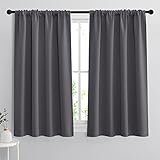
- Fit for Small Windows: Sold as 2 panels, each 42"W x 45"L. Tailored for small windows in bathrooms, kitchens, basements, and RV/Campers. Pro Tip: These blackout curtains feature a 3-inch rod pocket and support two hanging styles: rod pocket or clip rings (not included). If slightly shorter than your window, simply use clip rings or hooks to adjust the length by 3–4 inches for a perfect fit.
- Light Blocking: Our blackout curtains deliver superior light blocking thanks to triple-weave fabric. Deep hues like black and grey block 85–99% of light, creating a near-total darkness ideal for bedrooms, nurseries, light sleepers, and shift workers. Lighter shades such as white and beige block 60–70% of light, offering soft daylight filtering while ensuring daytime privacy—perfect for living rooms, bathrooms, or spaces where style meets function.
- Energy Smart: These thermal-insulated blackout curtains are crafted from heavy-duty fabric that provides effective temperature regulation—blocking summer heat and winter chill to help lower energy bills. The dense weave also shields interiors from harmful UV rays, protecting furniture, floors, and artwork from sun fading. Ideal for basement windows, RVs, or any space needing year-round comfort and efficiency.
- Total Privacy Protection: Unlike sheer or lightweight curtains, our thick blackout fabric ensures complete privacy. They’re essential for ground-floor bathrooms, street-facing kitchen windows, bedrooms in busy neighborhoods, or even crowded RV parks where close quarters demand discretion. Whether you're changing, relaxing, or simply want peace of mind, these curtains keep your space truly private without sacrificing style or light control.
- Easy Care: Built for durability and convenience. These curtains are machine washable in cold water (gentle cycle) and can be tumble dried on low heat. Note: Due to shipping, the curtains may arrive with temporary creases. We recommend a quick steam or a low-heat iron to remove wrinkles and achieve the best drape right out of the box.
- Daylight: Check whether occupied spaces receive useful light and whether blinds remain closed because of glare.
- Thermal comfort: Review temperature trends, complaints, cold-surface effects and perimeter-zone conditions across seasons.
- Solar control: Inspect overheating events, shading deployment and the relationship between façade orientation and complaints.
- Ventilation: Confirm that outdoor-air targets, window operation and mechanical modes agree with the intended sequence.
- Operations: Ask facilities staff which controls are understood, which components fail and which overrides are routinely used.
The UC report cautions that built performance can diverge from design intent. Treat post-occupancy evaluation as part of delivery, not as optional publicity. Without project-specific measurements, describe a strategy as a potential benefit rather than claiming that it saves energy or improves occupant outcomes.
Common mistakes and how to correct them
- Using one glazing ratio everywhere: Split the analysis by orientation, room type and climate exposure.
- Choosing glass before designing shade: Test glazing and shading together, including glare and maintenance.
- Counting daylight but ignoring blinds: Model or observe the way occupants are likely to operate shades.
- Specifying operable windows without an operating plan: Coordinate controls, security, weather response, air quality and user training.
- Relying on product labels: Review the complete window, frame, edge, installation and control assembly.
- Declaring success from drawings: Schedule commissioning and post-occupancy checks with named responsibilities.
- Ignoring the facilities team: Include maintainability, access, replacement and fault-reporting requirements in the project brief.
Applying the method to existing buildings
Retrofit decisions should begin with an operating audit rather than a default replacement package. Identify where occupants experience glare, drafts, overheating, condensation or poor ventilation. Review utility data and control settings alongside interviews with facilities staff. A window replacement may address heat loss while leaving solar gains or ventilation problems untouched; shading, air sealing, controls or mechanical changes may be needed as well.
Sequence work so that temporary measures can reveal the cause of a problem. For example, trialing improved shading or control settings on one elevation can show whether complaints arise from direct sun, poor air movement or a deeper envelope issue. Record the result and use the same evaluation method before expanding the intervention.
What a credible project brief should require
- Climate, orientation and surrounding-site assumptions for every façade.
- Daylight, glare, solar, thermal and ventilation objectives stated together.
- Window, frame, shading, seal, control and installation details treated as one assembly.
- Operating sequences for normal, extreme-weather, after-hours and override conditions.
- Maintenance access, cleaning, replacement and facilities training.
- Commissioning records and a post-occupancy evaluation plan.
- Clear language distinguishing predicted performance from measured results.
There is no universal “green window” specification. The greener choice is the one that meets the project’s documented priorities with a manageable operating strategy, survives local conditions and can demonstrate how it performs after people move in.
Bottom line
Windows make a building greener when daylight, solar control, thermal performance, ventilation and comfort are designed as one climate-specific façade strategy. More glass can help, hurt or do both at different times. Evaluate each orientation and operating mode, coordinate the full system, and verify the result in use instead of treating design intent as proof.
The Tool Desk
Outbyte PC Repair FREERepair Windows errors before they cause bigger problemsFix Now →Outbyte Driver Updater FREEScan for outdated or missing drivers - takes under a minuteDriver Scan →Quick Recap
Product prices and availability are accurate as of the date/time indicated and are subject to change. Any price and availability information displayed on Amazon at the time of purchase will apply.

