The Tool Desk
Outbyte Driver Updater FREEFix the driver behind crashes, sound loss and screen glitchesFind Drivers →Outbyte PC Repair FREERepair Windows errors before they cause bigger problemsFix Now →To use a standard three-piece moka pot, fill the lower chamber with water to just below the safety valve, fill the funnel basket with moka-ground coffee, level it without tamping, and screw the pot together firmly. Brew over low-to-medium heat. Remove it as soon as the upper chamber fills and the stream turns pale or begins to gurgle. Let the pot cool before opening, then rinse and dry it.
A moka pot makes concentrated moka coffee—not technically espresso. The method below is the safest, simplest starting point for a Bialetti Moka Express or a similar stovetop brewer. Brikka, Mukka Express, electric models, pressure-valve models, and other specialty designs may require different instructions, so their manuals take precedence.
Quick moka-pot recipe
- Water: Add water to the lower edge of the safety valve.
- Coffee: Use fresh coffee ground finer than drip but coarser than espresso. Fill and level the basket; do not tamp.
- Heat: Use low-to-medium heat. A typical Bialetti Moka Express brew takes approximately 3–6 minutes, but the coffee flow matters more than the clock.
- Finish: Remove the pot when the upper chamber is full and the flow turns pale, foamy, or distinctly gurgly.
- Serve: Stir the coffee in the upper chamber, then drink it straight or dilute it with hot water or milk.
- Clean: Cool the pot completely, separate the parts, rinse according to the model’s instructions, and dry everything before storing.
This follows Bialetti’s official baseline method for the Moka Express: cold water, moka-ground coffee, no tamping, low-to-medium heat, and immediate removal from the burner when the upper chamber is full. See Bialetti’s Moka Express instructions.
As an Amazon Associate I earn from qualifying purchases.
PC Slower Than It Used to Be?
A free scan shows the junk files, broken settings and background clutter dragging Windows down - then fixes them in one click.Free scan · Windows 10 & 11Outdated Drivers Are Slowing You Down
One free scan finds every outdated or missing driver and matches the right update for your exact hardware.Free scan · exact hardware matchWhat is a moka pot?
A moka pot is a stovetop brewer with three functional sections:
- Lower chamber or boiler: Holds the water and contains the safety valve.
- Funnel-shaped filter basket: Holds the ground coffee.
- Upper chamber or collector: Receives the brewed coffee.
When the water is heated, pressure in the lower chamber pushes hot water upward through the coffee bed and into the upper chamber. Engineering research describes moka brewing as a steam-pressure-driven process rather than a simple matter of waiting for ordinary atmospheric boiling. The underlying brewing study is available through ScienceDirect.
#1 Best Overall

- CRAFT COFFEE AT HOME: Produces six demitasse/espresso servings of rich, smooth espresso coffee in minutes. Craft your own espresso, Americano, Cuban coffee, Italian-style coffee, Moka, lattes, cappuccinos and more from the convenience of your home.Filter type:Reusable
- DURABLE DESIGN: Carefully crafted with cast aluminum for long-lasting durability. Provides thorough and even heat distribution for enhanced flavor, aroma and consistency. Features a flip-top lid with a heat-resistant knob and handle for safe, easy pouring.
- EASY TO USE: Simply fill the lower chamber with water, add ground coffee or espresso to the filter and place on stovetop. Within minutes, delicious espresso will fill the top chamber of your moka. Remove from heat and enjoy!
- EASY TO CLEAN: Simply rinse with warm water and allow all components to dry before reassembling.
- COFFEE ON-THE-GO: This coffee maker is portable and works on all electric, ceramic and gas stovetops (including propane) making it the perfect camping accessory. Available in 5 different sizes.
The result is concentrated, full-bodied coffee that works well on its own or in milk drinks. It is not espresso in the technical sense: an espresso machine uses a different brewing system, pressure profile, puck preparation, and extraction setup. “Stovetop espresso maker” is common retail terminology, but “moka coffee” or “espresso-style coffee” is more accurate.
What you need
For a normal brew, you need:
- A standard three-piece moka pot
- Fresh coffee
- Good-tasting water
- A compatible stovetop or heat source
- A cup or small serving vessel
- A heatproof towel or mitt
These tools are optional but useful:
- A burr grinder
- A kettle, especially if you want to try the pre-boiled-water technique
- A kitchen scale
- A timer
- A small bowl of cool water or a wet towel for stopping extraction
Use water that tastes good by itself. Filtered water can help if your tap water is heavily chlorinated or very hard, but beginners do not need a special mineral recipe.
Choose the right moka-pot size
Moka-pot “cups” are small, espresso-sized servings—not standard U.S. measuring cups. A pot is designed around a particular basket size and water volume, so choose one that matches the amount you normally want to brew.
For the Bialetti Moka Express, the manufacturer lists these approximate nominal capacities:
| Model size | Approximate capacity |
|---|---|
| 1 cup | 60 ml |
| 2 cups | 90 ml |
| 3 cups | 130 ml |
| 4 cups | 190 ml |
| 6 cups | 270 ml |
| 9 cups | 420 ml |
| 12 cups | 670 ml |
| 18 cups | 810 ml |
Actual drink yield can be lower because the coffee grounds retain some water and because a good brew is stopped before the final sputtering phase. Bialetti’s capacity information is a useful reference, but capacities vary by manufacturer and model.
Do not normally fill only half of a large basket to make a smaller serving. That changes the coffee-to-water geometry and often produces weak or unbalanced coffee. If you regularly want one small serving, use a smaller pot. You can dilute a correctly brewed concentrated coffee with hot water if you want a longer drink.
Choose coffee and the right grind
Grind
Use a moka grind: finer than ordinary drip coffee but coarser and less powdery than espresso. As a visual approximation, the grounds should resemble fine sea salt or table salt with visible particles—not flour.
Espresso-fine coffee can restrict the flow, especially if it is also pressed into the basket. That may cause harsh bitterness, violent sputtering, or steam escaping through the safety valve. If your grinder has no moka setting, start between its drip and espresso settings and adjust gradually. Grinder calibration differs, so the exact dial number is not universal. This practical grind guide provides a useful visual comparison.
Roast and freshness
Freshly ground coffee is easiest to work with. Medium, medium-dark, and dark roasts are straightforward starting points because their roast-forward flavor suits the concentrated moka style. Light roasts can work, but they often need more careful adjustment of grind, heat, and stopping point and may taste sharper or more acidic.
You do not need a particular coffee origin or roast to learn the brewer. Start with a coffee you already enjoy, then change one variable at a time.
Rank #2

- The original moka coffee pot: Moka Express is the original stovetop espresso maker, it provides the experience of the real Italian way of preparing a tasteful coffee, its unique shape and the inimitable gentleman with moustache date back to 1933, when Alfonso Bialetti invented it.
- Made in Italy: it is Made in Italy and its quality is enhanced by the patented safety valve which makes it easy to clean and its ergonomic handle, available in many sizes and suitable for gas, electric and induction (with the Bialetti induction adapter plate)
- How to prepare the coffee: fill the boiler up to the safety valve, fill it up with ground coffee without pressing, close the moka pot and place it on the stovetop, as soon as Moka Express starts to gurgle, turn the fire off and coffee will be ready
- One size for each need: Moka Express sizes are measured in Espresso Cups, coffee can be enjoyed in Espresso Cups or in larger containers
- Cleaning instructions: the Bialetti Moka Express should be rinsed simply with water, after use. Do not use detergents. The product should not be washed in the dishwasher as this could cause damage to the product and affect the taste of the coffee.
How to use a moka pot step by step
1. Inspect the pot before every brew
Before adding water or coffee, check that:
- The funnel basket is present and undamaged.
- The upper filter plate is installed.
- The rubber gasket is seated and is not cracked, brittle, or badly flattened.
- The safety valve is intact and unobstructed.
- The body is not cracked, severely dented, or otherwise damaged.
Do not use a pot with a damaged pressure or sealing component. A moka pot must be able to release pressure and seal correctly.
2. Add water to the lower chamber
For the standard Bialetti Moka Express method, use water only and fill the boiler to the lower edge of the safety valve. Do not cover the valve and do not fill above it.
That air space is intentional. “Fill below the screw” is an ambiguous instruction; use the valve as the reference point unless your specific model has a clearly marked fill line. Never put milk, wine, or another liquid in the lower chamber.
3. Fill the coffee basket
- Place the funnel basket into the lower chamber.
- Fill it with moka-ground coffee.
- Level the grounds gently with a finger or straight edge.
- Do not tamp, compress, or mound the coffee.
- Brush loose grounds from the basket rim and the sealing surface.
The basket is normally meant to be filled to its designed capacity. Tamping imports espresso technique into a brewer that is not designed for a compact espresso puck. A compressed or overly fine coffee bed can obstruct flow and raise pressure.
What’s actually slowing this PC down?
Pick the symptom - the matching free tool is one click away.
4. Assemble the pot
Screw the upper chamber onto the base firmly enough to seal, but do not force it. Hold the pot by its body rather than using the handle as leverage; excessive force can damage or break the handle. Keep the safety valve pointed away from you and close the lid before heating.
5. Heat gradually
Place the pot on low-to-medium heat. There is no universal stove-dial number because burners vary, but the goal is a controlled, gradual brew rather than a rapid boil.
- Gas: Keep the flame beneath the base. It must not wrap around the sides or heat the handle.
- Electric coil or ceramic glass: Avoid the highest setting and use a controlled setting that produces a steady flow.
- Induction: Use only an induction-compatible moka pot or a suitable adapter. A classic aluminum Moka Express is not induction-compatible because aluminum is not magnetic.
Bialetti gives approximately 3–6 minutes for a Moka Express, depending on pot size and heat intensity. Treat that as a range, not a fixed recipe time.
6. Watch the coffee flow
As the water moves through the coffee, it will emerge from the central column into the upper chamber. The desirable flow is generally smooth and steady.
Remove the pot from the heat when the upper chamber is mostly or fully filled and the stream becomes pale, foamy, or starts making a pronounced gurgling sound. Do not keep heating the pot to collect every last drop. The late phase tends to add harsh, overextracted flavors and can overheat the brewer.
7. Stop extraction and serve
- Move the pot off the burner immediately.
- If needed, cool the lower chamber with a wet towel or briefly place the base in cool water. Take care with any model containing hot glass or other temperature-sensitive components.
- Stir the coffee in the upper chamber before pouring. This blends the earlier and later portions of the brew.
- Serve it straight, dilute it with hot water, or add steamed or frothed milk.
Bialetti specifically recommends mixing the coffee before serving. A small moka pot can produce a strong drink; an Americano-style serving is made by adding hot water after brewing, not by arbitrarily underfilling the pot.
Rank #3
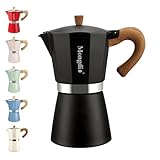
- Moka Espresso Coffee: Stovetop espresso maker, Moka pot, & manual coffee percolator machine. Available in 3-cup, 6-cup, 9-cup and 12-cup sizes. The stove top percolator makes home espresso like a barista. It's easier to use than an electric espresso machine and makes a rich cup of espresso mocha.3 cup, 6-cup, 9-cup and 12-cup expresso coffee pot, stove top size, food grade aluminum Espresso Moka coffee pot.
- Premium Quality Design: This espresso pot features a durable, food-grade cast aluminum body and a classic Italian design that ensures fast, even heat distribution for rich, velvety coffee flavor. A built-in safety valve regulates the pressure inside the pot to extract more caffeine. This espresso pot is designed with a heat-resistant handle, lid knob and built-in spout for easy pouring.
- Easy to Clean: Simply rinse with warm water and allow all parts to dry before reassembling.Notice: Do not wash the moka pot in the dishwasher.Notice: Do not wash the moka pot in the dishwasher
- Easy to Use: For stovetop espresso makers, unscrew the top and remove the filter from the base. Fill the base to the level of the safety valve and insert the filter. Fill the filter funnel with ground coffee (do not press down) and screw it back into the base. Heat over medium heat for 3-5 minutes for a high quality Cuban coffee.
- Mongdio Guarantee: Our home percolator coffee pot is a must-have in every coffee lover's kitchen. Ideal for making espresso. The perfect gift for all coffee lovers, if you have any questions please feel free to contact us, 2 Years Guarantee!
Cold water or pre-boiled water?
Both methods are used, but they should not be presented as equivalent instructions for every beginner.
The recommended beginner method: cold water
Bialetti’s official Moka Express instructions call for cold water. This is the simplest baseline because you can assemble the pot before heating it and avoid handling a hot lower chamber. Use this method until you can consistently control the heat and recognize the end of the brew.
Do these 3 things before closing this tab:
1Scan for outdated or missing drivers - takes under a minute2Repair Windows errors before they cause bigger problems3Fix the driver behind crashes, sound loss and screen glitchesAn optional lower-bitterness technique: pre-boiled water
James Hoffmann’s flavor-focused technique starts with freshly boiled water in the lower chamber, followed by careful assembly, medium-low heat, and early removal from the burner. The rationale is to reduce the time that coffee grounds sit in a hot metal basket before extraction is complete. Hoffmann’s moka-pot technique explains this approach.
However, the hot-water method creates a real burn hazard. The lower chamber, water, and surrounding metal become hot while you are assembling the pot. If you try it:
- Use a heatproof mitt or thick towel.
- Keep your hands away from the hot water and metal threads.
- Assemble the pot carefully without using the handle as leverage.
- Do not treat the technique as mandatory.
For most beginners, use the official cold-water method first. Roast level, grind, heat, pot material, and stopping point can matter as much as the starting-water temperature.
How to tell when the moka pot is finished
Do not rely on a single timer setting. Use sight and sound:
Quick wins for a faster PC:
Clear out junk files and repair common Windows errorsFree Scan →Fix the driver behind crashes, sound loss and screen glitchesFind Drivers →Repair Windows errors before they cause bigger problemsFix Now →- Beginning: Little or no coffee appears while the water heats.
- Middle: Coffee emerges in a steady, dark stream.
- End: The stream becomes lighter and thinner, often with foam or a loud gurgling sound.
Take the pot off the heat at the end of the useful flow. A short, controlled finish is preferable to prolonged violent sputtering. If the pot is still producing a small amount of pale coffee, do not chase it at the expense of flavor or safety.
How to serve moka coffee
- Straight: Stir the upper chamber and pour a small, concentrated serving.
- Longer and milder: Add hot water after brewing.
- With milk: Add steamed or frothed milk for a latte-style drink.
- Over ice: Let the coffee cool briefly, then pour it over ice or combine it with chilled milk.
Moka coffee is concentrated enough for milk drinks, but it will not have the same crema or extraction profile as espresso. If you specifically want true espresso and crema, use an espresso machine. For a cleaner, larger, brighter cup, consider pour-over or an AeroPress; for a large immersion brew, a French press may be a better fit.
Stovetop compatibility
Gas, electric, and ceramic glass
The classic aluminum Bialetti Moka Express is designed for gas, electric, and ceramic hobs, but use moderate heat and keep gas flames below the sides of the pot. Always check the instructions for your exact model.
Induction
A classic aluminum Moka Express should not be placed directly on an induction cooktop. Instead, use a model specifically made for induction, such as Bialetti’s Moka Induction, which uses a steel-and-aluminum construction. The manufacturer also advises checking that the base diameter is supported by the particular cooktop. See Bialetti’s induction-model guidance.
An induction adapter plate can heat some conventional moka pots. It may be slower or less convenient because the plate adds another layer between the burner and the pot. Follow the adapter’s instructions and use moderate heat. Bialetti lists its induction plate for Moka Express models up to six cups. See the adapter’s model guidance.
Rank #4

- Venus is the perfect combination of tradition and innovation: the original induction coffee maker that prepares a perfect coffee, with a Made in Italy taste from a pot with a unique design.
- Bialetti Venus is made in 18/10 stainless steel of the highest quality to guarantee durability over time and an unmistakable style.
- How to use Bialetti Venus: fill it up with ground coffee, close the pot and place it on the stovetop, as soon as Bialetti Venus starts to gurgle, turn the fire off and coffee will be ready
- One size for each need: Bialetti Venus sizes are measured in Espresso Cups, coffee can be enjoyed in Espresso Cups or in larger containers
- Cleaning instructions: Bialetti Venus must only be cleaned by rinsing every component with simple water, do not use any detergent nor put it in the dishwasher, as it damages the product and the taste of your coffee
Troubleshooting moka-pot problems
| Symptom | Likely causes | What to do |
|---|---|---|
| Bitter or burnt coffee | Heat too high, prolonged heating, grind too fine, or excessive late sputtering | Lower the heat, grind slightly coarser, remove the pot at the first sustained gurgle, and consider the optional pre-boiled-water method once you can handle it safely. |
| Sour or thin coffee | Grind too coarse, insufficient or uneven heat, stale coffee, or an incorrectly filled basket | Grind slightly finer, use steadier moderate heat, check that the basket is filled and leveled, and use fresher coffee. |
| Violent sputtering before much coffee is produced | Grind too fine, tamped or overfilled coffee, clogged filter, or excessive heat | Remove the pot from heat. Let it cool completely, clean the filter holes, use a looser and slightly coarser bed, and reduce the heat. |
| Steam escapes from the safety valve | Too much water, coffee that is too fine or compressed, a blockage, or a faulty valve | Remove the pot from heat. Do not open it while hot or pressurized. After it cools, check the water level, grind, basket, filter, and valve. Stop using the pot if the problem continues. |
| Water or coffee leaks around the seam | Loose assembly, grounds on the sealing rim, or a worn gasket | Cool the pot completely, clean the rim, reassemble it correctly, and replace the gasket if it is worn. |
| Little or no coffee reaches the upper chamber | Missing or misassembled parts, clogged filter, poor seal, or incorrect water level | Confirm that the basket, filter plate, gasket, and valve are present and seated. Clean the holes and check for leaks or damage. |
| Metallic or detergent taste | Dishwasher cleaning, detergent residue, residue from a new pot, or a damaged aluminum surface | Rinse thoroughly. Follow the model’s cleaning instructions; for a new Bialetti Moka Express, discard the first three brews. |
| The coffee is too strong | The pot may be working normally; moka coffee is concentrated | Dilute the finished coffee with hot water or milk. Use a smaller pot if you consistently need less coffee. |
| Grounds appear in the cup | Grind too fine, a damaged filter, loose grounds, or late sputtering | Grind slightly coarser, inspect the filter plate, clean the sealing surfaces, and stop before aggressive sputtering. Paper filters are optional experiments, not required for a standard brew. |
The safety-valve and leakage precautions above reflect Bialetti’s safety instructions. Flavor adjustments are practical starting points rather than guaranteed diagnoses; change one variable at a time.
Independent reader supportYour contribution helps us test, update, and keep practical guides available for everyone.Cleaning and maintaining a moka pot
- Cool it completely. Never disassemble a hot or pressurized pot.
- Separate the chambers. Remove the funnel basket and, if the design permits, the upper filter plate.
- Empty the grounds gently. Do not strike the funnel against a hard surface or deform it.
- Rinse the parts. For an aluminum Bialetti Moka Express, Bialetti recommends warm water without detergent or abrasive materials.
- Clean the holes. Check the funnel, upper filter, and safety valve for coffee or mineral deposits.
- Dry every part completely. Trapped moisture can contribute to odors, corrosion, or residue.
- Store it open or loosely assembled. Do not seal the pot shut while it is still damp.
- Inspect the gasket. Replace it when cracked, hardened, shrunken, or flattened. The referenced Bialetti manual recommends replacement at least once a year, although actual life depends on heat, frequency, cleaning, and model.
- Descale when needed. Follow the exact model’s instructions. The referenced Bialetti manual recommends water with two teaspoons of citric acid or vinegar, followed by a water-only rinse and a cleaning brew.
Bialetti says the aluminum Moka Express should not go in the dishwasher and should be washed by hand. Stainless-steel and other brands may permit different cleaning methods, so do not apply the aluminum rule blindly to every moka pot. Consult the Moka Express manual and Bialetti’s care FAQ.
Bialetti also recommends periodically checking the safety-valve piston. During washing, move the piston along its axis to help reduce the risk of mineral blockage. If the valve does not move as intended or appears damaged, do not brew with the pot.
Free tools Windows power users keep installed
One-click scans. No signup required.
First use and “seasoning”
For a new Bialetti Moka Express, Bialetti recommends washing the pot and discarding the first three brews. This is a manufacturer recommendation for that product, not a universal requirement that every moka pot develop a permanent seasoning layer.
After those initial brews, the important habits are simple: use the correct water level, avoid detergent if the model’s manual says not to use it, keep the filter and valve clear, and dry the pot completely.
Is aluminum from a moka pot dangerous?
Do not treat the material question as a reason to panic or as a guarantee that every model behaves identically. A 2024 risk-assessment study found greater aluminum migration from tested aluminum moka pots than from some steel pots, but reported that the tested concentrations did not exceed the study’s maximum permissible-dose assessment. Results depend on the pot, water, condition, and use. Follow the manufacturer’s care instructions and seek individual medical advice for personal health concerns. Read the cited 2024 assessment.
Common mistakes to avoid
- Calling the drink espresso without qualification.
- Filling “below the screw” instead of using the safety valve as the reference.
- Using high heat to make the brew finish faster.
- Tamping the basket like an espresso puck.
- Using espresso-fine coffee that restricts flow.
- Waiting for prolonged, violent sputtering.
- Reducing a large pot’s recipe by arbitrarily halving the water or coffee.
- Opening or washing the pot while it is hot.
- Putting a classic aluminum Moka Express directly on induction.
- Leaving the pot sealed while damp.
Frequently Asked Questions
Is moka-pot coffee espresso?
No. Moka coffee is concentrated and full-bodied, but it is brewed by a different pressure-driven stovetop process and does not have the same extraction conditions or crema as pump or lever espresso. “Stovetop espresso” is common marketing language; “moka coffee” is more technically accurate.
Recommended Free Tools
Can I use espresso-ground coffee in a moka pot?
You can, but it is usually a poor starting choice. Espresso-fine grounds may restrict flow and contribute to bitterness, sputtering, or safety-valve venting. Use a grind finer than drip but coarser and less powdery than espresso.
Should I tamp the coffee?
No. Fill the basket to its designed capacity and level the grounds gently without pressing them. Tamping can obstruct flow and increase pressure.
Should I use hot or cold water?
Use cold water for the standard beginner method because that matches Bialetti’s official Moka Express instructions and avoids handling a hot base during assembly. Pre-boiled water is an optional technique that may shorten the heating phase, but it introduces a burn hazard and is not mandatory.
Best Value

- COMPACT 6-CUP CAPACITY: Brews 6 demitasse servings of rich espresso in minutes. Craft espresso, Americanos, Cuban coffee, Italian-style moka, lattes, cappuccinos, and more at home, in the office, or on the go.
- DURABLE ALUMINUM BUILD: Crafted from high-quality cast aluminum for even heat distribution and long-lasting performance. Perfect for gas, electric and ceramic stovetops.
- SIMPLE TO USE: Add water to the base, coffee to the filter, and heat on your stovetop to brew authentic moka pot espresso without electric power or paper filters. Quick and easy for every morning.
- CLASSIC MOKA POT BREWING: Experience rich Italian-style espresso with the Primula Classic Stovetop Espresso and Coffee Maker, Moka Pot Cafetera. Ideal for Italian and Cuban coffee lovers, this stovetop espresso maker delivers bold flavor and aroma in minutes.
- EASY CLEANING & SAFE HANDLE: Features an ergonomic stay-cool handle and drip-free spout for controlled pouring. Disassembles quickly for hand washing with warm water.
How much coffee goes in a moka pot?
Fill the funnel basket to its intended capacity and level the grounds without tamping. Basket capacity varies by model, so there is no universal gram amount. If you want less coffee, a smaller pot is usually better than partially filling a larger basket.
Free tools Windows power users keep installed
One-click scans. No signup required.
Why is my moka coffee bitter?
The common starting causes are excessive heat, leaving the pot on the burner too long, a grind that is too fine, or prolonged sputtering. Lower the heat, grind slightly coarser, and remove the pot when the flow turns pale or begins to gurgle.
Why is my moka pot sputtering?
A brief gurgle at the end is a cue to remove the pot from heat. Violent sputtering before much coffee appears can indicate excessive heat, a fine or tamped coffee bed, a clogged filter, or a sealing problem. Let the pot cool completely before inspecting it.
Why is steam coming from the safety valve?
Possible causes include overfilling, coffee that is too fine or compressed, a blocked filter, or a faulty valve. Remove the pot from heat and do not open it while hot or pressurized. After it cools, inspect the water level, coffee bed, filter, and valve. Discontinue use if the problem persists.
Can I put a moka pot in the dishwasher?
Do not put an aluminum Bialetti Moka Express in the dishwasher; Bialetti recommends hand-washing it with warm water and no detergent or abrasives. Other materials and brands may have different rules, so check the specific manual.
Can I use a classic moka pot on induction?
A classic aluminum Moka Express is not induction-compatible. Use an induction-ready model or a suitable adapter plate, following the manufacturer’s instructions and checking the cooktop’s supported base diameter.
How can I make moka coffee weaker?
Brew the pot normally, then dilute the finished coffee with hot water or add milk. Do not force a partial brew by using only part of the water or coffee basket.
Can I brew milk in the lower chamber?
No. Use water only in the lower chamber. Add steamed, frothed, or cold milk after brewing.
How often should I replace the gasket?
Inspect it regularly and replace it when it becomes cracked, hard, shrunken, or flattened. The referenced Bialetti manual recommends replacing the gasket at least once a year, but service life depends on use, heat, cleaning, and the exact model.
Do I need to season a new moka pot?
Bialetti recommends discarding the first three brews of a new Moka Express. That is a product-specific first-use recommendation, not proof that every moka pot requires permanent seasoning.
The Bottom Line
The reliable moka-pot routine is simple: water to the lower edge of the safety valve, a full basket of moka-ground coffee with no tamping, low-to-medium heat, and removal at the first pale flow or pronounced gurgle. Cool the pot before opening, stir before serving, and rinse and dry it after use. If the coffee is harsh, adjust heat, grind, and stopping point before reaching for complicated hacks.
Quick Recap
Product prices and availability are accurate as of the date/time indicated and are subject to change. Any price and availability information displayed on Amazon at the time of purchase will apply.




