First determine whether the circuit is DC or AC. Batteries, cars, speakers, LED projects, and many low-voltage adapters use positive (+) and negative (−). Household wiring uses hot or line, neutral, and equipment ground—not fixed positive and negative wires.
The answer depends on whether you are dealing with DC or AC:
As an Amazon Associate I earn from qualifying purchases.
- In a DC circuit—such as a battery, car circuit, speaker system, LED strip, or low-voltage adapter—there is usually a positive (+) and negative (−) side. A properly rated digital multimeter can identify them when markings are missing or unreliable.
- In ordinary household AC wiring, the wires are not normally called positive and negative. The relevant terms are hot or line, neutral, and equipment ground.
How to identify positive and negative in a DC circuit
1. Check the markings before testing
Look first for a + or − symbol on the battery, power supply, circuit board, connector, or device housing. Battery terminals are normally marked directly. A wiring diagram or manufacturer’s instructions are more reliable than insulation color.
Windows Errors? Fix Them Before They Spread
Repair common Windows errors and clear accumulated junk for a smoother, more stable PC - no reinstall needed.Free scan · no reinstallCrashes, No Sound, or Screen Glitches?
Random freezes, missing sound and display glitches usually trace back to one bad driver. Find and replace yours safely.Free scan · under a minuteAlso look for polarity symbols on a wall adapter. The symbol may show whether the center pin of a barrel connector is positive or negative. Do not connect an unmarked adapter to a device merely because its plug fits; the voltage, current capability, connector size, and polarity must all be suitable.
#1 Best Overall

- Multifunctional Wire Stripper And Twister With Electricity Measurement Function For Efficient Wire Cutting, Pulling, Scraping, And Pressing. Perfect Tool For Electricians And DIY Enthusiasts
- 8-in-1 Wire Stripping Pliers With Voltage Test Feature, Offering Convenience And Accuracy For Electrical Work. Say Goodbye To Multiple Tools With This All-in-one Solution.suitable For AWG 18,14,12,10,6/1.0,1.5,2.0,2.5,4.0mm²; Cape Cable 25mm² Wire, Open Cable Outer Skin, Divide Wiring 2*1.5mm²
- Small And Compact Design For Easy Handling And Storage. Don't Let The Size Fool You, As This Wire Stripper Packs A Punch With Its Versatile Functionality
- High-quality Cable Scissors For Precise Cutting And Stripping Of Electrical Cables. No More Struggling With Dull Blades Or Uneven Cuts
- Professional-grade Wire Stripper Crimper For Reliable Wire Connections. Save Time And Effort With This Efficient Tool, Perfect For Electrical Projects Of Any Scale
2. Use a digital multimeter when the markings are missing
For a low-voltage DC circuit, use this general procedure:
- Confirm that the meter, test leads, and probes are rated for the voltage and environment being tested. Inspect them for cracked insulation, bent tips, or other damage.
- Set the meter to DC voltage. The setting is commonly labeled
V⎓or shown as a solid line over a dashed line. Do not select the AC-voltage setting, usually markedV~, for this test. - Insert the black lead into
COM. - Insert the red lead into the
VorV/Ωjack. Never leave the red lead in an amp or milliamp jack when measuring voltage. - Touch the probes to the two terminals or conductors. Keep the probe tips from touching one another, which could short the source.
- Read the number and its sign on the display.
If the display shows a voltage with no minus sign, the point touched by the red probe is at a higher electrical potential than the point touched by the black probe. In the normal two-wire DC test, that means the red probe is on positive relative to the black probe.
If the display shows a minus sign, the probes are reversed relative to the source: the point touched by the red probe is at a lower potential than the point touched by the black probe. Swap the probes and the reading should become positive, assuming the source is functioning and the connection is sound.
−12.4 V DC. The wire touched by the red probe is negative relative to the wire touched by the black probe. Reverse the probes and the meter should read approximately +12.4 V DC.What the red and black meter leads mean
The red and black colors on the meter leads establish the reference for the measurement. They do not prove that the unknown circuit wires use the same color convention.
A red wire in the circuit may be positive, switched, incorrectly connected, or used for another purpose. A black wire may be negative, a chassis return, switched power, or something else. The meter’s reading—not the insulation color—answers the polarity question.
Rank #2

- 2026 Newest & Fully Upgraded: 14-in-1 Wire Stripper – Upgraded from the traditional 8-in-1 design, this multifunction tool integrates cutting, stripping, crimping, looping, twisting, bolt/nail cutting, and a built-in voltage tester; updated again on December 10, 2025, it now features a built-in charging port and an extended handle for improved performance, comfort, and efficiency in professional electrical work.
- Durable and Safe - More Reliable: Forged from high-carbon steel and finished with precision-machined jaws, this wire stripper tool ensures clean cuts and firm crimps. The ergonomic ABS handles provide a secure, non-slip grip for safe and comfortable use over long periods, and the built-in rechargeable battery with a USB-C port fully charges in 40 minutes and supports 1500+ uses.
- Upgraded Chip - More Sensitive: Unlike standard wire strippers electrical, this upgraded version is equipped with four LED indicators and an audible alarm.The enhanced chip accurately distinguishes live (hot) and neutral wires, adding an extra layer of safety during quick electrical inspections.
- Versatile - A Great Gift: Suitable for home wiring, automotive repair, and professional electrical projects. Handles both small wires (8–20 AWG / 0.52–8.37 mm²) and large cables (20–3/0 AWG / 0.52–85.01 mm²). A versatile cable stripper that makes a thoughtful and practical gift for electricians, technicians, or DIY enthusiasts.
- Quality Service - More Comfort: Each package includes the 14-in-1 wire strippers and a professional user guide. If you encounter any issues, simply reach out via Amazon — we provide fast, professional after-sales support to ensure your satisfaction.
Color clues for common low-voltage DC wiring
In deliberately marked low-voltage systems, red is often used for positive and black for negative. Speaker cables may use a stripe, ridge, printed lettering, or a differently colored conductor to distinguish one side. Automotive wiring can use many colors and may include switched power, chassis ground, signal wires, and multiple circuits.
These are conventions, not guarantees. A previous repair, extension, installation error, or manufacturer-specific design can make the colors misleading. Verify uncertain wiring with documentation or a meter before connecting equipment.
Quick wins for a faster PC:
Repair Windows errors before they cause bigger problemsFix Now →Fix the driver behind crashes, sound loss and screen glitchesFind Drivers →Clear out junk files and repair common Windows errorsFree Scan →Household AC wiring: use hot, neutral, and ground
Alternating current changes direction periodically, so a household AC conductor does not have a fixed positive or negative identity in the same sense as a battery. Calling the wires “positive” and “negative” can lead to the wrong test or connection.
In a typical U.S. branch circuit:
- Hot or line: the ungrounded conductor that is normally energized relative to neutral and ground.
- Neutral or grounded conductor: the circuit conductor intentionally connected to the system ground at the appropriate point.
- Equipment grounding conductor: the protective conductor connected to non-current-carrying metal parts. It is intended to provide a fault-current path and is not normally energized.
Common U.S. color conventions
| Function | Common identification |
|---|---|
| Hot, line, or ungrounded | Black or red are common; other permitted colors may occur depending on the installation. |
| Neutral, or grounded conductor | Continuous white or natural gray. |
| Equipment ground | Green, green with a yellow stripe, or bare copper or aluminum. |
Can you test a household receptacle?
A listed plug-in receptacle tester can provide a simple indication of several common wiring faults without requiring you to hold probes against exposed conductors. It is useful as a screening tool, not as proof that an entire circuit is safe.
A properly rated multimeter can provide more information by comparing:
Rank #3

- 【8-IN-1 MULTI-TOOL】 Streamline your tool pouch. This heavy-duty electrician tool integrates wire stripping, cutting, splitting, winding, pulling, clamping, and crimping into one. Comes with a bonus screwdriver and replaceable blades.
- 【BUILT-IN VOLTAGE TESTER】 Features a dual-mode AC/DC voltage tester (12V-250V) to check live and neutral wires instantly. Bright red flashes and audible beeps alert you to live wires for maximum electrical safety.
- 【PRECISION WIRE STRIPPER】 Laser-precise stripping holes perfectly fit 10-20 AWG solid and stranded wires (1.0-4.0mm²) without nicking the copper core. The premium stainless steel blade (HRC55±2) ensures clean, effortless cuts.
- 【LABOR-SAVING SPRING】 Equipped with an internal auto-open spring to drastically reduce hand fatigue during repetitive tasks. The ergonomic, non-slip textured handle provides a comfortable grip in any job site condition.
- 【PROFESSIONAL & DIY GIFT】 Built with premium rust-resistant stainless steel for long-lasting durability. Extremely portable and versatile, making it the perfect hand tool gift for professional electricians and DIY enthusiasts.
- hot to neutral,
- hot to equipment ground, and
- neutral to equipment ground.
In a normally wired receptacle, hot-to-ground is generally close to hot-to-neutral, while neutral-to-ground is normally near zero under lightly loaded conditions. A small neutral-to-ground voltage can occur because current flowing through a loaded neutral produces voltage drop.
These comparisons can help reveal conditions such as reversed hot and neutral or a neutral-ground problem, but one voltage measurement does not establish every conductor’s identity. Open wiring, a missing ground, shared neutrals, load conditions, and other faults can complicate the readings.
Do not turn this overview into a casual invitation to probe exposed mains wiring. If you do not already know how to select the correct meter function, input jack, measurement category, and test method, use a listed receptacle tester for a basic check or hire a qualified electrician. Electrical work in a service panel or building circuit should be left to a professional.
What a non-contact voltage tester can—and cannot—tell you
A non-contact voltage tester can be useful for an initial indication that an AC conductor may be energized. It does not identify DC positive and negative, and it should not be treated as conclusive proof that a wire is hot, neutral, or safely de-energized in every situation.
Use it only as a secondary screening tool, follow its instructions, and confirm the tester on a known live source before and after checking an AC circuit when the manufacturer recommends that procedure. A failure to trigger does not prove that a conductor is safe.
Rank #4

- Multifunctional Wire Stripper And Twister With Electricity Measurement Function For Efficient Wire Cutting, Pulling, Scraping, And Pressing. Perfect Tool For Electricians And DIY Enthusiasts
- 8-in-1 Wire Stripping Pliers With Voltage Test Feature, Offering Convenience And Accuracy For Electrical Work. Say Goodbye To Multiple Tools With This All-in-one Solution.suitable For AWG 18,14,12,10,6/1.0,1.5,2.0,2.5,4.0mm²; Cape Cable 25mm² Wire, Open Cable Outer Skin, Divide Wiring 2*1.5mm²
- Small And Compact Design For Easy Handling And Storage. Don't Let The Size Fool You, As This Wire Stripper Packs A Punch With Its Versatile Functionality
- High-quality Cable Scissors For Precise Cutting And Stripping Of Electrical Cables. No More Struggling With Dull Blades Or Uneven Cuts
- Professional-grade Wire Stripper Crimper For Reliable Wire Connections. Save Time And Effort With This Efficient Tool, Perfect For Electrical Projects Of Any Scale
Important multimeter safety rules
- Use the correct input jack. For voltage, the red lead belongs in the voltage input—not the amp or milliamp input. Using the current jack across a voltage source can create a short circuit through the meter and cause an arc, equipment damage, or injury.
- Use the correct function. Select DC voltage for battery polarity and AC voltage for an appropriate AC measurement. Never use resistance or continuity mode on an energized circuit.
- Turn power off for resistance and continuity tests. Disconnect the component or isolate the portion being tested where appropriate; stored energy can remain in capacitors and other components.
- Check the meter’s rating and condition. A meter suitable for a small battery is not automatically suitable for a service panel or receptacle. Voltage and measurement-category ratings, lead ratings, and the physical condition of the equipment all matter.
- Prevent probe slips and shorts. Hold insulated portions of the probes, expose only the required tip, and do not allow the tips to bridge adjacent terminals.
- Stop if anything is unclear. Smoke, heat, sparking, damaged insulation, an unexpected reading, or an unfamiliar circuit is a reason to de-energize the system if it can be done safely and call a professional.
Common mistakes
- Assuming red always means positive: often true in intentionally marked low-voltage wiring, but not reliable in unknown wiring.
- Assuming black always means negative: black is frequently used as hot in U.S. AC wiring.
- Calling AC conductors positive and negative: use hot or line, neutral, and equipment ground instead.
- Testing resistance on a live circuit: turn the power off first and isolate the component when appropriate.
- Using the amp jack for voltage: this can create a short circuit through the meter.
- Trusting one non-contact tester indication: presence detection is not a complete polarity or safety diagnosis.
- Relying only on a color chart: color is a starting clue, especially in modified or incorrectly wired installations—not final evidence.
What you need for a basic DC polarity check
For an ordinary low-voltage DC check, the essential tool is a properly rated digital multimeter with sound test leads. Choose a meter whose voltage range and measurement category match the circuit. An auto-ranging model can simplify range selection, but it does not remove the need to select the correct function and input jack.
A non-contact voltage tester may be useful for preliminary AC screening, but it is not a substitute for a DC polarity measurement or for professional diagnosis of household wiring.
When to call an electrician
Get professional help if the wiring is part of a wall, receptacle, junction box, service panel, or permanent building installation; if the circuit is high-voltage or unfamiliar; if insulation is damaged; if the colors and readings disagree; or if you cannot confidently identify the meter’s rating and test procedure.
For a battery, small electronic project, speaker lead, or other genuinely low-voltage DC circuit, the basic sequence is straightforward: check the markings, select DC voltage, use COM and V/Ω, and let the sign of the reading identify which test point is positive relative to the other.
The Tool Desk
Outbyte Driver Updater FREEScan for outdated or missing drivers - takes under a minuteDriver Scan →Outbyte PC Repair FREEClear out junk files and repair common Windows errorsFree Scan →Frequently Asked Questions
Is a red wire always positive?
No. Red is often used for positive in deliberately marked low-voltage DC wiring, but wire colors can be wrong, repurposed, or manufacturer-specific. In U.S. household AC wiring, red may be a hot conductor, while black is also commonly hot. Verify uncertain DC polarity with markings, documentation, or a properly rated multimeter.
Best Value
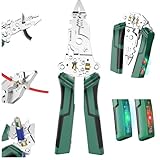
- 2026 Newest & Fully Upgraded: 14-in-1 Wire Stripper – Upgraded from the traditional 8-in-1 design, this multifunction tool integrates cutting, stripping, crimping, looping, twisting, bolt/nail cutting, and a built-in voltage tester; updated again on December 10, 2025, it now features a built-in charging port and an extended handle for improved performance, comfort, and efficiency in professional electrical work.
- Durable and Safe - More Reliable: Forged from high-carbon steel and finished with precision-machined jaws, this wire stripper tool ensures clean cuts and firm crimps. The ergonomic ABS handles provide a secure, non-slip grip for safe and comfortable use over long periods, and the built-in rechargeable battery with a USB-C port fully charges in 40 minutes and supports 1500+ uses.
- Upgraded Chip - More Sensitive: Unlike standard wire strippers electrical, this upgraded version is equipped with four LED indicators and an audible alarm.The enhanced chip accurately distinguishes live (hot) and neutral wires, adding an extra layer of safety during quick electrical inspections.
- Versatile - A Great Gift: Suitable for home wiring, automotive repair, and professional electrical projects. Handles both small wires (8–20 AWG / 0.52–8.37 mm²) and large cables (20–3/0 AWG / 0.52–85.01 mm²). A versatile cable stripper that makes a thoughtful and practical gift for electricians, technicians, or DIY enthusiasts.
- Quality Service - More Comfort: Each package includes the 14-in-1 wire strippers and a professional user guide. If you encounter any issues, simply reach out via Amazon — we provide fast, professional after-sales support to ensure your satisfaction.
What does a negative reading mean on a multimeter?
A minus sign means the point touched by the red probe is at a lower potential than the point touched by the black probe. Reverse the probes and the reading should become positive if the source and connections are working normally.
Can a non-contact voltage tester identify positive and negative?
No. A non-contact voltage tester can indicate that an AC conductor may be energized, but it cannot identify DC positive and negative and cannot conclusively prove that a wire is neutral or safely de-energized in every condition.
Why are household wires not called positive and negative?
Household AC wiring is normally described as hot or line, neutral, and equipment ground. AC reverses direction periodically and does not have fixed positive and negative conductors in the same sense as a battery.
Free tools Windows power users keep installed
One-click scans. No signup required.
The Bottom Line
Bottom line: For low-voltage DC, identify polarity from the markings or measure it with a properly rated digital multimeter: a positive display means the red probe is on the higher-potential side, and a minus sign means the probes are reversed. For household AC, do not look for positive and negative—identify hot, neutral, and equipment ground, and leave uncertain or exposed building wiring to a qualified electrician.
Quick Recap
Product prices and availability are accurate as of the date/time indicated and are subject to change. Any price and availability information displayed on Amazon at the time of purchase will apply.

