Outdated Drivers Are Slowing You Down
One free scan finds every outdated or missing driver and matches the right update for your exact hardware.Free scan · exact hardware matchPC Slower Than It Used to Be?
A free scan shows the junk files, broken settings and background clutter dragging Windows down - then fixes them in one click.Free scan · Windows 10 & 11Free woodworking charts give you quick shop references for three common decisions: drill-press speed, wood-screw dimensions, and lumber quantity. Here is how to use them accurately—and where a chart must give way to manufacturer instructions, actual measurements, and safe setup.
Free woodworking charts for the shop
Free woodworking charts are useful when you need a quick answer without stopping a project to search through a manual or calculate from scratch. The most useful references cover three recurring decisions: how fast to run a drill press, which wood screw and pilot hole to use, and how to estimate lumber by dimensions or board feet.
As an Amazon Associate I earn from qualifying purchases.
The core free chart collection from WOOD Magazine includes printable shop references for drill-press speeds, wood screws, and lumber sizing. WOOD’s separate drill-press reference was updated February 26, 2025. Treat these charts as planning and lookup aids—not as replacements for the instructions supplied with your machine, bit, fastener, or lumber dealer.
Do these 3 things before closing this tab:
1Clear out junk files and repair common Windows errors2Fix the driver behind crashes, sound loss and screen glitches3Repair Windows errors before they cause bigger problemsQuick guide to the charts
| Chart | What it helps you decide | Best used when |
|---|---|---|
| Drill-press speed chart | Approximate starting RPM for different bits and accessories | Before drilling or boring holes |
| Wood-screw chart | Screw gauge, length, pilot-hole size, shank-hole size, and head-bore size | When choosing screws for a joint |
| Lumber-sizing and board-foot references | How stock dimensions and board-foot volume relate to purchasing and estimating | When preparing a material list or comparing lumber prices |
1. Drill-press speed chart
A drill press does not operate at one universally correct speed. The appropriate revolutions per minute (RPM) depend on the bit or accessory, its diameter and design, the material, the cut, and the machine. The free chart is therefore best understood as a starting point: find the bit or accessory, note the recommended speed range or value, and then confirm it against the bit manufacturer’s instructions.
#1 Best Overall
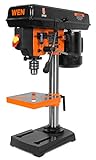
- Features a 2.3A induction motor, an 8-inch swing, and a 2-inch spindle travel
- Includes a 1/2-inch keyed chuck and onboard key storage
- Operates at 5 different speeds: 750, 1100, 1500, 2100, or 3200 RPM
- 6.5 by 6.5 inch height adjustable worktable bevels up to 45 degrees in each direction
- Measures in at 23 inches tall with a 7 by 11-inch base
How to use it
- Identify the exact bit or accessory—such as a twist drill, Forstner bit, hole saw, or sanding accessory.
- Note the material and diameter where the chart distinguishes them.
- Set the drill press within the machine’s available range, using the nearest suitable setting if the exact RPM is unavailable.
- Secure the workpiece and use the bit maker’s instructions as the final authority.
- Begin cautiously. Excessive heat, smoke, burning, chatter, or a stalled bit indicates that the setup needs attention.
Speed is only one part of a safe setup. A drill press uses a rotating cutting tool, and hazards include unsecured stock, rotating drills, chips, and exposed power-transmission components. Keep hands away from the rotating tool, remove the chuck key before starting, wear appropriate eye protection, and use a clamp, vise, or hold-down fixture when the work could shift or spin. OSHA’s drill-press guidance is the appropriate safety reference for workplace conditions; follow your machine’s manual and local requirements as well.
Practical rule: use the chart to choose a sensible starting RPM, then verify the bit manufacturer’s recommendation and secure the workpiece before drilling.
2. Wood-screw chart
Choosing a wood screw involves more than selecting a length that looks right. The free wood-screw reference compares several dimensions that affect whether a screw will hold well, pull the joint together, and leave an acceptable finished surface.
| Chart field | What it means |
|---|---|
| Screw gauge | The screw’s diameter or thickness classification. A larger gauge generally means a thicker screw, but the correct choice still depends on the material and joint. |
| Length | The available screw lengths. The screw must penetrate sufficiently into the receiving piece without breaking through or interfering with another part. |
| Pilot-hole size | The hole drilled in the receiving piece to make room for the screw’s threaded portion and reduce splitting or driving resistance. |
| Shank-hole size | The clearance hole through the piece nearest the screw head. It allows the unthreaded shank to pass through so the screw can draw the parts together. |
| Head-bore size | The size of a countersink or recess needed to seat the screw head below, flush with, or appropriately into the surface. |
Pilot hole, shank hole, and head bore are not interchangeable
A pilot hole prepares the material into which the threads will bite. A shank or clearance hole allows the screw to pass freely through the first board. A head bore or countersink creates room for the head. Some modern production screws use specialized thread and point designs and may not require exactly the same preparation as traditional wood screws. Use the chart as a lookup aid, then follow the fastener manufacturer’s guidance.
Also consider wood species, board thickness, grain direction, the distance from an edge, the joint’s load, and whether the screw is structural, decorative, exterior-rated, or intended for a pocket-hole system. A chart value cannot resolve every joint-design question.
3. Lumber sizing and board-foot charts
Lumber references solve two related but different problems: understanding the size a label represents and estimating how much wood a project contains.
Rank #2

- Versatile drilling capabilities. Suitable for straight or angled drilling, drilling on the edge of a board, on walls or on round stock.
- Attaches to all 3/8" and 1/2" cordless drills. It also includes a 3/8" capacity chuck with key.
- Multiple drilling angle settings of 45, 60, 75, and 90 degrees. Each setting locks into place ensuring total accuracy.
- Self-Centerting base to accommodate drilling any round stock up to 3" inches in diameter.
- Portable Drill Press Alternative. Compact and lightweight design allows you to achieve drill press precision anywhere without the bulk of a stationary drill press.
Nominal size versus actual size
A construction board labeled 2 × 4 is identified by a nominal size, not necessarily by its finished measured dimensions. Surfacing, drying, and standard retail practice change the actual size. Do not transfer a nominal label directly into a cut list when the fit depends on a precise measurement. Measure the stock you actually have, or confirm the supplier’s finished dimensions.
Hardwood is often sold differently. A dealer may price rough or surfaced hardwood by the board foot and sell boards in random widths and lengths. A home-improvement store may sell dressed construction lumber by a nominal dimension or by the piece. These systems are not automatically comparable, so ask the supplier how the stock is measured, surfaced, and priced.
What is a board foot?
One board foot is a volume equal to a board 1 inch thick, 12 inches wide, and 12 inches long. For dimensions measured in inches, the basic estimate is:
Board feet = thickness in inches × width in inches × length in inches ÷ 144
For example, a rough board measuring 1 inch × 8 inches × 96 inches contains:
1 × 8 × 96 ÷ 144 = 5⅓ board feet
If a project uses several boards, calculate each board or group boards with the same dimensions, then add the results. The total is a volume estimate—not a guarantee that the exact usable parts can be cut from the stock purchased.
Rank #3
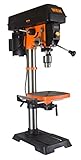
- Features a 6.2-amp induction motor, a 12-inch swing, and a 3-1/8-inch spindle travel
- Adjust the mechanical variable speed anywhere from 580 to 3100 RPM
- Digital speed readout displays current RPM of the machine for maximum precision
- Measures in at 16.8 by 13.5 by 36.6 inches in size with a weight of 85 pounds
- Includes a class IIIA 2.5mW laser, overhead light, adjustable depth stop, table roller extension, beveling 9-1/2 by 9-1/2-inch work table, 5/8-inch capacity keyed chuck, a chuck key with onboard storage, and a two-year warranty
Why the estimate needs a waste allowance
Board-foot math does not account for knots, cracks, cup, twist, saw kerfs, trimming, jointing, planing, grain matching, or unusable sections. Random-width hardwood may also require more material than the finished parts suggest. Add a realistic allowance for waste and defects, especially for wide parts, figured wood, matching panels, or a project with many short pieces. The seller’s own measuring and pricing policy controls the final invoice.
How to use the charts with a project plan
A chart is most valuable when it is connected to a cut list and bill of materials rather than used in isolation. An official Kreg workbench plan illustrates the workflow: it combines lumber and MDF quantities, hardware, dimensions, a pocket-hole setup, and cutting diagrams. Other printable project plans similarly combine bills of materials with cut lists.
- Start with the plan. Record every finished part, its dimensions, quantity, material, and grain or face requirements.
- Check the stock system. Convert nominal construction-lumber labels to actual working dimensions, and determine whether hardwood is rough or surfaced.
- Prepare a purchasing estimate. Calculate board feet for hardwood or linear and sheet quantities for other stock. Add waste for defects, surfacing, trimming, and cutting layout.
- Choose the hardware. Use the screw chart to compare gauge, length, pilot-hole, clearance-hole, and head-bore requirements. A pocket-hole design may call for a specific screw type and length instead.
- Plan drilling operations. Use the drill-press chart for a starting RPM, then check the bit instructions and machine limits.
- Recheck before cutting. Confirm actual stock dimensions, final measurements, blade or bit setup, and the safety arrangement at the machine.
Printing and keeping the references useful
- Download the chart from the publisher’s current free-chart or resource page rather than relying on an old copy saved elsewhere.
- Print at a legible size. If a chart contains dimensions, make sure the PDF viewer is set to print at 100% or Actual Size, not “Fit to Page,” unless the chart is intended only for reading.
- Check the printed page against the PDF on screen if physical measurement matters. Printer margins and automatic scaling can change the result.
- Keep the drill-press chart near the machine, the screw chart with fasteners and drill bits, and the lumber reference with project-planning materials.
- Write the project name, stock species, actual measured dimensions, and any manufacturer-specific settings beside your working copy.
More free woodworking resources
The core WOOD Magazine references are not the same thing as every free woodworking resource online. EZwoodshop’s free-resource library includes related pilot-hole guidance, pocket-screw charts, screw-and-bit references, buying-lumber information, project-planning material, workbench-height guidance, bookcase design, plywood calculations, board-length calculations, and lumber-dimension references. Traditional Woodworking lists other downloadable aids, including project cut-list templates, board-foot calculators, raised-panel and drawer-box calculators, door and compound-miter calculators, and an arch-formula chart.
Use these as complementary resources and check each publisher’s definitions. A pocket-hole chart, calculator, or template may follow different assumptions from the primary WOOD Magazine chart collection.
When a book is more useful than a single chart
Free charts are excellent for quick lookups. A woodworking reference book can be a useful companion when you need broader coverage of lumber, formulas, joinery, layout, and shop techniques in one place. Treat the book as supplemental reference material, not as permission to ignore current tool, bit, fastener, or safety instructions; verify any specific product’s current availability before buying.
Independent reader supportYour contribution helps us test, update, and keep practical guides available for everyone.Final checks before relying on a chart
- Is the chart intended for the same bit, screw design, material, and operation you are performing?
- Have you checked the manufacturer’s instructions and the machine’s operating limits?
- Are the workpiece and any small parts secured against movement?
- Are lumber dimensions actual measured sizes or only nominal labels?
- Does your board-foot estimate include waste, surfacing, defects, and cutting layout?
- Was the chart printed without unintended scaling?
Used this way, free woodworking charts do more than provide isolated numbers: they connect machine setup, fastener selection, lumber purchasing, and project planning while leaving final decisions with the tool manufacturer, fastener maker, lumber supplier, and safe shop practice.
Rank #4

- Exceptional Drilling Performance: Powered by a robust 2.5A induction motor, this benchtop drill press delivers superior power and stability, ensuring top-notch performance even during extended drilling sessions.
- Variable 5-Speed Control: Customize your drilling experience with five adjustable speeds ranging from 750 to 3200 RPM. Effortlessly switch between speeds by adjusting the belt, our bench drill press allowing you to tackle a variety of materials and projects with precision.
- Bright LED Work Light: Never miss a detail with the integrated LED work light. Our LED work light of benchtop drill press illuminates your workspace, providing clear visibility and making it easy to work accurately and efficiently even in dimly lit conditions.
- Precision-Engineered Drilling: Achieve flawless results with our drill press’s low radial runout and 1/2-inch maximum drilling diameter. The adjustable depth stop and 2-inch spindle travel let you set precise drilling depths for perfect holes every time.
- Flexible & Adjustable Worktable: Experience unmatched flexibility and stability with the thick metal worktable that adjusts in height and tilts up to 45°. Our benchtop drill press is ideal for precise, complex drilling hole tasks, making it an invaluable tool for any workshop.
Frequently Asked Questions
What woodworking charts are useful for a beginner?
The most useful free woodworking chart categories are drill-press speed, wood-screw selection, lumber sizing, and board-foot calculation. Related free resources may also include pocket-hole charts, pilot-hole references, calculators, and cut-list templates.
How do you calculate board feet?
A board foot is a volume equal to 1 inch × 12 inches × 12 inches. For inch measurements, calculate thickness × width × length ÷ 144. Add allowance for defects, surfacing, trimming, and cutting waste.
Is a 2 × 4 actually 2 inches by 4 inches?
No. A nominal size such as 2 × 4 identifies a standard construction-lumber category and is not automatically the board’s finished measured size. Measure the actual stock or confirm the supplier’s dimensions.
Can I use one drill-press speed chart for every bit?
Use the drill-press chart as a starting point, then confirm the bit manufacturer’s recommendation and your machine’s limits. Secure the workpiece and follow the machine’s safety instructions.
The Bottom Line
Use free woodworking charts as fast, printable starting references for drill-press RPM, screw selection, and lumber estimates. Verify manufacturer specifications, measure actual stock, allow for waste, and secure the work before cutting or drilling.
Free tools Windows power users keep installed
One-click scans. No signup required.
Quick Recap
Product prices and availability are accurate as of the date/time indicated and are subject to change. Any price and availability information displayed on Amazon at the time of purchase will apply.

