Recommended Free Tools
Plan a Midtown trip around live conditions, not a static map. Since October 15, 2026, construction at the Midtown Bus Terminal has changed the ramps and access routes used by buses, while Madison Avenue lane work and event-day street controls can slow or reroute surface service. Check MTA alerts, NYC DOT advisories and the Street Closures Map immediately before leaving; then keep a subway, walking or cycling fallback.
The most predictable route is not always the shortest. Compare each option by reliability under the current closure, transfers, walking distance, accessibility, fare and likely crowding, and add time for the specific departure window rather than relying on a typical off-peak estimate.

As an Amazon Associate I earn from qualifying purchases.
What is changing in Midtown
Several separate projects and temporary controls can affect one commute. Treat them as overlapping conditions rather than one permanent detour.
Midtown Bus Terminal access
The Port Authority of New York and New Jersey announced on October 13, 2026 that, beginning Thursday, October 15, buses would use altered and temporary routes to reach the Midtown Bus Terminal ramps while the new terminal is built. Ramp removals can affect buses entering from the Lincoln Tunnel as well as vehicles approaching the terminal from Manhattan streets. The Port Authority advises riders to allow extra time and check their individual carrier because the access pattern can vary by service.
A bus that normally appears to use the same tunnel or terminal entrance may therefore approach, queue or unload on a different path. Check the carrier’s departure instructions in addition to the MTA information used for the rest of your trip.
Madison Avenue double bus lanes
NYC Department of Transportation’s 2026 Madison Avenue redesign extends double bus lanes from 42nd Street south to 23rd Street. The corridor serves 34 local and express routes and about 92,000 daily local and express riders. DOT says 55% of people on the street south of 42nd Street are bus riders, even though that segment previously lacked dedicated bus space.
Before the redesign, buses below 42nd Street were reported moving as slowly as 4.5 miles per hour. The city cites neighboring Fifth Avenue results as an indication of what dedicated lanes can accomplish: local-bus speeds improved 6–12% and express-bus speeds 11–20% after double bus lanes were introduced there. Those figures are reported outcomes from the Fifth Avenue project, not a guaranteed travel time for every Madison Avenue trip. A lane may improve movement on one block while a construction closure, turn restriction or queue delays the approach to it.
What’s actually slowing this PC down?
Pick the symptom - the matching free tool is one click away.
World Cup match-day controls
Eight match days have dedicated traffic controls: June 13, 16, 22, 25, 27 and 30, and July 5 and 19, 2026. On those dates, the city temporarily converts 42nd Street into a bus and shuttle corridor, dedicates two eastern lanes of Sixth Avenue between 42nd and 59th Streets, uses the existing Fifth Avenue bus lanes and creates bus or shuttle blocks on West 40th and West 41st Streets.
The restrictions begin six hours before a match and may continue for up to three hours afterward. That window can cover the entire morning or evening commute, even if you are not attending a match. A route that is normal on a non-match day may be impossible for a car, taxi or bus during the control period.
Penn Station vehicle closures
On match days, vehicles are barred from 33rd Street between Sixth and Eighth Avenues and from 32nd Street between Sixth and Seventh Avenues beginning at least six hours before matches. These closures change the approach to Penn Station and can add walking or a different cross-town connection for anyone transferring there.
Rank #2
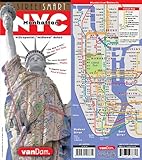
- most legible and complete NYC Map
- no surveillance, no tracking
- laminated, water and tear proof,
Start with the exact trip
Before choosing a route, write down the details that determine whether a closure matters:
- Origin, including the entrance or corner where you can actually begin walking.
- Destination entrance, not just the building name. A block-long building can have a much faster entrance from a different avenue.
- Date and required arrival time.
- Earliest acceptable departure and whether you can leave earlier.
- Any fixed appointment, timed ticket, shift start or intercity bus departure.
- Accessibility requirements, including elevator access, step-free transfers, curb conditions and tolerance for long outdoor walks.
- Whether you are carrying luggage, traveling with children or need a sheltered route.
Construction effects are corridor- and hour-specific. A bus that is slow below 42nd Street at the peak may be reasonable later, while a match-day closure can make the same street unusable for several hours.
Use live information in the right order
Static route maps show the planned network, not today’s work zone, police closure or bus stop relocation. Use this sequence every time the trip matters.
- Check MTA alerts first. Open the MTA alerts and planned-changes information for the subway or bus routes you might use. The MTA describes this page as the place to find current and future changes affecting subway, bus, Long Island Rail Road and Metro-North travel. Read the full alert, including the effective date, direction, affected stops and replacement service.
- Check the route-specific view. Look for a notice on the exact line and direction, not merely a systemwide banner. Confirm whether the stop shown by a journey planner is open, moved to another avenue or bypassed.
- Review street conditions. Consult NYC DOT’s Weekly Traffic Advisory and Street Closures Map. DOT’s advisory covers temporary construction and event closures and warns that information can change. Compare the map with every surface segment of your proposed trip, including the final approach to a terminal or station.
- Check the intercity carrier if you use the terminal. For a Lincoln Tunnel or Port Authority trip, read the carrier’s departure notice and terminal instructions. The October 15 terminal access change can produce a longer approach even when the bus schedule itself has not changed.
- Save the relevant alerts. Keep the alert page or notice available on your phone. A service can change after you leave home, and a saved route number makes it easier to verify the next leg after a transfer.
- Recheck immediately before departure. Conditions are volatile. Refresh both transit and street information just before walking to the first stop, then check again after any transfer or if the operator announces a delay.
Choose a primary route and a fallback
Do not leave with only one plan when a closure can strand you between a stop and your destination. Select a primary and a backup using the same criteria.
| Criterion | Questions to ask | What a construction day can change |
|---|---|---|
| Reliability | Does the route avoid the closed block and the terminal approach? | A subway may be more predictable than a bus in a lane closure; a terminal bus may need a carrier-specific detour. |
| Transfers | How many times must you change, and where? | Each transfer is another point where an alert, crowd or closed entrance can disrupt the trip. |
| Walking | How far are the first, transfer and final walks? | A stop relocation or Penn Station closure can add several blocks, especially outdoors. |
| Accessibility | Are elevators open and is the detour step-free? | A nominally short street detour may be unsuitable if a curb, entrance or elevator is closed. |
| Fare | Will the alternative require another paid ride or a different ticket? | A bus-to-subway switch can change the fare or transfer rules you rely on. |
| Crowding | Will match-day riders or displaced bus passengers use the same service? | A subway that is operational may still have heavier platforms and longer boarding times. |
When the subway is the better primary
Favor a subway route when the bus portion would run through a closed curb lane, the Madison Avenue corridor is congested in your departure window or a surface detour adds uncertain turns. It can be worth walking farther to a station if the rail segment avoids the work zone and has a functioning, accessible entrance. Confirm elevator status separately; a train route is not a practical backup if you cannot use its available entrances.
The Tool Desk
Outbyte Driver Updater FREEFix the driver behind crashes, sound loss and screen glitchesFind Drivers →Outbyte PC Repair FREERepair Windows errors before they cause bigger problemsFix Now →When a bus still makes sense
A bus can remain the best choice when the double bus lanes are operating in your direction, the route avoids the terminal construction and you need a close, step-free stop. Do not assume every bus benefits equally from the Madison Avenue redesign: local and express services may encounter different turns, stop patterns and queues. Check the exact route alert and stop location.
Rank #3

- Detailed info about directions to museums, landmarks, shopping places
- Laminated, waterproof, cheap, updated every 3 months
- Designed and Printed in the USA
- full subway system, streets index, events links,
When walking or cycling is the fallback
For a short cross-town or avenue trip, walking can remove uncertainty from a bus detour. Cycling can do the same if you have a safe, legal route and a place to secure the bicycle. Recheck the Street Closures Map first; a pedestrian or bicycle path can be affected even when motor traffic is the only closure shown in a headline. Allow for weather, luggage, lighting and the condition of the final block.
Build a realistic time buffer
There is no single “extra time” number that fits every Midtown trip. The required buffer depends on the construction phase, time of day, route, weather, event controls and whether you must make a timed connection. Use a component-based estimate:
- Normal travel time: the current estimate for the route when no alert is active.
- Access time: walking from your origin to the actual stop or station entrance, including a possible relocated stop.
- Transfer time: the walk, platform wait and boarding time at each change.
- Construction uncertainty: time for a temporary terminal approach, lane queue or stop bypass.
- Arrival margin: time between reaching the destination area and your non-negotiable deadline.
For the terminal, treat the construction component as variable rather than a fixed surcharge: the Port Authority’s October 2026 change concerns bus access routes, so your carrier and departure period determine the effect. For a Madison Avenue bus, compare the live bus prediction with a subway alternative instead of adding an arbitrary number of minutes to an old timetable. If an alert says service is suspended or a street is closed, replace that leg rather than trying to average the closure into the estimate.
Windows Errors? Fix Them Before They Spread
Repair common Windows errors and clear accumulated junk for a smoother, more stable PC - no reinstall needed.Free scan · no reinstallCrashes, No Sound, or Screen Glitches?
Random freezes, missing sound and display glitches usually trace back to one bad driver. Find and replace yours safely.Free scan · under a minuteA day-of procedure that minimizes surprises
- One to two hours before leaving, identify the exact entrance and direction. Write down the route number, stop name, station entrance and destination-side exit. This prevents following a map pin to a stop that has moved.
- Refresh MTA alerts and planned changes. Read notices for the outbound leg and every planned transfer. Check both local and express variants if you have a choice.
- Refresh NYC DOT information. Look for the street, avenue and cross-town blocks used by the route. On a World Cup match day, check whether you fall inside the six-hour pre-match to three-hour post-match control window.
- Verify terminal instructions. If the trip uses the Midtown Bus Terminal or Lincoln Tunnel, confirm the carrier’s boarding location and any temporary approach directions.
- Choose the primary and backup before walking out. Note the station or stop where you will switch plans. A backup that begins several blocks away may not be useful after a closure has already started.
- At the first stop or station, inspect the live status again. A train or bus that was scheduled when you left home may now be delayed. If the first leg is already failing, switch before spending time walking deeper into the work zone.
- After each transfer, confirm the next direction and exit. Match-day street controls and Penn Station closures can make a familiar exit impractical. Follow the current advisory rather than a remembered shortcut.
- Keep the final walking segment flexible. If a bus is held below 42nd Street, getting off earlier and walking may be faster only when the sidewalk route is open and safe. Check the closure map before making that change.
Match-day planning by area
Approaching 42nd Street and Sixth Avenue
Expect buses and shuttles to have priority on 42nd Street and on two eastern Sixth Avenue lanes from 42nd to 59th Streets during the event-control window. A private vehicle or taxi route that normally crosses or turns there may be diverted. If you are transferring between a subway station and a surface stop, plan the walking connection on the perimeter of the controlled area.
Using Fifth Avenue
Fifth Avenue’s existing bus lanes remain part of the match-day operating plan. They can help buses move, but they do not eliminate crowding, stop queues or delays on streets feeding the lane. Treat the lane as a potential reliability advantage, not a promise of a particular arrival time.
Reaching Penn Station
The 32nd and 33rd Street vehicle closures can block the usual curb approach. Use the station entrance that remains reachable from your side of Sixth or Eighth Avenue, and leave time for a longer walk. If you require step-free access, verify the accessible entrance before setting out rather than improvising at a closed block.
Common failure modes and fixes
The map shows a bus stop that is closed
Use the MTA alert’s replacement stop or the operator’s notice, then confirm the direction. Do not board the opposite-direction bus simply because its stop is still visible; the detour may not serve your destination.
Quick wins for a faster PC:
Repair Windows errors before they cause bigger problemsFix Now →Scan for outdated or missing drivers - takes under a minuteDriver Scan →The bus is moving but not keeping its prediction
Check whether the vehicle is below 42nd Street on Madison Avenue or approaching the terminal. Compare the remaining trip with a nearby subway entry. If the rail alternative avoids the affected segment and you have enough walking time, change before the bus enters the queue.
The terminal entrance in your directions is inaccessible
Follow the current carrier instruction, not an old map pin. Temporary ramp routes can change how a bus reaches the terminal; a carrier may direct passengers to a different curb or concourse.
A match-day closure blocks the final block
Use the Street Closures Map to select a perimeter walk, station exit or bus corridor. Avoid crossing the controlled street at a point marked closed, and allow for crowd-control barriers that may lengthen the path beyond the map’s nominal distance.
The backup is also crowded
Re-rank options by reliability and walking distance, then consider a different station, an earlier stop followed by walking, or a later departure if your deadline permits. Crowding is a decision factor, not proof that the route is closed; verify the service status before abandoning it.
Accessibility and practical safeguards
- Confirm elevator and escalator status in the MTA information before committing to a subway transfer.
- Ask the carrier or station staff where an accessible boarding point has moved if construction blocks the normal curb.
- Allow additional time for ramps, uneven sidewalks, temporary crossings and crowd-control barriers.
- Carry the route and alert information in a form you can read without standing in the roadway or blocking a platform.
- If you need assistance, contact the transit operator before departure; a last-minute detour may have a different accessible path than the regular route.
How the street changes fit together
The Madison Avenue redesign and the terminal project solve different problems. Dedicated lanes are intended to give buses a clearer path along the avenue, while terminal construction changes how buses reach ramps and passenger facilities. A trip can benefit from one change and still be delayed by the other. Match-day corridors add a third layer: they prioritize buses and shuttles in selected streets but close or restrict surrounding vehicle movements.
Best Value

- Poster measures 16x24 inches (41x61 cm) and ideal size for any standard 16x24 frame. Lightweight and low-glare satin finish paper creates photo quality poster art for your home decor. All poster prints are carefully rolled and packed.
- MAKES A GREAT GIFT - Whether you need a special gift for friends or family or looking for yourself, our wall poster is suitable for living room decor, bedroom wall art, bathroom decor and office posters wall decoration. This cool wall art will light up your home, it is the modern way to brighten up any space, each and every piece comes with its own unique story. We believe in delivering impeccable quality prints that last a lifetime.
- MADE IN THE USA and OFFICIALLY LICENSED - This poster is professionally printed in the USA on premium acid-free paper for a high color aesthetic and years of fade resistant enjoyment of your artwork. The attractive images come from our vast curated collection of officially licensed and custom designed art prints.
- EASY TO HANG - Wall decor posters are easy to hang in a variety of ways. You can also laminate them to create door signs or a dry erase sign. For Laminated version select the Plastic option aboveFor Laminated version select the Plastic option above
- Quality US maps and geographic charts are ideal for learning about world geography traveling cultures navigation and the locations of various continents countries nations regions states and cities. City maps have street level detail while topographic maps show elevations of mountains rivers forests desserts and educational laminated wall maps for classrooms. World maps feature various places like North America South America Russia Asia China Europe Central America Middle East. A quality product.
That is why a single citywide “best route” is misleading. The useful question is: which route avoids the active restriction during my departure window, has a workable accessible path and leaves a backup if the next alert changes?
Questions commuters still ask
Should I automatically take the subway instead of a bus?
No. Take the subway when it avoids an active bus-lane, curb or terminal problem and its entrances and transfers work for you. Keep the bus when its dedicated lane and stop pattern are operating reliably and the walking or accessibility trade-off is better.
How early should I leave for a terminal bus?
Use the carrier’s current boarding instruction and add a variable construction buffer to your normal access and connection time. The October 15, 2026 ramp change does not create one universal delay for every carrier or hour.
Do these 3 things before closing this tab:
1Repair Windows errors before they cause bigger problems2Scan for outdated or missing drivers - takes under a minute3Clear out junk files and repair common Windows errorsWhere can I confirm a temporary street closure?
Check NYC DOT’s Weekly Traffic Advisory and Street Closures Map immediately before departure. DOT notes that temporary construction and event information can change, so do not rely on a screenshot from an earlier day.
What if I discover the change after boarding?
Stay on the vehicle only if the operator confirms it will serve your stop. Otherwise, get off at a safe, open stop, check MTA and DOT information again, and use the preselected subway, walking or cycling fallback.
The Bottom Line
For a Midtown commute during 2026 construction, check MTA and NYC DOT information immediately before leaving, verify terminal instructions with the carrier, and choose a primary route plus a fallback. The most dependable option is the one that avoids the active closure, works for your walking and accessibility needs, and still functions if the next alert changes.
Quick Recap
Product prices and availability are accurate as of the date/time indicated and are subject to change. Any price and availability information displayed on Amazon at the time of purchase will apply.
Free tools Windows power users keep installed
One-click scans. No signup required.

