What’s actually slowing this PC down?
Pick the symptom - the matching free tool is one click away.
The best way to organize kitchen cabinets is to treat the project like a small kitchen performance upgrade, not a decorating task. Empty the cabinets, sort what stays, measure the inside of every cabinet, then assign storage by how the kitchen actually works: cooking near the range, prep tools near the prep counter, dishes near the dishwasher, food storage near the refrigerator or prep zone, and cleaning supplies under or near the sink.
On our job sites, the kitchens that stay organized are not the ones with the most containers. They are the ones with fewer decisions built into the daily routine. A pan should come out without moving three other pans. Plastic lids should have one obvious home. Heavy appliances should not live on an upper shelf. Deep base cabinets should pull out toward you instead of forcing you to crawl halfway into them.
As an Amazon Associate I earn from qualifying purchases.
For most homeowners, cabinet organization can be done in a weekend for under $300 in basic products. If you add installed pull-out shelves, trash pull-outs, custom drawer boxes, or hardware upgrades, the budget commonly moves into the $500 to $2,500 range depending on how many cabinets are involved. If the cabinet boxes are damaged, out of square, sagging, or poorly laid out, it may be smarter to discuss refacing or replacement before spending heavily on inserts.
Start With a Cabinet Audit, Not a Shopping Trip
The first professional step is not buying organizers. It is removing everything from the cabinets and sorting it into five groups: keep, relocate, donate, discard, and repair. This is where most cabinet projects succeed or fail.
#1 Best Overall

- [🔝 WARM TIPS]: Please note that this pull out cabinet organizer suitable for cabinets with internal width exceeding 13" and depth exceeding 21". This pull out drawer for cabinets with Upgraded Raising Pads are compatible with both frameless cabinets and framed cabinets with edge heights up to 0.4 inches. It is essential to carefully measure your cabinet's dimensions before installation to ensure compatibility.
- [Adjustable Width]: This put out drawer for cabinet is 21" depth * 3" height, and from 12" to 20" in width. This extendable design allows for easy adjustment to fit various cabinet sizes.
- [Easy installation]: The sliding drawers for cabinets fixed with Nano adhesive. It also comes with screws included in the package for additional mounting options.
- [Heavy Duty]: Our pull out spice rack organizer for cabinet is made of thickened carbon steel, and hooks design fixed cabinet shape, ensuring it can hold heavy items.
- [Sturdy and Smoothly]: Quality material and detail design make sliding cabinet organizer is sturdy. With upgraded 3 rails sliding system, ensuring slide smoothly and stronger bearing capacity.
Buying bins first often creates cleaner-looking clutter. You still have too many mugs, duplicate gadgets, expired pantry items, mismatched lids, and small appliances that get used twice a year. The difference is that now they are hidden in matching containers that may not fit the cabinet.
Work one zone at a time so the kitchen stays usable. A typical cabinet audit takes 2 to 4 hours for a small kitchen, 4 to 8 hours for an average kitchen, and a full day for a large kitchen with a pantry, island storage, and specialty drawers. If you are doing this around family meals, plan it over two days.
Use the 80/20 Rule
A cabinet that is 100% full on organizing day will fail after the next grocery trip. Leave about 20% open space in drawers, shelves, and pantry areas so items can be removed and returned without reorganizing the whole cabinet.
Quick wins for a faster PC:
Repair Windows errors before they cause bigger problemsFix Now →Scan for outdated or missing drivers - takes under a minuteDriver Scan →This matters most in food storage, mixing bowls, pots and pans, and plastic container cabinets. If removing one item requires unloading the cabinet, the system is too tight.
Separate Daily Use From Occasional Use
Prime cabinet space is between waist and eye height. That is where daily dishes, drinking glasses, coffee supplies, cooking utensils, cutting boards, frequently used pans, and staple foods belong. Occasional items can go higher, lower, or farther away.
Holiday platters, roasting pans, specialty baking molds, punch bowls, and oversized serving pieces do not need to occupy the best cabinet in the kitchen. If you use something fewer than 6 times per year, it should not displace daily-use storage.
Measure Before You Buy Any Cabinet Organizer
Good cabinet organization depends on measurement. A half-inch mistake can keep a pull-out shelf from clearing the hinges or cause a drawer organizer to block the cabinet door.
PC Slower Than It Used to Be?
A free scan shows the junk files, broken settings and background clutter dragging Windows down - then fixes them in one click.Free scan · Windows 10 & 11Outdated Drivers Are Slowing You Down
One free scan finds every outdated or missing driver and matches the right update for your exact hardware.Free scan · exact hardware matchMeasure the cabinet interior width, depth, and height. Then measure the actual door opening. In face-frame cabinets, the opening is often narrower than the interior box. A cabinet may be 24 inches wide outside, 22 1/2 inches wide inside, and only 20 1/2 inches clear at the face frame. That clear opening is what determines whether a pull-out will fit.
For base cabinets, also measure hinge intrusion, shelf pin locations, center stiles, pipes, garbage disposals, water filters, shutoff valves, and electrical outlets inside the cabinet. Under the sink, measure after accounting for the drain trap, disposal, supply lines, dishwasher hose, filter canisters, leak detector, and any outlet serving the disposal.
Measurements to Write Down
For each cabinet, record these numbers before shopping:
- Interior width, depth, and height
- Clear door opening width
- Distance from door opening to hinges
- Depth available before pipes, outlets, or back-wall obstructions
- Height between shelves
- Whether the cabinet is face-frame or frameless
- Whether the shelf is fixed or adjustable
- Condition of the cabinet bottom and side panels
Use painter’s tape to label cabinet openings while you work. Mark each one with its planned use and measurements. It keeps the process practical and prevents duplicate purchases.
Do these 3 things before closing this tab:
1Clear out junk files and repair common Windows errors2Fix the driver behind crashes, sound loss and screen glitches3Repair Windows errors before they cause bigger problemsOrganize Cabinets by Kitchen Work Zones
Professional kitchen storage is based on workflow. Categories matter, but workflow matters more. A kitchen organized only by item type can still force you to walk across the room while cooking.
Cooking Zone
Store pots, pans, lids, cooking utensils, oven mitts, oils used daily, and heat-safe tools near the range. Heavy cookware belongs in base cabinets or deep drawers, not upper cabinets. Cast iron, Dutch ovens, stockpots, and griddles are safer and easier to handle below counter height.
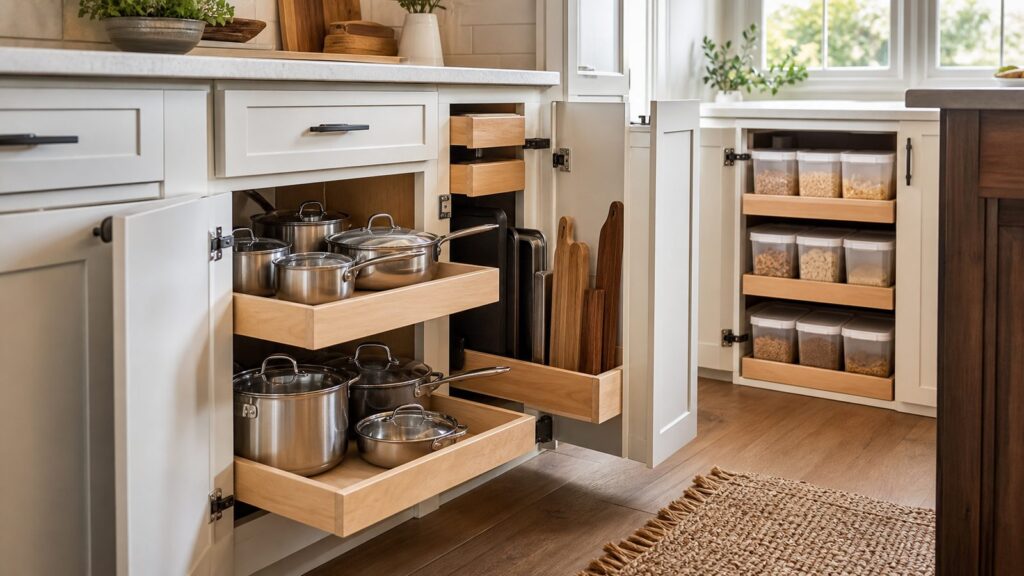
If you have a deep lower cabinet beside the range, a two-tier pull-out is usually better than stacked pans on a fixed shelf. Full-extension slides let you see the back of the cabinet and use the entire depth. Soft-close hardware is worth it in high-use kitchens because it reduces slamming and keeps heavy items from shifting.
Prep Zone
The prep zone should hold cutting boards, knives, mixing bowls, measuring cups, strainers, wraps, bags, and frequently used small tools. Ideally this is near the longest clear counter run, often between the sink and range or on an island.
Flat items perform well stored vertically. Sheet pans, cooling racks, muffin tins, cutting boards, and trays waste less space when filed upright with dividers. A 9-inch to 12-inch-wide vertical slot cabinet can do more useful work than a wide shelf full of stacked pans.
Cleanup Zone
Dishes and glasses should live near the dishwasher, not necessarily near the dining room. The goal is to unload the dishwasher with the fewest steps. Plates, bowls, mugs, everyday glasses, food storage containers, and lunch containers should be close to the dishwasher and sink.
Cleaning supplies belong under or near the sink but separated from food. Use a waterproof mat or removable tray under the sink so small leaks are visible before they damage the cabinet floor. Avoid overloading this cabinet; plumbing needs to remain accessible.
Food Storage Zone
Pantry goods should be near the refrigerator, prep counter, or cooking zone. Use broad categories: breakfast, baking, snacks, grains, canned goods, oils and vinegars, and dinner staples. Clear containers are useful for quick scanning, but they should solve a real problem. Decanting every item into decorative containers often adds maintenance without improving function.
Rank #2

- Important Measurement Reminder: Please ensure your cabinet’s internal width exceeds 13" and depth exceeds 21", excluding hinges, pipes, or obstructions. Note the usable drawer space is slightly smaller than the listed exterior dimensions.
- Compatible with Framed & Frameless Cabinets: Featuring adhesive raising pads, this organizer fits cabinet edge heights up to 0.4", preventing door frame interference for smooth installation.
- Robust Metal Construction with 3 Rails: Made from heavy-duty metal and reinforced by three independent sliding rails, delivering reliable strength and enduring stability for heavy cookware.
- Easy No-Drill Installation: Powerful nano adhesive enables quick, tool-free setup. Optional screws included for extra stability. Ideal for renters or damage-free installation.
- Adjustable Width 12.05"-20.4": Flexible fit for various cabinet sizes, perfect for storing pots, rice cookers, bakeware, bowls, spices, and packaged foods.
Use one or two bin sizes when possible. A kitchen with 14 different organizer shapes is harder to maintain than one with consistent bins that can move as needs change.
Use the Right Organizer for the Cabinet
The best organizer depends on the cabinet’s depth, access, item weight, and frequency of use. A shallow upper cabinet needs a different solution than a 24-inch-deep base cabinet.
| Cabinet Problem | Best Fix | Typical 2026 Cost | Best Use |
|---|---|---|---|
| Deep base cabinet where items disappear | full-extension pull-out shelf | $60-$250+ DIY unit; about $140-$350 installed per shelf | Pots, pans, small appliances, pantry goods |
| Stacked plates or bowls too high | Shelf riser or adjustable shelf | $6-$30 | Dishes, mugs, small bowls |
| Loose lids and containers | Lid divider plus matched container zone | $10-$40 | Food storage containers |
| Awkward corner cabinet | lazy Susan, swing-out, or blind-corner pull-out | $40-$600+ depending on hardware | Large cookware, pantry overflow |
| Trash can sitting loose in cabinet | pull-out trash/recycling unit | About $100-$300+; soft-close double units can run around $240+ | Prep and cleanup zones |
| Flat pans stacked horizontally | vertical dividers | $15-$75 | Sheet pans, cutting boards, trays |
Pull-Out Shelves
Pull-out shelves are the highest-impact upgrade for deep base cabinets. They turn a fixed shelf into drawer-like storage, which improves visibility and reduces bending. For most kitchens, the first pull-outs should go in the cabinets used every day: pots and pans, pantry goods, small appliances, and trash or recycling.
Look for full-extension slides, not three-quarter extension, when the cabinet is deep. A 22-inch-deep shelf that only extends 15 inches still leaves items buried in the back. soft-close slides are useful, but load rating matters more. Light wire baskets are fine for snacks or towels. Heavy cookware needs stronger slides and solid wood or plywood drawer boxes.
drawer dividers and Inserts
Drawer dividers work best when they are adjustable and easy to clean. Utensil drawers, knife drawers, measuring tool drawers, and junk drawers all need boundaries. For shallow drawers, avoid tall organizers that interfere with closing. For deep drawers, consider peg systems for plates or pots.
turntables and Corner Storage
Turntables are useful in upper cabinets for oils, vinegars, baking supplies, and small pantry items. In lower corner cabinets, a lazy Susan can work if the cabinet is already built for it. Blind-corner pull-outs are more expensive, but they can recover space that otherwise becomes a dead zone.
What Not to Store Above the Stove
The cabinet above the stove is usually a poor storage location. Heat, steam, grease, and vibration shorten the life of many items and can create safety problems.
Avoid storing oils, spices, paper goods, cookbooks, plastic containers, medications, snacks, and small appliances above the stove. Oils and spices degrade faster with heat. Paper goods and cookbooks create unnecessary fire risk. Plastic containers can warp or absorb odors. Small appliances are awkward and unsafe to retrieve over a cooking surface.
Recommended Free Tools
If that cabinet must be used, reserve it for lightweight, infrequently used, heat-tolerant items. Keep the cabinet from becoming packed. You should not need to reach over active burners and shift items around.
Plan Around Weight, Durability, and Cabinet Condition
Cabinet organizers are only as good as the cabinet holding them. Before installing pull-outs, inspect the cabinet floor, sides, back, and face frame. Look for swelling, water damage, loose joints, cracked particleboard, stripped screw holes, sagging shelves, and out-of-square openings.
Heavy items should stay low. A stand mixer can weigh 20 to 30 pounds. Cast iron cookware, Dutch ovens, bulk rice, canned goods, and large appliances add weight quickly. Do not assume a thin adjustable shelf can safely carry that load over time.
When installing slides, fasteners need solid material. Screwing a heavy pull-out into damaged particleboard or a thin cabinet side can lead to failure. In older cabinets, we often add blocking, reinforce the cabinet floor, or recommend a different storage location rather than forcing hardware into a weak box.
The Tool Desk
Outbyte Driver Updater FREEFix the driver behind crashes, sound loss and screen glitchesFind Drivers →Outbyte PC Repair FREEClear out junk files and repair common Windows errorsFree Scan →Load Ratings Matter
Check the slide-load rating before buying. Light-duty organizers may be rated around 35 to 50 pounds. Better full-extension slides for kitchen pull-outs often run 75 to 100 pounds or more. That rating includes the shelf, hardware, and stored contents, so leave margin.
If a cabinet will hold cast iron, stacked canned goods, countertop appliances, or pet food, buy stronger hardware than the minimum. The cost difference is usually small compared with repairing a failed cabinet bottom.
Costs to Organize Kitchen Cabinets in 2026
A practical cabinet organization budget depends on how much is product-based and how much becomes carpentry or cabinet work. Basic products are inexpensive. Permanent pull-outs and custom inserts cost more because they require accurate fitting, better slides, and labor.
| Project Scope | Typical 2026 US Cost | What It Usually Includes |
|---|---|---|
| Basic DIY organization | About $6-$30 per small organizer | Bins, risers, lid racks, turntables, drawer dividers |
| Retail pull-out organizer | Roughly $60-$250+ per unit | Wood or wire pull-outs, trash units, pantry pull-outs, soft-close options |
| Installed pull-out shelf | About $245 average; commonly $140-$350 per shelf | Measured shelf, slides, installation, fitting adjustments |
| Basic shelving installation | About $21.67-$33.48 per linear foot before site adjustments | General shelf installation labor benchmark |
| Broader cabinet hardware or organizer work | Often $482-$2,167, with many jobs around $1,044 | Multiple cabinets, pull-outs, hardware, adjustments |
| Full cabinet installation context | About $4,000-$14,000; national averages around $6,500-$7,000 | New cabinet boxes, installation labor, layout corrections |
Cost drivers include the number of cabinets, custom versus off-the-shelf inserts, slide-load rating, soft-close hardware, dovetail or plywood drawer boxes, face-frame versus frameless cabinet construction, plumbing obstructions, electrical inside cabinets, local labor rates, and whether doors or shelves need modification.
Free tools Windows power users keep installed
One-click scans. No signup required.
A smart sequence is to spend the first dollars on daily friction. If you only have budget for three upgrades, choose the base cabinet where cookware gets buried, the food storage container cabinet, and the trash or prep-zone cabinet. Those usually return the most convenience per dollar.
Independent reader supportYour contribution helps us test, update, and keep practical guides available for everyone.When to DIY and When to Hire a Pro
DIY is a good fit for decluttering, shelf risers, bins, turntables, drawer dividers, vertical pan racks, labels, and light-duty freestanding organizers. Most homeowners can handle these with a tape measure and a free afternoon.
Hire a pro when the work involves permanent pull-out shelves, trash pull-outs, cabinet reinforcement, cutting shelves, modifying doors, working around plumbing, electrical inside cabinets, or fitting hardware into older face-frame cabinets. A cabinet installer, carpenter, or experienced handyman can usually install several pull-outs in a half day to a full day depending on cabinet condition.
Rank #3

- IMPORTANT NOTICE: Our cabinet pull out shelves are not suitable for cabinets with lips.Before ordering, please measure your cabinet dimensions correctly using the method shown in the picture.If your deep cabinet has a lip, please choose from our other drawers options designed for cabinets with a lip available in the store
- ACCESSING ITEMS IN DEEP CABINETS IS NO LONGER DIFFICULT:With our adhesive pull out drawers, you won't need to dig through dark and deep cabinets or remove all items to reach those in the back. Simply slide out drawers for easy access to your items.The depth of the drawers is adjustable.Our kitchen cabinet pull out shelves are suitable for very deep cabinets, such as those with depths of 17 inches,18 inches,19 inches, 20 inches, 21 inches, 22 inches, 23 inches, and 24 inches
- ADJUSTABLE LENGTH AND WIDTH TO MEET DIFFERENT CABINET NEEDS: Our expandable pull out cabinet drawer feature adjustable length and width,allowing them to fit cabinets and closet of various sizes.This significantly enhances the utilization of your cabinet space.These roll out shelves for kitchen cabinets are your good choice
- UPGRADE THREE GUIDE RAILS:Our expandable pull out cabinet organizer come with three-track rails for stronger load-bearing capacity and smoother, more effortless pulling. Even when loaded with heavy items, the peel and stick slide out shelves can be pulled out with ease
- EASY INSTALLATION, NO DRILL OR TOOLS:Our no drill pull out drawers for cabinets are fixed with adhesive nano,offering strong adhesion without the need for drilling or tools.Simply peel off the protective film on the rails, place the adhesive pull out drawers in the cabinet, and press to complete the installation
Professional organizers can be useful when the issue is decision fatigue, volume, pantry systems, or family habits. Ask for a written scope. Product shopping, installation, label-making, disposal, donation drop-off, and return visits may be priced separately.
Good DIY Projects
- Decluttering and category sorting
- Adding shelf risers in upper cabinets
- Installing tension dividers for sheet pans
- Creating a lid and container system
- Adding broad labels to pantry bins
- Moving heavy items to lower cabinets
Good Pro Projects
- Full-extension pull-out shelf installation
- Soft-close trash and recycling pull-outs
- Blind-corner cabinet hardware
- under-sink pull-outs around plumbing
- Cabinet floor reinforcement
- Cabinet refacing or replacement planning
Permit and Safety Notes
Installing freestanding organizers, bins, dividers, and most screw-mounted pull-out shelves usually does not require a building permit. The work is generally considered cabinet accessory installation.
Permits may come into play when cabinet work is part of a larger kitchen remodel, when walls are moved, when plumbing is relocated, when electrical outlets or circuits are added, or when range, dishwasher, disposal, lighting, or ventilation work changes. Local rules vary by city and state, so verify with your building department before starting a remodel-level project.
Electrical work inside or near cabinets deserves special care. Modern kitchens often have outlets, disposal switches, under-cabinet lighting, appliance garages, and dedicated appliance circuits. Do not drill blindly through cabinet sides or backs. Open the adjacent cabinet, check both sides of the wall, and use short fasteners where possible.
For families with young children, use child-resistant latches for cabinets holding cleaners, blades, alcohol, medications, or breakables. For aging-in-place planning, prioritize pull-outs, drawers, D-shaped pulls, lower storage for heavy items, and clear pathways. Good cabinet organization should reduce bending, reaching, twisting, and lifting.
When Organization Should Become Cabinet Refacing or Replacement
There is a point where buying more organizers is the wrong move. If the cabinet boxes are sound but the doors, drawer fronts, and hardware are worn, refacing may make sense. Refacing can also pair well with new internal pull-outs and better drawer hardware.
If the layout is the real problem, replacement may be the better long-term investment. Warning signs include narrow cabinets that cannot accept useful pull-outs, deep blind corners that waste major space, water-damaged sink bases, sagging shelves, poor dishwasher-to-dish storage flow, doors that collide, or base cabinets that are out of level.
New cabinet installation is a larger project, commonly running several thousand dollars. 2026 cabinet installation figures often fall around $4,000 to $14,000, with national averages reported around $6,500 to $7,000. Stock and semi-custom cabinet installation can range widely, often around $100 to $650 per linear foot depending on materials, layout, and labor.
The practical rule is simple: if the cabinet boxes are sturdy and the layout works, organize and upgrade the interiors. If the boxes are failing or the layout fights daily use, discuss refacing or replacement before investing thousands in inserts.
Recommended Free Tools
A Pro Sequence for Organizing Your Cabinets
Use this order and the project will stay controlled:
- Empty one zone at a time.
- Sort into keep, relocate, donate, discard, and repair.
- Clean the cabinet interiors and inspect for damage.
- Measure interior dimensions and clear openings.
- Assign each cabinet to a work zone.
- Move daily-use items to waist-to-eye-height storage.
- Move heavy items to base cabinets or lower pull-outs.
- Choose the fewest organizer types that solve the actual problems.
- Install light organizers first, then decide where permanent pull-outs are worth the cost.
- Leave 20% open space so the system can survive real use.
After two weeks, adjust the system. The first version is a field test. If people keep putting items in a different place, pay attention. The best cabinet layout is the one the household naturally follows.
Final Takeaway
Kitchen cabinet organization works best when it is built around access, weight, workflow, and cabinet condition. Declutter first, measure carefully, use zones, keep heavy items low, and reserve permanent hardware for the cabinets that frustrate you every day.
Bins and labels can help, but they are not the main event. The real upgrade is making the kitchen easier to cook in, clean in, unload, and maintain. Done well, cabinet organization can feel like a small remodel without the disruption of tearing out the kitchen.
Quick wins for a faster PC:
Scan for outdated or missing drivers - takes under a minuteDriver Scan →Repair Windows errors before they cause bigger problemsFix Now →Fix the driver behind crashes, sound loss and screen glitchesFind Drivers →Frequently Asked Questions
What is the first step to organizing kitchen cabinets?
Empty one cabinet zone at a time and sort everything into keep, relocate, donate, discard, and repair. Do this before buying bins or pull-outs so you know what actually needs to fit.
How much does it cost to install pull-out shelves in kitchen cabinets in 2026?
Installed pull-out shelves commonly run about $140 to $350 per shelf, with an average around $245. DIY retail pull-out organizers usually cost about $60 to $250+ per unit before labor.
Where should pots, pans, plates, glasses, and food containers go?
Store pots and pans near the range, prep tools near the main prep counter, plates and glasses near the dishwasher, and food containers near the dishwasher or prep zone. Heavy items should stay in lower cabinets.
Do I need a permit to install cabinet organizers?
Most freestanding organizers and screw-mounted pull-out shelves do not require a permit. Permits may be required if the work is part of a larger remodel involving electrical, plumbing, wall changes, ventilation, or cabinet replacement.
What should not be stored above the stove?
Avoid storing oils, spices, paper goods, cookbooks, plastic containers, medications, and small appliances above the stove. Heat, grease, steam, and fire risk make that cabinet a poor location for those items.
When should I replace or reface cabinets instead of buying organizers?
Consider refacing if the cabinet boxes are sound but doors, drawer fronts, and hardware are worn. Consider replacement if boxes are damaged, out of level, poorly laid out, too narrow for useful inserts, or fighting the way the kitchen is used.
Quick Recap
Product prices and availability are accurate as of the date/time indicated and are subject to change. Any price and availability information displayed on Amazon at the time of purchase will apply.

