Recommended Free Tools
The most effective way to gain storage on a full-time liveaboard houseboat is to measure every cavity, remove low-value items, then fit restrained, removable storage that matches how you use the boat. Put heavy equipment low and near the centerline, keep daily-use items beside their point of use, and never sacrifice bilge, electrical, ventilation, fire-safety or escape access for another cupboard.
Start with a measured storage audit
Buying bins before understanding the boat usually creates wasted voids, blocked hatches and containers that cannot be removed once loaded. Begin with an inventory and a drawing of the existing space.
As an Amazon Associate I earn from qualifying purchases.
Measure the space and the route to it
For every locker, berth void, step cavity, settee base and cupboard, record width, depth, height and the dimensions of the hatch or door opening. The opening is as important as the cavity: a large box that cannot pass through the access hatch has no practical capacity. Photograph each space with a tape measure visible, and note obstructions such as hinges, wiring, plumbing, ventilation ducts and structural members.
What’s actually slowing this PC down?
Pick the symptom - the matching free tool is one click away.
Measure the path from the storage location to the companionway or exterior access as well. A container may fit through a locker opening but still be impossible to remove through a narrow passage when the berth is made up or the saloon table is in place.
#1 Best Overall

- Premium Material : The under bed storage containers are made from high-quality, odorless, three-ply composite non-woven thick fabric, foldable and breathable, keep clothing fresh from long-term storage. NO cardboard NOR metal supports insert, arrive to you collapsed and packaged in a clear storage bag.
- 95L Large Capacity : Each Underbed Storage Bags has 90 Liter or 24 Gallon load capacity, dimensions: 39 (L) x 20 (W) x 7 (H) inch, 7 inch height designed for most underbed space, the 4 Long Smart Cube bags works well for storing items like gifts wrap, blankets, linens, bedding, pillows, bed sheets, comforters, towels, children's stuffed animal toys, seasonal clothes, clothes, shoes, Halloween holiday decorations, Christmas wrapping papers ornament and etc. Ideal dorm room essentials storage and laundry room packing bags for girls guys
- Clear Window : The storage bins has large transparent see-through PVC window, which helps you to locate your items at a glance, easily access to what you need. The under-bed organizer used under beds, in closets, on shelves or under sofa. A good choice for room organization and storage.
- Reinforced Handles : The wide handles of the clothes storage bags are double-stitched with thick fabric, sturdy enough to pulling out from underbed and moving in your house, dependable for long time use.
- Sturdy Fastener : High quality stainless steel fastener closure design make it have a long service life, two-way smooth fastener closure make it slide along easily, and fully zippered closure preserves items from dust, pest, and humidity damage. Organize your space with under bed storage totes from Budding Joy.
Classify every item by retrieval frequency
Mark each possession as daily, weekly, seasonal or emergency-use. This simple classification determines where it belongs:
- Daily: keep at waist or chest height, close to the place of use, with one-handed access where possible.
- Weekly: use nearby lockers, settee bases or accessible shelves.
- Seasonal: assign to deep under-berth voids, under-bed containers or high, dry lockers.
- Emergency-use: keep clearly identified and reachable without moving unrelated gear.
Photograph the contents before sorting. The record helps identify duplicates and makes it easier to restore the correct location after a thorough clean-out.
Remove volume before adding furniture
Take out duplicate tools, clothing, galley equipment and spare supplies that have no defined use. Shore-store items used only once a year if you have access to a home, shed or rented locker. A one-in/one-out rule prevents the boat from gradually filling again: when a replacement enters, an equivalent item leaves.
Do not treat every empty cavity as available capacity. Some voids are needed for inspection, ventilation, drainage, wiring or structural movement. Mark those areas as reserved on your plan before assigning them to storage.
Use the boat’s existing voids first
Under-berth and under-bed storage
Low-profile bins or drawers are useful for linens, clothing and occasional-use equipment. Choose a container that can be removed through the opening while full; if unloading the berth is required every time, the theoretical volume will not become usable storage. Keep a small, immediately usable set of bedding and towels outside compressed or deep storage so a daily task does not require opening several containers.
Divide a long void into several manageable modules instead of one heavy box. Smaller loads are easier to carry, less likely to shift, and allow you to reach one category without emptying the whole berth. Label the top and the front of each container because labels on a hidden side become useless when bins are stacked.
Settee bases and storage behind steps
Where the vessel construction permits, the cavity behind a removable tread or riser can hold compact equipment. Retain the original inspection access and use lids that cannot lift during movement. A step lid should not become a loose trip hazard, and a settee panel must remain removable without dismantling unrelated cabinetry.
Quick wins for a faster PC:
Fix the driver behind crashes, sound loss and screen glitchesFind Drivers →Clear out junk files and repair common Windows errorsFree Scan →Store dense items low in these spaces, but do not concentrate all weight on one side. After loading, check whether the boat sits evenly and whether doors, hatches and drains still operate normally.
Doors, bulkheads and vertical surfaces
Racks, hooks, hanging pockets and nets turn unused vertical surfaces into storage, especially for light items. Install them only where they do not obstruct hatches, controls, walkways, fire extinguishers, ventilation openings or escape routes. A door-mounted organizer should not prevent the door from opening fully or interfere with a latch.
Use vertical storage for soft or low-density gear rather than heavy tools. A loaded rack high on a bulkhead raises the center of gravity and can become a projectile if its attachment fails.
Rank #2

- Large Capacity: This under bed storage bag measures 39.4"(100cm) x 19.7"(50cm) x 7.1"(18cm) and has a capacity of 95L which can easily hold 20 sweaters, 4 thick blankets and 14 sheets. Ideal for under-bed storage, closet or shelves.
- Reinforced Handle: The 4 reinforced handles on the front and sides allow you to pull them out in any direction from under bed. They are resistant to damage during transport. The clothing storage bag is 7.1"(18cm) tall, designed to accommodate different under-bed spaces.
- Sturdy Material: The storage containers for organizing are made of breathable non-woven fabric, they are sturdy and keep their shape, providing effective protection for your clothes.
- Top Clear Cover: You will easily identify the items inside through the clear PVC window and quickly open the lid to get them. Also, it is easy to clean, just wipe it with a damp cloth when it gets dirty.
- Smart Use of Space: Perfect for use in the closet, shelf and under bed. These under bed storage bins maximize the space under your bed. It can be folded to save space when not in use.
Hammocks and hanging net bags
Removable hammocks and net bags can hold lightweight clothing, toys or produce while keeping the deck clear. Fit them where they cannot swing into a person, cover a light or block a handhold. Select a mesh that allows inspection and airflow, and empty it before rough conditions if the contents could fall.
Plan storage around retrieval, not just capacity
Create daily-use zones
Store an item near the point where it is used. Cooking utensils belong near the galley, cleaning supplies near the cleaning area, and mooring or line-handling equipment near its working station. This reduces movement through a narrow cabin and makes it more likely that everyone will return items to the correct place.
Use a simple stowage map: label a locker by function and list its contents on a laminated card or inside the door. The map is particularly valuable when guests help tidy up. Keep emergency equipment visually distinct and never hide it behind ordinary supplies.
Separate clean, wet and dirty gear
Damp clothing, footwear and cleaning tools need ventilation and a surface that can be wiped. Do not put wet gear into sealed bins unless it is fully dry. Use breathable hanging storage for short-term drying, then move dry items to closed containers. Keeping wet and clean textiles in separate zones reduces odor and mold risk.
Compress soft goods carefully
Vacuum bags can reduce the bulk of bedding, towels and off-season clothing. They are best for seasonal material that will not be needed quickly. Keep one normal, uncompressed set available, and inspect compressed bags periodically for punctures or trapped moisture. Compression saves volume but does not remove weight, so do not use it as a reason to overload a high locker.
The Tool Desk
Outbyte PC Repair FREEClear out junk files and repair common Windows errorsFree Scan →Outbyte Driver Updater FREEFix the driver behind crashes, sound loss and screen glitchesFind Drivers →Choose containers for a moving, damp environment
Compare storage solutions by usable capacity and behavior aboard the vessel, not by advertised external dimensions alone.
| Decision factor | What to check | Why it matters on a houseboat |
|---|---|---|
| Usable volume and footprint | Internal dimensions, corner shape and wasted space around handles | A narrow container that fills a void can hold more than a larger box that leaves unusable gaps. |
| Access through the opening | Maximum width, height and diagonal clearance of the hatch or door | Stored volume is lost if the container cannot be removed without dismantling the berth. |
| Water resistance and cleanability | Wipeable surfaces, fitted lids and resistance to mildew or odor retention | Condensation, spray and wet clothing are common sources of contamination. |
| Stackability | Stable bases, lid strength and whether a lower box can be opened without moving the upper one | Stacks that require complete unloading create retrieval delays and encourage unsafe piles. |
| Restraint compatibility | Eyelets, grooves, dividers or a shape that accepts straps, nets or hook-and-loop restraints | Containers must stay put when the boat accelerates, rolls or vibrates. |
| Ventilation and inspection | Drainage or ventilation options and the ability to see contents | Airflow helps with textiles; inspection access helps reveal leaks, corrosion or mold. |
| Added weight and location | Container mass plus contents, and its final position relative to the centerline | Storage hardware itself changes trim and stability. |
| Multi-use value and replacement cost | Whether a module can move to another locker and how easily it can be replaced | Modular equipment lets you revise the layout without rebuilding cabinetry. |
Prefer removable modules during the trial stage
Start with modular containers, racks and hanging nets. They let you test a layout through normal use before committing to carpentry. Select units that can be lifted out for cleaning and inspection, and keep a clear route to the underlying hull or systems.
Positive latches, fitted dividers, cargo nets and hook-and-loop straps are useful restraints. A lid that merely rests on a box is not a reliable restraint in a moving vessel. Match the restraint to the load: a light textile bag and a dense tool case should not rely on the same attachment method.
Control weight, trim and movement
Put dense items low and near the center
Marine and Safety Tasmania warns: “The more weight in the boat, the lower the freeboard which increases the chances of swamping and lowers stability.” Store batteries, tools, canned goods, spare hardware and other dense articles as low as practical and close to the centerline, where they cannot move. Distribute comparable loads from port to starboard rather than filling one side.
Do these 3 things before closing this tab:
1Repair Windows errors before they cause bigger problems2Fix the driver behind crashes, sound loss and screen glitches3Clear out junk files and repair common Windows errorsDo not infer a safe payload from the empty volume of a locker. Every item has mass, and a full set of containers can alter trim even when the containers themselves are lightweight. Weigh dense groups or estimate them conservatively, then note their locations on the storage plan.
Rank #3

- Under-the-bed storage bag (2-pack) helps keep items safely stored, freeing up extra closet and drawer space
- Fabric bag with clear vinyl top to easily identify contents
- flat loop handles allow for convenient access and portability; bag can be folded flat and put away when not in use
- Zipper closure helps protect items from dust; store seasonal clothing, blankets, extra linens, keepsakes and more
- Dimensions: 18 x 42 x 6 inches
Secure contents against acceleration
The International Maritime Organization’s CSS Code identifies longitudinal, vertical and transverse accelerations as major causes of securing problems and states that cargo should be stowed and secured so the ship and people aboard are not put at risk. Household gear deserves the same treatment. Use a cargo net, strap, positive latch or fitted divider whenever an item could slide, tip or become airborne.
Inspect restraints after installation, after a rough passage and whenever a locker has been reorganized. Look for stretched webbing, loose fasteners, cracked clips and lids that no longer close fully. Replace a restraint at the first sign of failure rather than adding more items to compensate.
Check trim after every major change
After moving a substantial amount of gear, observe the boat at rest. Check list, freeboard, hatch operation, bilge access and whether doors remain aligned. If the vessel now sits lower or unevenly, remove or redistribute the load and consult the vessel documentation or a qualified marine professional before adding more cabinetry.
Protect systems and emergency access
Keep prohibited zones clear
Storage must not block bilge access, electrical panels, ventilation openings, companionways, fire extinguishers or escape routes. A container in front of a panel is not “out of the way” if it delays an inspection or emergency shutdown. Mark these no-storage zones on the plan and include them in every post-installation check.
Separate combustibles from ignition and machinery areas
U.S. 46 CFR §177.405 requires vessel construction to minimize fire hazards, keep combustible materials clear of ignition sources, and separate machinery and fuel spaces from accommodation spaces. Before installing fixed shelves or cabinets, compare the proposed work with the vessel manual, insurer requirements and applicable local marina or fire rules. Do not enclose a fuel, engine, electrical or ventilation area merely because it appears to be unused volume.
Preserve inspection and drainage paths
Leave enough clearance to inspect hoses, wiring, seacocks, pumps and structural areas. Do not seal a compartment that needs to drain or ventilate. If a removable panel is necessary, label it and keep the fasteners accessible. A permanent cabinet that hides a developing leak can create a larger repair than the storage is worth.
Use a staged installation sequence
- Measure cavities and openings. Record width, depth, height and the path required to remove a loaded container.
- Inventory and weigh dense items. Photograph contents, identify duplicates and remove low-value or shore-storable gear.
- Zone contents. Assign daily, weekly, seasonal and emergency items to locations based on retrieval frequency and safety consequence.
- Install reversible storage. Fit bins, drawers, racks, hanging nets and restraints without drilling into unknown wiring, plumbing or structure.
- Trial the arrangement. Use the boat normally for enough time to reveal retrieval delays, unused volume, condensation and items that are repeatedly left out.
- Revise the plan. Move categories, reduce container sizes or change the restraint before adding fixed work.
- Add permanent shelves or cabinetry. Build only after the modular trial proves the location, access and load distribution.
- Recheck the vessel. Confirm trim, list, freeboard, hatch operation, restraint condition and emergency access after the work is complete.
Design permanent cabinetry around access
Make each compartment serviceable
Permanent cabinetry should use removable fronts, lift-out drawers or inspection panels wherever a system lies behind it. A cabinet that offers more nominal volume but forces you to empty three other lockers for a pump inspection is a poor liveaboard design.
Free tools Windows power users keep installed
One-click scans. No signup required.
Keep drawer and door hardware compatible with motion. Fit positive catches, and ensure a person can operate them without blocking a passage. Avoid deep dead corners; shallow, labeled modules are easier to audit and less likely to become forgotten storage.
Build for future changes
Full-time residents acquire equipment, change hobbies and replace appliances. Use adjustable shelves, standard container widths and fasteners that can be removed without destroying the panel. Leave a small amount of spare capacity so one new item does not trigger a complete reorganization.
Before drilling, trace the other side of the bulkhead and check the vessel drawings. Construction that is acceptable in a house may compromise a marine structural member, insulation layer, wiring run or fire separation aboard a boat.
Rank #4
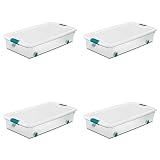
- Product Dimensions: With outer size of 33 7/8" x 18 3/4" x 7" and interior size of 30 1/8" x 15 7/8" x 6 1/4", this low-profile clear storage box rolls easily under beds and on closet floors.
- Organized Home Storage: Versatile organizer box for lightweight household storage, keeping shoes, folded clothing, blankets, bed linens, accessories, and seasonal items neatly contained.
- Latching Lid Design: Secure latching lid opens smoothly for easy one-handed access, allowing stored items to stay protected while remaining quick to reach during everyday home organization.
- Effortless Underbed Storage: Smooth-rolling wheels allow the storage box to glide easily for quick access, making it useful in bedrooms, apartments, dorm rooms, and other small living spaces.
- For more than 85 years, Sterilite products have helped make everyday life a little easier and a lot more organized.
Storage layouts for common houseboat areas
Sleeping cabin
- Use under-bed voids for seasonal clothing, spare linens and occasional-use gear in labeled, low-profile bins.
- Keep daily clothing in shallow drawers or hanging pockets that can be reached without lifting the mattress.
- Reserve a clear route to any hatch, ventilation opening or emergency exit.
Saloon and settee
- Divide settee bases by category rather than filling one continuous cavity with loose bags.
- Store heavy tools or provisions low and centrally; keep lightweight blankets and cushions in upper compartments.
- Use removable seat panels with secure latches and a clearly marked inspection point.
Galley
- Keep frequently used utensils at the point of use and restrain crockery so it cannot slide when the boat moves.
- Use narrow racks or dividers to prevent cans and bottles from becoming loose projectiles.
- Do not place combustible storage against an appliance or in a location that blocks ventilation.
Entry and exterior-access areas
- Keep footwear and wet-weather gear in ventilated, wipeable storage near the entrance.
- Do not reduce the clear width of a companionway or cover emergency equipment with hanging organizers.
- Store lines and fenders where they can be deployed quickly, with restraints that prevent them from entering the walkway.
Diagnose common storage failures
A container fits but cannot be retrieved
Measure the opening and the removal path again, including the angle needed to turn the container. Replace one large box with several smaller modules or install a drawer that travels through the opening. Do not solve an access problem by leaving the container permanently in place if it hides an inspection area.
Items keep falling out
Identify the direction of movement and fit a restraint suited to it: a positive latch for a door, a divider for sliding objects, or a net or strap for a group of loose items. Recheck the attachment point and the load’s center of gravity rather than simply tightening the existing hardware.
The boat lists after reorganizing
Undo the most recent changes and compare the weight and location of the moved items. Redistribute dense gear low and toward the centerline, then inspect freeboard and trim. If the list remains, stop adding storage and seek advice based on the vessel’s documented loading limits.
Textiles smell damp
Remove wet items, dry the compartment and inspect for condensation or leaks. Use breathable storage for drying gear and sealed, cleanable containers only for fully dry textiles. Avoid compressing anything that still contains moisture.
The boat has more storage but daily life is slower
Track which items take longest to retrieve for a week. Move those used daily to the point of use, reduce stacked layers and label the remaining modules. Capacity that cannot be reached quickly is not an improvement for a full-time home.
Maintain the system as part of boatkeeping
- Inspect latches, straps, nets, hooks and fasteners periodically and after heavy motion.
- Open deep compartments often enough to detect condensation, odor, corrosion or leaks.
- Review the stowage map when an item is repeatedly left out; the location may be wrong.
- Recheck trim, list and freeboard after acquiring dense equipment, provisions or watercraft accessories.
- Keep emergency equipment identifiable and reachable even when every normal locker is full.
- Repeat the inventory seasonally and enforce the one-in/one-out rule.
How much storage does a houseboat need?
There is no verified universal storage-capacity figure for houseboats. Capacity depends on hull size, displacement, layout, liveaboard occupancy, equipment and loading limits. A Netherlands maritime accommodation framework specifies 475 litres of clothes-locker space and 56 litres of drawer space for certain seafarer accommodations, but those figures describe that framework rather than a houseboat recommendation and should not be used to size your boat.
Your measured, accessible volume and the mass that the vessel can safely carry are more useful than a generic target. Record both: usable litres by zone and estimated weight by location.
When to involve a marine professional
Ask a qualified marine professional or the vessel builder before altering structural bulkheads, fire separations, fuel or machinery boundaries, electrical enclosures, ventilation, drainage or load-bearing members. Also check the vessel manual, insurer conditions and local marina or fire requirements before permanent work. Modular storage is a sensible first step, but it does not override the boat’s approved construction or loading limits.
Frequently Asked Questions
What should I store under a liveaboard bed?
Use low-profile, removable bins for linens, clothing and occasional-use equipment, provided the containers pass through the opening without unloading the berth. Keep daily bedding outside deep or compressed storage.
PC Slower Than It Used to Be?
A free scan shows the junk files, broken settings and background clutter dragging Windows down - then fixes them in one click.Free scan · Windows 10 & 11Crashes, No Sound, or Screen Glitches?
Random freezes, missing sound and display glitches usually trace back to one bad driver. Find and replace yours safely.Free scan · under a minuteHow do I stop storage boxes moving on a houseboat?
Use positive latches, cargo nets, hook-and-loop straps or fitted dividers matched to the load. Inspect restraints after installation, rough movement and any reorganization.
Can I build cabinets into any unused boat cavity?
No. First confirm that the area is not needed for bilge, electrical, ventilation, drainage, machinery, fuel separation, fire protection, inspection or escape access, then check the vessel manual, insurer and local rules.
How can I tell whether new storage is making the boat unsafe?
After major changes, check list, trim, freeboard, hatch and door operation, and restraint condition. Remove or redistribute dense loads if the boat sits lower or unevenly; consult a qualified marine professional if the condition persists.
Quick Recap
Product prices and availability are accurate as of the date/time indicated and are subject to change. Any price and availability information displayed on Amazon at the time of purchase will apply.
The Tool Desk
Outbyte PC Repair FREEClear out junk files and repair common Windows errorsFree Scan →Outbyte Driver Updater FREEScan for outdated or missing drivers - takes under a minuteDriver Scan →
