To make leaf mold, collect fallen leaves, place them in a heap, wire or wood enclosure, or perforated bags, moisten them thoroughly, keep them consistently damp with access to air, and leave them to decompose. Shredding with a mower can shorten the wait but is optional. Expect at least six to twelve months in favorable conditions, with some batches taking a couple of years. The finished material is primarily a soil conditioner that improves structure and moisture retention, not a complete fertilizer.
What leaf mold is—and why it is different from compost
Leaf mold is the dark, crumbly material produced when fallen leaves break down mainly through fungal activity. Ordinary hot composting relies more heavily on rapid bacterial decomposition of a mixture of materials. A leaf-mold pile can therefore be much simpler: it does not require kitchen scraps, manure, a carefully balanced recipe, or frequent turning. Its essential ingredients are leaves, moisture, air, and time.
As an Amazon Associate I earn from qualifying purchases.
The finished product is valuable because it changes how soil holds water and air. Iowa State University Extension and Outreach describes leaf mold as useful for improving soil structure and moisture retention while contributing little plant nutrition. Treat it as a soil conditioner or mulch rather than as a fertilizer that can supply a crop’s complete nutrient requirements.
Leaf mold also gives you a productive destination for autumn leaf litter. You can contain the leaves neatly or use an open heap, depending on the space available. The container affects convenience and tidiness; it does not replace the need for moisture or patience.
#1 Best Overall
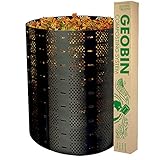
- Large capacity—expandable to 3.75 feet (237 gallon)
- Easy to assemble with closure keys. Easy to move. Easy to reassemble.
- The best value composting bin on the market.
- Excellent ventilation.
Choose a setup that fits your space
Three arrangements are supported by extension and horticultural guidance. Pick the one that makes it easiest to keep the leaves together and check their moisture.
| Setup | How it works | Best fit |
|---|---|---|
| Open heap | Leaves are piled directly on the ground and moistened as they are added. | Large gardens or any site where appearance and containment are not major concerns. |
| Wood or wire enclosure | A simple-sided bin holds the leaves in one place while allowing air to reach the pile. | Small yards, visible areas, or locations where wind and neatness matter. |
| Perforated bags | Leaves are packed into bags with holes that permit airflow; the bags are kept moist and are not sealed airtight. | Compact spaces, rented properties, or gardeners who want movable batches. |
A wire enclosure is a convenience, not a requirement. Penn State Extension notes that leaves can simply be piled, while a wood or wire bin helps contain them. The Royal Horticultural Society (RHS) likewise recommends perforated bags or a supported wire frame. Use an open heap if that is easiest; build or buy an enclosure only when containment solves a real problem.
Collect leaves and remove unwanted material
Gather autumn leaves from a suitable area
Collect leaves after they have fallen and before they are mixed with rubbish. Autumn collection is the normal starting point described by the RHS. Keep the material as leafy as possible so the batch behaves consistently and is easy to assess later.
Sort leaves collected from streets or public edges
If you collect leaves from a street, curb, or other public edge, sort them before adding them to the pile. Remove visible litter and other non-leaf debris. The RHS specifically advises sorting street-collected leaves for this reason. This is a cleanliness step, not a claim that every tree species must be excluded; the available guidance does not establish a universal species ban or a blanket disease rule.
Decide whether to shred
Shredding is optional. Smaller pieces expose more surface area and can decompose faster, so a mower is a practical way to chop leaves as you collect them. A dedicated leaf shredder can do the same job. University of Georgia Cooperative Extension describes both mower and shredder options, while Iowa State and the RHS treat shredding as a way to speed the process rather than a prerequisite.
Rank #2

- 【LARGE CAPACITY & EFFICIENT】With a massive 172-gallon capacity, this compost bin is ideal for large families and serious gardeners. It provides ample space to efficiently process yard waste, leaves, and kitchen scraps, significantly reducing turning frequency and accelerating the creation of nutrient-rich compost.
- 【SUPERIOR DURABILITY & BUILD】Constructed from premium powder-coated steel, our composter offers exceptional corrosion resistance and long-lasting durability. Unlike flimsy wire bins, it features reinforced perforated steel plates welded to sturdy posts for a robust structure that withstands the elements.
- 【FASTER, OPTIMAL DECOMPOSITION】The innovative dense grid design ensures excellent oxygen flow and maximizes surface area for microbial activity. This enhanced aeration speeds up the decomposition of grass clippings, cardboard, food waste, and more, yielding fertile soil for your garden faster.
- 【EASY ASSEMBLY & REUSABLE DESIGN】Enjoy a hassle-free setup with our user-friendly plug-in system that requires no tools. The bin can be quickly assembled, disassembled for seasonal storage, and reused year after year. (Pro Tip: Wearing gloves during assembly ensures an even smoother experience).
- 【SATISFACTION GUARANTEED】We stand behind our product with a dedicated customer promise. If your outdoor composting experience isn't perfect, contact us directly for a solution. Your satisfaction is our top priority, guaranteed.
Whole leaves are acceptable when low effort matters more than speed. If you do not have a mower or shredder, skip this step and compensate with realistic expectations about the waiting period.
How to make leaf mold: step-by-step
- Select the location. Choose a place where a heap, enclosure, or bags can remain undisturbed for an extended period. The site should be accessible enough that you can inspect the leaves and add water when necessary.
- Set up containment if you want it. Make an open heap, place leaves inside a wood or wire enclosure, or use bags with holes for airflow. The sides should hold the leaves without turning the container into an airtight chamber.
- Add the leaves. Put shredded or whole leaves into the chosen setup. If you are filling bags, leave the material loose enough for air to move through it rather than compressing it into a solid plug.
- Moisten dry leaves as you add them. Water the material so the batch starts damp throughout. Dry leaves resist the fungal decomposition that creates leaf mold, so do not rely on rain alone if the pile or bags remain dry.
- Check the moisture periodically. Inspect the pile, enclosure, or bags from time to time. Add water whenever the contents have dried. Bagged leaves deserve particular attention because the outside of a bag can look intact while the interior is dry.
- Preserve airflow. Keep holes open in bags and avoid sealing them airtight. An open heap or ventilated enclosure already provides the necessary access to air; the goal is a damp, aerated mass rather than a sealed package.
- Leave the batch to mature. Decomposition is slow. Resist the temptation to set a fixed harvest date before you know how quickly your leaves are changing. Shredding and steady moisture can shorten the wait, while whole or dry leaves can take longer.
- Assess the texture before use. When the material has broken down to the texture you need, remove any conspicuous pieces of litter and use the leaf mold as a soil amendment or mulch. Coarser, partly decomposed leaves can still serve as a rough mulch; finer material is more suitable when you want a more uniform soil conditioner.
Moisture and airflow: the two controls you can manage
Keep the batch consistently moist
Moisture is the most important routine check. Iowa State Extension and Outreach, the RHS, and North Carolina Cooperative Extension all emphasize wetting dry leaves and checking the material over time. A pile that dries completely is not following the recommended process. Add water whenever the contents feel dry rather than waiting for the next storm.
What’s actually slowing this PC down?
Pick the symptom - the matching free tool is one click away.
Use the phrase “consistently moist,” not “waterlogged.” The guidance calls for damp leaves, not a saturated container. If you are using bags, make the holes before filling them and keep the bags where you can inspect them. Do not seal them airtight, because trapped, stagnant contents defeat the airflow the process needs.
Containment should not block ventilation
Wire and wood sides hold leaves while leaving gaps for air. Perforated bags provide a compact alternative, but only when the holes remain open. An enclosure that keeps leaves from blowing away is useful; an airtight enclosure is counterproductive. No special purchased bin is required when an open heap can be kept together and checked.
How long leaf mold takes
There is no single reliable completion date. Leaf size, starting moisture, weather, and how long the material stays damp all affect the pace. The named extension sources give a broad range rather than a guarantee.
Rank #3

- Large Capacity: The compost bins has a capacity of 172 gallons, making it perfect for large families. It provides ample space for storing and fermenting various waste materials, helping save time, reduce the frequency of turning, and improve fermentation efficiency
- Durable Construction: Our Large metal composter is crafted from powder-coated steel, providing long-lasting durability and excellent corrosion resistance. Unlike traditional wire compost bins, it features perforated steel plates welded to sturdy posts for added strength
- Efficient Composting: The dense grid structure of the compost bin promotes optimal air circulation, increases surface area, and enhances fermentation, speeding up the decomposition of leaves, grass clippings, cardboard, coffee grounds, and food waste to quickly produce nutrient-rich soil for your garden
- Quick Assembly: The outdoor compost bin’s plug-in system allows for easy setup, disassembly, and reuse. Watch the video and check the listing for installation steps. For a smoother experience, wearing gloves is recommended
- Excellent Customer Service: Our outdoor metal compost bins are primarily sold in North America and Europe, receiving consistent positive feedback. If you have any questions, please feel free to contact us
| Condition or guidance | What to expect | Source context |
|---|---|---|
| Shredded leaves | They generally decompose faster than whole leaves. | Iowa State Extension and University of Georgia Cooperative Extension describe shredding as a speed-enhancing option. |
| Typical maturation window | Six to twelve months or longer. | Iowa State University Extension and Outreach, page reviewed October 2026. |
| Longer batches | Some leaf mold may take a couple of years. | Penn State Extension, guidance published approximately 2025. |
| Harvest decision | Use the material when its texture suits the job instead of relying on a calendar promise. | The timing range reflects variable conditions and leaf size. |
This is why a batch started in autumn should not automatically be advertised or planned as ready by spring. It may be usable sooner in a coarse form, but the sources allow for substantially longer maturation. Marking the start date on a bag or enclosure helps you track age without pretending that age alone proves readiness.
Recommended Free Tools
When to use leaf mold and what it does for soil
Use it as a soil conditioner
Work finished or well-decomposed leaf mold into garden soil when you want to improve its structure and its ability to retain moisture. The material adds organic matter that changes the physical condition of the soil; that is its principal role in the extension guidance.
Use coarser material as mulch
If some leaf pieces remain recognizable, spread the coarser material as mulch where an uneven texture is acceptable. Waiting longer produces a more decomposed product, so the right harvest point depends on whether you need a rough surface cover now or a finer amendment later.
Do not substitute it for fertilizer
Leaf mold contributes little plant nutrition according to Iowa State Extension and Outreach. Continue to manage fertility separately when a crop requires nutrients. Calling leaf mold a complete fertilizer sets the wrong expectation and can leave plants underfed.
Troubleshooting common problems
The leaves are dry
Dryness is the clearest correctable failure. Add water and check the batch again later. Pay special attention to bags, where the inner leaves can dry even when the outer surface appears unchanged. The process depends on keeping the contents consistently moist, not on wetting them once and forgetting them.
Rank #4

- Large Capacity: Compost bin max capacity: 300 gallons, which is enough to store and ferment all kinds of waste; Adjust the size of the compost bin according to the actual needs to save time and reduce the fermentation frequency and improve the fermentation efficiency
- HDPE Materials: This compost bin is made of HDPE, which is resistant to corrosion, weathering, and is highly durable; It can withstand bad weather and has a longer service life than other materials; This product is very light and easy to use
- Good Ventilation System: The holes on the wall of the composter helps air fully circulate, increasing the contact area and improving fermentation, thus speeding up the compost of leaves, grass clippings, cardboard boxes, coffee grounds, kitchen waste, etc.
- Reusable: Once your composting is complete, you can easily disassemble and reuse the bin to continue composting wherever you want; Reusing is a win-win for you and the environment, creating nutrient-rich soil for our vegetable garden and gardens
- Easy to Install and Use: The assembly process is very simple, with five anchor bars and 10 connecting buckles, you can easily adjust the bin to the desired size; The free garden gloves protect your hands from injury, and are waterproof and easy to clean
The leaves are taking longer than expected
Do not treat a slow batch as proof that the method failed. Whole leaves decompose more slowly than shredded leaves, and the published guidance allows both a six-to-twelve-month-or-longer window and cases lasting a couple of years. Confirm that the material has not dried and that bags still have open ventilation holes before deciding what to change.
Leaves are escaping the pile
Move the material into a wood or wire enclosure, or use perforated bags. Containment is the reason to add a bin; it is not a biological requirement. An open heap remains a valid method when the site keeps the leaves together.
The batch contains litter
Remove visible rubbish when you build the pile and again before using the finished material. This is particularly important for leaves gathered from streets or public edges, where small pieces of trash can be mixed through the litter.
You need material before the batch is fully decomposed
Use the texture as your guide. A partly decomposed, coarse batch can function as mulch, while a more broken-down batch is better when you want a uniform soil conditioner. Do not relabel an unfinished batch as nutrient-rich compost; leaf mold remains chiefly a structural amendment even when mature.
Free tools Windows power users keep installed
One-click scans. No signup required.
A practical seasonal workflow
Autumn: collect and start
Gather leaves as they fall, sort out litter, and decide whether to shred. Put them in a heap, enclosure, or perforated bags and moisten them as you build the batch. Record the start month if you are managing several batches.
Best Value

- Twin chambers: Two separate chambers allow one side to finish composting while leaving the other side available to add fresh wastes; Constant alternation of the two sides will create an uninterrupted stream of nutritious compost
- 360⁰ Tumbling Design: The rotating design prevents you from digging or mixing the pile by hand; And the deep fins on eight panels make it easier to turn the compost bin
- Excellent Aeration: Air vents can make the air fully circulate and will not cause an explosion due to excessive internal pressure; Deep fins can better break the clumps, which is conducive to the full fermentation of oxygen
- Sturdy & Durable Construction: Constructed of premium metal frame and high-quality pp plastic body, this tumbling composter is corrosion-resistant, weathering-resistant, sturdy, and durable for long-lasting service life
- Garden Gloves Included: The gloves that not only protect your hands from injury, but are also waterproof, making them easy to clean; With 4 durable ABS plastic claws for easy digging, planting and other gardening work
Winter and spring: inspect rather than disturb
Check whether the leaves have stayed damp and whether bags still have airflow. Add water when necessary. There is no requirement in the cited guidance to turn the material, so avoid adding unnecessary work to a process intended to be low effort.
Summer: compare texture with your intended use
Examine a small amount before spreading it. Decide whether its coarser form is adequate as mulch or whether you will leave it longer for a finer amendment. If the material is still dry, restore moisture and continue the batch.
Next autumn: keep the cycle going
Start a new batch while the previous one continues to mature. Staggering batches means you can use older material when ready without forcing every year’s leaves into one harvest date.
PC Slower Than It Used to Be?
A free scan shows the junk files, broken settings and background clutter dragging Windows down - then fixes them in one click.Free scan · Windows 10 & 11Outdated Drivers Are Slowing You Down
One free scan finds every outdated or missing driver and matches the right update for your exact hardware.Free scan · exact hardware matchSources behind the method
The practical steps above reflect guidance from named horticultural and extension organizations. Iowa State University Extension and Outreach’s “Composting for Home Gardeners,” reviewed October 2026, explains fungal decomposition, moisture, optional shredding, the six-to-twelve-month-or-longer timing, and the soil-conditioning role. Penn State Extension’s “Leaves Are Treasure, Not Trash,” published approximately 2025, describes piling and moistening leaves, optional wood or wire containment, and the possibility of a couple of years of maturation.
The RHS “Leafmould” guidance, accessed October 2026, covers autumn collection, perforated bags, supported wire frames, moistening dry leaves, and sorting street leaves for litter. North Carolina Cooperative Extension’s “Making and Using Leaf Mold,” a 2018 PDF hosted by the LSU AgCenter, advises pile or bin methods and periodic moisture checks in bags. University of Georgia Cooperative Extension’s “Make Fall Leaves Work for You,” published October 2015, describes shredding with a mower or shredder and using a pile or wire enclosure.
Quick Recap
Leaf-mold checklist
- Collect fallen leaves and remove visible rubbish, especially from street-collected material.
- Choose an open heap, wood or wire enclosure, or perforated bags.
- Shred with a mower or shredder only if faster decomposition justifies the extra effort.
- Wet dry leaves as you add them.
- Keep the batch consistently moist and add water when it dries.
- Keep bags ventilated; never seal them airtight.
- Allow at least six to twelve months or longer, with some batches taking a couple of years.
- Use the resulting material for soil structure, moisture retention, or mulch—not as a complete fertilizer.
Product prices and availability are accurate as of the date/time indicated and are subject to change. Any price and availability information displayed on Amazon at the time of purchase will apply.

