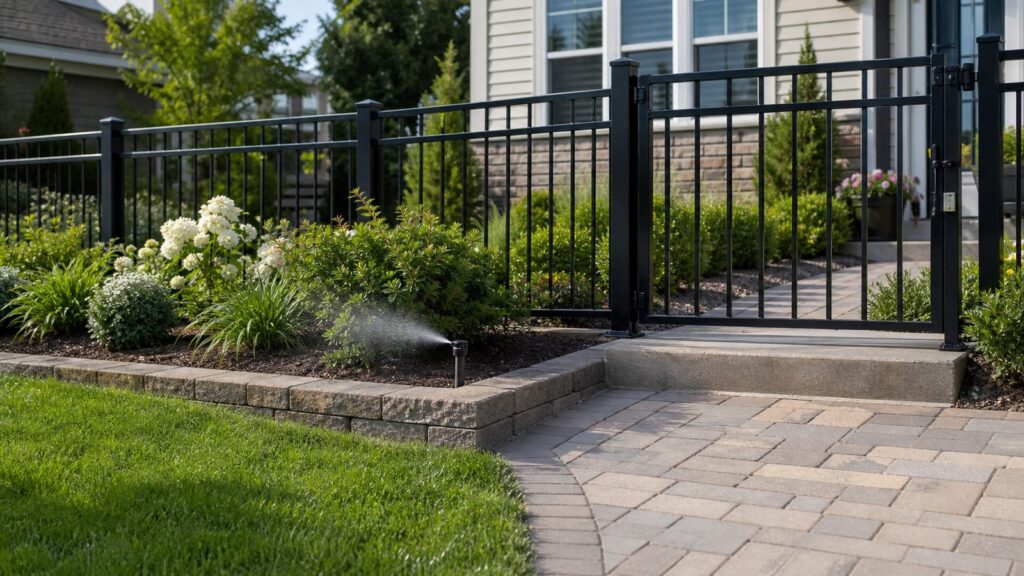
The most effective way to keep dogs out of your yard is physical exclusion: a fence, gate repair, mesh footer, dense planting edge, raised bed, or another barrier that removes access. Repellent sprays, granules, vinegar, citrus, and ultrasonic devices can help in narrow situations, but they are temporary. Rain, irrigation, mowing, mulch refreshes, and the individual dog all change the result.
On our job sites, the yards that stay protected are handled in layers. First, remove what is attracting the dog. Second, close the easiest route. Third, protect the bottom 6 inches of the perimeter, because that is where most failures happen. Fourth, use a temporary deterrent such as a motion-activated sprinkler or commercial repellent while the dog changes its habit.
As an Amazon Associate I earn from qualifying purchases.
If you want the short answer: clean the area, block the entry point, use a motion sprinkler for active reinforcement, and upgrade the weak spot with fence repair, welded wire, garden edging, or an L-footer. That approach costs anywhere from under $50 for a simple cleanup and repellent reset to several thousand dollars for a full fence, but it solves the real problem instead of repeatedly treating symptoms.
Start by Removing the Reason Dogs Come Back
Dogs often return to a spot because it already smells like dog urine or feces. Before buying repellent, remove the scent trail. Pick up waste, rinse hardscape, clean marked posts or walls, secure trash, and remove anything along the property edge that smells like food or animals.
#1 Best Overall

- Humane Lawn & Garden Protection - Help protect lawns, gardens, flower beds, and landscaping from unwanted animal visitors with a motion-activated sprinkler that responds with a burst of water.
- Heat & Motion Animal Detection - Using passive infrared sensing technology, the Yard Enforcer detects the movement of heat-producing animals and activates a burst of water when activity is detected. Detection performance may vary based on animal size, environmental conditions, and sensor placement.
- Day, Night & Always-On Operation - Choose from Day, Night, or Always-On modes to help tailor protection for the times when animal activity is most common in your yard.
- Adjustable Detection Range & Spray Duration - Customize coverage with an adjustable sensor range of up to 40 ft. and spray durations from approximately 3 to 10 seconds to fit your outdoor space.
- 30-Minute Manual Watering Function - In addition to animal deterrence, activate a convenient 30-minute manual watering cycle for quick watering tasks around lawns, gardens, and planting areas.
A basic reset can cost $0 to $50. That usually covers waste bags, a hose-end sprayer, an enzyme cleaner for hardscape, a trash-can clip or bungee, and minor edging repairs. Use enzyme cleaner on concrete, pavers, porch posts, fence bases, and trash storage areas. On lawns and planting beds, remove waste promptly and water the area deeply enough to dilute urine residue without overwatering the soil.
Be careful with fertilizers near the front edge of the property. Bone meal, blood meal, fish emulsion, and other animal-product fertilizers can attract dogs and wildlife. If the issue is happening near a sidewalk or shared side yard, use those products farther inside the property or switch to a less attractive fertilizer in that zone.
This first step is not glamorous, but it changes the odds. A repellent sprayed over a dog-marked corner is fighting uphill. A clean, blocked, less interesting corner is much easier to protect.
Best Dog Repellent Methods, Ranked by Reliability
Homeowners usually ask for the best dog repellent, but the better question is: which method matches the behavior? A passing stray, a neighbor dog squeezing under a gate, and a dog digging under a fence need different fixes.
| Method | Best Use | Typical 2026 Cost | Reliability | Main Limitation |
|---|---|---|---|---|
| Fence, gate repair, or physical barrier | Repeated access, neighbor dogs, long-term yard protection | $2-$15 per linear foot for low DIY barriers; full fence projects often several thousand dollars | Highest | Cost, code limits, property-line accuracy |
| Welded wire or hardware-cloth L-footer | Dogs digging under fences | About $1-$4 per linear foot for mesh plus staples and fasteners | High | Labor around roots, rocks, slopes, and existing fence bottoms |
| Motion-activated sprinkler | Occasional strays, repeat entry line, garden protection | Roughly $25-$100+ per unit | Medium to high | Needs hose, batteries, water pressure, and correct aiming |
| Commercial granular repellent | Bed edges, perimeter strips, mulch zones | Small shakers about $10-$35; 40 lb bulk around $130-$140 | Medium | Coverage and durability vary by product, rain, irrigation, and traffic |
| Commercial spray repellent | Small target zones, posts, planters, trash areas | About $10-$35 per 32 oz bottle; larger concentrates about $25-$60 | Low to medium | Often needs reapplication after rain or watering |
| Ultrasonic deterrent | Small, open areas with clear line-of-sight | Commonly $20-$70 per unit | Inconsistent | Blocked by shrubs, vehicles, grade changes, wind, batteries, and dog temperament |
| DIY vinegar, citrus, or spice deterrents | Short-term testing in non-sensitive areas | Usually under $20 | Lowest | Can damage plants, irritate pets, wash away quickly, or fail completely |
For most homes, the best value is not the cheapest product. It is the least expensive method that stops the specific access point. A $25 bottle of spray used every week for a year can cost more than fixing a loose gate threshold once.
Commercial Dog Repellent Sprays and Granules
Commercial dog and cat repellents usually work by scent, taste, or odor masking. They are useful for small areas where the dog is marking, nosing through mulch, approaching a trash area, or cutting through a bed. They are not a substitute for a fence when a dog has an easy path into the yard.
Spray repellents
Ready-to-use spray repellents commonly cost about $10 to $35 for a 32-ounce bottle. Larger concentrates or gallon sprayers can run roughly $25 to $60. Sprays are convenient for vertical and hard surfaces: fence posts, mailbox posts, trash storage pads, porch steps, planters, and the edge of a gate.
Quick wins for a faster PC:
Repair Windows errors before they cause bigger problemsFix Now →Fix the driver behind crashes, sound loss and screen glitchesFind Drivers →Clear out junk files and repair common Windows errorsFree Scan →The tradeoff is durability. Some ready-to-use products state effectiveness of about a week or more and are not waterproof. After rain, irrigation, pressure washing, or heavy dew cycles, assume the protection has weakened. For a problem area along a front walk, that may mean reapplying weekly during wet seasons.
Granular repellents
Granular repellents are better for bed edges, mulch strips, and narrow perimeter bands than for treating a full lawn. Small 1- to 5-pound shakers commonly run about $10 to $35. Bulk 40-pound granular products can be around $130 to $140. Some granular products advertise roughly 30 days of performance regardless of weather or watering, but real-world performance still depends on slope, irrigation heads, foot traffic, mulch depth, and how determined the dog is.
Use granules as a border, not a blanket. Treat the 12- to 24-inch strip where the dog enters or marks. Keep product out of vegetable beds unless the label allows that use. Follow the label exactly, including reapplication timing and pet restrictions.
EPA and label safety
Some repellent products are sold as minimum-risk pesticides. That does not mean anything goes. EPA minimum-risk pesticide rules require qualifying products to meet specific conditions, including permitted active and inert ingredients and proper labeling. For homeowners, the practical rule is simple: buy labeled products, use them only where the label says they can be used, and do not mix your own stronger version.
Do these 3 things before closing this tab:
1Clear out junk files and repair common Windows errors2Scan for outdated or missing drivers - takes under a minute3Repair Windows errors before they cause bigger problemsMotion-Activated Sprinklers Work When Placement Is Right
A motion-activated sprinkler is one of the better humane deterrents because it interrupts the dog at the moment it enters. The sudden spray changes the behavior without contact, trapping, or confrontation.
Current units commonly cost about $25 to $100 or more. Lower-cost imports often sit around $25 to $55, while name-brand models such as Orbit’s Yard Enforcer list around $99.99. Depending on the model and sensor angle, advertised detection can reach up to about 40 feet or around 1,000 square feet.
The mistake is aiming the sprinkler at the whole yard. Aim it at the entry line: the side gate gap, the corner of the hedge, the opening beside the driveway, or the stretch of bed along the sidewalk. Keep the spray off sidewalks, mailboxes, driveways, and neighbor property. If the mail carrier, children, or guests trigger it constantly, you will turn it off, and then it stops being a system.
Plan for batteries, hose length, water pressure, and seasonal storage. In freezing climates, remove and drain the unit before winter. If the entry point is far from a hose bib, the cost may include a longer hose, a splitter, or a more permanent irrigation adjustment.
Physical Barriers Are the Long-Term Fix
When dogs repeatedly enter a yard, the access route matters more than the repellent. Most failures are low: a sagging gate, a loose chain-link bottom, a 5-inch gap under a fence, open pickets near the ground, or a bed that looks like a path.
For front yards, do not assume a 6-foot privacy fence is allowed. Many cities limit front-yard fence height, require more open designs, or treat corner lots differently because of visibility at intersections and driveways. A better front-yard solution is often a code-compliant open fence, hedge, raised planter, masonry cheek wall, wood accent screen, or decorative metal panel that guides traffic without walling off the street.
Gate details that stop dogs
Gates deserve special attention. A fence can be well built and still fail at the gate. Keep the bottom gap tight enough that a dog cannot crawl under it, while still allowing drainage and frost movement. In many yards, a 1- to 2-inch bottom clearance is workable; larger gaps invite problems. Use a firm threshold where soil has settled. For double gates, use a cane bolt or drop rod into a proper sleeve so the inactive leaf does not swing or lift.
Use latch hardware that will not sag after freeze-thaw cycles, wet soil movement, or repeated slamming. If posts are leaning, replacing the latch alone is cosmetic. The post may need to be reset with proper depth and concrete, especially on wide wood gates.
Recommended Free Tools
Low decorative barriers for beds
For garden beds, a low fence or edging system can be enough. DIY decorative garden fence panels, steel edging, and small welded-wire panels often run about $2 to $15 per linear foot in materials. They work best when the issue is a dog cutting a corner, stepping into mulch, or marking shrubs along a walk.
Use stable dimensions. A 16- to 24-inch-high bed barrier is often enough for a small dog or a visual boundary, but it will not stop a determined large dog. For large dogs, focus on closing the perimeter rather than decorating the bed edge.
Stop Dogs From Digging Under a Fence
If the problem is digging, the bottom of the fence needs reinforcement. The most practical retrofit is an L-footer made from galvanized welded wire or hardware cloth. Attach the mesh to the bottom of the fence, then extend it outward along the ground or bury it shallowly on the dog side of the fence. Pin it with landscape staples and cover it with soil, mulch, stone, or turf.
The footer does not always have to be buried. Surface installation can be less disruptive around roots, irrigation, and existing posts. For many yards, a 24-inch outward extension is a good target. Use galvanized welded wire or hardware cloth sturdy enough to stay flat, with openings small enough that paws cannot easily pull through. Materials often run roughly $1 to $4 per linear foot, plus staples, fasteners, and any cover material.
The Tool Desk
Outbyte PC Repair FREEClear out junk files and repair common Windows errorsFree Scan →Outbyte Driver Updater FREEFix the driver behind crashes, sound loss and screen glitchesFind Drivers →Rank #2

- Motion Activated Sprinkler: Our motion activated sprinkler serves as an effective deer repellent device and cat deterrent, providing an efficient solution for keeping cats out of yard permanently. Ideal for yards, this device offers peace of mind.
- Animal Deterrent Devices Outdoor: This animal repeller is designed for outdoor use to deter common yard invaders such as deer, raccoons, and skunks. The orbit sprinkler system is engineered to protect your lawn while being environmentally friendly.
- Rotating Yard Sprinklers: Our rotating yard sprinklers are perfect for lawn care, doubling as raccoon deterrent devices. This yard sprinkler provides optimal coverage while safeguarding your property from unwelcome wildlife.
- Cat Deterrent Outdoor: Specifically designed as a cat deterrent outdoor, the water sprinkler is an excellent tool to keep cats and other critters out of your garden. Its motion-activated feature ensures targeted and effective animal repelling.
- Comprehensive Sprinkler System: The comprehensive sprinkler system for yard combines motion activated features with a robust garden sprinkler, offering a dual-purpose solution for irrigation and critter ridder animal repellent.
Where the dog is digging at one gate or one corner, do not rebuild the entire fence first. Reinforce the 8 to 12 feet around the failure point and watch the behavior. If the dog moves down the line, continue the footer along the full vulnerable run.
Check irrigation before pinning or trenching. Sprinkler laterals, drip lines, low-voltage lighting, and invisible pet fence wires are commonly near fence lines and bed edges. Call for utility marking before deeper digging, especially for new posts, masonry, or long fence runs.
Independent reader supportYour contribution helps us test, update, and keep practical guides available for everyone.DIY Deterrents: Use Carefully and Expect Short Results
Vinegar, citrus peels, coffee grounds, cayenne, and other homemade dog deterrents get passed around because they are cheap. They can sometimes discourage a dog from sniffing a very small area. They are not reliable perimeter protection.
Vinegar can injure grass and sensitive plants, especially when applied repeatedly or in strong concentration. Cayenne and hot pepper products can irritate eyes, noses, paws, and skin. Citrus may be unpleasant to some dogs but ignored by others. Coffee grounds can be messy, can affect soil conditions, and are not a professional-grade solution for a client-facing landscape.
If you test a DIY scent deterrent, keep it off lawns and valuable plants until you know how the material behaves. Never use anything that can injure the dog. The goal is to redirect, not punish. For planted barriers, choose pet-safe, non-toxic species and check proposed plants against a reliable toxic and non-toxic plant list before installing rosemary, lavender, citrus, thorny shrubs, or ornamental varieties in areas pets can reach.
What to Do About a Neighbor’s Dog
If the dog belongs to a neighbor, start with documentation and a practical fix. Record dates, times, photos, and the exact access point. A clear pattern is more useful than a heated conversation. Check local leash, nuisance, and animal-control rules so you know where the line is.
Then offer the simplest solution: close the shared gap, repair the loose gate board, add mesh at the fence bottom, or adjust a latch. Many neighbor-dog problems come from one weak detail, not bad intent. If the dog is repeatedly loose, aggressive, damaging property, or the owner refuses to address it, then animal control or local code enforcement may be appropriate.
Do not put hazardous materials along a shared line. Besides being unsafe, it can turn a solvable property issue into a legal one. Use humane deterrents, barriers on your side where allowed, and documented communication.
Free tools Windows power users keep installed
One-click scans. No signup required.
Fence Costs, Permits, and Code Issues
Full fence installation has a wide cost range. National 2026 installed project ranges commonly span about $500 to more than $10,000, with many full-yard projects landing in the several-thousand-dollar range. Published 2026 fence costs cite broad ranges such as $6,000 to $12,000 for many projects and about $10 to $36 per linear foot for 4-foot wood picket fencing. Home Depot reported an average fencing job around $6,300 in 2024.
The range is wide because fences are site work, not shelf products. Cost depends on linear footage, material, height, gates, slope, demolition, post depth, concrete, soil, drainage, local labor, HOA requirements, survey work, utility marking, and whether the fence is decorative front-yard work or 6-foot privacy fencing.
Permit rules vary by city. Some jurisdictions allow many residential fences without a building permit if they stay below height limits. Others require zoning review, corner-lot visibility checks, or permits for taller fences, retaining walls, masonry, commercial properties, or fences near rights-of-way. Before building, confirm property lines, easements, HOA rules, and front-yard height limits. For corner lots and driveways, visibility triangles can control what you can build even when the material itself is allowed.
When to DIY and When to Hire a Pro
DIY makes sense when the problem is small and the structure is sound. Cleaning scent areas, applying labeled repellent, setting a motion sprinkler, adding a short bed barrier, tightening a latch, or stapling a short run of mesh to the bottom of a fence are reasonable homeowner projects. Budget $0 to $250 for many of these fixes, depending on how many products or small materials you need.
What’s actually slowing this PC down?
Pick the symptom - the matching free tool is one click away.
Hire a pro when the fence is leaning, posts are rotten, gates are wide or sagging, masonry is involved, the property line is uncertain, the yard has major slope or drainage problems, or the dog is large and persistent. A professional fence or landscape contractor can solve the access route, preserve drainage, avoid irrigation damage, and build something that looks intentional from the street.
A good contractor will also look at the whole edge condition. That includes gate swing, bottom clearance, soil settlement, mulch depth, roots, utility conflicts, surface drainage, and whether the proposed barrier is legal in that yard. The difference between a weekend patch and a durable fix is often in those details.
A Practical Plan for Most Homes
For an occasional stray, clean the area, secure trash, apply a labeled repellent at the specific marking point, and use a motion-activated sprinkler aimed at the entry line for two to four weeks. For a neighbor dog, document the pattern and close the shared gap with gate repair, welded wire, or an agreed fence-bottom fix. For garden beds, use a low barrier or raised planter edge plus granules only at the vulnerable strip. For digging, install an L-footer before replacing the whole fence. For long-term curb appeal, build a code-compliant fence or layered landscape edge that matches the house.
The best dog repellent is the one the dog cannot walk around, crawl under, or outlast after the next rain. Use sprays and granules as temporary support. Use motion sprinklers when timing matters. Use barriers when you want the problem solved.
Crashes, No Sound, or Screen Glitches?
Random freezes, missing sound and display glitches usually trace back to one bad driver. Find and replace yours safely.Free scan · under a minuteWindows Errors? Fix Them Before They Spread
Repair common Windows errors and clear accumulated junk for a smoother, more stable PC - no reinstall needed.Free scan · no reinstallFrequently Asked Questions
What is the most effective way to keep dogs out of a yard?
A physical barrier is the most reliable method: a fence, repaired gate, dense planting edge, raised bed, welded wire, or L-footer. For best results, combine that with cleanup and a temporary deterrent such as a motion-activated sprinkler.
Are dog repellent sprays safe for lawns and pets?
Some commercial repellents are labeled for outdoor use around lawns and pets, but safety depends on the exact product and application. Follow the label exactly, keep pets away when directed, and avoid using products on edible plants unless the label allows it.
Does vinegar keep dogs away?
Vinegar may discourage some dogs for a short time, but it is not reliable and can damage grass or sensitive plants. It is better used, if at all, on limited hardscape test areas rather than lawns or planting beds.
Do motion-activated sprinklers work for neighbor dogs?
They can work well when aimed at the actual entry line, such as a side gate, hedge gap, or fence corner. They are less useful if they spray sidewalks, driveways, mailboxes, or neighboring property.
Do these 3 things before closing this tab:
1Clear out junk files and repair common Windows errors2Fix the driver behind crashes, sound loss and screen glitches3Repair Windows errors before they cause bigger problemsHow do I stop a dog from digging under my fence?
Install a galvanized welded-wire or hardware-cloth L-footer at the fence bottom. Extend it outward about 24 inches, pin it with landscape staples, and cover it with soil, mulch, stone, or turf.
Do I need a permit to build a fence to keep dogs out?
Maybe. Fence rules vary by city, HOA, height, front-yard location, corner-lot visibility, and material. Confirm local code, property lines, easements, and utility marking before installing a new fence or major barrier.
Quick Recap
Product prices and availability are accurate as of the date/time indicated and are subject to change. Any price and availability information displayed on Amazon at the time of purchase will apply.

