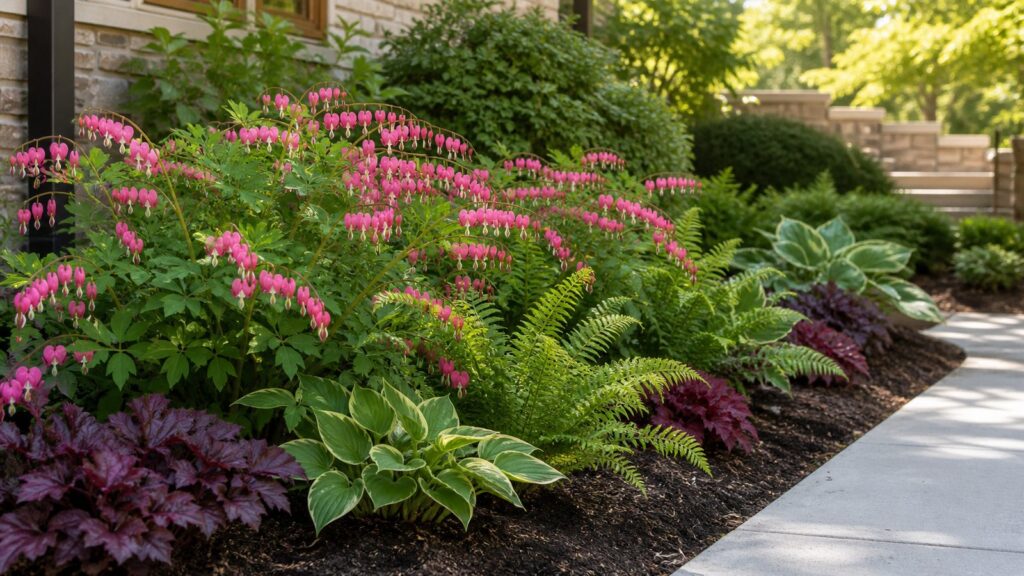
Some links on this page are affiliate links: if you buy through them we may earn a commission, at no extra cost to you.
Bleeding heart is one of the best spring perennials for a shaded American yard, but it is not a plant you can drop into any dark corner and forget. The classic old-fashioned bleeding heart, now classified as Lamprocapnos spectabilis and still often sold as Dicentra spectabilis, wants cool roots, humus-rich soil, steady moisture, and drainage that does not leave the crown sitting wet through winter.
For most homeowners, the right planting formula is simple: morning sun or bright dappled shade, afternoon shade, amended soil, 24 to 36 inches of spacing, and companion plants ready to fill the space after the foliage yellows in summer. On our job sites, the plants that fail are usually not underfed. They are planted too deep, cooked by afternoon sun, smothered with mulch, or set into compacted clay where water cannot move.
| # | Preview | Product | Price | |
|---|---|---|---|---|
| 1 |

|
Red Bleeding Heart Plants – Pack of 2 Live Starter Plants (5-9 Inches Tall) – Dicentra... | Buy on Amazon |
As an Amazon Associate I earn from qualifying purchases.
A mature old-fashioned bleeding heart usually reaches about 2 to 3 feet tall and wide. It blooms for roughly 4 to 6 weeks in spring, often from late spring into early summer depending on climate, then may go dormant when heat arrives. That summer disappearance is normal. The trick is to design the bed so the garden still looks intentional after the plant checks out for the season.
What Bleeding Heart Needs to Grow Well
Bleeding heart is a woodland-edge perennial. Think cool, protected, evenly moist soil with organic matter, not a dry tunnel under a maple or a wet low spot beside a downspout.
Popular on Amazon
- What You Will Receive: You will receive a pack of 2 healthy Red Bleeding Heart starter plants, currently standing 5-9 inches tall. These vigorous, well-rooted plugs are shipped ready to transplant, providing an affordable way to add rare, romantic crimson color to your woodland garden or shady borders.
- A Romantic Shade Masterpiece: Transform dark corners into a love story. Unlike the common pink variety, this rare selection produces dangling, heart-shaped flowers in a rich, cherry-red hue with white tips. Suspended from elegant, arching stems over fern-like green foliage, they look like floating jewels in the spring garden.
- Thrives Where Others Fade: Finally, a showstopper for the shade! These plants flourish in full shade to partial shade, making them the perfect solution for under trees, north-facing walls, or covered patios where sun-loving flowers fail. They bring vibrant energy to the darkest parts of your landscape.
- Hummingbird Magnet: Bring nature to your doorstep. The unique shape of the Bleeding Heart flower is perfectly designed for hummingbirds and long-tongued bees. Planting this 2-pack creates a high-traffic nectar station that supports local pollinators early in the spring season.
- Tough & Deer Resistant: Enjoy beauty without the battle. Red Bleeding Hearts are exceptionally cold hardy (down to Zone 3) and are generally ignored by deer and rabbits, allowing you to enjoy the blooms without waking up to a grazed garden.
The best site has partial shade or dappled shade. In many U.S. climates, morning sun with afternoon shade is the sweet spot. Full sun can work only in cool regions where soil stays consistently moist. In hot parts of the South, Midwest, and inland West, afternoon sun shortens bloom time, scorches foliage, and pushes the plant into early dormancy.
Soil matters as much as shade. Bleeding heart likes moisture, but it does not tolerate saturated soil. Heavy clay that stays wet is the main failure point because the crown and roots can rot, especially in winter. If you can squeeze a handful of soil into a slick, sticky ribbon after rain, improve the bed before planting.
Outdated Drivers Are Slowing You Down
One free scan finds every outdated or missing driver and matches the right update for your exact hardware.Free scan · exact hardware matchWindows Errors? Fix Them Before They Spread
Repair common Windows errors and clear accumulated junk for a smoother, more stable PC - no reinstall needed.Free scan · no reinstallBest growing conditions
- Light: Morning sun, afternoon shade, or bright dappled woodland shade.
- Soil: Moist, loose, humus-rich, and well drained.
- Hardiness: Commonly grown in USDA Zones 3 through 9, with local success depending on heat, humidity, and drainage.
- Size: Plan for 2 to 3 feet tall and 2 to 3 feet wide for old-fashioned bleeding heart.
- Spacing: Use 24 to 36 inches between plants.
- Bloom time: Usually 4 to 6 weeks in spring.
- Summer behavior: Foliage may yellow and disappear by midsummer, especially in heat.
Before you buy plants, check your USDA Plant Hardiness Zone and then look at your actual microclimate. A north or east foundation bed, a shaded patio edge, or a woodland border with open overhead light can be much better than deep shade under thirsty tree roots.
Choosing the Right Type of Bleeding Heart
The name “bleeding heart” gets used for several related perennials. They are similar enough to share care preferences, but different enough that the right choice depends on your climate and design goal.
| Type | Botanical name | Best use | Typical size | Seasonal behavior |
|---|---|---|---|---|
| Old-fashioned bleeding heart | Lamprocapnos spectabilis, often sold as Dicentra spectabilis | Classic spring display in shade beds | About 2 to 3 ft. tall and wide | Blooms 4 to 6 weeks, often dormant by midsummer |
| Fringed bleeding heart | Dicentra eximia | Native-style woodland gardens and longer bloom interest | Often smaller and finer textured | Can bloom longer if kept cool and moist |
| Western or Pacific bleeding heart | Dicentra formosa | Shaded beds in cooler western or woodland settings | Lower, spreading habit depending on cultivar | Often offers longer seasonal presence than old-fashioned types |
If you want the traditional arching stems with heart-shaped pink flowers, choose old-fashioned bleeding heart. If you want a more native planting or a longer bloom window, look at fringed bleeding heart or western bleeding heart. In hotter climates, the native relatives are often easier to blend into a layered shade bed because their finer foliage is less visually disruptive when it fades.
When to Plant Bleeding Heart
In cold and temperate regions, early spring is the most common planting time for bare roots and potted plants. Plant when the soil is workable, not frozen, and not waterlogged. For many northern yards, that means roughly March through May depending on the year.
The Tool Desk
Outbyte Driver Updater FREEFix the driver behind crashes, sound loss and screen glitchesFind Drivers →Outbyte PC Repair FREEClear out junk files and repair common Windows errorsFree Scan →In milder winter regions and hot-summer climates, late summer or fall planting can work well because the plant can establish roots before spring growth. In parts of the South, fall planting may be easier on the plant than asking a new spring transplant to establish right before summer heat.
Bare-root plants are common in spring catalogs and online sales. They are economical, but they need careful handling. If the roots arrive before your bed is ready, keep them cool and slightly moist, not wet. Plant as soon as conditions allow.
How to Prepare the Planting Bed
Good bed preparation is the difference between a bleeding heart that returns for years and one that disappears after one season. We treat shade planting like small site work: understand water movement, loosen compaction, amend the soil, and protect existing roots.
Check drainage first
After a steady rain, look at the bed. If water stands for more than a few hours, fix drainage before planting. Bleeding heart can handle moist soil, but not a crown sitting in cold mud.
Quick wins for a faster PC:
Clear out junk files and repair common Windows errorsFree Scan →Scan for outdated or missing drivers - takes under a minuteDriver Scan →Downspouts are a common problem. A shaded foundation bed may look perfect until roof runoff dumps 50 to 100 gallons of water into it during a storm. Extend the downspout, redirect discharge, or build the bed so water moves through and away from the crown.
Improve soil without overworking tree roots
For a new or tired shade bed, spread 2 to 3 inches of compost or leaf mold over the planting area and loosen the top 8 to 10 inches of soil where practical. In compacted clay, add compost and, where appropriate, pine bark fines or soil conditioner to improve structure. Do not turn the bed into a bathtub by digging a deep amended hole in clay and filling it with loose material. Water will collect there.
Under mature trees, work by hand. Do not sever large roots to make room for perennials. Loosen only what you can safely loosen, plant between major roots, and use compost as a topdress. Cutting structural roots or feeder roots to install a small ornamental plant is poor tradecraft.
Call 811 before deeper digging
For a simple shallow perennial planting, you may only be working 6 to 10 inches deep. Still, if you are creating a new bed, changing grade, trenching irrigation, driving edging stakes, or digging near utility corridors, contact 811 before you dig. Utility-locate rules are not just for major construction. Gas, electric, communication, and irrigation lines can be shallower than homeowners expect.
Do these 3 things before closing this tab:
1Scan for outdated or missing drivers - takes under a minute2Clear out junk files and repair common Windows errors3Fix the driver behind crashes, sound loss and screen glitchesHow to Plant Bleeding Heart Step by Step
Planting depth is where many bleeding hearts get into trouble. The crown should sit near the soil surface, not buried under several inches of soil and mulch.
- Lay out the bed. Space old-fashioned bleeding heart 24 to 36 inches from neighboring perennials, walls, and hardscape edges.
- Dig a wide planting hole. Make it about twice as wide as the root mass, but only deep enough that the crown sits at the correct height.
- Set the crown correctly. For potted plants, keep the top of the root ball level with the surrounding soil. For bare roots, spread the roots gently and position the crown just below or at the soil surface according to the supplier’s instructions.
- Backfill with improved native soil. Firm it lightly by hand. Do not stomp around the crown.
- Water deeply. Soak the root zone after planting so soil settles around the roots.
- Mulch lightly. Apply about 1 to 2 inches of shredded leaves, fine bark, or organic mulch, keeping mulch pulled back from the crown.
- Mark the plant. Use a durable label or discreet marker so you do not dig into the crown during summer dormancy or spring cleanup.
If you are planting a group of five, stagger them rather than lining them up like fence posts. A triangular or loose drift pattern looks more natural and gives companion plants room to carry the bed later in the season.
Watering, Mulching, and Feeding
Bleeding heart needs consistent moisture during establishment and active spring growth. That does not mean daily shallow sprinkling. Water deeply so moisture reaches the root zone, then let the top layer begin to dry before watering again.
During the first growing season, check soil moisture every few days in warm weather. A new plant in loose, amended soil may need water 1 to 2 times per week depending on rainfall, temperature, mulch, and root competition. In established beds, the goal is steady moisture in spring and early summer, not wet soil year-round.
Free tools Windows power users keep installed
One-click scans. No signup required.
Mulch helps moderate soil temperature and moisture. Use 1 to 2 inches around the plant. More is not better if it piles against the crown. Mulch volcanoes are bad for trees and they are bad for perennials too.
Fertilizer should be restrained. Compost or leaf mold is usually enough in a well-built shade bed. High-nitrogen fertilizer can push soft foliage instead of better flowering. If your soil is poor, use a balanced, slow-release garden fertilizer at label rates in spring, but do not try to force a dormant plant back into growth in midsummer.
Planning for Summer Dormancy
Old-fashioned bleeding heart often turns yellow and disappears after flowering as summer heat builds. Homeowners sometimes mistake this for plant death, dig it up, or overwater it until the crown rots. In many climates, dormancy is simply part of the plant’s rhythm.
Let the foliage stay in place while it is still green. Those leaves are feeding the crown for next year. Once the foliage is mostly yellow or collapsed, cut it back cleanly to the ground. Keep the crown location marked.
The better move is to design for disappearance from the start. Plant bleeding heart behind or between later-emerging shade perennials so the bed still has volume in July and August.
Good companion plants
- Hosta: Broad leaves fill space after bleeding heart fades.
- Ferns: Fine texture pairs well with arching spring flowers.
- Brunnera: Early spring interest and attractive foliage.
- Astilbe: Summer flowers in moist shade.
- Heuchera: Colorful foliage for the front of the bed.
- Hellebores: Late winter to early spring structure.
- Carex: Grasslike texture and season-long coverage.
For a 10 to 20 square foot shade pocket, one to three bleeding hearts with five to nine companion plants usually reads better than a single lonely specimen surrounded by mulch.
Pruning, Dividing, and Propagation
Bleeding heart is not a shrub and does not need shaping. Remove damaged stems if needed, deadhead if you want a tidier look, and cut back spent foliage after it yellows. Avoid cutting healthy green foliage right after bloom.
Division is possible, but mature clumps do not appreciate unnecessary disturbance. Divide only when dormant or just emerging in spring. Lift the clump carefully, keep roots moist, and separate sections with visible buds and healthy roots. Replant immediately at the same crown depth.
What’s actually slowing this PC down?
Pick the symptom - the matching free tool is one click away.
Seeds are the cheapest way to start bleeding heart, often around $4 to $20 per packet or listing, but they are slower and less predictable. They may need cold stratification, and seedlings take time to reach flowering size. For most homeowners who want a reliable spring display, potted plants, bare roots, or divisions are the better route.
Common Problems and How to Prevent Them
Most bleeding heart problems come back to site conditions. Pests and diseases exist, but the typical homeowner failure is environmental.
Yellow foliage in summer
This is often normal dormancy. If the plant bloomed well and then yellowed as temperatures rose, mark the crown, reduce watering to normal bed moisture, and let companion plants take over visually.
Wilting in spring
Wilting can mean dry soil, root competition, transplant shock, or crown rot. Check moisture 3 to 4 inches down before watering. If the soil is wet and the plant is wilting, do not add more water. Improve drainage and inspect for rot if the plant collapses.
Poor flowering
Common causes include too much shade, too much nitrogen, drought during spring growth, immature plants, or a clump that was recently disturbed. Move plants only when dormant or just emerging, and give new divisions time to recover.
Crown rot
Crown rot is usually tied to soggy soil, deep planting, or mulch packed against the crown. Replanting in the same wet spot without fixing drainage usually repeats the failure.
Independent reader supportYour contribution helps us test, update, and keep practical guides available for everyone.Safety for Pets, Children, and Sensitive Skin
Treat all parts of bleeding heart as toxic or irritating if eaten. Pet safety resources flag bleeding heart as a concern for dogs and cats, and the same practical rule applies around young children: do not plant it where anyone is likely to graze, chew, or handle plant parts unsupervised.
Use gloves if you have sensitive skin, especially when dividing roots or cutting back foliage. If a pet or child eats any part of the plant, contact a veterinarian, poison control resource, or medical professional promptly. Do not wait for severe symptoms before asking for help.
In family yards, we place questionable ornamentals inside defined beds rather than along play edges, dog runs, or paths where stems get broken and handled. Good plant placement is part horticulture and part site planning.
What It Costs to Plant Bleeding Heart in 2026
Bleeding heart is not an expensive plant by itself, but the real cost depends on whether the shade bed already has good soil and drainage. A $12 bare root planted into compacted clay may be wasted money. A $35 potted plant in a well-prepped bed can come back for years.
| Item or project | Typical 2026 U.S. cost | Notes |
|---|---|---|
| Bare-root bleeding heart | $8 to $13 each for common types; $18 to $30 for many marketplace divisions | Specialty cultivars and shipping raise the price |
| Potted nursery plant | $15 to $35 for many 1-quart to 1-gallon plants; $30 to $50+ for larger or named cultivars | Local spring availability matters |
| Seed packet or listing | $4 to $20 | Cheapest, but slowest and least predictable |
| Compost or leaf mold | $5 to $10 per bag | A small shade-bed refresh may need several bags |
| Pine bark fines or conditioner | $4 to $9 per bag | Useful for improving clay soil structure |
| Organic mulch | $3 to $8 per bag | Use 1 to 2 inches, not a deep pile |
| DIY one-plant project | $20 to $65 | Includes one plant, compost, mulch, and minor supplies |
| DIY five-plant grouping | $90 to $275 | Depends heavily on bare roots versus potted specialty plants |
| Professional small grouping | $150 to $600+ | Includes labor, site prep, plants, soil correction, mulch, and trip minimums |
For labor, 2026 gardener pricing is broad. Basic gardener rates commonly fall around $33 to $47 per hour, with entry-level help around $20 to $30 per hour and experienced specialists reaching $60 to $88 per hour. Task-based platforms often show common gardening averages around $50 to $75 per hour, with higher-skilled gardeners reaching $100 to $150 per hour. Many small gardening projects land around several hundred dollars once minimum service charges, travel, plants, soil amendments, and cleanup are included.
The biggest cost drivers are plant size, cultivar, local labor rates, soil condition, drainage correction, irrigation work, and whether the planting is part of a larger landscape visit. If a pro is already on site for bed cleanup, mulch, or drainage work, adding a few bleeding hearts is usually cheaper than scheduling a separate trip.
Recommended Free Tools
When to DIY vs. When to Hire a Pro
Bleeding heart is a good DIY project if you already have a defined shade bed, decent soil, and basic hand tools. A homeowner can plant one to five perennials in an afternoon, especially if the work is limited to compost, mulch, and careful planting.
Hire a pro when the plant is part of a bigger site problem. If the area has standing water, compacted construction soil, downspout discharge, exposed tree roots, erosion, irrigation issues, or grade changes, the planting is the easy part. The site work determines whether the garden succeeds.
We also recommend professional help when planting near utilities, retaining walls, foundation drainage, hardscape edges, or mature trees where root damage and water movement matter. A bleeding heart bed should not compromise drainage away from the house or encourage water against the foundation.
Bottom Line
Bleeding heart is worth planting when you can give it the conditions it actually wants: partial shade, cool soil, organic matter, steady moisture, and drainage that works. Expect a 2 to 3 foot plant, a 4 to 6 week spring bloom, and possible midsummer dormancy. Plan that dormancy into the design with hosta, ferns, brunnera, astilbe, heuchera, hellebores, or carex.
For budget, figure roughly $20 to $65 for a simple one-plant DIY project, $90 to $275 for a five-plant DIY grouping, and $150 to $600 or more for professional installation depending on site prep. Spend first on soil and drainage. That is where bleeding heart usually lives or dies.
Frequently Asked Questions
When is the best time to plant bleeding heart in the U.S.?
Early spring is the standard time for bare roots and potted plants in cold and temperate regions. In milder winter or hot-summer areas, late summer or fall planting can also work because roots can establish before the next spring bloom season.
Does bleeding heart need full shade?
No. Bleeding heart usually performs best in partial shade or bright dappled shade. Morning sun with afternoon shade is ideal in many climates. Deep, dry shade under tree roots is usually worse than a cooler site with some filtered light.
Why did my bleeding heart disappear in summer?
Old-fashioned bleeding heart often yellows and goes dormant by midsummer, especially in heat. That is normal if the plant grew and bloomed earlier. Mark the crown location and avoid overwatering or digging it up.
What’s actually slowing this PC down?
Pick the symptom - the matching free tool is one click away.
How much does it cost to plant bleeding heart in 2026?
A single DIY plant commonly costs about $20 to $65 including the plant, compost, mulch, and small supplies. A five-plant DIY grouping is roughly $90 to $275. Professional installation for a small grouping often runs $150 to $600 or more depending on labor, soil prep, and drainage work.
Is bleeding heart poisonous to dogs, cats, or children?
Yes. Treat all parts of bleeding heart as toxic or irritating if eaten. Avoid planting it where pets or children chew plants, wear gloves if you are sensitive to sap, and contact a veterinarian or medical professional if ingestion occurs.
Do I need to call 811 before planting bleeding heart?
For shallow planting in an existing bed, you may not be digging deeply. But if you are creating a new bed, changing grade, trenching irrigation, driving edging stakes, or digging near utility corridors, contact 811 before work begins.
Quick Recap
Product prices and availability are accurate as of the date/time indicated and are subject to change. Any price and availability information displayed on Amazon at the time of purchase will apply.

