What’s actually slowing this PC down?
Pick the symptom - the matching free tool is one click away.
To get rid of millipedes in your home, vacuum or sweep them up, seal the gaps they use to enter, remove damp organic debris near the foundation, and correct moisture problems. Millipedes are usually harmless outdoor decomposers that do not damage the structure, so indoor foggers and routine pesticide spraying are rarely the right first step.
The most effective way to get rid of millipedes in your home is to remove the ones you see, then stop more from entering. Vacuum or sweep up the millipedes, seal gaps around doors and ground-level openings, clear damp organic debris from the foundation, and correct moisture problems in basements, crawl spaces, and around the exterior. Millipedes are usually an outdoor nuisance—not a threat to the structure, stored food, or household members—and indoor pesticide treatment is rarely necessary.
As an Amazon Associate I earn from qualifying purchases.
Are millipedes dangerous or damaging your house?
Usually, no. Millipedes are decomposers that live outdoors in moist leaf litter, mulch, rotting wood, compost-like debris, and decaying vegetation. Unlike termites and carpenter ants, they do not eat or damage building materials. They also generally do not bite people.
Some species release a defensive fluid when disturbed or crushed. It can irritate skin and may burn the eyes, so do not handle millipedes with bare hands or rub your eyes after contact. Wash your hands after cleanup, and rinse exposed skin or eyes promptly if irritation occurs.
#1 Best Overall

- SWEET BANANA SCENT: Lures and captures cockroaches and other crawling insects with a built-in sweet Banana scent and a powerful sticky glue layer. Ideal for roach traps indoor and cockroach killer indoor home use.
- REAL BAIT, REAL INGREDIENTS: Every ZingZap roach trap comes with irresistible bait capsules made from food-grade ingredients bean, fish, and shrimp powder. This all-natural, pesticide-free formula is a powerful attractant that roaches simply can't resist.
- VERSATILITY: Designed with a dual-slot and dual-mounting system, allowing flexible placement under appliances, inside cabinets, or between tight structures. Perfect for glue traps and sticky traps in all confined indoor spaces.
- TOTAL PROTECTION: Effectively traps a wide range of crawling pests including roaches, ants, moths, millipedes, silverfish, and beetles. Your go-to cockroach trap and roach repellent indoor for kitchens, pantries, storage, and more.
- GREEN & SAFE: Made from eco-friendly, non-toxic materials. Safe to use around children, the elderly, and pets. The ventilated top design ensures bait freshness while keeping your household protected and worry-free.
Millipedes commonly enter basements, garages, window wells, and ground-level rooms when outdoor conditions change. Heavy rain, unusually dry weather, population movement, damp soil, and easy access through gaps can all push them toward a building. They often die relatively quickly indoors because the air is too dry and there is little suitable food.
First, make sure they are millipedes
Millipedes are usually slow-moving and cylindrical, with many body segments and two pairs of legs on most segments. When disturbed, many curl into a coil.
Centipedes are different: they are generally flatter and faster, have one pair of legs per body segment, and are active predators. The control steps for moisture and entry points can overlap, but do not assume a fast-moving, long-legged indoor arthropod is a millipede.
The Tool Desk
Outbyte PC Repair FREEClear out junk files and repair common Windows errorsFree Scan →Outbyte Driver Updater FREEFix the driver behind crashes, sound loss and screen glitchesFind Drivers →What to do when you find millipedes indoors
- Vacuum or sweep them up. Use a household vacuum, handheld vacuum, or wet/dry vacuum, or sweep the millipedes into a dustpan. This is the sensible response to isolated sightings and avoids unnecessary pesticide exposure.
- Dispose of them outside. Empty a bagless vacuum canister outdoors, or seal and discard a disposable vacuum bag according to the vacuum manufacturer’s instructions. Vacuuming removes the individuals already inside; it does not prevent new millipedes from entering.
- Note whether they are alive. A few dead millipedes near a window, door, or basement wall may be remnants of an earlier entry event. Repeated sightings of live millipedes are more useful evidence: they point to an active opening, favorable indoor moisture, or both.
- Avoid crushing them with bare hands. Their defensive secretion can irritate skin and eyes. Wear gloves if hand cleanup is unavoidable, and wash afterward.
Do not begin with an indoor fogger or routine room spraying. Fogging adds exposure and cleanup concerns without correcting the opening, moisture, or outdoor habitat that allowed the millipedes to arrive.
Rank #2

- 【Advanced Ultrasonic Technology】This ultrasonic pest repeller uses multi-frequency ultrasonic waves within a frequency range of 10kHz-65kHz to help create an uncomfortable environment for common indoor pests. As a pest repellent ultrasonic plug in, it supports daily pest control needs for mice, roaches, ants, spiders, mosquitoes, and more. It is a practical choice for customers looking for a mouse repellent, rodent repellent, or ultrasonic rodent repeller for indoor spaces.
- 【Safe Indoor Use & No Mess】Compared with traditional mouse traps indoor for home or chemical sprays for mice, spiders, ants, mosquitoes, and other indoor pests, this mouse repellent ultrasonic plug in helps support a cleaner home without bait, sticky boards, harsh odors, or messy cleanup. Designed for bedrooms, kitchens, living rooms, hallways, and other enclosed areas, it offers a more reassuring choice for everyday indoor use around people and pets.
- 【3 Ultrasonic Modes – Frequency & Target Pest Coverage】Easy plug-in and one-button operation. 3 professional frequency modes for precise pest repelling: Blue Mode (25-45 kHz) for mosquitoes, gnats, fruit flies; Yellow Mode (18-35 kHz) for ants, cockroaches, spiders; Red Mode (10-25 kHz) for rats, mice, large bugs. Red mode may make slight noise, use when no people/pets are indoors. No mess, full room pest protection.
- 【Wide Indoor Coverage】This mice repellent indoor device is suitable for indoor areas up to 1600 sq ft in open space. For better performance, place one unit in each room because ultrasonic waves may be blocked by walls and large furniture. It can be widely used in most indoor environments, whether at home, in the workplace, garages, basements, attics, warehouses, or other enclosed areas, helping provide effective support for a cleaner and more comfortable space.
- 【Energy-saving & 24/7 Automatic Protection】This plug-in ultrasonic device only consumes 3-5W power, saving more electricity than a desk lamp. No batteries required. Simply plug it in, and it works 24/7 all year round with no extra attention needed. It acts as an effective mice repellent and roach repellent indoor, providing steady low-power operation and reliable whole-house pest control for long-term home defense.
Find and block the route into the house
Inspect the side of the building closest to the sightings, then work around the entire ground-level perimeter. Pay particular attention to:
- Gaps beneath exterior doors and damaged or missing door sweeps.
- Worn weatherstripping around exterior doors and basement windows.
- Cracks in the foundation and gaps around window frames.
- Openings around plumbing, wiring, utility penetrations, vents, and other service entries.
- Torn screens and poorly fitted basement-window covers.
- Window wells that collect leaves, water, or damp organic material.
Repair or replace damaged door sweeps, renew worn weatherstripping, repair screens, and caulk suitable exterior gaps. Select sealants and repairs that are appropriate for the surface and exposure; do not seal over active drainage problems or block required ventilation openings.
If the gap beneath an exterior door is the obvious route, measure the door and the clearance before buying a door sweep for exterior doors. Choose an outdoor-rated model that fits the door and threshold. A door sweep blocks an access path; it does not kill millipedes or eliminate their outdoor population.
Free tools Windows power users keep installed
One-click scans. No signup required.
Remove the outdoor conditions that attract millipedes
Millipedes are valuable decomposers outdoors, so the realistic goal is not to eliminate every millipede from the property. The goal is to reduce damp shelter and decaying material immediately beside the building, where large numbers are more likely to migrate indoors.
- Rake leaf litter and decaying grass away from foundation walls.
- Move rotting boards, logs, firewood, and other decomposing material away from the house.
- Remove excess organic debris from window wells and foundation edges.
- Thin dense foundation plantings where they prevent soil and walls from drying.
- Avoid excessive mulch directly beside doors and foundation walls.
- Reduce irrigation that repeatedly wets siding, thresholds, foundation walls, or the soil next to the structure.
- Keep a relatively clear, maintainable strip beside the structure where practical.
These changes reduce the likelihood of mass movement toward the home, but they do not guarantee that no millipede will ever cross the property or enter through a remaining opening.
Rank #3

- COMPACT AND VERSATILE: Designed to fit in tight spaces, capturing spiders, crickets, and various small pests effectively
- NON-TOXIC TRAPPING: Safe for use around non-target animals, with no poisons or harmful chemicals
- MESS-FREE CLEANUP: Non-drying, non-flowing glue ensures easy disposal without the mess
- ALL-TEMPERATURE USE: Reliable performance in a range of temperatures, providing consistent pest control year-round
- LEGACY OF TRUST: Since 1932, JT Eaton has been a trusted partner for PMPs worldwide, pioneering solutions like the first paraffin bait block and modern glue board. Today, we continue to lead with innovative products for both the pest control and retail industries.
Correct moisture problems—not just the symptoms
Repeated live sightings indoors should trigger a moisture inspection. Check for:
- Leaking supply pipes, drains, water heaters, or plumbing fixtures.
- Condensation on cold pipes, walls, or windows.
- Damp basement floors or walls.
- Wet crawl-space insulation or persistently damp soil.
- Water flowing toward the foundation because of poor grading or drainage.
- Gutters, downspouts, or extensions that discharge too close to the structure.
- Irrigation or hose use that keeps the foundation perimeter wet.
The remedy depends on the source. It may involve repairing a leak, improving grading or downspout discharge, correcting drainage, improving ventilation, or addressing water intrusion. A dehumidifier can help manage humidity in a damp basement or crawl space, but it is not a millipede-specific treatment. It also cannot substitute for repairing a leak or structural water problem. If you are tracking a recurring damp area, a basic moisture meter can help identify patterns, but readings are not a substitute for diagnosing the building envelope or drainage system.
Do pesticides work on millipedes?
Pesticides are usually unnecessary. Exclusion, removal of damp hiding places and decaying material, and keeping basements and crawl spaces dry address the reasons millipedes approach and enter a home. Spraying indoors does not remove the outdoor habitat or repair the entry route.
Some pesticide labels list millipedes as a target pest, and some pest-control guidance discusses an outdoor foundation or perimeter application as a possible last resort. That does not make every insecticide appropriate. Labels differ by formulation, target pest, application site, application method, and location.
Rank #4

- Traps and kills spiders, ants, cockroaches, crickets and other crawling insects
- Kills Brown Recluse, Black Widow and Hobo Spiders
- Non-toxic and pesticide-free
If nonchemical measures have not solved a substantial, recurring problem, use only a product currently registered for your jurisdiction whose label specifically permits millipede control at the intended site. Read the entire label before purchase and application, including:
- The product’s registration information and active ingredients.
- Whether millipedes are listed as a target pest.
- Whether the intended site is permitted—for example, an exterior foundation, lawn, crack and crevice, or indoor room.
- Application rates, protective equipment, ventilation, re-entry, storage, and disposal directions.
- Restrictions involving drains, gardens, water, children, pets, or wildlife.
Never assume that a product labeled generally for “insects” is legal or suitable for millipedes, a foundation, a basement, or a particular state or country. Avoid insecticide chalks and suspicious imported or unregistered household pesticides, especially products lacking required safety information. Do not use an indoor fogger as a shortcut around exclusion and moisture correction.
When should you call a professional?
Contact a licensed pest-control or building-moisture professional when:
- Large numbers continue appearing after you have sealed obvious openings and reduced outdoor shelter.
- Live millipedes keep emerging from a basement, crawl space, wall edge, or window well.
- You suspect foundation leakage, drainage failure, grading trouble, or another moisture defect.
- The entry point is inaccessible or repairs cannot be performed safely.
- You are considering a pesticide but cannot confidently interpret the current label and local restrictions.
Ask for an inspection and an integrated pest-management plan. A useful plan should identify entry points, moisture sources, and outdoor shelter before recommending routine blanket spraying. For persistent or high-volume sightings, a local IPM pest control professional can help separate a pest problem from an underlying building-maintenance problem. If water intrusion or crawl-space dampness is involved, the appropriate solution may require a drainage, waterproofing, plumbing, or foundation specialist as well.
Best Value
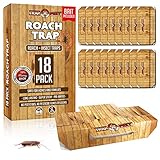
- Safe for your home - Our sticky traps for roaches can be inside your house without any problem. Our roach sticky traps catch all sizes of cockroaches and other insects.
- Easy To Use Bug Traps – Simply peel back the paper to expose the glue, place the bait pouch in the designated spot, fold the trap, and place it along walls or areas where roaches are commonly seen. For best results, ensure the trap is fully folded and set flat on the surface.
- Non-Toxic - Our insect traps sticky indoor are safe, non-toxic and odor free. Ideal to keep your family safe from unwanted pests.
- 18 Glue Traps for Cockroaches - These pack of large bug traps indoor work for cockroaches, spiders, scorpion, roaches, and other crawling insects.
- The Trap A Pest Promise - If for any reason you're not completely satisfied with these spider traps , simply contact us and we'll take care of it.
A practical millipede-control checklist
Today
- Vacuum or sweep up visible millipedes.
- Dispose of vacuum contents or bags outdoors according to the appliance instructions.
- Record where the live specimens were found and whether sightings are increasing.
This week
- Inspect door bottoms, weatherstripping, screens, foundation cracks, window wells, and utility penetrations.
- Repair the most obvious entry points.
- Move leaf litter, rotting wood, excess mulch, and decaying debris away from the foundation.
- Check gutters, downspouts, irrigation, grading, and basement or crawl-space moisture.
If sightings continue
- Prioritize the moisture source rather than repeatedly killing visible specimens.
- Recheck the perimeter after rain or irrigation.
- Seek a licensed IPM inspection before agreeing to routine pesticide treatment.
Bottom line
Millipedes inside the home are usually a sign of outdoor movement, an easy entry route, damp conditions, or some combination of the three—not an infestation of the building itself. Remove the specimens, seal the structure, clear decaying material from the foundation, and fix moisture problems. Escalate to a licensed professional when sightings are persistent or reveal a drainage, foundation, or crawl-space problem. Chemical treatment is a secondary, label-controlled option, not the starting point.
Frequently Asked Questions
Are millipedes dangerous or damaging to houses?
Usually not. Millipedes do not damage building materials like termites or carpenter ants, and they generally do not bite. Some species can release an irritating defensive fluid, so avoid handling them bare-handed.
What is the fastest way to get rid of millipedes indoors?
Vacuum or sweep them into a dustpan and dispose of them outdoors according to your vacuum’s instructions. Then inspect for gaps, moisture, leaf litter, mulch, and decaying wood near the foundation.
Should I spray insecticide or use a fogger for millipedes?
Usually no. Sealing openings, removing damp organic debris, and correcting moisture are generally more useful than indoor spraying. Any pesticide must be currently registered and specifically labeled for millipedes and the intended application site.
Why do millipedes keep coming back inside?
Repeated live sightings can indicate an active entry route or excess moisture. Check basements, crawl spaces, window wells, plumbing, drainage, grading, gutters, downspouts, and irrigation.
When should I call pest control for millipedes?
Call a licensed professional if large numbers continue after exclusion and habitat changes, if you suspect drainage or foundation moisture problems, or if you need help evaluating pesticide-label and application requirements.
The Bottom Line
Remove millipedes by vacuuming or sweeping them up, then prevent their return with exclusion, outdoor cleanup, and moisture control. Indoor pesticides and foggers are rarely necessary.
Quick Recap
Product prices and availability are accurate as of the date/time indicated and are subject to change. Any price and availability information displayed on Amazon at the time of purchase will apply.

