Free tools Windows power users keep installed
One-click scans. No signup required.
Some links on this page are affiliate links: if you buy through them we may earn a commission, at no extra cost to you.
Short answer: You cannot safely create a 120-volt supply by simply changing a 240-volt receptacle, using the grounding wire as a neutral, or connecting a 120-volt appliance across two hot wires. The correct solution depends on what kind of 240-volt source you actually have.
If the source is a U.S. 120/240-volt split-phase service and a properly installed neutral is available, an electrician may be able to install a correct 120-volt branch circuit. If the source is a two-wire 240-volt branch circuit with no neutral, a listed step-down transformer or a newly installed 120-volt circuit may be appropriate. Both options require correct overcurrent protection, grounding, bonding, conductor sizing, and compliance with locally adopted electrical code.
As an Amazon Associate I earn from qualifying purchases.
Recommended Free Tools
Why 110V from 220V is an ambiguous question
People commonly say 110 volts and 220 volts, but modern U.S. equipment and electrical documentation generally use 120 volts and 240 volts. The terminology matters because a label that says 220 or 240 does not, by itself, tell you how the circuit is arranged.
There are at least four different situations that can be described casually as 220 or 240 volts:
#1 Best Overall

- Universal Use: This AC to DC converter 12v car cigarette lighter adapter transform 110V-240V AC from Wall Plug to 12V DC car charger power cigarette lighter female socket, with a 8.8ft extended total cord length to reach a wide range.
- Safe & Stability: This AC to DC converter 12v car cigarette lighter adapter manufactured with the highest quality materials and includes safeguard features against Over-load/over-voltage/short-circuit protection; offering complete protection for you and your devices.
- Easy to Use: Just plug this AC to DC converter 12v car cigarette lighter adapter into any 110V-240V AC outlet, and it will ready to use for anything that has a 12v DC standard car cigarette lighter plug below 5 Amp 60 Watt.
- Wide Application Range: This AC to DC converter 12v car cigarette lighter adapter powers any car cigarette lighter powered car devices, car appliances accessories and any vehicle electronic products with rated power less than 60W at home, office or hotel. SO PLEASE NOTE this 12V converter CAN'T OPERATE ON your devices if the rated power is bigger than 60W or rated current is bigger than 5A.
- What You Get: 1x AC to DC converter 12v car cigarette lighter adapter.
- A U.S. 120/240-volt split-phase service with two hot conductors and a neutral.
- A 240-volt branch circuit supplying a particular appliance, with two hot conductors and an equipment-grounding conductor but no neutral.
- A 208Y/120-volt commercial or multifamily system, where line-to-line voltage is approximately 208 volts rather than 240.
- An international 220–240-volt system that may use a different frequency, plug standard, earthing arrangement, and neutral configuration.
Those systems are not interchangeable. Before anyone chooses a circuit, receptacle, adapter, or transformer, the source topology and the load nameplate must be identified.
How 120 volts and 240 volts are produced in a U.S. home
Ordinary U.S. residential service is commonly a 120/240-volt, single-phase, three-wire arrangement. It has two ungrounded conductors, often called the two hot legs, and a grounded conductor called the neutral.
| Connection | Nominal result | Typical use |
|---|---|---|
| One hot conductor to neutral | Approximately 120 volts | Lights, receptacles, small appliances, controls |
| Hot conductor to the other hot conductor | Approximately 240 volts | Dryers, ranges, water heaters, compressors, heaters, and other larger loads |
The two hot legs are opposite sides of the split-phase supply. A 120-volt load uses the neutral as its normal-current return path. A 240-volt load uses the two hot conductors as the circuit conductors and may not need a neutral at all.
That distinction creates the most common misunderstanding: a 240-volt circuit does not automatically contain everything needed for a 120-volt circuit. A circuit with two hots and a grounding conductor can supply a 240-volt load, but the grounding conductor is not a substitute for a neutral.
The neutral is not the same as the ground
The neutral is a grounded circuit conductor intended to carry normal load current. The equipment-grounding conductor, usually bare or green, is a safety conductor intended to carry fault current so protective devices can operate. It should not carry normal appliance current.
Using the grounding conductor as the return path for a 120-volt appliance can place current on metal enclosures, raceways, or other bonded equipment. It can also defeat the intended operation of the electrical protection system. This is unsafe and is not an acceptable way to obtain 120 volts.
Quick wins for a faster PC:
Scan for outdated or missing drivers - takes under a minuteDriver Scan →Repair Windows errors before they cause bigger problemsFix Now →Likewise, do not connect neutral and ground together at a downstream receptacle, junction box, or subpanel as a workaround. Neutral-to-ground bonding is made only at the permitted service or separately derived system location under the applicable electrical design and code requirements. A remote improvised bond can put normal neutral current on grounding paths.
First identify which source you have
Do not infer the circuit type from the phrase 220 volts, from a receptacle shape, or from insulation color alone. Older wiring may use different color conventions, and modified or improperly wired installations may not follow any reliable convention.
Source A: 120/240-volt split-phase service with a usable neutral
This is the situation in which a proper 120-volt branch circuit may be possible. An electrician must still determine whether the neutral is actually present at the intended location, whether the cable or raceway contains all required conductors, whether the breaker and conductor size are correct, and whether the panel and service have capacity for the added load.
An existing 240-volt circuit should not be treated as converted merely because one hot conductor is removed or a receptacle is changed. The circuit must be redesigned or repurposed as a complete, code-compliant branch circuit, including the correct overcurrent protection, disconnecting means, receptacle, enclosure, grounding, and conductor identification.
Source B: Two-wire 240-volt branch circuit with no neutral
This arrangement can operate a 240-volt load but does not provide a legitimate 120-volt supply. The equipment-grounding conductor remains a safety conductor and cannot be turned into a neutral.
The usual choices are to install a new 120-volt branch circuit from an appropriate source or to use a properly selected listed transformer when a transformer is suitable for the equipment and installation.
Source C: 208Y/120-volt system
Commercial buildings, apartments, and some light-industrial facilities may use a 208Y/120-volt system. It can provide approximately 120 volts from a phase conductor to neutral, but approximately 208 volts between phase conductors. A device or transformer intended for a 240-volt input may not perform as expected on 208 volts.
Do not assume that a measurement or label described as 220 or 240 represents a 120/240 residential split-phase system. The phase arrangement, frequency, neutral availability, and equipment nameplate all matter.
The Tool Desk
Outbyte Driver Updater FREEFix the driver behind crashes, sound loss and screen glitchesFind Drivers →Outbyte PC Repair FREEClear out junk files and repair common Windows errorsFree Scan →Source D: International 220–240-volt power
Outside the United States, 220–240 volts may be supplied differently. Many countries commonly use 220–240 volts at 50 hertz, while U.S. residential power is commonly 120/240 volts at 60 hertz. Plug configuration, earthing system, neutral arrangement, and local installation rules can also differ.
A step-down device may reduce voltage, but an ordinary transformer does not change frequency. Motors, compressors, clocks, heating controls, and some electronic equipment may not be suitable for the wrong frequency or waveform. A U.S. 120-volt appliance being used internationally therefore needs more than a voltage check.
Rank #2

- [3000W 110 to 220 voltage converter]110-120V to 220-240V step-up voltage converter, perfectly fits 220/230/240V household appliances from EU, UK, France, Germany, Australia, China, and Asian countries. Widely works with hair dryers, coffee makers, rice cookers, air fryers, blenders, mixers, toasters, robot vacuums and more home devices.
- [Step Up Transformer 3000W]This voltage converter is specially designed for European and Asian household appliances, suitable for use in 110V-120V countries such as the US, Canada, Mexico.【For long-term durability and stable service life, it is recommended to choose a voltage converter/transformer with a maximum wattage at least 50% higher than the rated power of your appliance.】
- [Compact & Efficient]Built with high-performance toroidal transformer & high-purity pure copper coils, iron snow-white shell and convenient handle design, it is easy to carry and transport, portable and simple fully integrated home fashion.Only 6.5kg ultra-compact body, achieves ultra-quiet noiseless operation, low energy loss, stable voltage output.
- [Multiple Protections]Overload protection, over-current protection, thermal protection, short circuit protection, anti-leakage protection, anti-trip protection, fully protects your devices and home electricity safety.【If the transformer shuts down due to overheating, disconnect the load and allow the equipment to cool for about half an hour.】
- 【High Efficiency Energy-Saving Step-Up Transformer】Professional heavy-duty voltage converter, specially designed for US/Canada/Mexico 120V power grid. Low heat generation, high conversion efficiency, durable stable operation, lets you safely use global imported electrical equipment in North American household circuits at ease.
The three legitimate ways to supply a 120-volt load
Option 1: Install a proper 120-volt branch circuit
For a permanent installation, this is often the cleanest solution. A qualified electrician can determine the source, route a suitable cable or conductors, install the correct breaker and receptacle, and verify grounding, polarity, voltage, and protection.
This is particularly appropriate when the 120-volt load is:
What’s actually slowing this PC down?
Pick the symptom - the matching free tool is one click away.
- Fixed or permanently connected.
- High-current or used continuously.
- Installed outdoors, in a wet location, or in a garage or workshop.
- Part of a construction alteration or building permit.
- Motor-driven, heating-related, or connected to other fixed equipment.
Depending on the existing wiring, an electrician may be able to repurpose a suitable circuit or may need to install a new one. That decision cannot be made safely from voltage readings alone.
Option 2: Use a listed step-down transformer
When a usable neutral is not available, a transformer can convert a suitable 220–240-volt input to a 120-volt output for a compatible load. The product must be selected for the actual source and load, not simply because its label contains the numbers 240 and 120.
If this is the appropriate architecture, look for a listed 220V to 120V step-down transformer. A transformer is equipment, not permission to improvise a household branch circuit. Its nameplate and installation instructions must be followed, including requirements for:
- Primary input voltage and secondary output voltage.
- Frequency and phase compatibility.
- Continuous VA or watt capacity.
- Starting or inrush current for motors, compressors, and some electronic loads.
- Primary and secondary overcurrent protection.
- Grounding and bonding of the transformer and secondary system.
- Enclosure type, ventilation, heat dissipation, and environmental rating.
- Disconnecting means, wiring method, and permitted location.
For a simple resistive load, running watts are a useful starting point for capacity. For motors, compressors, heating equipment with controls, and switching power supplies, starting or inrush demand may be substantially higher than the running figure. The manufacturer’s VA guidance should control; do not rely on an arbitrary rule of thumb.
Crashes, No Sound, or Screen Glitches?
Random freezes, missing sound and display glitches usually trace back to one bad driver. Find and replace yours safely.Free scan · under a minutePC Slower Than It Used to Be?
A free scan shows the junk files, broken settings and background clutter dragging Windows down - then fixes them in one click.Free scan · Windows 10 & 11A small listed portable converter may be reasonable for a temporary, portable load when its input plug, output receptacle, voltage, frequency, grounding instructions, waveform, and continuous rating all match the equipment. A fixed transformer serving premises wiring requires a more formal electrical installation and should be evaluated by an electrician.
Option 3: Use equipment designed for 240 volts
For a large heater, compressor, pump, or other high-power load, replacing or selecting equipment designed for the available voltage may be more practical than converting 240 volts down to 120 volts. This is a design and equipment-selection decision, not a reason to modify a receptacle without checking the nameplate and circuit protection.
A safe step-by-step decision workflow
The following sequence is intentionally non-procedural. It helps determine the correct solution without directing an unqualified person to work inside an energized panel.
Step 1: Define the actual source
Record the source information that can be obtained without opening an energized enclosure:
- Nominal voltage shown on the equipment or building documentation.
- Frequency, such as 50 or 60 hertz.
- Whether the source is residential split-phase, commercial 208Y/120, international, or another system.
- Breaker or disconnect arrangement as identified by a qualified person.
- Whether a properly installed neutral is present at the intended connection point.
- Existing receptacle or equipment type, without assuming that its configuration proves correct wiring.
If identifying the conductors requires removing a panel cover or exposing terminals, stop and use a qualified electrician. Service-side parts may remain energized even when a branch-circuit breaker is switched off.
Step 2: Define the load
Read the equipment nameplate and manufacturer documentation. Record:
- Required voltage and acceptable voltage range.
- Frequency.
- Amperage, wattage, or VA rating.
- Plug and receptacle configuration.
- Whether the equipment contains a motor, compressor, heater, transformer, or electronic power supply.
- Whether the equipment is portable, cord-and-plug connected, or permanently installed.
Do not size a transformer from voltage alone. A 120-volt motor and a 120-volt lamp may have very different starting and operating requirements.
Step 3: Choose the architecture
Use a conventional 120-volt branch-circuit arrangement only when a valid neutral and all required circuit conductors and protections are available. If there is no neutral, choose between a correctly engineered transformer, a new branch circuit, or equipment designed for the available voltage.
If the load is fixed, high-current, outdoors, in a wet location, motor-driven, heating-related, or part of a building alteration, the normal decision should be to have the work designed and completed by a licensed or otherwise locally authorized electrician.
Step 4: Confirm compatibility and protection
Before installation, confirm the source and load against the manufacturer’s documentation. For a transformer, check the input and output ratings, frequency, VA capacity, inrush requirements, enclosure, ventilation, environmental rating, listing or approval, and protection requirements.
Protection is not optional. A transformer can be damaged by an overload even when its output voltage appears correct. Primary and secondary overcurrent protection, conductor sizing, disconnecting means, grounding, and bonding must be evaluated as part of the complete installation.
Rank #3
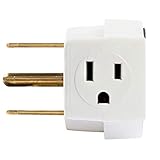
- [240V-120v] (250v-125v)] your new gas range will use a 120V plug as opposed to the 220V plug for your previous electric range This unit is UL listed and allows for an easy plug and play solution to convert that old Plug from a 4 prong 220/240/250 volt plug to a 110/120/125 volt plug
- [Save money] you already had to pay to run a gas line for the new range; save money by doing the switch over yourself with this plug and play solution
- [Safety listed] UL listed for your safety with built in overload protection provided by a non-replaceable 15 amp fuse
- [Functional design] the 90-degree Plug orientation of the plug allows for the appliance to be closer to the wall and the easy-grip; folding Tee handle allows for easy and safe removal from the 220-volt outlet
- [Technical stuff] UL Listed; 125-Volt/250-volt outlet configuration: NEMA 5-15R (2-pole; 3-wire grounding) 15 amp 125-volt (protected by non-replaceable 15 amp fuse)[More details] Plug Configuration: 250-volt 50-amp NEMA 14-50P (4-prong) receptacle: 125-Volt 15-amp NEMA 5-15R (2-pole; 3-wire grounding)
Step 5: Have the installation completed and tested safely
Electrical work should be performed deenergized whenever workers may be exposed to live parts. OSHA electrical-safety rules address disconnecting from every energy source, controlling stored energy, applying lockout/tagout where applicable, and verifying the absence of voltage with suitable test equipment. Only qualified persons may work on energized circuit parts under the applicable limited exceptions.
A qualified person should inspect terminations and enclosures, confirm polarity and grounding, test the actual operating voltage with appropriately rated equipment, and check for unexpected energization or backfeed. A non-contact voltage tester can provide an indication but is not proof that a circuit is deenergized. A meter also does not make an untrained person safe to work in a panel.
Step 6: Verify local requirements
The National Electrical Code is a model standard. Its adoption and enforcement depend on the jurisdiction, and requirements can vary by state, city, utility, building type, and adopted code edition. Confirm permit, inspection, disconnect, receptacle, grounding, and installation requirements with the local authority having jurisdiction before altering premises wiring.
Independent reader supportYour contribution helps us test, update, and keep practical guides available for everyone.What not to do
- Do not connect a 120-volt appliance between two hot conductors. In a 120/240-volt system, that exposes the appliance to approximately 240 volts and can cause immediate failure, fire, or shock.
- Do not use the green or bare grounding conductor as a neutral. It is not a normal-current return conductor.
- Do not bond neutral and ground at a remote receptacle or subpanel. That is not a substitute for a properly designed neutral.
- Do not trust insulation color alone. Older, altered, or miswired systems may not follow current identification practices.
- Do not install a receptacle simply because it fits the appliance plug. The receptacle voltage and configuration must match the circuit and equipment.
- Do not use a blade adapter as a voltage converter. An adapter changes physical connection, not electrical voltage or frequency.
- Do not work inside a panel just because the branch breaker is off. Incoming service components can remain energized.
- Do not repeatedly reset a breaker that trips after conversion or connection. Disconnect the load and have the fault investigated.
- Do not rely on a non-contact tester as proof of a deenergized circuit. Verification requires suitable test equipment and qualified procedures.
Common scenarios and the correct direction
| Situation | Likely correct direction | Unsafe shortcut to avoid |
|---|---|---|
| A new 120-volt receptacle is needed near a 240-volt appliance circuit | Have an electrician determine whether a separate 120-volt branch circuit can be installed. | Replacing the 240-volt receptacle with a 120-volt receptacle. |
| A portable 120-volt tool must be used temporarily from a suitable 240-volt source | Evaluate a listed transformer or converter for voltage, frequency, waveform, grounding, and starting current. | Using a plug adapter or connecting the tool between a hot and ground. |
| A fixed 120-volt pump, heater, or compressor is being added | Use a properly designed branch circuit or professionally installed transformer system. | Using a small consumer converter sized only to running watts. |
| The source is in a commercial building | Identify whether it is 208Y/120, 120/240, or another system before selecting equipment. | Assuming every two-hot circuit is 240 volts. |
| The source is outside the United States | Check voltage, frequency, plug standard, neutral, earthing, and equipment approval together. | Assuming a 120-to-240 transformer solves every compatibility issue. |
If a 120-volt appliance was accidentally connected to 240 volts
Disconnect it only if doing so can be done without touching damaged, hot, smoking, or energized equipment. If there is smoke, burning odor, arcing, melting, or fire, move away and contact emergency services; do not use water on energized electrical equipment.
Do not simply replace the fuse, reset the breaker, or try the appliance in another receptacle without checking it. The appliance, cord, receptacle, and circuit may have been damaged. Have the circuit and equipment inspected by a qualified person before reuse.
Do these 3 things before closing this tab:
1Repair Windows errors before they cause bigger problems2Fix the driver behind crashes, sound loss and screen glitches3Clear out junk files and repair common Windows errorsWhen to stop and call an electrician
Call a qualified professional before proceeding if any of the following applies:
- You cannot identify the source system or whether a neutral is present.
- The work requires opening a panel, removing a dead front, or exposing terminals.
- The circuit is outdoors, underground, in a wet location, or in a commercial or multifamily building.
- The load is permanently installed, high-current, motor-driven, heating-related, or used continuously.
- The existing wiring is old, damaged, unlabeled, aluminum, modified, or inconsistent with the receptacle.
- A transformer would be installed as part of premises wiring.
- The breaker trips, the wiring heats, or there is buzzing, arcing, discoloration, or a burning smell.
- A permit, inspection, landlord approval, utility requirement, or building alteration may apply.
A professional should be able to explain whether the job needs a new branch circuit, a transformer, a different piece of equipment, additional protection, or no change at all.
Information to gather before requesting a quote
You can make the electrician’s evaluation faster without opening the panel. Take clear photographs of the equipment nameplate and existing receptacle, record the intended location and use, and note whether the load is temporary or permanent. Provide the source voltage as stated on building documents or equipment labels, the frequency, the load’s watts or amps, and any motor or startup information.
Also describe the environment: indoor or outdoor, dry or wet, accessible or concealed, residential or commercial, and whether walls or finishes will need to be opened. These details affect wiring method, enclosure selection, protection, labor, permits, and inspection.
What’s actually slowing this PC down?
Pick the symptom - the matching free tool is one click away.
Frequently Asked Questions
Can I get 120 volts from one hot wire and the ground wire?
No. A grounding conductor is a safety path, not a neutral or normal-current return path. A 120-volt load needs a properly designed circuit with the correct grounded conductor, overcurrent protection, grounding, and receptacle.
Does every 240-volt outlet need a neutral?
No. Many 240-volt loads use two hot conductors and an equipment-grounding conductor without a neutral. A neutral is needed only when the equipment or circuit design requires a grounded conductor, such as for a 120-volt portion of a combination appliance.
Will a 240-to-120-volt transformer run any 120-volt appliance?
No. The transformer must match the input voltage, output voltage, frequency, waveform, grounding instructions, and the load’s continuous VA and startup requirements. Fixed installations also require appropriate protection, enclosure, ventilation, and code-compliant installation.
Can I replace a 240-volt breaker or receptacle with a 120-volt one?
Not by itself. The complete branch circuit must have the correct conductors, neutral where required, breaker, grounding, receptacle, wiring method, and capacity. A receptacle change alone can create a dangerous mismatch.
PC Slower Than It Used to Be?
A free scan shows the junk files, broken settings and background clutter dragging Windows down - then fixes them in one click.Free scan · Windows 10 & 11Outdated Drivers Are Slowing You Down
One free scan finds every outdated or missing driver and matches the right update for your exact hardware.Free scan · exact hardware matchIs 220 volts the same as 240 volts?
They are often used as informal descriptions, but they are not necessarily identical in an equipment or design calculation. U.S. residential documentation generally uses nominal 120/240 volts, while commercial systems may be 208Y/120 and international systems may be 220–240 volts at 50 hertz. Identify the actual system and follow the equipment nameplate.
The Bottom Line
Bottom line: Do not wire a 120-volt load from a 240-volt circuit by using the ground as a neutral, connecting across two hots, or changing only the receptacle. If a proper neutral is available, have an electrician install or evaluate a compliant 120-volt branch circuit. If no neutral is available, use a correctly rated listed transformer or install the right circuit, with the source, load, protection, grounding, bonding, and local code requirements evaluated together.
Quick Recap
Product prices and availability are accurate as of the date/time indicated and are subject to change. Any price and availability information displayed on Amazon at the time of purchase will apply.

