Some links on this page are affiliate links: if you buy through them we may earn a commission, at no extra cost to you.
Estimate the finished concrete volume first, then convert that volume with the published yield for the exact mix and bag size you will use. For a rectangular slab, multiply length by width by thickness after converting all dimensions to the same unit. Divide the result by the product’s yield per bag and round up to a whole bag. Then inspect the base and allow for uneven areas and handling waste. This estimates the amount of concrete mix to buy; it does not, by itself, select a structural mix design or tell you how much pure cement to purchase.
What you are actually estimating
People often say “cement” when they mean a bag of concrete mix. The distinction matters when you calculate quantities and when you specify strength.
As an Amazon Associate I earn from qualifying purchases.
Cement is one ingredient in concrete
The American Cement Association describes concrete as a mixture of aggregate, portland or blended cement, and water. A concrete mixture can also contain supplementary cementitious materials (SCMs), fibers, chemical admixtures, and entrained or entrapped air. Aggregate normally makes up most of the volume, while cementitious material binds the ingredients together.
The association gives broad typical ranges of approximately 7%–15% cement, 60%–75% aggregate, and 14%–21% water, with air sometimes adding up to 8%. These ranges describe concrete generally; they are not a recipe for your slab, footing, wall, or beam. You cannot reliably determine a specified-strength mix by multiplying a project volume by a generic cement percentage.
Popular on Amazon

- Quikrete #110110 10LB Concrete Mix
- QUIKRETE COMPANIES
A bag of concrete mix is not a bag of cement
Preblended concrete mix contains cementitious material and aggregate. For example, QUIKRETE Concrete Mix No. 1101 is described as a blend of Portland cement, sand, and gravel or stone for general concrete work. The product is sold in 40 lb, 60 lb, and 80 lb bags and is described by the manufacturer as having a 4000 psi average compressive-strength blend. Treat those details as product information, not as a universal specification: read the current package and data sheet for the product available in your area.
If a project document calls for a particular cement type, SCM content, water-cementitious ratio, slump, air content, or exposure class, a volume calculation cannot replace that specification. You need the specified ready-mix design or a suitable proportioning procedure.
The Tool Desk
Outbyte PC Repair FREERepair Windows errors before they cause bigger problemsFix Now →Outbyte Driver Updater FREEFix the driver behind crashes, sound loss and screen glitchesFind Drivers →Calculate the concrete volume before buying materials
Rectangular slabs, pads, and walls
Use this formula when the project is a rectangular prism:
Volume = length × width × thickness
All three dimensions must be in the same unit. If length and width are in feet and thickness is in inches, convert the thickness before multiplying:
Thickness in feet = thickness in inches ÷ 12
For a result in cubic feet:
- Measure the length in feet.
- Measure the width in feet.
- Convert the thickness from inches to feet by dividing by 12.
- Multiply the three measurements.
- Keep extra decimal places until the final division by bag yield.
| Dimension | Conversion |
|---|---|
| 1 foot | 12 inches |
| 1 inch | 1/12 foot, or approximately 0.0833 foot |
| 4 inches | 4/12 foot, or approximately 0.333 foot |
| 6 inches | 6/12 foot, or 0.5 foot |
| 8 inches | 8/12 foot, or approximately 0.667 foot |
Worked example: a 10 ft × 6 ft × 4 in slab
Convert the thickness first: 4 inches ÷ 12 = 0.333 foot. Then calculate:
10 ft × 6 ft × 0.333 ft ≈ 20 cubic feet
The exact fraction gives 20 cubic feet (10 × 6 × 4/12). This is the volume of finished concrete before any allowance for an irregular or uneven base.
Recommended Free Tools
Use cubic yards when ordering delivered concrete
Ready-mix suppliers commonly quote volume in cubic yards. Convert cubic feet to cubic yards by dividing by 27:
Cubic yards = cubic feet ÷ 27
The 20-cubic-foot example is approximately 0.74 cubic yard. Ask the supplier which unit it uses, and confirm whether its quoted quantity is the calculated volume or includes an allowance for site conditions. Delivery minimums, dispatch fees, and availability vary by location and were not established here, so obtain those terms from local suppliers.
Convert volume into the number of bags
Use the yield printed for your exact product
Once you know the required volume, divide it by the manufacturer’s stated yield:
Number of bags = required volume ÷ yield per bag
Yield is the volume of freshly mixed concrete produced from a known quantity of ingredients. The American Concrete Institute uses that definition in its Concrete Fundamentals glossary. Yield changes with the product formulation and package size, so a figure from one product cannot be applied to another.
Free tools Windows power users keep installed
One-click scans. No signup required.
| Illustrative package | Example yield | What the figure means |
|---|---|---|
| 80 lb concrete-mix bag | Approximately 0.60 cubic foot | Manufacturer training example for a particular product; verify the current package |
| 60 lb concrete-mix bag | Approximately 0.45 cubic foot | Manufacturer training example for a particular product; verify the current package |
These yields are examples from QUIKRETE training material, not universal values. A different brand, formulation, aggregate size, or package can produce a different volume. If the bag label and a calculator disagree, use the current product documentation for the exact bag you are purchasing.
Worked bag-count calculation
Using the 20-cubic-foot slab and the illustrative 0.60-cubic-foot yield for an 80 lb bag:
20 ÷ 0.60 = 33.33 bags
You cannot buy one-third of a bag, so round the unrounded quotient up: plan on 34 whole 80 lb bags before considering waste or an uneven subgrade. The training presentation reports 33 bags when it rounds an intermediate value; that is a presentation convention, not a reason to order down. Rounding only at the end avoids losing volume through premature rounding.
For the same nominal volume with an illustrative 0.45-cubic-foot yield for a 60 lb bag:
Also popular on Amazon
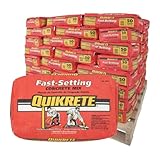
- ULTRA-FAST SETTING TIME: Specially formulated to set in just 20 to 40 minutes, allowing you to complete projects faster without the long wait times of standard mixes.
- NO-MIX POST SETTING: Ideal for setting fence posts, mailboxes, and deck anchors; simply pour the dry mix into the hole and add water for a durable, high-strength hold.
- VERSATILE SLAB APPLICATIONS: Perfect for pouring small concrete pads, steps, or slabs that are at least 2 inches thick, providing a general-purpose, professional finish.
- CONSISTENT YIELD & QUALITY: Each 50 lb (22.7 kg) bag yields approximately 0.375 cu. ft. (11 l) of mixed concrete, ensuring reliable performance across large-scale projects.
- BULK HALF-PALLET VALUE: Includes 32 individual bags (1,600 lbs total), delivered directly to your job site for maximum convenience and cost-efficiency.
20 ÷ 0.45 = 44.44 bags
That result rounds up to 45 bags before site allowances. The example demonstrates why bag count cannot be inferred from weight alone: the published yield is the controlling number.
What to do when a label gives a different yield
- Record the exact product name, formulation, and bag weight.
- Find the yield in cubic feet per bag on the package, data sheet, or manufacturer calculator.
- Use the same volume unit for both the project and the yield.
- Divide the project volume by that yield.
- Round up to a whole bag before adding any allowance for conditions.
Do not substitute a yield listed for a 60 lb bag when buying 80 lb bags, and do not assume that a “cement” bag has the yield of a concrete-mix bag. Pure cement is measured and proportioned differently from a preblended aggregate-containing product.
Account for the base, waste, and measurement uncertainty
A calculator result describes an idealized geometric volume. The manufacturer’s slab calculator states that its approximate yields exclude an uneven substrate and waste. A compacted base that varies in elevation, forms that are not perfectly square, spillage during placement, and material left in a mixer can all increase the amount required.
Inspect the subgrade rather than inventing a universal percentage
There is no single allowance that is correct for every site. Before purchasing, check:
- Whether the base is level or has low spots that will increase thickness.
- Whether the forms hold the specified thickness along their entire length.
- Whether edges, thickened sections, steps, or footings add volume beyond the main rectangle.
- How far bags or a mixer must be carried and how much handling may cause spillage.
- Whether the crew can obtain additional material quickly if the pour runs short.
After this inspection, add a practical allowance appropriate to the measured uncertainty and access to replacement material. Keep that allowance separate from the geometric calculation so you can see whether the extra quantity is caused by the design or by site conditions.
Check the result against the physical job
If the calculated quantity seems unexpectedly high or low, remeasure the thickness at several locations and verify every unit conversion. A four-inch thickness entered as four feet, or a cubic-yard result compared with a cubic-foot yield, creates a factor-of-12 or factor-of-27 error. Confirm the bag count with the product calculator only after you have verified that it uses the same product and package size.
Estimate irregular shapes by splitting them into sections
For an L-shaped slab, a landing with steps, or a pad with a thickened edge, divide the project into simple shapes. Calculate each section separately, then add the volumes before converting to bags or cubic yards.
Useful geometric formulas
- Rectangular section: length × width × thickness.
- Triangular section: 1/2 × base × height × thickness when the section is a triangular prism.
- Cylindrical pier: π × radius² × height.
- Annular or ring-shaped section: π × (outer radius² − inner radius²) × height.
Keep dimensions in one unit within each calculation. If a thickened perimeter beam is part of a slab, calculate the beam volume separately and add it to the slab volume; do not count the same area twice. For complex structural geometry, use the dimensions and quantities in the project drawings or have the designer confirm them.
Quick wins for a faster PC:
Clear out junk files and repair common Windows errorsFree Scan →Fix the driver behind crashes, sound loss and screen glitchesFind Drivers →Repair Windows errors before they cause bigger problemsFix Now →Why volume quantity is not a mix design
Water-cement ratio affects performance
The American Cement Association defines water-cement ratio as “the weight of the mixing water divided by the weight of the cement.” Adding water changes this ratio and can affect strength, durability, shrinkage, and workability. The ratio is a proportion by weight, not a volume shortcut for deciding how many bags to buy.
Strength and exposure requirements control proportions
ACI guidance explains that selecting a water-cementitious ratio depends on the required strength or exposure conditions. Water quantity also depends on the desired slump and aggregate size. Where performance records are available, they should inform the mixture. Without suitable records, ACI notes that direct testing with the actual materials may be appropriate before construction, using established mixture-proportioning guidance.
Consequently, a quantity calculator can answer “How much finished concrete volume do I need?” It cannot answer all of these questions:
- What compressive strength is required?
- What water-cementitious ratio is permitted?
- How much air entrainment is needed for the exposure?
- Which cement, SCM, aggregate, fiber, or admixture is appropriate?
- What slump and curing procedure will satisfy the specification?
For structural work, frost or deicing exposure, sulfate exposure, heavy vehicle loading, retaining walls, footings, and work governed by a permit or engineer, follow the project documents and obtain the required mix from the supplier or qualified designer. Do not replace a specified design with a generic cement-to-sand-to-stone ratio.
What’s actually slowing this PC down?
Pick the symptom - the matching free tool is one click away.
Bagged mix or delivered ready-mix?
After calculating volume, choose the supply method that fits the project and its requirements. The sources establish how to use product yield and why specifications matter, but they do not establish local prices, delivery charges, minimum orders, or availability. Those details must be verified with merchants and suppliers in your area.
| Consideration | Bagged concrete mix | Delivered ready-mix concrete |
|---|---|---|
| Typical quantity decision | Multiply project volume by the number of bags required from the package yield. | Order the required volume in the supplier’s unit, commonly cubic yards; confirm the supplier’s minimum and ordering increments. |
| Handling | Requires moving, opening, measuring, and mixing many packages on site. | Reduces bag handling but requires truck access and a prepared discharge route. |
| Mixing capacity | Your mixer, water measurement, and crew determine production rate. | The supplier produces the specified mix, subject to the order and delivery conditions. |
| Specification control | Confirm that the product label and instructions meet the project’s strength and exposure requirements. | Provide the supplier with the specified strength, slump, air, aggregate, and admixture requirements. |
| Site access | Useful where a truck cannot reach the pour, provided the crew can mix and place the volume in time. | Requires access, timing coordination, and a plan for discharge, placement, and finishing. |
| Cost information | Bag price depends on the local merchant and current package. | Concrete, delivery, minimum-load, and waiting charges depend on the local supplier. |
For a small repair or isolated pad, bags may be practical. As volume and placement speed increase, compare the labor and handling burden with a local ready-mix quotation. Make the decision only after confirming the exact mix requirements and the site’s access constraints.
Also popular on Amazon
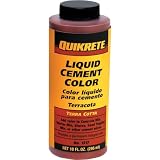
- Made in United States. Can be used in concrete, mortar, sand, stucco, and other cement mixes
- Mix into concrete to create colored surface It will not fade, chip, peel or wear out.
- Mix with water and add to dry concrete mix for adding color to Walk Maker projects, or any concrete, mortar, sand topping or stucco project.
- Concrete Coatings Vivid Acid Stain is a budget-friendly option, and there’s no need to hire a professional and spend a ton of money on beautifying your home.
- Unlike regular paint, Concrete Coatings Vivid Acid Stain penetrates deep into the surface, making it long-lasting and durable.
A repeatable estimating worksheet
Use this sequence for each separate pour:
- Define the pour. Identify every slab, footing, step, thickened edge, pier, or other section that will be placed.
- Measure each section. Record length, width, depth, and any changing dimensions. Note whether measurements are in feet, inches, or another unit.
- Convert units. Convert all dimensions within a calculation to the same unit. For feet and inches, divide inches by 12.
- Calculate each volume. Use the appropriate geometric formula and retain decimal places.
- Add the sections. Sum the cubic-foot volumes, checking that no shared area has been counted twice.
- Convert units for ordering. Divide cubic feet by 27 for cubic yards when a supplier uses that unit.
- Identify the exact product. For bagged mix, record the manufacturer, formulation, bag weight, and published yield. For ready-mix, record the specified strength and performance requirements.
- Convert volume to packages. Divide required volume by the exact yield per bag and round up to a whole bag.
- Review site conditions. Measure low spots, verify form thickness, and account for practical waste or difficult handling.
- Confirm the order. Check current package information, delivery terms, access, crew capacity, and the project specification before paying for material.
Common estimating mistakes and fixes
Using inches without conversion
Symptom: The calculated volume is 12 times too large or too small.
Fix: Convert thickness to feet before multiplying by dimensions in feet, or convert every dimension to inches and use cubic inches consistently before converting the final result.
Outdated Drivers Are Slowing You Down
One free scan finds every outdated or missing driver and matches the right update for your exact hardware.Free scan · exact hardware matchWindows Errors? Fix Them Before They Spread
Repair common Windows errors and clear accumulated junk for a smoother, more stable PC - no reinstall needed.Free scan · no reinstallDividing by the bag weight instead of the yield
Symptom: The estimate assumes every 80 lb bag makes the same amount of concrete.
Fix: Use the cubic-foot yield printed for the exact product and package. Weight alone does not reveal how much aggregate and cementitious material the blend contains.
Rounding intermediate numbers down
Symptom: The estimate says 33 bags when the unrounded calculation is 33.33.
Fix: Retain decimals through the division and round the final package count up. Then assess site allowances separately.
Do these 3 things before closing this tab:
1Fix the driver behind crashes, sound loss and screen glitches2Clear out junk files and repair common Windows errors3Scan for outdated or missing drivers - takes under a minuteTreating a calculator output as a guarantee
Symptom: The order is exactly the geometric result even though the base has low spots or the crew expects spillage.
Fix: Inspect the substrate and forms. Manufacturer calculators identify approximate quantities and may exclude uneven substrate and waste.
Choosing a generic recipe for structural work
Symptom: A cement-to-sand-to-stone ratio is selected without checking strength, exposure, slump, or water limits.
Fix: Follow the drawings and specification, use the supplier’s specified mix, or obtain qualified mixture-proportioning guidance. Quantity and mix design are separate decisions.
Confusing cubic feet and cubic yards
Symptom: A bag estimate is compared directly with a ready-mix quote without converting units.
Fix: Convert cubic feet to cubic yards by dividing by 27, and confirm which unit appears on every quotation and product label.
Final pre-order check
- The finished volume has been calculated from measured dimensions.
- All dimensions use consistent units.
- Irregular sections and thickened areas are included once.
- The exact bag yield or ready-mix ordering unit is documented.
- The final bag quotient is rounded up, not down.
- Uneven substrate and practical waste have been considered.
- The selected product satisfies the project’s strength and exposure requirements.
- Local availability, delivery terms, access, and crew capacity are confirmed.
The reliable sequence is therefore: calculate volume, apply the exact product yield, round up, and then adjust for measured site conditions. That method tells you how much concrete material to obtain while keeping the separate engineering decision—what mix is suitable for the work—under the control of the project specification and qualified concrete guidance.
Quick Recap
Product prices and availability are accurate as of the date/time indicated and are subject to change. Any price and availability information displayed on Amazon at the time of purchase will apply.

