Do these 3 things before closing this tab:
1Repair Windows errors before they cause bigger problems2Scan for outdated or missing drivers - takes under a minute3Clear out junk files and repair common Windows errorsA low-maintenance landscape starts with the site, not a shopping list of plants. Record your climate, sun, soil, drainage, existing trees, utilities and intended use; then choose plants whose mature size and needs already fit those conditions. Group plants by water and soil requirements, keep lawn only where people, pets or circulation need it, and build the planting in layers: evergreen forms for winter, shrubs and grasses for structure, ground covers to close bare soil, and perennials that hand off flowers or foliage from spring through fall.
The work is front-loaded. New plants need close inspection, timely watering, early weeding and correctly applied mulch. Once roots are established, maintenance can shift to a short monthly check and a few seasonal tasks instead of constant mowing, pruning and irrigation.
As an Amazon Associate I earn from qualifying purchases.
Start with a site plan, not a plant list
Map the conditions that plants cannot change
Walk the property at different times of day and mark full sun, afternoon shade, reflected heat, wind exposure, low spots and areas that stay wet. Note mature trees and shrubs worth preserving, because established root systems and canopy are valuable structure that you do not have to grow again. Locate paving, downspouts, irrigation lines, septic components and overhead or underground utilities before digging.
Measure each bed and write down the intended use of adjacent space. A play area, dog run, dining terrace and path need durable clearances; a pollinator bed or screening border can be looser. These decisions determine how much lawn is genuinely useful. Removing lawn that nobody uses saves mowing and irrigation, while removing the only practical route from the driveway to the door creates future maintenance and access problems.
#1 Best Overall

- Be a Gardening Master with the help of our superior and complete Drip Irrigation Kit: 50ft flexible & durable PVC 5/16" Irrigation Tubing + 50ft 1/4" Drip Distribution Tubing + 2 x Female Thread Water Connectors for 5/16" Mainline + 20 Barbed Drip Emitters Stream + 10 Barbed Drip Emitters Vortex + 4 x 1-Way, 6 x 2-Way and 2 x 4-Way Barbed Splitters from 5/16" to 1/4" + 5 x 1/4" Tubing Tee Splitters + 2 x 5/16" Mainline End Plugs + 5 x 1/4" Distribution Tubing End Plugs
- Make your own garden irrigation system kit easier than ever: run a 3/4 connection from your water source to the watering area. Use the 5/16 irrigation tubing as the mainline. Branch off with the 1/4 drip irrigation tubing and connect a maximum of 30 drip irrigation emitters. Stick the dripper stake into the soil, adjust the desired irrigation spray, and feed your plants with your own drip irrigation system. Designed to work with between 20 - 45 PSI and a maximum output of 60 gallons/hour/emitter
- Enjoy taking care of your garden with high quality adjustable spray emitters and forget about broken irrigation sprayer stakes and clogged drip heads. With a length of 7.5 inch and a sharp bottom, the irrigation bubbler stake can be easily fixed into the ground and stays still even in loose soil. Perfect for long time application, the drip irrigation emitter heads are detachable and easy to clean so you don’t worry about clogging. Make gardening less of a chore!
- Spend less, get more - UV resistant and designed for underground or above-ground installation, the Carpathen 1/4 inch drip irrigation tubing will last year-round in any weather. Use the 4 ways/2 ways/1 way couplers to create the perfect branch for your plants. Season after season the distribution tubing part of the irrigation drip system will keep your plants hydrated with minimal waste from evaporation. Choose to cut down your water bills!
- Save Your Time with Carpathen Garden Irrigation System. Our automatic drip watering system minimizes water loss by directly hydrating the roots of your plants. Easily adjust the drip emitters by rotating the cap for precise hydration. Designed for up to 3 raised garden beds, this irrigation system for the garden is ideal as a garden starter kit for healthy vegetables, an automatic watering system for potted plants, a raised garden bed watering system, or a reliable garden grid watering system
Test soil and solve drainage before planting
Use a soil test before a major renovation. The results show pH, texture and fertility, allowing you to select plants that fit the existing conditions instead of repeatedly amending soil to force unsuitable plants to survive. Check drainage by observing the site after rain and by digging a test hole in representative areas. Correct grading, compacted soil and chronic standing water during site preparation; plants cannot compensate for water moving toward a foundation or collecting in a planting crown.
Do not assume one soil treatment suits the whole property. A sunny, sandy strip beside a drive may need a different plant community from a shaded, heavier-soil bed beneath an existing tree. Treat each as a water-and-soil zone.
Design from mature dimensions
Read the mature height and width for every plant and draw those dimensions on the plan. Allow room for branches and roots at maturity, sightlines at corners, and access for a mower or wheelbarrow. Correct spacing prevents the common low-maintenance failure in which plants are installed close together for an immediate full look, then require repeated shearing, transplanting or removal as they crowd one another.
The Tool Desk
Outbyte Driver Updater FREEScan for outdated or missing drivers - takes under a minuteDriver Scan →Outbyte PC Repair FREEClear out junk files and repair common Windows errorsFree Scan →Keep woody plants away from walls, roofs, gates and electrical equipment by the clearance required for their mature spread. Where a screen is needed, stagger plants in a broad bed rather than placing a single crowded row; the wider root zone and varied heights are easier to maintain than a hedge that must be clipped into a fixed shape.
Rank #2
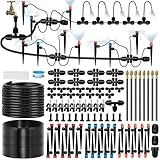
- 【Upgraded Tube Design & Water Saving】 Our garden watering system is upgraded to 1/2” diameter to support high water pressure. The 1/2” tee connector allows seamless splitting into 2 independent zones for customized watering schedules. By delivering moisture directly to root zones, this drip Irrigation system significantly reduces evaporation and runoff—saving more water compared to conventional sprinklers while eliminating the need for manual watering.
- 【Quick Connect & Tool-Free Set Up】 Designed for simplicity with push-to-connect fittings that secure instantly without heating, gluing, or specialized tools. The intuitive 1/2" to 1/4" 4-way connector link 1/2" main lines to 1/4" drip lines in quickly, allowing you to build a custom layout exactly where needed. Connections stay firmly sealed under pressure, preventing leaks and making installation a breeze. This drip irrigation kit saving you time and effort!
- 【Durability & Nozzle Variety】 This drip system features adjustable sprinklers, adjust each sprinkler head by rotating the cap for precise watering. The stake at the bottom of the sprinkler secures firmly into the soil. 3 nozzle types—vortex, stream, and misting—for tailored watering across different plants, plus 8 copper nozzles can be bent and fixed 360 ° to adjust the place where the spray is needed and the spraying direction. This makes gardening less tedious!
- 【Versatility & Wide Application】 Ideal for a wide range of applications, including raised garden beds, greenhouses, vegetable patches, flower borders, patios, and lawns. Flexible tubes, a variety of nozzles, and connection components allow you to easily customize different irrigation methods. Suitable for both above-ground and elevated installations, this quick-connect garden watering system is your all-in-one solution for a thriving and well-maintained garden.
- 【Complete Kit & All You Need】 The irrigation system for garden comes with a variety of components to meet your needs: 10 drip vortex emitters, 10 drip stream emitters, 10 misting nozzles, 8 360° bendable metal spray nozzles, 33 FT 1/2" main line, 197 FT 1/4" drip line, 15 1/4" tee splitter, 8 1/2" to 1/4" 4-way connector and more. Precise and efficient watering is no longer a tedious process, but an easily achievable reality.
Build a landscape that carries itself through the seasons
Use layers, not isolated specimens
A dependable year-round composition has several layers with different jobs:
- Evergreen structure: Conifers or broadleaf evergreens suited to your region hold mass and screening through winter. Use them sparingly enough that seasonal flowers and foliage remain visible.
- Woody framework: Regionally adapted shrubs provide branching, bark, berries or persistent form after flowers fade. Select some with different bloom periods so one does not carry the entire display.
- Grasses and seed-bearing perennials: Upright stems and seedheads add movement and winter texture. Leave sound stems standing when they are not blocking access or creating a safety issue.
- Ground covers: Plants that spread without invading paths close bare soil, reduce evaporation and make it harder for annual weeds to establish.
- Seasonal perennials: Combine early, midseason and late bloom or foliage interest. A small number of well-adapted groups is easier to divide and edit than a collection of one-off plants.
Use native or regionally adapted plants whenever they fit the site. “Low maintenance” does not mean no maintenance: the University of Illinois Extension notes that native plants require particular attention during their first two years. Their long-term advantage comes when the plant community matches local conditions, not from a label alone.
Reduce lawn strategically
Retain lawn for play, pets, circulation, seating and other defined uses. Replace only the unused remainder with connected beds, ground covers or low-input meadow-style planting. Curved edges are not automatically easier; a simple, mowable geometry with generous bed widths usually produces fewer trimming tasks than many narrow islands. Install a clean edge where turf meets beds so runners do not require hand cutting every week.
PC Slower Than It Used to Be?
A free scan shows the junk files, broken settings and background clutter dragging Windows down - then fixes them in one click.Free scan · Windows 10 & 11Crashes, No Sound, or Screen Glitches?
Random freezes, missing sound and display glitches usually trace back to one bad driver. Find and replace yours safely.Free scan · under a minuteChoose the maintenance style deliberately
| Design approach | What it looks like | Maintenance trade-off |
|---|---|---|
| Formal, tightly clipped | Uniform hedges, repeated shapes and bare, defined edges | Predictable appearance, but frequent pruning and more green-waste removal |
| Layered mixed border | Evergreens, shrubs, grasses, ground covers and perennials at varied heights | Moderate editing; plants can grow naturally within planned mature space |
| Naturalistic native planting | Drifts of locally suited plants with stems and seedheads retained | More learning and weeding while plants fill in, then generally fewer long-term inputs |
| Lawn-heavy layout | Large uninterrupted turf areas | Simple planting plan, but recurring mowing, edging, fertilizing and watering over the largest area |
Compare options by mature height and width, established water demand, sun and soil tolerance, winter structure, bloom or foliage timing, pruning frequency, weed pressure during establishment, habitat value and the amount of lawn retained. The cheapest installation is not necessarily the lowest-cost landscape if it creates years of irrigation or clipping.
Rank #3
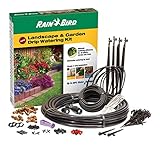
- Comprehensive 108-piece kit for flower beds, gardens and landscaped areas; eliminates hand watering, saves time and money
- Ultimate watering efficiency for all plants, shrubs and trees; up to 80% water savings
- Simple 3-step installation: connect to faucet, insert fittings into tubing, attach watering devices
- Includes 3 differnet types of watering devices: drippers, micro-bubblers and micro sprays
- Pressure-compensating technology ensures all plants receive same amount of water
Install in a way that reduces future work
Prepare beds once
- Remove invasive weeds and unwanted turf thoroughly, including persistent roots where practical.
- Correct grading and drainage, then loosen compacted soil without destroying existing healthy tree roots.
- Use the soil-test results to guide only the amendments that are needed. Avoid routine fertilizer when the test and plant requirements do not call for it.
- Lay out plants at mature spacing, checking paths, windows, utilities and mower access before digging.
- Install irrigation components, if needed, before final planting and mulch.
Plant for establishment, not just installation day
Set each plant at the depth recommended for its root flare or crown; planting too deeply is a common cause of decline. Water the root ball thoroughly after planting so air pockets collapse. The University of Illinois Extension advises, “Water your new plants every other day for two weeks if it doesn’t rain.” That is an establishment instruction for newly installed plants, not a permanent daily schedule.
Virginia Cooperative Extension identifies the period immediately after planting as the most critical watering time and notes that trees and shrubs may need establishment care through their first growing year. Check soil moisture and weather rather than applying a fixed amount automatically. New plants in hot, windy or sandy sites may need attention more often than those in cool, heavier soil.
Mulch without creating new problems
Mulch suppresses weeds, moderates soil temperature and slows evaporation, but depth and placement matter. U.S. Environmental Protection Agency WaterSense recommends three to four inches for most plants; Iowa State University Extension and Outreach recommends two to three inches around perennials. Use the lower end where stems are fine or drainage is marginal.
Quick wins for a faster PC:
Scan for outdated or missing drivers - takes under a minuteDriver Scan →Clear out junk files and repair common Windows errorsFree Scan →Keep organic mulch several inches away from woody stems and out of perennial crowns. Do not build a cone against a trunk, bury low branches or cover the flare where roots meet the stem. Inspect depth as it settles and top up only where it has thinned; repeatedly adding new layers can compact soil and hide rot.
Rank #4

- NO MORE HARD INSTALLATION - SET UP IN MINUTES. Tired of struggling with stiff barbed fittings? This drip irrigation system features quick-connect fittings that let you push, lock, and secure tubing effortlessly. No tools, no leaks, just a smooth setup experience. Enjoy a frustration-free installation and get your garden watering system running in minutes.
- LEAK-FREE & SECURE CONNECTIONS. Traditional connectors often loosen or leak over time. Our upgraded quick-connect design creates a tight seal, keeping water flowing exactly where you need it without waste or mess. Save water, avoid puddles, and keep your garden neat and efficient.
- COMPLETE 230FT KIT - READY TO BUILD YOUR SYSTEM. Includes 230FT tubing (197FT 1/4” + 33FT 5/16”), adjustable emitters, connectors, and stakes. Everything you need to customize your irrigation layout for raised beds, potted plants, or greenhouse setups. No extra trips, no missing parts—build your system right out of the box.
- ADJUSTABLE WATER FLOW FOR EVERY PLANT. Different plants need different care. With 3 types of adjustable stake sprayers, you can control water flow from gentle drip to full spray, ensuring each plant gets exactly what it needs. Promote healthier growth while avoiding overwatering or underwatering.
- AUTOMATIC WATERING WITH TIMER COMPATIBILITY. Connect easily to a hose timer and automate your watering schedule. Perfect for vacations or busy days when manual watering isn’t possible. Keep your plants thriving—even when you’re away.
Make irrigation and soil moisture predictable
Water the root zone efficiently
For beds that need irrigation, drip lines or soaker hoses place water at the soil surface with less evaporation and overspray than sprinklers. The Jordan Valley Water Conservancy District calls drip irrigation the most efficient method for this type of landscape. Use separate zones for plants with different water needs so a drought-tolerant border is not watered to suit a thirsty lawn.
After establishment, check the soil several inches below the surface before watering. Virginia Cooperative Extension says many established native plants can manage with about one inch of water per week during long dry periods; irrigation may run once or twice weekly or only as needed rather than every day. The figure is a guideline for prolonged dryness, not a universal schedule. Rainfall, soil, exposure, plant size and local restrictions change the amount required.
Iowa State University Extension and Outreach gives many perennials a reference range of one to one and a half inches per week. Measure rainfall and irrigation together, water slowly enough to soak the root zone, and pause when the soil is moist. Frequent shallow sprinkling encourages shallow roots and can keep foliage wet, increasing disease pressure.
Recommended Free Tools
Group plants by water demand
Place plants with similar needs together: the driest group on a well-drained slope or near heat-reflecting paving, moderate-demand plants in ordinary beds, and moisture-tolerant plants in naturally damp areas. A plant that is perfectly adapted to dry soil can decline if it shares a zone with plants receiving frequent irrigation. Grouping also makes it easier to adjust one valve or hose rather than hand-watering individual specimens.
Best Value

- Quick Connect Design: Newly Upgraded Quick Connect Irrigation System Say Goodbye to Complicated Settings! Our upgraded 4-way connectors, tees, and nozzles can now be easily connected directly to 1/4 "irrigation pipes. No more trouble with heating or softening - just plug and play!
- A brand new drip irrigation kit: ABAKUKU drip irrigation system, equipped with multiple components to meet all your garden watering needs. Including basic components such as 197 foot 1/4 inch irrigation pipe, 33 foot 1/2 inch irrigation pipe, 1/2 inch locking barbed tee connector, drip emitter flow, vortex emitter, blue mist nozzle, quick connect tee, faucet connector, etc.
- Multifunctional Applicability: Whether it is a small home garden or a large plantation, this drip irrigation system can provide even moisture distribution and is suitable for a variety of plants such as vegetables, flowers, fruit trees, etc., ensuring the healthy growth of plants.
- Four kinds of irrigation systems: the irrigation device includes four kinds of drip emitters, which can adjust different irrigation modes, such as micro drop, spray, watering, etc. A precise watering system can solve the watering problem of plants in different locations, and the amount of water sprayed can be adjusted separately according to the settings and needs.
- Easy to install and use: The set contains all the necessary components, and is easy to install without professional tools. Users can freely adjust the location of the drip irrigation tubes according to the garden layout to meet the irrigation needs of different plants.
Use a seasonal maintenance calendar
| Season | Essential tasks | What to leave alone |
|---|---|---|
| Winter | Check for storm damage, hazards and blocked access; keep paths safe; observe evergreen forms, bark, stems and persistent fruit that provide structure. | Do not cut every stem for tidiness. Retain sound grasses, seedheads and suitable leaf litter for habitat and soil protection. |
| Spring | Cut back grasses just before new growth begins, top up mulch where it has thinned, inspect drip lines and emitters, plant or divide during the appropriate local window, and weed before weeds flower or set seed. | Do not work saturated soil or disturb emerging perennials unnecessarily. |
| Summer | Check soil moisture and water deeply when needed, prioritize new plantings, inspect for drought stress, pests and irrigation failures, and deadhead only when it supports the desired appearance or repeat bloom. | Do not automatically irrigate every day or shear plants simply because they look less formal in heat. |
| Fall | Plant many trees, shrubs and perennials during the dormant season when local ground conditions permit; chop large leaves if they mat; remove invasive or diseased debris; review which plants supplied color, texture and habitat. | Leave useful leaves and stems in beds where they do not smother crowns, block access or create a safety problem. |
Virginia Cooperative Extension describes long-term maintenance as “less frequent” and occurring “on a more seasonal basis,” with attention directed to the plant community rather than to constant grooming of individual plants. A monthly walk-through is usually enough after establishment: look for broken branches, weeds setting seed, exposed roots, clogged emitters, mulch against stems and plants outgrowing their allotted space.
Prune only for a reason
Remove damaged, diseased, deformed, crowded or unsafe growth. Make cuts that preserve the plant’s natural form, and schedule species-specific pruning in the local window recommended by an extension service or qualified arborist. Avoid shearing shrubs that naturally fit the space; repeated shearing creates dense outer growth, more clippings and a plant that is permanently dependent on clipping.
For trees, protect the trunk and root flare from mulch, mowers and string trimmers. Do not top trees to reduce height. If a mature tree has large dead limbs, structural defects or branches near utilities, use a qualified arborist rather than attempting hazardous work from a ladder.
Control weeds with design and timing
Weed pressure is highest while new beds are still open. Inspect frequently during the first growing seasons and pull weeds before they flower or set seed. A continuous mulch layer, close plant spacing at mature dimensions and vigorous ground covers reduce the light and bare soil that annual weeds need. They do not eliminate inspection: perennial weeds can grow through mulch and require prompt removal.
Do not use a dense planting scheme as an excuse to ignore access. Leave enough room to reach irrigation valves, inspect trunks and remove invasive plants without stepping on crowns or compacting soil.
Diagnose common low-maintenance failures
Plants keep wilting despite irrigation
- Check whether water is reaching the root zone rather than running off compacted soil.
- Look for clogged emitters, broken tubing or a valve shared with a different water-demand zone.
- Examine planting depth and roots for circling, rot or damage.
- Recheck drainage; constantly wet soil can produce symptoms that resemble drought.
The bed is becoming a pruning project
- Compare current dimensions with the mature size on the plant label.
- Remove or relocate plants that are fundamentally too large rather than committing to perpetual shearing.
- Thin crowded growth selectively and restore clear access around paths, windows and equipment.
Mulch is washing away or piling against stems
- Correct the slope or use a contour, edging or appropriate ground cover to slow runoff.
- Rake mulch back from trunks and crowns, then replace only the amount needed to reach the recommended depth.
- Inspect after heavy rain instead of adding material on a fixed calendar.
The landscape looks empty in winter
Add evergreen masses, shrubs with distinctive bark or persistent fruit, grasses and seedheads during the next planting window. Review the seasonal calendar rather than adding random flowers; the goal is a sequence of interest, not a peak display followed by bare soil.
A practical decision framework before you buy
- Define the job: screening, shade, erosion control, habitat, flowers, circulation or seating.
- Match the site: confirm sun, drainage, soil texture, pH and mature space.
- Set the maintenance limit: decide how often you are willing to water, weed, prune and remove leaves.
- Build the structure first: place retained trees, evergreen forms and long-lived shrubs.
- Fill the gaps: add grasses, ground covers and perennials with staggered bloom or foliage timing.
- Plan establishment care: schedule inspections, watering, weeding and mulch checks for the first growing season and, for many trees and shrubs, through the first year.
- Reassess annually: note which plants handled local weather with little intervention and replace repeated failures with better-adapted choices.
This process produces a landscape that is intentionally less demanding, not merely neglected. It accepts some seasonal change, leaves useful stems and leaves in place, and spends effort when it prevents larger work later.
Quick Recap
Product prices and availability are accurate as of the date/time indicated and are subject to change. Any price and availability information displayed on Amazon at the time of purchase will apply.

