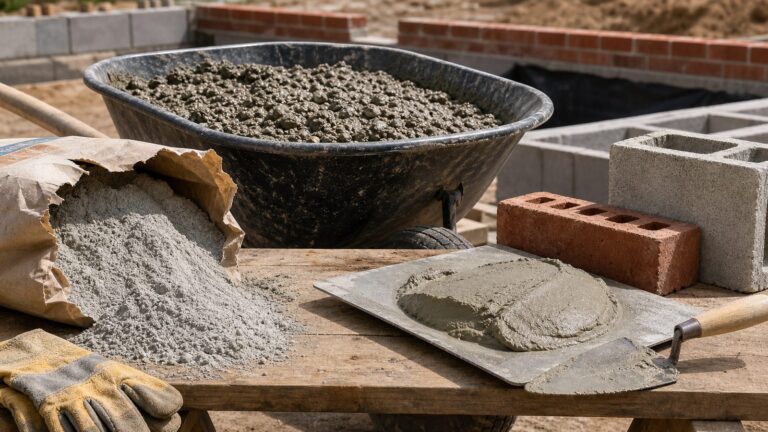
The lowest-carbon cement cannot be identified reliably from its type name alone. Compare current, independently verified product-specific Environmental Product Declarations (EPDs) that use the same product category rules, declared or functional unit, life-cycle modules, global-warming-potential method, geography and validity period. Then check whether each cement can deliver the required concrete performance. A lower value per tonne of cement may not produce lower carbon per cubic metre of concrete with the required strength.
Decide what you are actually comparing
“Embodied carbon of cement” can describe three different decisions. The correct comparison method depends on which one you must make.
As an Amazon Associate I earn from qualifying purchases.
| Decision | Useful comparison | Why the distinction matters |
|---|---|---|
| Cement procurement | Product-specific GWP per declared tonne of cement | This supports purchasing and material reporting, provided the products have matching declarations and boundaries. |
| Concrete mix selection | GWP per cubic metre of concrete at the required strength and exposure performance | Different cements may require different dosages, water ratios, admixtures, curing regimes or replacement rates. |
| Building or infrastructure assessment | A functional-unit result for the whole application, including relevant transport, construction, service-life and end-of-life stages | A cement-only number does not show the impact of a structural element, pavement or building over its required life. |
Do not assume that equal masses of two cement types perform identically. Define the required strength, durability, setting time, exposure class, early-age performance and design life before choosing the metric.
Recommended Free Tools
Use EPDs as the primary evidence
An Environmental Product Declaration is the most defensible starting point because it reports life-cycle impacts for a specified product under stated rules. Prefer a current, product-specific EPD that has independent verification. Record enough information to identify exactly what the declaration covers:
#1 Best Overall

- Valued Carpenter Pencil Set: You will get 2 pcs solid carpenter pencils with 26 piece 2.8 mm refills, 1 replaceable sharpener, 1 plastic storage box.The complete carpenter pencils combination allows you to finish your work faster and more easily
- Deep Hole Marker Pencil: The deep-hole construction pencils adopts 45mm elongated tip design, which is more convenient to mark in the small hole or in other tight areas that other carpenter markers cannot reach
- Carpenter Pencils with Sharpener: The sharpener is screwed into the top of the work pencil, which won't get lost either. Built-in pencil sharpener that keep the lead with pointed and smooth to Improves line of sight in fine work
- Stronger Solid Lead: This work pencil is matched with a 2.8 mm thick lead , which is much thicker and stronger during the drawing process of construction work, it will not break or damage easily
- Marks on Various Surfaces: 3 colors solid construction pencil can marks on various surfaces,such as metal, plastic, wood, paper etc. Ideals for woodworkers, contractors, craftsmen, builders, merchants and masons
- manufacturer and named plant or geographic coverage;
- cement designation and any disclosed clinker, limestone, slag, pozzolan or other constituent proportions;
- declared unit or functional unit;
- life-cycle modules included;
- the applicable Product Category Rules (PCR) and PCR edition;
- global-warming-potential indicator and accounting convention;
- background data and data-quality information where provided;
- publication date, version date and expiry date; and
- verification body and declaration status.
Industry-average EPDs and product-specific EPDs answer different questions. An industry average represents a defined population; a product-specific declaration represents the stated product, plant or coverage. Do not rank them as though they describe the same population.
Match the life-cycle boundary before comparing numbers
For an upfront materials comparison, cement declarations commonly use cradle-to-gate modules A1–A3. Confirm that every value you compare uses the same modules.
| Module | What it normally covers | Questions to ask |
|---|---|---|
| A1: raw-material supply | Extraction, processing and preparation of limestone, clay, gypsum, supplementary materials and other inputs | Are by-products or recovered materials treated under the same allocation rules? |
| A2: transport | Movement of inputs to the cement plant | Are transport distances and modes product-specific or generic? |
| A3: manufacturing | Clinker production, grinding, blending, plant energy, process emissions and manufacturing waste | Are kiln fuels, electricity, process emissions and waste treatment reported consistently? |
Downstream delivery to a project (A4), construction activities (A5), use, maintenance and end-of-life may be outside an A1–A3 declaration. Never combine an A1–A3 cement value with a value that includes A4 transport and present them as an equal comparison. For a project assessment, add the relevant downstream stages rather than silently treating a gate result as a whole-life result.
Align the rules governing each EPD
ISO 14025 comparability requires more than putting two GWP figures side by side. Comparable declarations should use the same product category, declared unit, equivalent system boundaries, data-quality requirements, allocation and calculation rules, and a valid declaration period.
EN 15804 places an additional limitation on comparisons below the building level: a comparison is not valid unless omitted life-cycle stages and processes perform identically, or the differences are explicitly accounted for. In practice, read the PCR and programme instructions printed in each EPD rather than relying on the cement label.
Regional systems are not interchangeable by default. The American Cement Association describes a North American EPD module based on ISO 21930 and an international module based on EN 15804; the PCRs differ even where they are being harmonised. The Global Cement and Concrete Association’s cement rating method uses EN 15804+A2 and PCR-001 (EN 16908), with cradle-to-gate A1–A3 scope and net GWP, while noting that countries may adapt the method. A result generated under one regional rule should not be ranked against a result from another region without explaining the methodological difference.
Rank #2

- Ergonomically Designed: Work in tight areas with a compact design that gets into tough spots
- Compact and Lightweight: Both tools are designed to fit into difficult to reach spaces. The 1/4" impact driver has a length of 5.55 in. and weighs just 2.8 lbs, while the 1/2" drill/driver measures only 7.5 in. and weighs 3.6 lbs
- Both the DEWALT impact driver and electric drill driver feature integrated LED work lights with a convenient 20-second delay, ensuring enhanced visibility in dimly lit or challenging work areas
- One-Handed Loading - Keep one hand free with a 1/4 in. hex chuck that accepts 1 in. bit tips
- Power drill cordless with 1/2" single sleeve ratcheting chuck provides tight bit gripping strength, making bit changes faster and more secure
Compare the same GWP indicator and unit
Global warming potential is expressed as carbon-dioxide equivalent, but the denominator determines what the number means. Common denominators include kilograms of CO₂e per tonne of cement and kilograms of CO₂e per cubic metre of concrete. A project may instead require a result per cubic metre of wall, square metre of pavement, tonne of installed product or other functional unit.
- Put the indicator and denominator in the same table cell. “GWP” without a unit is not comparable.
- Check whether the EPD uses a gross or net convention and how emissions from treated waste or recovered fuels are handled.
- Confirm the declared cement mass. A blended product with a lower clinker share may require a different cement dosage in concrete.
- Do not convert a declared unit into a functional unit unless the required performance and conversion assumptions are documented.
The GCCA global cement rating methodology specifically reports net GWP under its stated rules. A declaration using another convention may show a different value even when the physical product and plant are similar.
Interpret clinker content without treating it as a guarantee
Clinker is usually the most carbon-intensive part of cement because calcination releases process CO₂ and the kiln requires high-temperature energy. Replacing part of the clinker with lower-carbon constituents can reduce GWP, but clinker percentage alone does not determine an EPD result. Electricity mix, kiln fuels, raw materials, transport, plant efficiency, allocation choices and the LCA model also affect the outcome.
Portland-limestone cement
American Cement Association guidance describes portland-limestone cement (PLC, Type IL) as containing 5%–15% ground limestone. The same guidance says PLC can reduce the carbon footprint by up to 10% when it replaces portland cement in concrete mixtures. “Up to” is a potential cited by the association, not a guaranteed reduction for every product, plant or concrete design.
Blended hydraulic cements
Other blended cements can use pozzolans, slag or multiple constituents. In U.S. categories, Types IP, IS and IT may permit higher proportions of non-clinker materials than PLC and can therefore show lower carbon footprints where suitable constituents are available. Availability is location-dependent, and a lower-clinker formulation is not automatically available at the required scale or with the required performance.
The Tool Desk
Outbyte Driver Updater FREEFix the driver behind crashes, sound loss and screen glitchesFind Drivers →Outbyte PC Repair FREEClear out junk files and repair common Windows errorsFree Scan →What published EPD patterns can and cannot tell you
A peer-reviewed 2020 analysis in Buildings & Cities examined 102 EPDs covering 118 cementitious products, including cements, cementitious co-products and products such as ground limestone. More than 80% of the declarations used EN 15804:2012+A1:2013. In that historical sample, observed GWP was highest for white cement, followed by CEM I, with reductions as clinker content fell through some CEM II and CEM III categories; CEM IV had a similar impact to CEM II/B in that sample.
Rank #3

- 【Great Compatibility】This Katerk 1/4 inch hex shank bit holder is specifically designed for 1/4 inch hex shank drill bits. It's compatible with most 1/4 fast hex handles, hex sockets, various electric screwdrivers, and handheld screwdrivers. The bit holder makes it a valuable addition for any handyman.
- 【Secure and Safe】Built with a secure backup nut design, each drill bit holder securely locks onto your bits, ensuring they stay firmly in place. Additionally, our bit holder incorporates a high-quality steel ball rolling design that holds up to several kilograms of weight, ensuring your various drill bits don't fall off.
- 【Easy One-Handed Operation】The bit holder for impact driver allows you to change bits single-handedly, simplifying your workflow. Its multi-color design further allows for quick identification of the drill bit you need.
- 【Compact and Convenient】Thanks to its compact size, this 1/4 inch bit holder is easy to carry around. The bit holder allows for easy attachment to various tools, making this a convenient addition to your construction accessories. The Katerk bit holder is cast from high-quality alloy material, promising a long product lifespan. Despite its rugged strength, the bit holder remains lightweight, making it portable.
- 【Cool Christmas Gift For Men Stocking Stuffers】 This screwdriver bit holder, driver bit holder, impact bit holder, can be given as a gift to your loved one, especially for anyone involved in construction or electrical work. It's a must-have for stocking stuffers for men and women, tools gifts for dad, tech gadgets for men, gifts for dad, gifts for him, gifts for husband, gifts for boyfriend, cool gadgets for men, and cool gifts for dad.
Those are sample-level patterns, not a universal ordering of cement types. The study’s country mix and publication dates are not a current census of national production. Use it to formulate questions, then use current local EPDs to make a procurement or design decision.
Move to the concrete level when performance matters
Cement is an ingredient; concrete is the construction material that must meet a specification. If the decision concerns a mix, compare the GWP of concrete per relevant functional unit and include the required strength. The GCCA concrete rating approach uses both GWP in kilograms of CO₂e per cubic metre and concrete strength in MPa, illustrating why a carbon value without performance context can mislead.
Suppose a lower-GWP cement requires a higher dosage, changes the water demand or delays strength development. Its advantage per tonne may shrink or disappear when the complete mix is designed to achieve the same strength, durability and placing requirements. Conversely, a mix with supplementary cementitious materials may reduce cement content as well as clinker content, but only if the resulting concrete remains compliant.
PC Slower Than It Used to Be?
A free scan shows the junk files, broken settings and background clutter dragging Windows down - then fixes them in one click.Free scan · Windows 10 & 11Outdated Drivers Are Slowing You Down
One free scan finds every outdated or missing driver and matches the right update for your exact hardware.Free scan · exact hardware matchAmerican Cement Association guidance states that when a concrete mixture design changes, testing is needed to determine effects on fresh and hardened properties. Plan testing for workability, setting, temperature, early and specified-age strength, shrinkage, permeability or other project-specific properties. Treat a type substitution as a mix redesign, not a paperwork change.
Check geography, dates and verification status
EPD values are time- and place-specific. A kiln’s fuel mix, electricity supply, raw-material source, transport distance and production technology can change the result. Record the plant or geographic scope and do not extend one plant’s value to an entire country without evidence.
Declaration dates also matter. The American Cement Association reports that U.S. industry-average cement EPDs made under the 2020 PCR were published in 2021, revised in 2023 and extended until July 2027 while new data are collected under the 2025 PCR. The categories covered are portland, portland-limestone, blended hydraulic and masonry cement. Confirm that the declaration you use is still valid and identify whether it follows the 2020 or 2025 PCR.
Rank #4

- Long Nib and Deep Hole Marker: Our mechanical carpenter pencil with 45mm nib is designed for easy marking of deep holes or narrow areas. These construction pencils are the great choice for woodworking tools, construction tools, carpenter tools, contractor tools, wood carpentry tools and architect tools
- Extra Refills in 2 Colors for Versatile Marking: The construction mechanical pencil comes with 12 extra 2.8mm refills, including 6 red and 6 black refills. The black refill is suitable for light surfaces, while the red wax is perfect for dark surfaces. Our carpenter mechanical pencil makes sure that you'll have an ample supply for extended use
- Built-in Sharpener: Our construction pencil comes with a built-in sharpener to ensure the mechanical pencil tip is always sharp and ready for use. Never buy an extra pencil sharpener again. A great tool for any woodworker pencil, contractor pencils. The refill can easily be extended or retracted with a simple click of the pencils mechanical, allowing you to work more efficiently and accurately
- Portable Clip Design: Our deep hole construction pencil features a portable clip design, easy to carry and attach to your pocket or tool box, so that you can keep the carpenter pencils mechanical close at hand, making it a convenient tool to have on the go. Great gifts choice for carpenters
- Stronger Pencil Lead: The black refills are made of lead, sturdy and smooth. The red refills are made of wax, clear and light. These marking pencils are much thicker and stronger than normal pencils during the marking process of construction work, suitable for various surfaces, such as glasses, metal, boards, floors, walls, furniture, etc. The written marks can be easily wiped with a wet paper towel when needed
For a UK example, the Mineral Products Association lists a UK average CEM I EPD published on April 13, 2022, with a version date of March 27, 2024, and validity through April 13, 2027. Those dates apply to that declaration; they are not a validity period for every UK cement EPD.
Do these 3 things before closing this tab:
1Fix the driver behind crashes, sound loss and screen glitches2Repair Windows errors before they cause bigger problems3Scan for outdated or missing drivers - takes under a minuteCheck that an EPD is verified, current and applicable to the product being purchased. An expired or draft declaration can be useful background but should not be the sole basis for a contractual carbon claim.
Independent reader supportYour contribution helps us test, update, and keep practical guides available for everyone.A defensible comparison workflow
- Define the decision and functional requirement. State whether you are comparing cement procurement, a concrete mix or a building element. Write down strength, durability, exposure, design life and any setting or placing constraints.
- Set the comparison rules before collecting values. Choose the product category, PCR and geography. For an upfront cement screen, A1–A3 and a tonne-based declared unit may be suitable. For concrete or a building, select a functional unit that captures performance.
- Collect current declarations. Obtain product-specific, independently verified EPDs where possible. If only industry averages are available, label them as averages and compare them only with equivalent averages.
- Build an evidence table. Record manufacturer, plant, cement designation, clinker or constituent information, unit, modules, GWP indicator, PCR edition, publication and expiry dates, verifier and data-quality notes.
- Remove non-comparable entries. Exclude declarations with different product categories, boundaries, units, accounting conventions or validity status. Do not average unlike declarations to create a synthetic ranking.
- Compare GWP under matched conditions. Rank the remaining values only after confirming that the denominator, modules and GWP method match. Keep the full precision reported by the EPD until the final presentation, then round consistently.
- Translate the result to the application. Design or check concrete mixes at equal required performance. Include cement dosage, supplementary materials, admixtures and any additional testing or curing requirements.
- Document uncertainty and approval. State the declarations, dates, geography, PCR, modules, units and assumptions used. Have the designer, concrete technologist or sustainability assessor approve the functional comparison before procurement.
A practical comparison worksheet
| Field | Entry to capture | Reason |
|---|---|---|
| Product identity | Cement designation, manufacturer and plant | Prevents a type label from being mistaken for a specific product. |
| Constituents | Clinker and disclosed limestone, slag, pozzolan or other materials | Explains, but does not by itself determine, the GWP result. |
| Declared or functional unit | For example, mass of cement or volume of concrete, with the exact denominator | Ensures the values answer the same question. |
| GWP indicator | Indicator name, CO₂e unit and gross/net convention | Avoids mixing different accounting methods. |
| Modules | A1, A2, A3 and any additional modules | Prevents cradle-to-gate and delivery-inclusive values being combined. |
| PCR and programme | Standard, PCR number and edition | Reveals calculation, allocation and data-quality rules. |
| Geography and data | Plant, country, reporting period and background datasets | Captures electricity, fuel, transport and production differences. |
| Verification and validity | Verifier, publication date, version and expiry | Shows whether the declaration is current and independently checked. |
| Performance evidence | Strength, durability, dosage and test results for the proposed concrete | Connects cement GWP to the function the project must deliver. |
Understand rating bands without mistaking them for universal rankings
The GCCA global cement ratings system uses seven bands, from AA to F. A band is a classification under that method, not a universal label that can be transferred between countries. The rating values depend on the country’s selected clinker-to-cement ratio and applicable calculation method. Use the band only with its stated geography, PCR, scope and date; retain the underlying GWP value for a detailed comparison.
Common comparison errors and how to correct them
Ranking cement types from a generic chart
Problem: A chart implies that one type is always lowest-carbon. Correction: Use the chart as context, then obtain current product-specific EPDs under matched rules.
Comparing kilograms per tonne with kilograms per cubic metre
Problem: The denominators describe different products or applications. Correction: Convert only with documented mix quantities and performance assumptions, or compare each product in its own appropriate decision framework.
What’s actually slowing this PC down?
Pick the symptom - the matching free tool is one click away.
Mixing A1–A3 with broader boundaries
Problem: One value includes delivery or construction and the other does not. Correction: Align modules or report the boundary difference prominently and keep the figures separate.
Best Value

- Milwaukee Ink all Fine Point Marker, Black, 4 Per Pack
- 4 per pack Features Clog Resistant Marker Tip Writes through Dusty, Wet and Oily Surfaces Durable Marker Tip for Writing on Concrete, OSB and Rough Surfaces
- Clog resistant tip writes on dusty, wet and oily surfaces and is optimized for rough surfaces such as OSB, cinderblock and concrete
- Hard hat clip- attaches for easy access
- Quick dry time with reduced smearing and marking
Assuming less clinker always means less project carbon
Problem: A lower-clinker cement may require a higher dosage, longer curing or additional materials. Correction: Compare compliant concrete designs at equal required performance.
Ignoring PCR and regional differences
Problem: Values produced under different allocation, waste or GWP conventions are ranked directly. Correction: Match PCR and programme rules, or explain why a cross-region comparison remains indicative only.
Using an expired or average declaration as a product guarantee
Problem: A historical average is treated as the current impact of a named plant. Correction: verify the declaration’s status, scope and dates, and obtain a current product-specific document for procurement claims.
Free tools Windows power users keep installed
One-click scans. No signup required.
Changing the mix without testing
Problem: A cement substitution is approved solely on the carbon number. Correction: test fresh and hardened properties and obtain design approval before use.
How to state a conclusion responsibly
A sound conclusion identifies the compared products and declarations, not just the cement names. State the geography, PCR, GWP indicator, unit, modules and validity dates. Explain whether the result is per tonne of cement or per functional unit of concrete. If the evidence is an industry average or a historical sample, label it as such. If the products are not methodologically comparable, say that no defensible ranking can be made rather than forcing one.
For an initial screen, lower clinker content is a useful hypothesis for lower GWP, and PLC or other blended cements may offer reductions where constituents and performance permit. The procurement decision should still rest on matched EPDs and a tested, compliant application-level design. That is the difference between a credible embodied-carbon comparison and a misleading type-based league table.
Quick Recap
Product prices and availability are accurate as of the date/time indicated and are subject to change. Any price and availability information displayed on Amazon at the time of purchase will apply.
Quick wins for a faster PC:
Repair Windows errors before they cause bigger problemsFix Now →Fix the driver behind crashes, sound loss and screen glitchesFind Drivers →