The Tool Desk
Outbyte PC Repair FREEClear out junk files and repair common Windows errorsFree Scan →Outbyte Driver Updater FREEFix the driver behind crashes, sound loss and screen glitchesFind Drivers →Choose an extension ladder by matching three things: the height and type of access, the model’s usable working reach, and the total load it must carry. Measure the work point or upper landing first. For construction access to an upper landing, the side rails generally must extend at least 3 feet above the landing. Then check the specific ladder’s label for its working length, extension overlap, duty rating, material, and setup instructions. A ladder’s number on the package is not automatically the height at which you can safely work.
Start with the access you actually need
There is no single extension-ladder length that is right for every two-story wall, roof edge, gutter, or construction task. The correct choice depends on whether you are reaching a work point from the ladder or using the ladder to step onto a higher surface. Those are different access problems and can require different usable lengths.
As an Amazon Associate I earn from qualifying purchases.
Reaching a work point
Measure the vertical height from the ladder’s intended footing to the point you must reach, then account for the ladder’s required leaning angle and the manufacturer’s stated working reach. The usable reach is affected by how far the sections overlap and by the ladder’s design. Do not treat the longest number in a product name as the height of the top rung you can safely use.
Recommended Free Tools
Stepping onto a roof or other upper landing
For construction access to an upper landing, OSHA 29 CFR 1926.1053 says the side rails must extend at least 3 feet (0.9 m) above the landing surface. That extension provides a handhold while you transition from the ladder to the landing. The rule describes an exception when the ladder is too short to provide the 3-foot extension: the ladder must be secured at the top and a grasping device must be provided. Treat that as a specific regulatory exception, not permission to use an undersized ladder without the required controls.
#1 Best Overall

- Reduced Wobble: After repeated tests, we added two new triangle stabilizers on the telescopic ladder, which can reduce the shaking amplitude from 30° to 10° and effectively improve the stability by 36% compared with the same product.
- Safety of Use: The high quality construction of the telescoping ladder ensures that each part retracts safely. Smart locking pins hold the parts in place and prevent sliding, and the ladder will retract smoothly and slowly.
- Quality Material: The sturdy frame of the telescopic ladder is made of high-quality aluminum alloy, which is resistant to wear and corrosion, rust, high and low temperatures and aging, and can withstand up to 330 pounds of weight.
- Multi-Scene Application: Changing light bulbs and going up to the attic indoors, or repairing roofs or climbing into RVs outdoors, our aluminum retractable ladders can be used in any scenario where you need a ladder.
- Easy Portability and Storage: Retractable ladder, tied with a fixed belt, easily pick up, no matter where to take it is very convenient. The ladder 19 * 33 size can also be placed in the trunk or in various corners of the house at will.
Measure before you shop
Use a tape measure, not a guess based on the number of stories. Record the destination height, the location where the feet can stand, and whether the ladder must reach above a landing. Also note obstructions such as roof overhangs, balconies, scaffolding, vehicles, uneven ground, or overhead conductors. The measurement is the starting point; the final selection comes from comparing it with the ladder model’s label and instructions.
Separate destination height from ladder working length
An extension ladder is made from overlapping sections. When it is extended, part of each section remains overlapped for strength and stability. Consequently, the ladder’s usable extended length is not simply the sum of every section’s full length, and the top of the rails is not the same as a permitted standing or working position. The U.S. Office of Compliance extension-ladder fact sheet illustrates that overlap varies with ladder length. Use those examples only as illustrations; do not generalize them to a different model.
Read the individual product label
Before buying or deploying a ladder, look for the manufacturer’s statements covering maximum extended length, working reach or access height, minimum overlap, highest permitted standing level, and the intended configuration. If a listing gives only a nominal size and no usable-reach information, obtain the manufacturer’s instructions or choose a model with a clearly documented label. The label on the ladder you receive controls, even if a retailer’s description uses a rounded size.
Set the ladder at the correct angle
A ladder that is long enough on paper can still be unusable if its base is placed incorrectly. For a non-self-supporting ladder, OSHA describes an approximately 4-to-1 setup: the horizontal distance from the top support to the foot should be about one-quarter of the ladder’s working length. The OSHA Construction Ladder Safety eTool explains the same angle guidance.
Rank #2
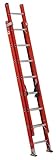
- NON-CONDUCTIVE: Crafted with fiberglass for non-conductive safety assurance, this extension ladder combines strength and durability.
- MAXLOCK RUNG LOCK: Engineered with your safety in mind, custom engineered specifically for our extension ladders from a patented, advanced molecular polymer.
- QUICKLATCH SYSTEM: Seamlessly offers a straightforward and intuitive solution for our extension ladders, securing both the fly and base sections during extension.
- SAFE AND STABLE: Steel Swivel Safety Shoe with metal shield specifically designed for extension ladders, ensures stability and safety even on uneven surfaces.
- STURDY AND STRONG: With its 300-Pound capacity, elegant design and smooth finish, you won’t find a more durable, reliable 16-foot Extension Ladder.
Apply the 4-to-1 relationship
- Determine the ladder’s working length in the configuration you will use, following the product instructions.
- Divide that working length by four.
- Use the result as the approximate horizontal distance from the upper support to the feet.
- Recheck that the chosen footing still reaches the measured work point or provides the required extension above a landing.
For example, if the manufacturer identifies a 24-foot working length for the planned setup, one-quarter is 6 feet, so the feet would normally be positioned about 6 feet from the upper support. This arithmetic is only an application of the approximate ratio; it does not override the label, site conditions, or a different setup required by the manufacturer.
Why angle changes the practical reach
Moving the feet closer to a wall makes the ladder steeper; moving them farther away makes it shallower. Either change affects the top position and the forces on the rails. A ladder selected solely by measuring a vertical wall height may therefore be too short once it is placed at the prescribed angle. Include the base setback in your site measurement and make sure the footing area is available before selecting a length.
Choose a duty rating from the complete load
The duty rating must cover the person on the ladder plus every tool, material, component, and item supported by the ladder. OSHA’s rule states: “Ladders shall not be loaded beyond the maximum intended load for which they were built, nor beyond their manufacturer’s rated capacity.” Read the rating printed on the specific ladder and do not exceed it.
Quick wins for a faster PC:
Repair Windows errors before they cause bigger problemsFix Now →Fix the driver behind crashes, sound loss and screen glitchesFind Drivers →Clear out junk files and repair common Windows errorsFree Scan →OSHA category reference values
The OSHA Safe Use of Extension Ladders Fact Sheet lists these category load values. They are reference categories, not a substitute for checking the ladder’s own label.
Rank #3

- NON-CONDUCTIVE: Crafted with fiberglass for non-conductive safety assurance, this extension ladder combines strength and durability.
- MAXLOCK RUNG LOCK: Engineered with your safety in mind, custom engineered specifically for our extension ladders from a patented, advanced molecular polymer.
- QUICKLATCH SYSTEM: Seamlessly offers a straightforward and intuitive solution for our extension ladders, securing both the fly and base sections during extension.
- SAFE AND STABLE: Steel Swivel Safety Shoe with metal shield specifically designed for extension ladders, ensures stability and safety even on uneven surfaces.
- STURDY AND STRONG: With its 300-Pound capacity, elegant design and smooth finish, you won’t find a more durable, reliable 16-foot Extension Ladder.
| Duty category | Rated load | Typical selection implication |
|---|---|---|
| Type III | 200 lb | Suitable only when the complete intended load is no more than 200 lb and the ladder’s label confirms the category. |
| Type II | 225 lb | Provides a 225-lb category capacity; include all carried tools and materials in the calculation. |
| Type I | 250 lb | Provides a 250-lb category capacity; verify the specific model’s printed rating. |
| Type IA | 300 lb | Provides a 300-lb category capacity for a higher intended load. |
| Type IAA | 375 lb | Provides a 375-lb category capacity, subject to the individual ladder’s instructions and rating. |
OSHA does not establish that every ladder in a category has identical construction, length, or handling characteristics. Confirm the rating, length, material, and configuration on the exact ladder you plan to use.
Calculate the load before selecting the ladder
- Weigh or conservatively estimate the user, including clothing and personal protective equipment.
- Add hand tools, tool belts, buckets, fasteners, paint, roofing materials, and anything else carried while climbing.
- Include equipment or materials that may rest on or be supported by the ladder.
- Compare the total with the manufacturer’s maximum intended load, not merely with a convenient category name.
As a simple example, a 190-lb worker carrying 20 lb of tools has a 210-lb intended load. A Type III category rated at 200 lb would not cover that combination; a ladder with a rating of at least 225 lb might, provided its length, setup, and instructions also fit the job. The example is arithmetic, not a recommendation to ignore the product label or site rules.
Match the ladder material to electrical hazards
Material selection is a safety decision, not just a durability preference. OSHA’s extension-ladder fact sheet calls for nonconductive side rails where the worker or ladder could contact exposed energized equipment. The same guidance says to keep ladders and tools at least 10 feet from power lines. Identify overhead and nearby electrical hazards before carrying, extending, or repositioning the ladder, and follow the stricter requirement if your site rules or applicable regulation require more clearance.
PC Slower Than It Used to Be?
A free scan shows the junk files, broken settings and background clutter dragging Windows down - then fixes them in one click.Free scan · Windows 10 & 11Crashes, No Sound, or Screen Glitches?
Random freezes, missing sound and display glitches usually trace back to one bad driver. Find and replace yours safely.Free scan · under a minuteA nonconductive rail does not make contact with electricity safe, and it does not remove the need to maintain the stated separation. If the work area cannot provide the required clearance, stop and obtain a safe method or qualified site direction rather than trying to solve the problem with a different ladder length.
Rank #4
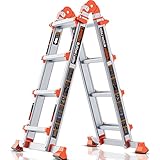
- REINFORCED AND THICKENED UPGRADE, More secure and reliable aluminum ladders, aluminum thickness of 2mm, is double the thickness of other Multi Position Ladders on the market, the weight therefore increased but will not affect its portability, more secure security escort to you
- PRACTICAL AND FLEXIBLE, Multi Position Ladder can be quickly converted into different types of ladders: extended A frame ladder, stair ladders, tall ladders, outdoor long ladders, Storable folding ladders, thus improving efficiency for different work needs
- BALANCE UPGRADE, With 2 Anti-slip balance bars, effectively strengthen the stability of the ladders, with sloping mesh design, more grip, more stable and solid than other Multi Position Ladder, and the soft pad will not wear the floor and walls
- DETAILS UPGRADE, The whole body of the ladder aluminum manufacturing, we use high-strength plastic components wrapped local metal, metal edge polishing and plastic protection, effectively prevent the use of being cut
- SAFETY CERTIFICATION, EN131 standards and ANSI standards. ISO9001 BSCI GS TUV facility certification. our reinforced thickened aluminum Multi Position Ladder easily load 300 pounds, experimental testing load up to 450KG, please pay attention to identify other inferior ladders, responsible for safety
Compare candidate ladders by more than nominal size
When two or more models appear to fit, compare the following characteristics side by side. The best choice is the model that satisfies every applicable condition, not the one with the largest number printed on its label.
| Comparison point | What to verify | Why it matters |
|---|---|---|
| Working reach | Manufacturer’s stated reach or access height for the intended configuration | Shows whether the ladder reaches the task after angle and overlap are accounted for. |
| Extension overlap | Minimum overlap and the permitted extended position | Sections need the designed overlap; excessive extension or insufficient overlap can be unsafe. |
| Landing extension | At least 3 feet above a construction landing, unless the rule’s secured-top and grasping-device exception applies | Provides a handhold for the transition onto the landing. |
| Duty rating | Printed maximum intended load and category | Must cover the user, tools, materials, and supported equipment together. |
| Rail material | Conductive or nonconductive construction and the manufacturer’s electrical-use warnings | Determines whether the model is appropriate where exposed energized equipment may be contacted. |
| Setup instructions | Required angle, footing, securing method, and approved configuration | Controls how the ladder is placed and prevents improvised use. |
| Accessories or attachments | Whether a stabilizer or attachment is expressly compatible with that model | An attachment cannot correct an unsafe angle, footing, or overloaded ladder. |
A step-by-step selection procedure
- Identify the destination. Write down the work point or landing height and decide whether you need to step onto the upper surface.
- Measure the usable site. Mark the intended upper support and the safe location for the feet. Confirm that the approximate 4-to-1 setback can be achieved without placing the base on unstable or obstructed ground.
- Determine the access allowance. For construction landing access, add the required 3 feet of rail above the landing, or verify that the regulation’s exception can be met if the available ladder is too short.
- Shortlist models by working reach. Read each model’s label and instructions for usable reach, maximum extension, and section overlap. Eliminate models that provide only a nominal length without a verifiable configuration.
- Calculate the intended load. Add the user, tools, materials, and supported equipment. Select a rating that is at least that total and confirm the printed manufacturer rating.
- Screen for electrical and site hazards. Check for exposed energized equipment and power lines. Where contact is possible, use the nonconductive-rail guidance and maintain at least 10 feet from power lines as directed by OSHA.
- Confirm the approved configuration. Make sure the ladder is designed for the way you intend to extend, support, secure, and access it. Do not rely on a retailer’s generic diagram when the manufacturer’s label says otherwise.
- Inspect before use. Look at the rails, rungs, locks, feet, ropes, pulleys, and labels. Remove a ladder from service if damage or a missing instruction prevents you from confirming safe use.
Use only the intended ladder configuration
Extension sections are engineered to work together with a specified overlap and locking arrangement. Do not create extra length by tying or fastening sections together unless the ladder is specifically designed for that use. OSHA 29 CFR 1910.23 prohibits tying or fastening ladder sections together for added length unless they are designed for that purpose.
This restriction matters even when the combined sections appear rigid. Improvised connections can change the load path, reduce overlap, defeat the locks, and invalidate the manufacturer’s instructions. If the required reach is greater than the approved configuration provides, select a longer compatible ladder or use a different access system rather than modifying the ladder.
Common selection problems and the fix
The ladder reaches the wall but not the roof edge
Recheck whether the task requires a landing transition. If it does, the rails generally need to continue 3 feet above the landing for construction access. Then verify the model’s working reach and the 4-to-1 base setback. A ladder that touches the roof edge but has no compliant handhold above it is not an adequate landing-access choice.
Best Value

- 🏗️【High-Strength Aluminum, Holds Up to 330 lb】Built with high-strength 6063 aluminum alloy with an oxidized surface, holds up to 330 lb. Resists wear, corrosion, rust, and aging. Reinforced nylon fiber in plastic parts enhances strength. Features 40 cm (15.7 inch) step spacing. Lightweight at only 35 lb.
- 🔗【Detachable Top Hooks & Non-Slip Feet for Secure Fixing】Equipped with 2 detachable hooks that securely grip roof edges, gutters, or wall tops — greatly increasing stability on attics, lofts, roofs, RVs, and trees. Non-slip bottom caps and angled feet protect your safety during use. For indoor use, simply turn the hooks toward you. Need more storage space? Remove the hooks in seconds.
- 🔒【Two Locks Per Rung, Prevents Pinching & Collapse】Each rung features two independent auto-locking mechanisms. You’ll hear a solid “click” when they lock — your clear signal that the ladder is secure. Helps prevent accidental collapse and pinching, while allowing flexible height adjustment.
- 🧳【Lightweight & Portable, Fits Anywhere】Lightweight at only 35 lb and folds down to just 19″×3.7″×42″. Includes storage straps and a carrying handle for easy transport. Toss it in your car trunk, slide it under your bed, or stand it in a closet corner. No more bulky ladders eating up your space.
- 🏠【One Ladder for Roof, Attic, and Job Site】From roof repairs and second-story window cleaning to warehouse shelving and RV roof access — this ladder reaches up to 20.3FT, going where others can‘t. Need something mid-height? Just extend the bottom few sections where you stand, no need to open it all the way.
The ladder is long enough but cannot be placed at the correct angle
Measure the available base area and calculate the approximate setback from the working length. If a wall, trench, vehicle, scaffold, or uneven surface prevents that placement, do not compensate by standing the ladder unusually steep or shallow. Choose an access method and equipment that fit the site, following the manufacturer’s instructions.
The load is close to the rating
Recalculate every item, including equipment that may be placed on a rung or carried during climbing. If the total approaches or exceeds the printed rating, use a ladder with a higher confirmed capacity or reduce the carried load through a safe handling plan. Never assume a category label permits an additional margin beyond the manufacturer’s maximum intended load.
The listing gives a size but no overlap or working reach
Do not infer the usable reach from the nominal size or from a different ladder’s specifications. Obtain the model’s instructions and label information. The Office of Compliance notes that overlap examples vary by ladder length, so a value from one model cannot be transferred to another.
Power lines are near the work area
Stop the setup and measure the separation. OSHA’s fact sheet calls for at least 10 feet between ladders or tools and power lines and for nonconductive side rails where contact with exposed energized equipment could occur. If the clearance cannot be maintained, obtain a safer work arrangement rather than trying to reach around the hazard.
Landing access, securing, and final checks
Before climbing, verify that the ladder is positioned at the approximate prescribed angle, that the feet are on a stable surface, and that the top support and any required securing arrangement follow the product instructions. For construction landing access, confirm the 3-foot rail extension or the precise secured-top and grasping-device exception. Keep the intended load within the printed rating and keep the ladder and tools clear of power lines.
Use the ladder only in the configuration for which it was built. The OSHA construction rule, 29 CFR 1926.1053, and OSHA’s extension-ladder fact sheet provide the governing requirements and selection guidance; the manufacturer’s label supplies the model-specific limits. When those sources differ in detail, follow the applicable regulation and the more restrictive safe instruction.
Decision summary
- Need to reach a task? Select by measured destination height, model-specific working reach, overlap, and the required 4-to-1 setup.
- Need to step onto a construction landing? Provide at least 3 feet of rail above it, or meet the rule’s secured-top and grasping-device exception when the ladder is too short.
- Carrying tools or materials? Add their weight to the user’s weight and choose a confirmed duty rating that covers the entire load.
- Working near electricity? Use nonconductive rails where contact could occur and keep ladders and tools at least 10 feet from power lines.
- Considering a modification? Do not tie or fasten sections together unless the ladder is specifically designed for that use.
The right extension ladder is therefore the shortest model that provides the required, label-approved working reach and landing extension while meeting the correct angle, material, configuration, and total-load limits. Verify those details on the exact ladder before it enters service.
Do these 3 things before closing this tab:
1Fix the driver behind crashes, sound loss and screen glitches2Repair Windows errors before they cause bigger problems3Scan for outdated or missing drivers - takes under a minuteQuick Recap
Product prices and availability are accurate as of the date/time indicated and are subject to change. Any price and availability information displayed on Amazon at the time of purchase will apply.

