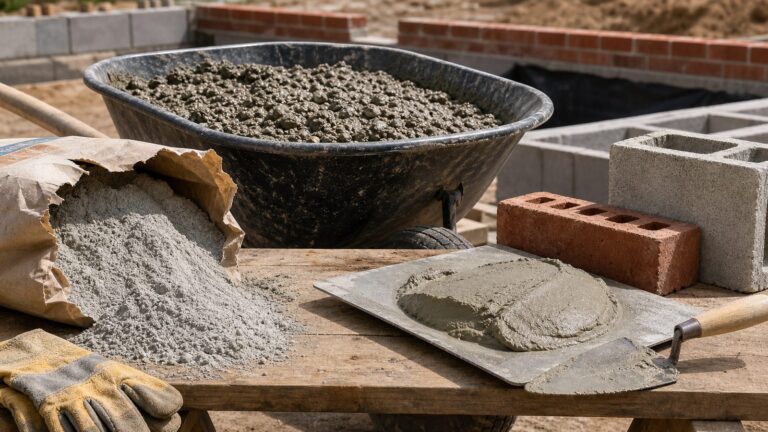
Choose cement for the application and the performance the project requires—not by looking for a product advertised as the “strongest.” For ordinary concrete, a general-purpose portland or blended cement is a normal starting point when the plans and mix design call for no special properties. Mortar and plaster have their own cement categories. Exposure conditions, project specifications, local standards, and the available product documentation determine whether a different choice is needed.
Start with the application and the project specification
Concrete, masonry mortar, and plaster are different systems. A cement intended for one is not automatically the right choice for another. First identify the work, then check the plans, contract documents, or mix and installation requirements for the cement type, applicable standard, and any special performance designation.
As an Amazon Associate I earn from qualifying purchases.
In the United States, the American Cement Association describes three main specification families: portland cement under ASTM C150, blended hydraulic cement under ASTM C595, and performance-based hydraulic cement under ASTM C1157. These standards identify product families; they do not replace the project’s instructions or establish a single best cement for every job. The Association also cautions that availability varies by region. See its overview of cement types.
Quick wins for a faster PC:
Repair Windows errors before they cause bigger problemsFix Now →Fix the driver behind crashes, sound loss and screen glitchesFind Drivers →Clear out junk files and repair common Windows errorsFree Scan →| Project | Common cement category to investigate | What to verify |
|---|---|---|
| Concrete | General-purpose portland or blended cement when no special property is required | The project-approved cement standard and type, mix design, exposure requirements, and product documentation |
| Masonry mortar | Masonry cement | The specified mortar system and the product’s directions; do not substitute a concrete mix recipe |
| Plaster or stucco | Plastic cement formulated for plastering, or general-purpose cement where the system permits it | Applicable plaster requirements, substrate, reinforcement, proportioning, curing, and installation instructions |
The table is a quick comparison of intended uses, not an equivalence chart. A concrete cement designation does not tell you which mortar or plaster system to use, and a product category alone does not specify every material or installation step. For each application, check both the cement’s intended use and the requirements for the complete system.
#1 Best Overall

- Valued Carpenter Pencil Set: You will get 2 pcs solid carpenter pencils with 26 piece 2.8 mm refills, 1 replaceable sharpener, 1 plastic storage box.The complete carpenter pencils combination allows you to finish your work faster and more easily
- Deep Hole Marker Pencil: The deep-hole construction pencils adopts 45mm elongated tip design, which is more convenient to mark in the small hole or in other tight areas that other carpenter markers cannot reach
- Carpenter Pencils with Sharpener: The sharpener is screwed into the top of the work pencil, which won't get lost either. Built-in pencil sharpener that keep the lead with pointed and smooth to Improves line of sight in fine work
- Stronger Solid Lead: This work pencil is matched with a 2.8 mm thick lead , which is much thicker and stronger during the drawing process of construction work, it will not break or damage easily
- Marks on Various Surfaces: 3 colors solid construction pencil can marks on various surfaces,such as metal, plastic, wood, paper etc. Ideals for woodworkers, contractors, craftsmen, builders, merchants and masons
This is a starting point, not a substitute for approval by the project designer or the authority governing the work. If the specification names a cement type or standard, use that requirement to narrow the choice before comparing products. If the documents are silent, unclear, or appear to conflict, ask the responsible designer or supplier to clarify rather than choosing based on a general product description.
What the cement standards and labels tell you
ASTM C150: portland cement
ASTM C150 is the U.S. specification for portland cement. Within that family, type designations can identify a general use or a special property. For example, the American Cement Association identifies Type II as providing moderate sulfate resistance and Type V as providing high sulfate resistance. A Type II or Type V label matters when the exposure and governing specification call for it; it is not a general ranking of which cement is “better.”
When comparing C150 products, identify the required type first, then confirm that the product documentation shows that designation. A familiar name such as “portland cement” is not enough to verify a special performance requirement. Likewise, the existence of a type designation does not mean that every project needs it. The plans, exposure assessment, and applicable specification determine whether it is relevant.
ASTM C595: blended hydraulic cement
ASTM C595 covers blended hydraulic cement, including Type IL portland-limestone cement. Blended cement types can carry designations such as MS for moderate sulfate resistance or HS for high sulfate resistance. Read the full product designation and technical documentation: the word “blended” by itself does not tell you whether a cement meets a particular project requirement.
Blended cement is not a niche label in the U.S. market. The Association reported that it represented roughly two-thirds of the U.S. cement market as of August 2025. That figure describes the market at the stated time; it does not establish that a specific type is stocked near you or accepted in your project. Check local supply and the contract documents independently. The Association’s blended-cement guidance discusses use in concrete.
ASTM C1157: performance-based hydraulic cement
ASTM C1157 is a performance-based hydraulic cement specification. The relevant performance category and acceptance requirements must come from the project documents or the designer. Do not treat a C1157 label as interchangeable with a C150 or C595 type name without checking what the project permits.
In practice, compare labels in the context of the contract rather than trying to translate one standard family into another by name alone. The specification may allow a particular standard, type, or performance category; if it lists alternatives, confirm that the proposed product meets one of them. If you are working from a supplier’s product sheet, check the complete designation and ask which project requirement it satisfies.
Rank #2

- Ergonomically Designed: Work in tight areas with a compact design that gets into tough spots
- Compact and Lightweight: Both tools are designed to fit into difficult to reach spaces. The 1/4" impact driver has a length of 5.55 in. and weighs just 2.8 lbs, while the 1/2" drill/driver measures only 7.5 in. and weighs 3.6 lbs
- Both the DEWALT impact driver and electric drill driver feature integrated LED work lights with a convenient 20-second delay, ensuring enhanced visibility in dimly lit or challenging work areas
- One-Handed Loading - Keep one hand free with a 1/4 in. hex chuck that accepts 1 in. bit tips
- Power drill cordless with 1/2" single sleeve ratcheting chuck provides tight bit gripping strength, making bit changes faster and more secure
Choose concrete cement for the required performance
When a concrete project has no special property requirement, the Association says general-purpose cement is suitable. Its listed applications include pavements, floors, reinforced buildings, bridges, tanks, reservoirs, pipe, masonry units, and precast products. The right product is still the one allowed by the project specification and concrete mix design—not simply any bag or bulk cement labeled general purpose. Check the Association’s cement-type descriptions.
That range of applications shows why “general purpose” should not be read as “automatically appropriate for every job.” It is a reasonable starting category when the project calls for no special cement property, but the concrete still has a specified mixture and intended use. Confirm the approved cement type with the mix design, and do not change the cement on the assumption that a broad product label settles the concrete requirements.
Check exposure before choosing a sulfate designation
Sulfates in soil or groundwater can make sulfate resistance a project requirement. The Association identifies Type II portland cement and blended cement marked MS as moderate sulfate-resistance options; Type V portland cement and blended cement marked HS are associated with high sulfate resistance. Which level applies depends on the actual exposure class and the governing specification.
These designations describe different resistance levels; they are not interchangeable shorthand for “more is always better.” The correct level must be tied to the documented exposure and project requirements. Do not choose a designation solely because the site is described informally as “sulfate soil” or “near groundwater.” Ask the project designer or supplier to match the documented exposure and applicable requirements to a compliant cement. The Association’s cement and concrete FAQ provides additional context on cement types and sulfate resistance.
Recommended Free Tools
A useful question for the designer or supplier is not just “Which cement resists sulfate?” but “What exposure class and specification apply here, and which full cement designation satisfies them?” That distinction helps avoid both under-selecting based on incomplete site information and specifying a special designation without a project basis. If the exposure information is not available, get it resolved rather than treating a generic description as an engineering assessment.
Other special properties must be specified, too
Depending on the project, the required property may involve early strength, heat of hydration, or air entrainment rather than sulfate resistance. These are selection criteria, not permission to choose a cement type based on a brief label description. Have the designer or concrete supplier confirm that the cement, complete mixture, and construction schedule meet the stated requirement.
For example, a schedule concern does not by itself tell you which cement to buy: early strength is a project performance need that must be checked against the mix and the required timing. The same principle applies when heat of hydration or air entrainment is specified. Ask what performance is required, which product designations are accepted, and whether the mixture as a whole is designed to meet the need. Do not infer that one cement name alone ensures a particular result.
Rank #3

- 【Great Compatibility】This Katerk 1/4 inch hex shank bit holder is specifically designed for 1/4 inch hex shank drill bits. It's compatible with most 1/4 fast hex handles, hex sockets, various electric screwdrivers, and handheld screwdrivers. The bit holder makes it a valuable addition for any handyman.
- 【Secure and Safe】Built with a secure backup nut design, each drill bit holder securely locks onto your bits, ensuring they stay firmly in place. Additionally, our bit holder incorporates a high-quality steel ball rolling design that holds up to several kilograms of weight, ensuring your various drill bits don't fall off.
- 【Easy One-Handed Operation】The bit holder for impact driver allows you to change bits single-handedly, simplifying your workflow. Its multi-color design further allows for quick identification of the drill bit you need.
- 【Compact and Convenient】Thanks to its compact size, this 1/4 inch bit holder is easy to carry around. The bit holder allows for easy attachment to various tools, making this a convenient addition to your construction accessories. The Katerk bit holder is cast from high-quality alloy material, promising a long product lifespan. Despite its rugged strength, the bit holder remains lightweight, making it portable.
- 【Cool Christmas Gift For Men Stocking Stuffers】 This screwdriver bit holder, driver bit holder, impact bit holder, can be given as a gift to your loved one, especially for anyone involved in construction or electrical work. It's a must-have for stocking stuffers for men and women, tools gifts for dad, tech gadgets for men, gifts for dad, gifts for him, gifts for husband, gifts for boyfriend, cool gadgets for men, and cool gifts for dad.
Type IL is a blended option, not a blanket substitution
Type IL portland-limestone cement is a type of blended cement under ASTM C595. The American Cement Association says it contains 5% to 15% limestone. It also reports that replacing portland cement with Type IL in concrete mixtures can reduce the cement carbon footprint by up to 10%. That is an Association-reported comparison for cement footprint; it is not a guaranteed reduction for an entire building or across its whole life cycle. Verify project acceptance and product-specific performance before using it. Read the Association’s blended-cement and sustainability information.
If you are comparing Type IL with another cement, separate the environmental comparison from the approval question. The reported up-to-10% figure concerns the cement footprint in the stated replacement comparison; it is not a promise about every product, concrete mixture, building, or project outcome. Type IL may be an option to discuss where the specification permits it, but the project documents and product information still govern acceptance and performance.
Why cement type alone does not determine concrete strength
Concrete strength depends on more than the cement selected. The American Cement Association identifies mixture design, water-to-cement ratio, materials, and curing as relevant factors. A cement label cannot compensate for an unsuitable mixture or poor execution, and a project’s specified concrete strength should not be inferred from the cement designation.
That means a cement comparison is only one part of a concrete decision. The approved mixture, the materials used, the amount of water relative to cement, and curing all contribute to the outcome. Changing cement without reviewing the mix design can leave an important part of the project decision unresolved. Follow the approved mix and the specified placement and curing requirements, and direct questions about strength to the designer or concrete supplier.
For example, the Association’s FAQ explains that “3,000-pound concrete” means concrete with a compressive strength of 3,000 psi at 28 days. That figure explains a strength label; it is not a recommendation for every slab, footing, or structural element. The project documents determine the required concrete strength and testing provisions. A named strength target and a cement type answer different questions: one describes the concrete requirement, while the other identifies a cement product family or property.
PC Slower Than It Used to Be?
A free scan shows the junk files, broken settings and background clutter dragging Windows down - then fixes them in one click.Free scan · Windows 10 & 11Outdated Drivers Are Slowing You Down
One free scan finds every outdated or missing driver and matches the right update for your exact hardware.Free scan · exact hardware matchChoose a separate system for mortar and plaster
Masonry mortar
Masonry cement is a cement category intended for mortar applications. Mortar is not simply a concrete recipe with a different name: the specified mortar system and the product directions govern the materials and use. Follow the project’s requirements rather than improvising proportions from a concrete mix. The available cement-type guidance establishes the application distinction but does not provide mortar proportioning instructions.
When buying for masonry, check that the product is intended for mortar and that it matches the specified system. Do not assume that a general-purpose concrete cement is an equivalent substitute, or that a concrete mix recipe can be adapted to mortar by changing quantities. The cement category is one input; the project documents and product directions remain the basis for how the mortar is proportioned and used.
Rank #4

- Long Nib and Deep Hole Marker: Our mechanical carpenter pencil with 45mm nib is designed for easy marking of deep holes or narrow areas. These construction pencils are the great choice for woodworking tools, construction tools, carpenter tools, contractor tools, wood carpentry tools and architect tools
- Extra Refills in 2 Colors for Versatile Marking: The construction mechanical pencil comes with 12 extra 2.8mm refills, including 6 red and 6 black refills. The black refill is suitable for light surfaces, while the red wax is perfect for dark surfaces. Our carpenter mechanical pencil makes sure that you'll have an ample supply for extended use
- Built-in Sharpener: Our construction pencil comes with a built-in sharpener to ensure the mechanical pencil tip is always sharp and ready for use. Never buy an extra pencil sharpener again. A great tool for any woodworker pencil, contractor pencils. The refill can easily be extended or retracted with a simple click of the pencils mechanical, allowing you to work more efficiently and accurately
- Portable Clip Design: Our deep hole construction pencil features a portable clip design, easy to carry and attach to your pocket or tool box, so that you can keep the carpenter pencils mechanical close at hand, making it a convenient tool to have on the go. Great gifts choice for carpenters
- Stronger Pencil Lead: The black refills are made of lead, sturdy and smooth. The red refills are made of wax, clear and light. These marking pencils are much thicker and stronger than normal pencils during the marking process of construction work, suitable for various surfaces, such as glasses, metal, boards, floors, walls, furniture, etc. The written marks can be easily wiped with a wet paper towel when needed
Plaster and stucco
Stucco is commonly called portland cement plaster. Its cementitious ingredients may include general-purpose cement or plastic cement made for plastering. The American Cement Association references ASTM C926 for plaster proportioning and installation guidance. Choosing a plaster cement does not settle the rest of the system: substrate preparation, reinforcement, proportions, curing, and installation remain important. See the Association’s cement application descriptions.
Plastic cement is specifically formulated for plastering, while general-purpose cement may also be used in stucco where the system permits. That does not make the products interchangeable in every assembly. Check the plaster requirements and product instructions together, including the substrate, reinforcement, proportions, curing, and installation method. The cement choice cannot compensate for overlooking those other parts of the plaster system.
Do these 3 things before closing this tab:
1Repair Windows errors before they cause bigger problems2Scan for outdated or missing drivers - takes under a minute3Clear out junk files and repair common Windows errorsUse this checklist before buying
- Name the application. Confirm whether the cement is for concrete, masonry mortar, or plaster/stucco, and select a product category intended for that work.
- Read the project documents. Look for the required cement standard, type, special property, concrete strength, mortar system, or plaster guidance. Ask the designer to resolve any missing or conflicting requirement.
- Confirm the exposure and schedule. Identify whether the project calls for sulfate resistance, early strength, heat-of-hydration control, air entrainment, or another specified property. Do not infer a designation from a vague site description.
- Match the full designation to the requirement. Check whether the product is specified under ASTM C150, C595, or C1157 and read any type or performance suffix. If local transportation or contract documents use another accepted specification, verify the permitted equivalent with the project team.
- Review current product documentation. Ask the supplier for the product data and applicable certification or test documentation needed to establish that the cement meets the project requirement. A short shelf label may not show every relevant designation.
- Check availability and approval together. Confirm that a compliant product can be supplied in the project location and that the designer or other responsible party accepts it. Do not assume a type is stocked everywhere.
- Keep installation requirements in view. For concrete, follow the approved mix and curing requirements; for mortar or plaster, follow the specified system and product directions. Cement selection is only one part of the finished work.
Before placing an order, it can help to have the product sheet in hand and compare it directly with the specification. Confirm the application, standard, full designation, special property if required, and responsible-party approval. If a supplier proposes an alternative because the specified product is not available, treat it as a substitution to be reviewed—not as an automatic equivalent. The Association notes that cement types are not available everywhere, so checking supply early can prevent a late change from becoming a project decision made without approval.
U.S. standards are not universal
This guidance is U.S.-oriented. The American Cement Association says there is no single universal international specification for portland cement; national requirements vary. U.S. and some international specifiers use ASTM C150 and C595, while state transportation agencies may use AASHTO counterparts. Outside the United States, check the national standard, local code, contract requirements, and supplier documentation rather than assuming a U.S. designation is accepted. The Association’s FAQ discusses standards and cement types.
For a deeper technical reference, the Association lists Design & Control of Concrete Mixtures, 17th Edition, covering subjects including hydraulic cement, supplementary cementitious materials, mix design, durability, sustainability, placing, and curing.
Frequently Asked Questions
What are the different types of cement?
In the U.S. framework described by the American Cement Association, portland cement is specified under ASTM C150, blended hydraulic cement under ASTM C595, and performance-based hydraulic cement under ASTM C1157. Within those families, designations can identify general use or special properties. The right category and type depend on the application and project specification.
Free tools Windows power users keep installed
One-click scans. No signup required.
What is portland-limestone cement (PLC)?
Type IL is portland-limestone cement under ASTM C595. The American Cement Association says it contains 5% to 15% limestone and reports that replacing portland cement with Type IL in concrete mixtures can reduce the cement carbon footprint by up to 10%. Check project acceptance and product-specific performance; the reported figure is not a guaranteed whole-building reduction.
Best Value

- Milwaukee Ink all Fine Point Marker, Black, 4 Per Pack
- 4 per pack Features Clog Resistant Marker Tip Writes through Dusty, Wet and Oily Surfaces Durable Marker Tip for Writing on Concrete, OSB and Rough Surfaces
- Clog resistant tip writes on dusty, wet and oily surfaces and is optimized for rough surfaces such as OSB, cinderblock and concrete
- Hard hat clip- attaches for easy access
- Quick dry time with reduced smearing and marking
Which cement should I use for concrete?
For concrete with no special property requirement, general-purpose portland or blended cement is a normal starting point, provided the project specification and mix design allow it. Exposure conditions, strength requirements, schedule, and any required special properties can change the selection. Confirm the approved cement and complete mixture with the project documents or responsible designer.
What cement is used for mortar or stucco?
Masonry cement is intended for mortar applications. Stucco is commonly called portland cement plaster; its cementitious ingredients may include plastic cement formulated for plastering or general-purpose cement where the system permits it. Follow the specified mortar or plaster system and product directions rather than substituting a concrete recipe.
Does choosing a stronger cement guarantee stronger concrete?
No. Concrete strength depends on mixture design, water-to-cement ratio, materials, and curing as well as cement selection. The project documents determine the required concrete strength. The Association explains that “3,000-pound concrete” means a compressive strength of 3,000 psi at 28 days; that is an explanation of a strength label, not a recommendation for every project.
When do I need sulfate-resistant cement?
Sulfates in soil or groundwater can make sulfate resistance a project requirement. The Association identifies Type II portland cement or blended cement marked MS for moderate sulfate resistance, and Type V portland cement or blended cement marked HS for high sulfate resistance. Ask the designer or supplier to match the documented exposure and governing specification to the correct designation.
Can I use ASTM cement designations outside the United States?
Not automatically. The Association says national cement specifications vary and there is no single universal international portland cement specification. Some international specifiers use ASTM C150 or C595, but outside the U.S. you should check the local standard, code, contract requirements, and supplier documentation.
The Bottom Line
Choose cement by intended application first, then match its full standard and designation to the project’s performance and exposure requirements. General-purpose cement is a common starting point for concrete without special requirements; masonry cement is intended for mortar, and plastic cement is formulated for plastering. Verify the product documentation, local availability, mixture or installation requirements, and project approval before ordering.
Quick Recap
Product prices and availability are accurate as of the date/time indicated and are subject to change. Any price and availability information displayed on Amazon at the time of purchase will apply.
What’s actually slowing this PC down?
Pick the symptom - the matching free tool is one click away.