What’s actually slowing this PC down?
Pick the symptom - the matching free tool is one click away.
Building a spot welder is practical, but the right design depends on what you intend to weld. For nickel tabs on 18650 or 21700 lithium-ion cells, the most suitable DIY project is a controlled, low-voltage, high-current pulse welder. A rewound microwave transformer can produce more power, but its mains-voltage primary makes it an advanced electrical-engineering project—not a safe beginner shortcut.
This guide explains the architecture, components, construction sequence, calibration, weld testing, and limits of a DIY machine. It focuses primarily on thin nickel or nickel-plated steel tabs. A battery-tab welder is not automatically suitable for copper, thick sheet steel, automotive panels, or production work.
As an Amazon Associate I earn from qualifying purchases.
Choose the application before choosing the welder
Resistance spot welding joins overlapping conductive pieces by clamping them between electrodes and sending a short, high-current pulse through the joint. The electrical resistance at the interface produces localized heat while electrode pressure holds the parts together.
| Application | Suitable direction | Main limitation |
|---|---|---|
| Thin nickel strip on cylindrical cells | Low-voltage battery or capacitor pulse welder | Cell heating and weld consistency |
| Thin nickel-plated steel | Low-voltage pulse welder | Confirm the actual coating and base metal |
| Thin sheet steel | Engineered transformer resistance welder | Much greater force, energy, and duty-cycle demands |
| Copper tabs | Specialized high-power equipment | Copper rapidly conducts heat away |
| Aluminum tabs | Specialized process and equipment | Oxide layer and high conductivity complicate welding |
| Production battery packs | Commercial controlled welder | Repeatability, monitoring, and traceability |
For context, Sunstone identifies approximately 0.005-inch nickel as a common battery-tab material and notes that thicker tabs may require design features such as dimples or slits. Its guidance also treats copper tabs around 0.010–0.020 inch as a substantially more demanding application requiring specialized equipment. These are manufacturer application guidelines, not universal limits; see Sunstone’s battery-welding guidance.
#1 Best Overall

- [HIGH POWER]: The spot welder board outputs in high power with 99 gears adjustable, providing more accurate welding results. It can continuously weld thousands of points on plate.
- [APPLICABLE FOR]: This spot welder board is suitable for spot welding of lithium cylindrical batteries and hydrogen batteries such as 14650 17490 32650.
- [WIDE PURPOSE]: This welding board supports welding 0.05mm to 0.3mm sheet, iron sheet, and stainless steel sheet, leaving accurate and beautiful welds.
- [LARGE CURRENT]: Equipped with 5 pcs MOS tubes and 2 brass bars, this spot welder board can handle a maximum current of up to 2390A, substantially increasing its over current capacity.
- [EFFICIENT AND EFFECTIVE]: Based on the principle of high current and high-temperature quick melting, this spot welder board efficiently and effectively welds the foil, ensuring and connections.
How resistance spot welding works
The heat generated at the joint is broadly related to I2Rt: current squared, resistance, and time. Because current is squared, a small current increase can create a large increase in heating. The total resistance includes the tab, workpiece, electrodes, cables, connectors, and every contact point.
A capacitor-discharge design stores energy according to E = 1⁄2CV2, where C is capacitance and V is voltage. This equation helps estimate stored energy, but it is not sufficient to design a welder. Actual performance also depends on source impedance, switch behavior, pulse shape, electrode force, alignment, material, and thermal limits.
A dramatic peak-current claim is not a useful comparison by itself. A published figure may be a theoretical short-circuit current, a brief source-side peak, or a value measured with a particular cable and load. Compare delivered energy, pulse duration, output impedance, cable configuration, electrode force, and test material instead. Sunstone’s published technical material illustrates why current, energy, pulse width, load resistance, and cable configuration should be considered separately.
Free tools Windows power users keep installed
One-click scans. No signup required.
The recommended DIY architecture
For a first build intended for battery tabs, use an isolated 12–24 V DC source or a properly designed capacitor bank. The functional blocks are:
- Energy source: a suitable high-current battery or capacitor bank.
- Switching stage: an appropriately rated MOSFET, IGBT, SCR, or equivalent pulse switch.
- Pulse controller: adjustable pulse timing, preferably with first- and second-pulse control.
- High-current path: short, flexible cables, busbars, secure terminals, and copper electrodes.
- Mechanical fixture: a welding pen for occasional work or a fixed arm/lever for repeatable pressure.
- Protection: fuse or current limiting, enclosure, emergency disconnect, insulated terminals, and thermal monitoring where appropriate.
Low voltage reduces ordinary shock exposure at the welding head, but it does not make the system harmless. A battery or capacitor bank can create an arc, vaporize metal, ignite insulation, rupture components, or severely damage a lithium-ion cell during a short circuit.
Rank #2
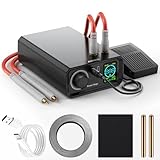
- Two types of Trigger Flexibility & Safety: The maximum current is 1,380 A, and the power is 11.5 KW. Seamlessly switch between hands-free foot pedal operation and precise hand control (Trigger) for versatile workflows and enhanced safety when handling sensitive batteries.
- Intelligent Thermal Protection: Built-in safety monitors battery temperature (Cont), automatically halting welding (Trigger disable) and alerting you if overheating is detected, preventing damage. If there is no operation for 8 minutes, the spot welder will automatically shut down.
- Ultra-Low Power Consumption: Engineered for exceptional energy efficiency , significantly extending standby time between uses and reducing operational costs. Precision 100-Level Power Control: Fine-tune welding strength for delicate tasks (like phone/Button batteries) or robust jobs (cylindrical power cells) with our intuitive rotary knob.
- Multi-Mode Welding for Diverse Batteries: Expertly weld cylindrical power batteries, mobile phone batteries, and Button batteries (Mode) with tailored settings accessible via the clear control panel.
- Simple Rotary Knob Operation & Clear Interface: Effortlessly adjust settings (Gear, Trigger Time, Mode, Number of continuous spot welds) using the large rotary knob and clearly labeled control panel for ultimate user-friendliness.
Parts and tools
Functional components
- High-current DC source or capacitor bank
- High-current switching device and suitable heat sinking
- Pulse timer/controller
- Copper or copper-alloy electrodes
- Short, flexible high-current cable
- Electrode holders or welding pens
- Fixed pressure arm or lever fixture
- Low-resistance busbars and terminals
- Charging supply, if using capacitors
- Bleeder/discharge resistor, if using capacitors
- Enclosure and mounting hardware
Safety-critical components
- Correctly rated fuse or circuit breaker
- Main disconnect and guarded trigger
- Insulated, touch-safe terminals
- Strain relief and heat-resistant barriers
- Grounding conductor for exposed conductive parts where applicable
- Positive capacitor discharge path and a verified voltage indicator
- Eye protection and a nonflammable work surface
Do not select a universal cable gauge, fuse value, capacitor value, or switch rating from a generic online list. Those values must be calculated from source voltage, pulse duration, peak and fault current, duty cycle, source impedance, conductor length, and thermal limits.
Build the low-voltage pulse welder
1. Define the weld target
Record the material, tab thickness, cell format, number of weld nuggets, expected welding frequency, and maximum acceptable cell temperature. Confirm whether the material is pure nickel or nickel-plated steel; they do not behave identically.
Quick wins for a faster PC:
Repair Windows errors before they cause bigger problemsFix Now →Fix the driver behind crashes, sound loss and screen glitchesFind Drivers →2. Choose and protect the energy source
A battery-powered design is compact and conceptually simple, but voltage sag and battery condition affect results. A capacitor design can make short-pulse energy more repeatable, but capacitors remain dangerous after power is removed. Include charging protection, fusing, enclosure, balancing where required, a permanent discharge path, and a way to measure and verify the bank voltage before servicing.
OSHA’s resistance-welding provisions require suitable enclosure, insulation, interlocks, and a positive means of discharging capacitors for applicable high-voltage capacitor-discharge equipment. Review 29 CFR 1910.255 for U.S. requirements.
3. Test the control section first
With the welding source and high-current stage disconnected, verify that the controller powers up, the trigger is momentary and guarded, and the pulse output returns to an inactive state. Test the switching signal separately. Add an accessible emergency shutoff before connecting the power stage. Operator controls should be isolated from the welding current.
Rank #3

- Enhanced Performance: Built with an upgraded 7500mA-h rechargeable battery, this mini spot welder features a power bank design and Type-C fast charging, reaching full charge within 3-5 hours. It can execute thousands of welds on a single charge and effectively welds 0.1-0.15mm nickel sheets (Note: Cannot weld nickel strips with thickness greater than or equal to 0.2mm thick).
- Adjustable Precision: The spot welder Offers a wide range of 80 adjustable power levels, allowing users to fine-tune welding settings from 1-8 and 1.1-5.4-8.0 for different materials and thicknesses. Ideal for both beginners and professionals, If you are a novice, we recommend setting the delayed auto weld time to (1-5 seconds)
- Clear LCD Display: Battery Spot Welder Equipped with a colorful LCD screen that provides real-time information on battery status, delay time, temperature, and gear level, ensuring you remain informed and can adjust settings easily during your welding projects.
- Safety and Convenience: Integrated with an advanced chip for adaptive control and temperature monitoring, the DJYIYEW spot welder automatically shuts off when temperatures exceed 60°C/140°F to ensure user and equipment safety. Its compact design enhances portability, making it an excellent tool for various applications.
- Versatile Use and Complete Kit: Perfect for welding nickel sheets and capable of handling cylindrical lithium batteries like 18650/21650, and nickel-metal hydride or cadmium batteries. The kit includes everything needed: 1 x spot welder, 4 x nickel strips, 4x4 battery holders, 2 x welding pens, 1 x metal file, a USB-C cable and 1 x Manual.
4. Assemble the high-current path
Keep cables short and flexible, minimize connectors, and use mechanically secure crimped or bolted connections. Add strain relief at the enclosure and electrode holders. Protect cables from sharp edges and ensure busbars, switches, and terminals cannot contact the enclosure. Mount switching devices and conductors so heat can escape.
Outdated Drivers Are Slowing You Down
One free scan finds every outdated or missing driver and matches the right update for your exact hardware.Free scan · exact hardware matchPC Slower Than It Used to Be?
A free scan shows the junk files, broken settings and background clutter dragging Windows down - then fixes them in one click.Free scan · Windows 10 & 11Low resistance in the useful current path improves welding, but it also increases possible fault current. Treat every exposed terminal as a serious arc and fire hazard.
5. Install the electrode fixture
A fixed arm or lever is preferable to freehand pressure when repeatability matters. It improves alignment, electrode force, operator distance, and the usefulness of peel tests. Tips must contact the tab cleanly and evenly. Dirty, rounded, oxidized, or misaligned electrodes alter contact resistance and can produce weak welds or excessive surface heating.
First welds and calibration
- Use scrap nickel strip over a nonflammable test piece, or sacrificial cells that will not be placed into service.
- Start at the lowest setting likely to make a weld.
- Change only one variable at a time: pulse energy, duration, pressure, delay, or electrode condition.
- Make several welds at each setting rather than judging one successful-looking spot.
- Use a second pulse only after a stable single-pulse weld has been established.
- Record settings, source voltage, material, electrode condition, and results.
The aim is a repeatable mechanically strong weld with minimal heat transfer into the cell—not the largest spark, deepest mark, or highest advertised current.
How to qualify weld strength
Visual appearance alone is not enough. Make a strip peel test by pulling the tab away from the test surface. A useful weld should require meaningful force and should produce consistent failure behavior. Record whether the nugget remains attached, whether the strip tears around the weld, or whether the weld simply releases cleanly.
Rank #4

- Safe to use: The spot welding board requires a self-contained power supply. You can use your own bike battery or other batteries to connect to our circuit board. The battery spot welding machine has a powerful output power, with 6 adjustable gears, and can weld materials of 0.02mm or even 0.03mm. Welding is more accurate, and thousands of points can be continuously welded onto nickel plates.
- Widely used: Spot welding plates can be used for spot welding of lithium cylindrical batteries and nickel hydrogen batteries such as 14650, 17490, 18650, 21700, 26650, and 32650. You can also repair electronic devices with batteries, such as handheld drills, electric toy cars, electric toothbrushes, electric facial washers, and so on, saving you a lot of expenses.
- Power selection: Spot Welding Machine Lithium Battery Control Board needs its own power supply, supporting 6.5V-16V power supply, battery discharge current <900A, short circuit current <1800A, beyond the above range may damage the control board.
- Safe use: After connecting to the power supply, it will intelligently match and determine whether the power supply can work to prevent damage to the circuit board. The operation is simple. There is a multiplier and battery capacity to choose from. It can be determined whether the battery is low-power or high-power.
- Rich accessories: We have equipped the power supply positive and negative poles with connecting wires, screws, spot welding pens, 2-meter nickel plated plates. You can practice more on discarded batteries, familiarize yourself with the power level of each gear, and then operate your equipment in practice. This is to prevent damage to your battery. The accessories are complete, and after receiving the goods, you only need the power to operate immediately.
Also inspect for burn-through, large craters, discoloration, electrode sticking, and excessive indentation. On cell work, monitor temperature and reject cells that become hot, swell, vent, leak, or show other damage. Repeat the test after the electrodes have warmed; thermal drift can change results.
Advanced option: a rewound microwave transformer
A microwave-oven transformer welder replaces the original high-voltage secondary with a few turns of very heavy insulated conductor. The result is low secondary voltage and very high current. The concept is straightforward; the mains side is not.
This route requires engineered primary-side switching, inrush management, fusing, a nearby disconnect, insulation, grounding, strain relief, a grounded and enclosed metal frame where applicable, and a low-voltage isolated control circuit. Never connect a salvaged transformer directly to a pushbutton, leave its primary exposed, use an ordinary relay without checking transformer-inrush ratings, or assume the secondary is safe merely because its voltage is low.
OSHA requires resistance-welding equipment to be safely installed, provided with an appropriate disconnect, and operated by instructed competent personnel. Its rules also address guarded controls, control-circuit voltage, grounding, and capacitor safety. See 29 CFR 1910.255 and 29 CFR 1910.254. If you do not have mains electrical experience, do not make this your first welder; obtain qualified electrical review or use a low-voltage design.
The Tool Desk
Outbyte PC Repair FREEClear out junk files and repair common Windows errorsFree Scan →Outbyte Driver Updater FREEFix the driver behind crashes, sound loss and screen glitchesFind Drivers →Troubleshooting
Weak welds
Check pulse energy, electrode force, material identity, electrode cleanliness, alignment, cable length, connector heating, and battery voltage sag. Clean or dress the tips, improve pressure, shorten the current path, then increase energy gradually and repeat the peel test.
Best Value

- ♞ Adjustable 99 gears: The spot welder control board supports 99 adjustable output power gears, making it easy to adjust according to the spot welding material. Real time gear display on 3-digit digital tubes.
- ♞ The welding points are accurate and beautiful, supporting the welding of 0.1-0.2mm nickel sheets, iron plate, and stainless steel plate.
- ♞ The spot welder control board adopts 8 MOS transistors, and the maximum current can reach 2400A. Extreme temperature: 175 ° C. Breakdown voltage: 40V. Conduction internal resistance: 0.53 milliohms/min. Single load current: 300A MAX.
- ♞ 2 Welding pen: Aluminum oxide copper spot welding needle, ensuring high current capacity and durability, greatly improving spot welding efficiency.
- ♞spot welder/spot welder for lithium batteries/spot welder 110v/spot welder pen/spot welder cutter/spot welder machine/spot welder dent puller/spot welder board/spot welder kit/spot welder tips/spot welder machine/spot welder machine auto body/
Burn-through or excessive cratering
Energy or pulse duration may be too high, pressure too low, or current too concentrated through a damaged tip. Reduce energy, improve pressure, correct the tip shape, and stop using any cell that shows overheating, swelling, venting, or damage.
Strip sticks to the electrodes
Stop and let the tips cool. Clean and dress them, verify parallel contact, improve pressure, and reduce energy. Sharp, dirty, or overheated tips increase current density.
Inconsistent welds
Variable hand pressure, moving leads, changing source voltage, uneven tips, premature triggering, and thermal drift are common causes. Use a fixed fixture, trigger only after pressure is established, record source voltage, clean tips consistently, and add cooling intervals.
Recommended Free Tools
Unexpected arcing or a capacitor that will not discharge
Stop immediately, disconnect the source if it can be done safely, keep clear of exposed conductors, and do not touch the bank until its voltage has been measured and brought to a verified safe state using the designed discharge system. Do not improvise with a screwdriver or loose wire.
Lithium-ion cell safety
- Do not weld visibly damaged, swollen, leaking, hot, or unknown cells.
- Do not weld directly onto a cell when the process calls for a tab.
- Do not use first-test cells in a saleable or safety-critical pack.
- Prevent loose tools and strip from shorting cells.
- Never leave a partially assembled pack unattended.
- Do not charge a cell immediately after a questionable weld without inspection.
A good weld does not by itself make a safe battery pack. Serious pack construction also requires suitable insulation, cell matching, fusing, a battery-management system where appropriate, and documented inspection.
Build or buy?
DIY makes sense for learning, experimentation, custom fixtures, and noncritical prototypes when you have suitable test equipment and a safe workshop. Buying is usually preferable for expensive cells, customer equipment, frequent use, copper tabs, production quantities, or any application where repeatability matters more than the project itself.
A controller kit such as the Malectrics Arduino-based battery spot-welder kit can reduce the control-electronics design burden while retaining some DIY assembly. A packaged unit such as the model described in the U.S. Solid manual is another alternative; its published specifications include 11.6 kW/2,000 A output and support for 0.2 mm pure nickel, but those are manufacturer claims and are not universal performance guarantees.
Do these 3 things before closing this tab:
1Repair Windows errors before they cause bigger problems2Fix the driver behind crashes, sound loss and screen glitches3Clear out junk files and repair common Windows errorsProfessional systems cost substantially more but add controlled energy delivery, fixtures, documentation, and repeatability. Sunstone listed its CDDP-A dual-pulse capacitive-discharge system at $8,900–$15,000 and electrode pairs at $59–$119 when the supplied information was accessed; prices and availability are volatile, so verify them on the product page and electrode page. Sunstone’s higher-power platforms are aimed at demanding applications such as copper tabs, not ordinary hobby nickel-strip work.
Quick Recap
Final safety checklist
- Use a suitable enclosure, fuse, disconnect, grounding, and strain relief.
- Guard the trigger against accidental activation.
- Keep welding cables short and inspect them for damage.
- Provide positive capacitor discharge and verify voltage before service.
- Wear eye protection and work on a fire-resistant surface.
- Keep combustible materials and loose metal away from the electrodes.
- Test on scrap before using valuable cells or finished packs.
- Stop if the machine arcs unexpectedly, overheats, or produces inconsistent results.
- Choose a commercial machine when the application exceeds thin nickel tabs or requires documented repeatability.
Product prices and availability are accurate as of the date/time indicated and are subject to change. Any price and availability information displayed on Amazon at the time of purchase will apply.

