What’s actually slowing this PC down?
Pick the symptom - the matching free tool is one click away.
Short answer: a pure sine wave inverter is a complete power-conversion system—not an oscillator wired to four MOSFETs. A practical design needs battery protection, controlled switching, gate drivers with dead time, voltage and current feedback, an output transformer or high-voltage DC link, an LC filter, thermal management, and a properly enclosed AC output.
This guide covers an isolated, single-phase inverter for a dedicated off-grid load. It does not cover grid-tie operation, connection to building wiring, or a substitute for a certified backup-power product. Even a 12 V battery can deliver enough current to cause fires, severe arcs, and fatal faults; the filtered output can deliver lethal voltage.
As an Amazon Associate I earn from qualifying purchases.
What “pure sine wave” means
A pure sine wave inverter produces AC whose voltage approximates a sinusoid at the required RMS voltage and frequency—for example, 120 V RMS at 60 Hz. “Pure” does not mean mathematically perfect. The meaningful specifications are:
Free tools Windows power users keep installed
One-click scans. No signup required.
- RMS voltage and frequency accuracy
- Total harmonic distortion (THD)
- Crest factor and DC offset
- Voltage regulation during load changes
- Transient response and electromagnetic interference
A modified-sine inverter produces a stepped waveform with substantial harmonic content. An inverter bridge also produces a high-frequency PWM waveform before filtering. The waveform delivered to the load is only sinusoidal after the switching waveform has been filtered and regulated.
#1 Best Overall

- 【POWERFUL DC to AC CONVERTER】: This solar inverter delivers 2000W of continuous battery DC 12V to AC 110V 120V power and up to 4000W of peak surge power when the load is started. The 12V inverter has a conversion efficiency of greater than 93% during normal working and low no-load losses
- 【PURE SINE WAVE INVERTER】: The power inverter output waveform is consistent with the AC waveform of the utility grid and is suitable for inductive and capacitive loads. It extends the service life of the equipment and reduces the fault rate. Can be used with electrical equipment such as televisions, home theaters and other sensitive loads for a long time
- 【INTELLIGENT LCD DISPLAY】: This 2000Watt inverter comes with a high-brightness real-time smart screen that simultaneously displays input and output voltages, battery and load status, multiple operating conditions for timely troubleshooting. At the same time, the output voltage and screen can be adjusted independently in a small range
- 【POWER YOUR EXPECTATIONS】: The inverter 12V to 110V features dual AC socket, 20A Outlet, 5V2.1A USB port, Hardwire Port and remote controller with 23Ft Cable. This solar inverter is ideal when you need energy for off-grid, outdoors, RV, trucks
- 【MULTIPLE SAFETY PROTECTIONS】: Pure sine wave inverter provides undervoltage, overvoltage protection, overload, over temperature protection, short circuit and reverse connection protection. Aluminum and sturdy plastic housing ensures long term use
Do not judge output quality with a multimeter alone. Use an oscilloscope and a properly rated differential probe, with the measurement equipment connected according to its safety ratings.
The architecture you are building
A practical isolated inverter normally contains these blocks:
Battery
  ↓
DC fuse, disconnect and reverse-polarity protection
  ↓
Isolated DC-DC or transformer-fed power stage
  ↓
Regulated DC link
  ↓
Full H-bridge with SPWM control
  ↓
LC low-pass filter
  ↓
Isolated 120 V, 60 Hz AC output
The power stage also needs battery, DC-link, output-current, temperature, and fault sensing. Texas Instruments’ 800 VA reference design illustrates this general approach with PWM control, gate drivers, a switching bridge, transformer operation, and output filtering. It is a reference design—not a finished certified inverter. See the TI reference design documentation.
Choose the topology before choosing components
Low-frequency transformer inverter
Battery → MOSFET bridge or push-pull stage → 60 Hz transformer → filter → loadThis is conceptually straightforward and provides isolation and voltage conversion in one major component. The trade-offs are a heavy transformer, lower power density, magnetizing current, and the risk of core saturation if the drive contains DC offset or unequal switching.
High-frequency isolated inverter
Battery → high-frequency converter → transformer → rectifier/DC link → SPWM H-bridge → filterThis can be smaller and more efficient, but the design is substantially harder. You must design high-frequency magnetics, manage leakage inductance and switching transients, control several stages, and address more severe EMI problems.
Non-isolated boost converter plus H-bridge
Battery → boost converter → high-voltage DC link → H-bridge → LC filterFor 120 V RMS output, the sine-wave peak is approximately:
VPEAK = 120 × √2 ≈ 169.7 V
The DC link must be higher than this peak, with margin for modulation limits, voltage sag, semiconductor losses, filter loss, and regulation. This approach can be compact, but it places hazardous voltage throughout the power stage and does not inherently provide galvanic isolation.
Quick wins for a faster PC:
Fix the driver behind crashes, sound loss and screen glitchesFind Drivers →Clear out junk files and repair common Windows errorsFree Scan →Scan for outdated or missing drivers - takes under a minuteDriver Scan →For a first project, use a 12 V or 24 V system in the roughly 100–300 W range, and use a commercially designed isolated DC-DC or inverter power module wherever possible. Higher-power systems are not beginner projects.
Define the electrical specification
Write the specification before selecting MOSFETs, transformers, or inductors:
Rank #2

- 【PURE SINE WAVE INVERTER】: The power inverter output waveform is consistent with the AC waveform of the utility grid and is suitable for inductive and capacitive loads. It extends the service life of the equipment and reduces the fault rate. Can be used with electrical equipment such as televisions, home theaters and other sensitive loads for a long time
- 【POWERFUL DC to AC CONVERTER】: This solar inverter delivers 3000W of continuous battery DC 12V to AC 110V 120V power and up to 6000W of peak surge power when the load is started. The 12V inverter has a conversion efficiency of greater than 93% during normal working and low no-load losses
- 【INTELLIGENT LCD DISPLAY】: This 3000Watt inverter comes with a high-brightness real-time smart screen that simultaneously displays input and output voltages, battery and load status, multiple operating conditions for timely troubleshooting. At the same time, the output voltage and screen can be adjusted independently in a small range
- 【MULTIPLE SAFETY PROTECTIONS】: Pure sine wave inverter provides undervoltage, overvoltage protection, overload, over temperature protection, short circuit and reverse connection protection. Aluminum and sturdy plastic housing ensures long term use
- 【POWER YOUR EXPECTATIONS】: The inverter 12V to 110V features dual AC socket, 20A Outlet, 5V 2.1A USB port, Hardwire Port and remote controller with 23Ft Cable. This solar inverter is ideal when you need energy for off-grid, outdoors, RV, trucks
- Nominal battery voltage and its actual operating range
- Output voltage, such as 120 V RMS
- Output frequency, such as 60 Hz
- Continuous power and surge power with duration
- Load type: resistive, motor, transformer, charger, audio, or electronic
- Required isolation
- Target THD, efficiency, and temperature rise
- Cooling method and enclosure
- Battery chemistry, BMS limits, and low-voltage cutoff
Do not select a battery voltage merely because it is convenient. At a given output power, a higher battery voltage greatly reduces input current.
Battery current and energy calculations
Use these as initial sizing equations:
PDC ≈ PAC ÷ η
IDC ≈ PAC ÷ (VBAT × η)
At 1,000 W, 12 V, and 90% efficiency:
IDC ≈ 1000 ÷ (12 × 0.90) = 92.6 A
At the same power and efficiency, a nominal 48 V battery draws about one-quarter as much current. The practical consequences include smaller conductors, lower cable losses, and less demanding semiconductor current ratings—although the higher-voltage battery system introduces additional shock and arc hazards.
Do these 3 things before closing this tab:
1Repair Windows errors before they cause bigger problems2Scan for outdated or missing drivers - takes under a minute3Clear out junk files and repair common Windows errorsFor battery energy:
EBAT ≈ PAC × t ÷ (η × DOD)
Account for voltage sag, cable loss, battery temperature, maximum continuous current, BMS limits, and—for lead-acid batteries—the Peukert effect. Nominal amp-hours alone are not a reliable runtime calculation.
Illustrative 300 W design target
The following is a design example, not a verified performance specification:
| Parameter | Illustrative value |
|---|---|
| Battery | 24 V nominal, approximately 20–30 V operating range |
| Output | 120 V RMS, 60 Hz, isolated |
| Continuous power | 300 W |
| Initial load | Resistive |
| Efficiency goal | 85–90%, to be measured rather than assumed |
| SPWM carrier | Approximately 10–20 kHz as an initial range |
At 300 W, 24 V, and an assumed 88% efficiency:
IDC ≈ 300 ÷ (24 × 0.88) = 14.2 A
Motor-start capability cannot be inferred from the continuous wattage. A motor may require several times its running current and may cause the battery voltage to collapse or the inverter’s protection to trip.
Generate the sine wave with SPWM
Sinusoidal pulse-width modulation compares a low-frequency sine reference—such as 60 Hz—with a high-frequency triangular carrier. The resulting duty cycle changes throughout each cycle. After the bridge and LC filter, the average voltage follows the sine reference.
The Tool Desk
Outbyte Driver Updater FREEFix the driver behind crashes, sound loss and screen glitchesFind Drivers →Outbyte PC Repair FREERepair Windows errors before they cause bigger problemsFix Now →Carrier frequency is a compromise among switching loss, filter size, audible noise, EMI, and controller capability. The TI reference design discusses a switching range of approximately 6–20 kHz; the appropriate value depends on the complete design.
The modulation index controls fundamental output amplitude. A robust controller should include soft-start, a duty-cycle limit, frequency supervision, DC-link overvoltage shutdown, battery undervoltage shutdown, output overvoltage shutdown, overcurrent protection, thermal shutdown, and a latched or controlled-retry fault state.
Firmware alone should not be the only protection against catastrophic faults. Where practical, use hardware comparator protection or a gate-driver shutdown input so an overcurrent event can disable the bridge independently of a malfunctioning control loop.
Rank #3

- 【𝟑𝟎𝟎𝟎 𝐖𝐚𝐭𝐭 𝐈𝐧𝐯𝐞𝐫𝐭𝐞𝐫】--- This pure sine wave inverter can provide 3000W continuous clean DC to AC power (6000W surge) with >91% efficiency, which strongly and effectively reduces conversion loss and protecting sensitive electronics (Microwave Oven, Laptops, CPAPs, LEDs) from damage. Handles heavy startups (Coffee Machine, Window AC, Power Tools) effortlessly. For RV, Home, Solar, Emergencies.
- 【𝐏𝐨𝐰𝐞𝐫 𝐈𝐧𝐯𝐞𝐫𝐭𝐞𝐫 𝐏𝐮𝐫𝐞 𝐒𝐢𝐧𝐞 𝐖𝐚𝐯𝐞】--- LANDERPOW inverter delivers the same as grid-quality Pure Sine Wave AC power, outperforming modified sine wave units. Safely powers inductive/capacitive loads (Window ACs, Coffee Machines, Refrigerators, Home Theaters, Car Audio) with zero hum/flicker. Protects sensitive electronics, extends lifespan, and cuts failure risks—ideal for long-term use.
- 【𝟑 𝐀𝐂 𝐎𝐮𝐭𝐥𝐞𝐭𝐬+𝐅𝐚𝐬𝐭 𝐂𝐡𝐚𝐫𝐠𝐢𝐧𝐠 𝐔𝐒𝐁/𝐔𝐒𝐁-𝐂+𝐇𝐚𝐫𝐝𝐰𝐢𝐫𝐞𝐝 𝐀𝐂 𝐓𝐞𝐫𝐦𝐢𝐧𝐚𝐥】--- This All-in-One Power Inverter features 3 AC Outlets + 1 Hardwired Terminal for high current electrical appliances/tools, plus 5V/3.1A USB & 30W PD ports for fast device charging. Multi-interface flexibility powers RV trips, job sites, and emergencies with pro-grade reliability. The plug-and-play design is very user-friendly.
- 【𝐇𝐢𝐠𝐡 𝐐𝐮𝐚𝐥𝐢𝐭𝐲 𝟏𝐀𝐖𝐆 𝗣𝘂𝗿𝗲 𝗖𝗼𝗽𝗽𝗲𝗿 𝐁𝐚𝐭𝐭𝐞𝐫𝐲 𝐂𝐚𝐛𝐥𝐞𝐬】--- The LANDERPOW inverter 12V to 110V comes with two 1AWG/2 FT high-quality thickened pure copper battery cables, which can effectively protect the safety of the inverter during use. It is not easy to get hot during use and the conversion efficiency is higher.
- 【𝐒𝐦𝐚𝐫𝐭 𝐋𝐄𝐃 𝐒𝐜𝐫𝐞𝐞𝐧 𝐑𝐞𝐦𝐨𝐭𝐞 𝐂𝐨𝐧𝐭𝐫𝐨𝐥】--- LANDERPOW 3000 watt inverter comes with 15ft wired remote controller. The remote has smart LED screen to track battery levels, output, and errors in real time—no more guesswork, enables you timely battery swaps & power control. One-touch shutdown/restart design thrives in trucks, RVs, and job sites. Real-time Monitor from your cab or campsite.
Design the full H-bridge safely
             +DC
              |
        Q1          Q2
         |          |
         +-- Load --+
         |          |
        Q3          Q4
              |
             -DC
Turning on Q1 and Q4 applies one polarity to the load. Turning on Q2 and Q3 applies the opposite polarity. The upper and lower switch in the same leg must never conduct simultaneously.
Prevent shoot-through
Shoot-through occurs when both switches in one leg turn on at once, effectively shorting the DC link. It can destroy switches, PCB traces, fuses, and battery wiring.
Complementary gate signals need dead time between one device turning off and its partner turning on. Dead time must account for propagation delay, gate charge, Miller behavior, temperature, device variation, and layout parasitics. Too little risks shoot-through; too much increases distortion and body-diode conduction.
A microcontroller pin should not directly drive large power-device gates. Select gate drivers for bus voltage, gate voltage, source and sink current, switching frequency, high-side method, bootstrap limitations, undervoltage lockout, isolation, and fault shutdown. Keep gate loops short, provide local bypass capacitors, use suitable gate resistors, and verify the actual gate-source waveforms with an oscilloscope.
Select switches by more than current rating
Evaluate MOSFETs or IGBTs using voltage overshoot, conduction loss, gate charge, switching loss, reverse-recovery behavior, thermal resistance, package limits, short-circuit behavior, and junction temperature. A headline current rating often assumes ideal case temperature and cooling.
MOSFETs are generally attractive at lower bus voltages and higher switching frequencies. IGBTs may suit higher voltage and power, but switching losses, gate-drive requirements, and short-circuit behavior must be examined carefully.
Transformer and DC-DC-stage design
Transformer voltage ratio is only one parameter. Also specify VA rating, operating frequency, core material, flux density, winding resistance, leakage inductance, insulation, creepage, clearance, temperature rise, inrush current, and load regulation.
A 60 Hz transformer must not receive significant DC offset. Unequal duty cycles, timing errors, or mismatched push-pull drive can cause flux walking and saturation. Saturation produces rapidly rising current, heating, switch failure, and fuse operation. Enforce symmetrical drive, limit current, and verify the transformer’s flux and temperature behavior.
High-frequency transformers additionally require core and turns calculations, skin- and proximity-effect analysis, winding-window planning, interwinding insulation, shielding, leakage-inductance control, and snubbers or clamp networks. A salvaged transformer may have unknown insulation, temperature, and duty-cycle limits.
Rank #4
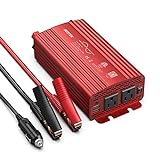
- BESTEK 500W Pure Sine Wave Car Inverter:Its output waveform is same as the AC power waveform of mains power grid which delivers a smoothly-varying sine wave for sensitive electronics provided by the electric utility.Perfects for off-grid system,Lower THD,Less wear,Strong inductive Loads Capability.It has little interference with radios, communication and precision equipment.It's also recommended by most cordless tool manufacturer that a pure sine wave inverter is used to ensure long battery life
- This is an inverter converting DC from your car battery to AC for whatever you want to use within its Watt range.It can pull power from the battery through the cigarette lighter plug or directly clamp the alligator battery clips onto the car battery.Plug this into 12v cigarette lighter outlet provides continuous DC to AC power with 2 AC outlets operates any 110v device and 2 USB ports which detects your device automatically to deliver its fastest charge speed up to 2.4 amps per port/4.2 amps max
- The Sine Wave Inverter has well placed thermal protection sensors,The aluminum alloy casing with a few ripples,Unique vents and also a built-in FAN which comes ON under NO any loads or when the Inverter becomes Hot Once Powerred. It has 2 x 40 amp/32V external replaceable fuse for protection when hooked up to your battery,readily accessible/replaceable from the back of the Inverter;when hooked to cigarette lighter it will use 15 amp fuse designated to your car.
- Isolated Voltage Protects Perfectly for your device from Over-voltage,Under-voltage,Overheat,Overload,Reverse Polarity,Short circuit.it will not drain your battery dry because of an under-voltage protection point.The Inverter does automatically sense overload condition and shuts down AC power when the load exceeds 500W.You will need to power Off/On to reset the overload condition indicated by the Flashing Red.The ON-OFF switch only works for the 3-prong plugs.
- The 12V plug is spring-loaded and fits snugly into the receptacle.You cannot get 500 watts from 12volt cigarette lighter plug,needs alligator clips for car battery. If you're going to be plugging this into car cigarette lighter,you should keep the wattage under 150,since that is what most car fuses are set for.What You Get:1xBESTEK 500W Pure Sine Inverter,1xUser Manual,2xbattery clamps cable,1x 12V cigarette Lighter plug cable,2 x spare fuses.
Design the output LC filter
The bridge produces a PWM waveform. The filter attenuates the carrier and passes the 50/60 Hz fundamental:
H-bridge → series inductor → AC output
                         |
                      capacitor
                         |
                      return
A first-pass resonance estimate is:
f0 = 1 ÷ (2π√(LC))
The resonance should be well above the output frequency and well below the PWM carrier. It must also be damped sufficiently to avoid dangerous peaking and remain stable over the expected load range.
Specify the inductor for RMS current, peak current, saturation current, copper loss, core loss, and temperature rise. Specify the capacitor for voltage, AC RMS current, surge, temperature, and the appropriate safety class when connected to accessible wiring.
A filter designed only for a resistive load may behave badly with no load, laptop chargers, motor drives, UPS inputs, audio amplifiers, or other capacitive and nonlinear loads. Filter resonance, inductor saturation, parasitic resistance, and control-loop interaction must be checked by simulation and measurement. An LC filter alone does not guarantee a pure sine output.
Add feedback and protection
Open-loop SPWM will not maintain output voltage as battery voltage, load, temperature, transformer regulation, and semiconductor losses change. Use a properly isolated sensing method to regulate the output waveform or RMS voltage.
Useful sensing channels include:
- Battery voltage and battery current
- DC-link voltage
- Output voltage and output current
- Bridge current
- Heat-sink and transformer temperature
- Fan or airflow status
Never connect a microcontroller ADC directly to a mains-referenced output. Use an isolation amplifier, isolated voltage sensor, sensing transformer, or a deliberately designed isolated measurement circuit.
Essential protections include a battery fuse close to the positive terminal, DC disconnect, reverse-polarity protection, precharge or controlled inrush limiting, low-voltage cutoff, DC-link overvoltage protection, output overload and short-circuit shutdown, thermal shutdown, gate-driver undervoltage handling, soft-start, and a safe controller-reset state.
Independent reader supportYour contribution helps us test, update, and keep practical guides available for everyone.PCB, enclosure, and wiring
- Use short, low-inductance gate and power loops.
- Use high-current copper sized for continuous current, temperature, length, and acceptable voltage drop.
- Keep Kelvin sensing separate from high-current return paths.
- Maintain appropriate creepage and clearance around hazardous-voltage conductors.
- Provide covered busbars, insulated terminals, strain relief, ventilation, and a secure enclosure.
- Place the battery fuse close to the battery positive terminal.
- Separate control, power, and sensing circuits to reduce ground bounce and EMI.
- Provide a clearly marked, guarded AC output and a reliable protective-earth strategy appropriate to the isolated design.
Low-voltage battery wiring is not automatically low risk. A battery can supply hundreds or thousands of amperes into a short circuit, vaporizing metal and starting a fire. Lithium batteries also require compatibility with the BMS, contactors, precharge requirements, temperature limits, and discharge limits.
Recommended Free Tools
Build and test in stages
1. Simulate first
Model battery-voltage range, switch resistance, transformer leakage and magnetizing inductance, inductor saturation, capacitor ESR, dead time, startup, no-load operation, load steps, and short-circuit behavior. Examine switch voltage and current, transformer flux, filter current, THD, dissipation, and startup overshoot.
Best Value

- BESTEK 300W Pure Sine Inverter (Patent Number US D818,853 S): Designed for your devices that require careful protection, provide 300W continuous DC to AC power and 700W of peak power featuring 2 AC outlets and 2 USB charging ports, great for Christmas gift, charging string lights, laptop, speakers, camera, nebulizer, game console, kindle, iPad and other
- 2*AC and 2*USB Fast Charging Ports: Equipped with 2 Smart USB charging ports, which detects your devices automatically to deliver its fastest charge speed up to 2.4 amps per port/4.8 amps max, and you can charge most phones and tablets simultaneously
- Upgraded Version Compatible with Tesla: Bestek power inverter upgraded to 11-17V, Compatible with Tesla and other new energy vehicle. Unique vents and smart fan design make our 300W power inverter easier to dissipate heat, and cigarette lighter plug is easy to plug into a cigarette lighter socket
- Comprehensive Protection: Built-in 40 amps fuse and full protection against overheating, under and over voltage charging, short circuiting, overloads, and overcharging
- What You Get: 1*BESTEK 300W Pure Sine Power Inverter, 1*User Manual, 18-month warranty and customer service
2. Test the controller without the power stage
With the power stage unpowered, verify PWM frequency, complementary outputs, dead time, duty-cycle limits, soft-start, frequency stability, and fault shutdown. Do not connect a grounded oscilloscope probe clip to an unknown high-side switching node.
3. Use a current-limited low-voltage supply
Before connecting a high-energy battery, use a current-limited bench supply and a small protective fuse. Check quiescent current, gate-source voltage, unexpected switching, and abnormal heating.
4. Energize at reduced voltage
Use a low-voltage source, current limiting, temperature monitoring, and a resistive dummy load. A series incandescent lamp can sometimes provide a rough diagnostic indication, but it is not a substitute for a properly engineered current limiter or precharge circuit.
Crashes, No Sound, or Screen Glitches?
Random freezes, missing sound and display glitches usually trace back to one bad driver. Find and replace yours safely.Free scan · under a minuteWindows Errors? Fix Them Before They Spread
Repair common Windows errors and clear accumulated junk for a smoother, more stable PC - no reinstall needed.Free scan · no reinstall5. Add the filter and load gradually
- Check no-load output.
- Apply a small resistive load.
- Increase the resistive load.
- Test the intended load category.
- Apply controlled load steps.
- Check low-battery and thermal behavior.
Measure RMS voltage, frequency, THD, peak voltage, DC offset, input current, efficiency, temperatures, and recovery after load changes.
6. Test failure behavior
With suitable current limiting and safety controls, verify battery undervoltage, DC-link overvoltage, overload, short circuit, overtemperature, fan failure, controller reset, gate-driver undervoltage, and loss of feedback. The inverter should shut down predictably rather than repeatedly restarting into a fault.
Troubleshooting common failures
| Symptom | Likely causes | Checks |
|---|---|---|
| Fuse blows immediately | Shoot-through, shorted switch, wiring error | Test the bridge unpowered; inspect gate timing and switch resistance |
| Heavy distortion or visible steps | Incorrect SPWM, inadequate filter, saturation | Inspect controller, bridge, filter current, and DC offset |
| Switches overheat at no load | Shoot-through, switching loss, poor gate drive | Measure gate waveforms, dead time, and driver supply |
| Voltage collapses under load | Battery sag, transformer regulation, current limiting | Measure battery and DC-link voltage simultaneously |
| Output rises at no load | Feedback failure or unstable LC loop | Check isolated sensing, compensation, damping, and filter resonance |
| Audible buzzing | Magnetics, carrier frequency, filter resonance | Check flux, temperature, saturation, and switching losses before changing frequency |
| Controller resets | Ground bounce, bus sag, EMI | Improve decoupling, layout, grounding, and isolation |
When to build and when to buy
A DIY inverter is reasonable for a controlled bench experiment, education, or a low-power isolated prototype. A certified commercial inverter is the better choice for permanent off-grid power, RV or marine installation, household backup, medical or life-safety equipment, or any environment where children or untrained users may access the system.
When comparing a finished inverter, check continuous power, surge power and duration, input-voltage range, THD test conditions, isolation, low-voltage cutoff, overload behavior, thermal derating, idle consumption, battery-BMS compatibility, warranty, and whether it is standalone, charger/inverter, or grid-interactive.
Morningstar’s SureSine product line is one example of commercial pure-sine equipment; verify the exact model’s power rating and certifications rather than generalizing across the range. Advanced developers can study the TI 800 VA reference design, but it remains a development reference and not a drop-in certified product.
Why grid connection and household backfeeding are excluded
Do not connect a homemade inverter to a receptacle, branch circuit, or utility grid. Never use a plug-to-plug cable. Backfeeding can energize wiring thought to be disconnected and kill utility workers or occupants.
Grid-interactive systems require synchronization, anti-islanding protection, fault coordination, interconnection approval, and applicable certification. UL 1741 covers inverter and interconnection equipment within its scope, while interactive equipment is also associated with IEEE interconnection requirements. Verify the current edition and local rules; the retrieved UL listing identified a revision dated May 21, 2026.
UL 458 covers relevant fixed, stationary, and portable DC-input inverters with 120 V or 240 V single-phase output, including applicable 12–60 V nominal DC-input provisions. A component marked UL recognized does not make a homemade finished inverter UL listed. Certification applies to the evaluated product, construction, enclosure, wiring, software, markings, and test conditions.
PC Slower Than It Used to Be?
A free scan shows the junk files, broken settings and background clutter dragging Windows down - then fixes them in one click.Free scan · Windows 10 & 11Crashes, No Sound, or Screen Glitches?
Random freezes, missing sound and display glitches usually trace back to one bad driver. Find and replace yours safely.Free scan · under a minuteQuick Recap
Product prices and availability are accurate as of the date/time indicated and are subject to change. Any price and availability information displayed on Amazon at the time of purchase will apply.




