What’s actually slowing this PC down?
Pick the symptom - the matching free tool is one click away.
Some links on this page are affiliate links: if you buy through them we may earn a commission, at no extra cost to you.
Yes—accurate, real-time environmental monitoring can help a construction team spot emerging problems sooner, show what is happening around a site, and give neighbours evidence rather than assurances. It is not a substitute for sound design, statutory controls or honest consultation, and data alone cannot guarantee public support. Its value comes from connecting measurements to decisions: sensors collect readings, a shared platform makes them visible, teams act when conditions approach agreed thresholds, and suitable results are explained to the community.
That is the argument made by George Williams, associate director of digital products and services at Stantec, in Building on July 15, 2026. Williams writes that “Accurate data monitoring in real time not only increases industry efficiency and productivity but can change user behaviour and reassure the public that new development is beneficial.” The examples and performance claims below are therefore attributed to Williams and Stantec, rather than presented as independent evaluations.

As an Amazon Associate I earn from qualifying purchases.
The Tool Desk
Outbyte PC Repair FREERepair Windows errors before they cause bigger problemsFix Now →Outbyte Driver Updater FREEFix the driver behind crashes, sound loss and screen glitchesFind Drivers →Why environmental data can change a development conversation
Residents often judge a project through effects they can see, hear or feel: traffic queues, dust, noise, vibration, flooding or changes in air quality. When information about those effects is delayed, scattered or difficult to inspect, concern can grow even when a project team is acting responsibly. A live record cannot remove every impact, but it can make the impact, the response and the remaining uncertainty easier to discuss.
Williams links this transparency challenge to public confidence. His article reports that just 16% of the UK public had confidence in developers and planning authorities, citing Social Value Portal polling from 2025. The article does not provide the poll’s sample, question wording or methodology, so the figure should be treated as a reported snapshot, not a current benchmark for every region or project.
Popular on Amazon

- Product Type :System Power Device
- Package Dimensions :23.114 Cm L X 16.764 Cm W X 5.08 Cm H
- Country Of Origin :Italy
- Package Weight :0.62Lbs
For a project team, the practical opportunity is to move from retrospective explanation to early intervention. Continuous readings can reveal a pattern before a formal limit is exceeded, allowing supervisors to investigate, change a work practice or warn affected people. For a community, publishing appropriate information can show whether conditions are stable, worsening or improving and whether promised controls are operating.
How the monitoring loop works
- Measure conditions at the site. Low-power sensors deployed in the field collect environmental readings. The categories named by Stantec are noise, air quality, vibration, weather and ground movement.
- Bring readings into one view. Stantec describes its in-house ADAhub platform as a single view for live monitoring data, rather than a collection of disconnected logs.
- Watch for developing issues. Teams can look for readings that are trending towards a project threshold or that change suddenly. Williams says this helps them identify emerging issues and respond before thresholds are breached.
- Act and record the response. A useful operating plan assigns responsibility for checking an alert, investigating its cause, taking corrective action and recording what happened.
- Explain what the evidence shows. Selected readings, actions and outcomes can support transparent, auditable compliance reporting and more practical conversations with neighbours.
The platform does not make a decision by itself. People still need to define relevant thresholds, understand local conditions, check that sensors are working and decide what action is proportionate. The benefit is a shorter path from a changing condition to an informed response.
What ADAhub is described as monitoring
Williams presents ADAhub as an in-house Stantec platform that consolidates live readings from low-power, field-deployed sensors. The article names five monitoring categories. Their relevance will vary by project, planning condition and surrounding land uses, so the table is a scoping aid rather than a claim that every project needs every sensor.
| Reading category | Questions it can help a project team investigate |
|---|---|
| Noise | Are construction activities creating changing sound levels at sensitive locations, and do controls need to be adjusted? |
| Air quality | Are airborne conditions changing during particular activities, weather conditions or traffic patterns? |
| Vibration | Are ground-borne effects associated with works approaching a project’s agreed limits? |
| Weather | Could current conditions affect how other readings should be interpreted or how work is planned? |
| Ground movement | Are there changes that warrant investigation against the project’s design, temporary-works or monitoring plan? |
Those questions are operational examples, not additional capabilities claimed in the article. A monitoring specification should state the locations, sampling approach, alert rules, data-retention period and person responsible for each measure before equipment is installed.
What the reported project examples show
The Octagon, Birmingham: live controls during construction
According to Stantec’s account in Williams’s article, the team monitored noise, vibration and dust during construction at The Octagon in Birmingham. Stantec says live monitoring helped the project avoid breaches of environmental regulations.
Also popular on Amazon
The account illustrates the value of combining several measures rather than treating a complaint as an isolated event. Noise, vibration and dust can arise from related activities but may not change at the same time. A live view can help a team link a change to a work phase, check whether controls are effective and retain a record of the response. The article does not provide the site’s thresholds, sensor count, monitoring period, baseline readings or an independent audit of the outcome, so the claim should be read as Stantec’s project report.
Fairway Primary School, Stockport: measurements alongside behaviour change
Williams reports that monitoring at Fairway Primary School in Stockport showed a 79% reduction in key pollutants after parents and teachers changed behaviours, including parking farther away and cycling. The article does not identify the pollutants, measurement period or methodology, and it does not say that the result was independently evaluated.
The example is important because it treats data as a way to support choices, not only as a compliance instrument. Showing a school community how travel patterns relate to local readings may make a particular action more tangible. A project should still separate correlation from causation: if a pollutant level falls, the team should document the time period, other changes, weather conditions and measurement method before attributing the result to one intervention.
Wrexham: making readings available to residents
The article describes a council-led initiative in Wrexham using city-centre air-quality and environmental-noise sensors. Readings were made publicly accessible so residents could choose healthier travel routes. No named platform, route-planning result or quantified health outcome is supplied.
This is a different use of monitoring from a contractor-only dashboard. Public access can turn a measurement programme into a service for residents, but publication needs context: what the reading represents, when it was last updated, how to interpret a change and where to report a fault. Without that explanation, a live number can create confusion instead of confidence.
Do these 3 things before closing this tab:
1Clear out junk files and repair common Windows errors2Scan for outdated or missing drivers - takes under a minute3Repair Windows errors before they cause bigger problemsAlso popular on Amazon

- BME680 Digital Temperature Humidity Sensor Module
- Temperature/Humidity/Pressure/VOC Gas, 4 in 1 Sensor Module
- High Precision Environmental Monitoring Sensor with SPI IIC DC 5V
Designing a monitoring programme that leads to action
The following sequence translates the article’s mechanism into a practical project workflow. It is guidance for planning, not a claim that every step was used in the cited examples.
1. Start with the decision, not the sensor
Write down the decisions the data must support. Examples include whether to change a noisy operation, investigate a dust event, alter vehicle movements, issue a flood-related warning or demonstrate compliance with a planning condition. If a reading will not change a decision, its cost and complexity need a clear justification.
2. Identify sensitive receptors and baseline conditions
Map homes, schools, workplaces, public routes and other locations where people or assets may experience an effect. Establish a baseline before disruptive work where practicable. Record the time, location and conditions for each baseline measurement so later comparisons are meaningful.
3. Select the smallest useful set of measures
Choose among noise, air quality, vibration, weather and ground movement according to the project risks and obligations. A school beside a haul route may need a different combination from a deep excavation next to existing structures. Specify measurement locations and the reason for each one; avoid presenting a single consumer device as evidence of construction compliance without project-specific validation.
Free tools Windows power users keep installed
One-click scans. No signup required.
4. Define thresholds and escalation rules
For every measure, document the relevant limit or trigger, who receives an alert, how quickly it must be checked and what actions are available. Include a rule for repeated near-threshold readings, not only outright exceedances. Thresholds should be consistent with the project’s approvals, method statements and professional advice.
Also popular on Amazon
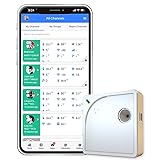
- Easy Setup & Connectivity: Quick setup via the UbiBot App or PC tools. Supports 2.4GHz WiFi for easy integration into your home network. Access data anywhere through the App or web console. Compatible with IFTTT and Alexa for smart home integration.
- Advanced Monitoring with External Probes: Leverage highly accurate Swiss-made sensors for comprehensive temperature (-20ºC to +60ºC/-4ºF to 140ºF), humidity (10% to 90% RH), and light (0.01 to 157K lux) tracking. Connect optional external probes (ASIN: B07G31F4MF) to enable multi-point temperature data collection in extreme conditions.
- Reliable Data Storage & Access: Offers 24/7 remote monitoring with free 200MB cloud storage for up to 2 years of data. Supports PDF or CSV downloads. Large internal memory stores up to 300,000 data points, ensuring no gap during network outages.
- Versatile Alerts System: Receive notifications for network loss, abnormal sensor readings, low battery, and more. Alerts through Email, App, HTTP, API, IFTTT, SMS, and Voice call (fees may apply).
- No Subscription Required: Enjoy additional features including customizable measuring and sync rates, Celsius/Fahrenheit settings, sensor calibration on platform end, device management in one account, and technical support via web-console and App.
5. Put live readings in a shared view
Use a dashboard or equivalent record that allows authorised project roles to see current conditions and historical trends. Stantec describes ADAhub as providing this single view. Access rights should distinguish people who operate the site, those who verify compliance and any public-facing information that is suitable to release.
6. Test the data before relying on it
Confirm sensor location, power, connectivity, time synchronisation and maintenance arrangements. Log outages, suspect readings and recalibration. A gap or implausible spike should be visible to the person making decisions; it should not silently appear as a complete record.
7. Connect alerts to a named response
When readings approach a threshold, investigate the activity, weather and nearby sources. Apply the agreed control, check whether the reading changes and record the time, action and result. This creates the auditable trail Williams associates with transparent compliance reporting.
8. Communicate in terms people can use
Explain what is being measured, where, how often it updates, what the categories mean and what the project will do when a trigger is reached. Publish trends or summaries where appropriate, while protecting personal information and avoiding false precision. Invite questions through a channel that can route technical issues to the responsible team.
9. Review whether behaviour and outcomes changed
After an intervention, compare the defined baseline with the same measure over a stated period. Note other influences, such as weather, traffic or changes in work activity. This discipline is essential when reporting outcomes such as the 79% pollutant reduction described for Stockport.
Also popular on Amazon

- Monitors temperature, humidity, ambient light, and water leaks Long-range SuperLink connectivity with up to 2 km (1.2 mi) transmission range Battery-powered (CR123A) with up to 6 years of battery life Compact, weather-resistant IPX5 design with multiple mounting options (adhesive, magnet, screw) Compatible with UniFi Protect web and mobile applications Ideal for server rooms, data centers, basements, and critical infrastructure monitoring
Choosing an approach: questions to compare
The source does not rank competing products. For a procurement or design decision, compare proposals against the project question and the operating model rather than choosing a platform by name.
| Comparison question | Why it matters |
|---|---|
| Which environmental measures are required? | Noise, air quality, vibration, weather and ground movement answer different risk and compliance questions. |
| Must readings be continuous and site-based? | Live field data is useful when conditions can change quickly or a response is time-sensitive; a different approach may suit periodic surveys. |
| Who can see the data? | Operators, compliance leads, clients, regulators and residents may need different views and explanations. |
| Can records be audited? | Time-stamped readings, alert history, maintenance notes and response logs make a compliance account more credible. |
| What happens near a threshold? | A reading has limited value unless roles, response times and corrective actions are defined in advance. |
Where real-time data has limits
- It does not prove causation on its own. A change in a reading may reflect weather, traffic, a neighbouring activity or a sensor issue. Investigation and documented context are required.
- It does not guarantee consent. Publishing evidence can reduce opacity, but people may still disagree about a project’s scale, location, construction period or residual effects.
- It does not replace statutory monitoring. The project must continue to meet its approvals, environmental regulations and professional duties. A dashboard is a management aid, not an automatic legal defence.
- It can create a false sense of completeness. Sensors cover selected places and times. Explain coverage, gaps and uncertainty rather than implying that one display represents every experience around a site.
- It needs governance. Decide who owns the data, who can alter thresholds, how corrections are recorded and how long records are retained. Public confidence is damaged if figures change without an explanation.
Other built-environment uses of data-led technology
Williams also points to traffic management and flood alerts as examples of data-led technology in the built environment. The article names no system and reports no outcome for either. The transferable lesson is to define the decision first: traffic data might inform movement planning, while flood information might support warnings and operational changes. Neither example should be presented as evidence of a particular product’s performance.
Recommended Free Tools
A practical checklist for project leaders
- Set out the community and operational questions the monitoring must answer.
- List relevant receptors, planning conditions and environmental risks.
- Choose measures from noise, air quality, vibration, weather and ground movement only where they support a decision.
- Document baselines, locations, thresholds, alert recipients and response times.
- Provide a shared view for authorised users and a clear explanation for any public-facing data.
- Test power, connectivity, time stamps, maintenance and data gaps.
- Record every alert, investigation, control and follow-up measurement.
- Report outcomes with the period, method and limitations attached to the number.
- Invite questions and publish corrections when data or interpretation changes.
Bottom line: data opens the door, but decisions build trust
Real-time monitoring is most valuable when it is an operating system for responsible action, not a screen installed for appearances. Stantec’s ADAhub description and the reported examples from Birmingham, Stockport and Wrexham show three possible roles: controlling construction effects, helping a community change behaviour and giving residents access to environmental information. The 16% confidence figure reported from 2025 polling underlines why transparency matters, but it is not a universal measure of acceptance.
For a new development, the credible promise is narrower and more useful: measure the conditions that matter, make the evidence understandable, respond before problems become breaches where possible, and show what changed. That combination can improve efficiency and productivity while giving neighbours a clearer basis for judging whether the project is managing its impacts.
Quick Recap
Product prices and availability are accurate as of the date/time indicated and are subject to change. Any price and availability information displayed on Amazon at the time of purchase will apply.

