Some links on this page are affiliate links: if you buy through them we may earn a commission, at no extra cost to you.
LEED v5 BD+C requires infrared imaging as part of its one-point Enhanced Commissioning for Building Enclosure credit. The credit names ASTM C1153 or ASTM C1060, selected according to the enclosure assembly and the condition being investigated. Infrared work is only one part of a broader building-enclosure commissioning process that also includes air-leakage and water-penetration testing, documented findings, and the deliverables described in ASTM E2947-21a, subject to the credit’s stated exclusions.
The practical decision is not which infrared camera to buy. It is whether the project needs a framed-cavity insulation investigation under ASTM C1060 or nighttime mapping of wet insulation in a qualifying roof system under ASTM C1153. In either case, a thermal anomaly is a lead for validation—not automatic proof of missing insulation, a code failure, or the source of a leak.
As an Amazon Associate I earn from qualifying purchases.
What infrared testing does LEED v5 BD+C require?
The February 2026 LEED v5 BD+C rating-system text places infrared imaging in the Enhanced Commissioning for Building Enclosure credit. The credit is worth one point. It requires the commissioning team to perform the broader enclosure-commissioning activities and produce the associated documentation described in ASTM E2947-21a, with the exclusions identified by the LEED credit.
Infrared imaging is listed alongside building air-leakage testing and water-penetration testing. LEED does not prescribe one camera model, one universal scan procedure, or one temperature-difference threshold for every project. The appropriate method depends on the enclosure type, the suspected condition, the building’s size and configuration, and the field conditions available for testing.
#1 Best Overall

- 【Enhanced Thermal Clarity】Start with 128x128 thermal imaging and enhance to 240x240 resolution with TISR technology for greater details. The wide 40°x 30° field of view and a 25Hz refresh rate deliver accurate, smooth thermal images—ideal for detailed inspections in homes and on electrical systems and machinery
- 【Wide Application with Smart Alerts and Photograph】From underfloor heating to leak detection and electrical inspections, the TC004 Mini adapts to every challenge. When temperatures exceed preset levels, an on screen warning alerts you instantly while automatically capturing a photo to streamline your diagnostics. In addition, TC004 Mini also supports manual photo taking to help you record and solve problems, and the built-in 512MB eMMC storage can store up to 8,000 photos
- 【Effortless Temp Measurement with Alerts】Easily measure temperatures between -4°F to 842°F (-20°C to 450°C), with an accuracy error within ±3.6°F/2%, the thermal camera automatically pinpointing the highest, lowest, and central spots. Plus, you can choose from 5 different color palettes - White Hot, Black Hot, Iron, Rainbow, and Red Hot - to meet your specific work needs. Instant warnings will alert you when the temperature exceeds your preset level, making your job more efficient
- 【Longer Runtime, Fewer Charges】Designed for efficiency, this thermal imaging camera gives you 15 hours of power and automatic shut-off options at 5, 10, and 20-minute intervals to extend battery life. Keep going without the hassle of frequent charging, no matter how long your inspections last. A charging cable is given with the machine, but no charging head.
- 【Portable, Durable & Hassle-Free】Take this thermal imaging camera anywhere with its mini, pocket-friendly design. The ergonomic design makes it easier for you to hold during use, and the lightweight design is more suitable for long-term use. Engineered for durability, it can survive drops up to 2 meters without skipping a beat. Supports IP54 waterproof rating to ensure worry-free daily use. Get peace of mind with TOPDON's lifetime technical support to keep it running smoothly
USGBC’s commissioning guidance describes an infrared camera as equipment that may be needed for enclosure testing. It also gives examples such as tracer smoke, a moisture meter, a calibrated water hose, and blower-door equipment for applicable tests. Those examples are planning guidance, not a universal LEED equipment shopping list.
Check which LEED requirements govern your project
USGBC’s requirements guidance states that a registered project follows the rating-system requirements in effect on its registration date. Before treating the February 2026 text as controlling, confirm the project’s registration date, the applicable addenda, and any current guide provisions. A project registered under an earlier version may have different credit language or documentation expectations.
Free tools Windows power users keep installed
One-click scans. No signup required.
That version check belongs at the beginning of the enclosure-commissioning plan. It prevents a team from applying a current method or deliverable to a project that is governed by an earlier set of requirements.
ASTM C1060 and ASTM C1153 are different tests
LEED says ASTM C1153 or ASTM C1060 should be used “as appropriate.” The standards are not interchangeable. They address different construction types, target conditions, timing, and validation procedures.
| Characteristic | ASTM C1060-23 | ASTM C1153-23 |
|---|---|---|
| Primary target | Suspected missing, partial-thickness, or malfunctioning insulation in framed cavities | Wet insulation in qualifying roof systems |
| Construction scope | Insulated cavities in framed walls, ceilings, roofs, and floors; limited to frame construction | Roofing systems where insulation is above the deck and in contact with waterproofing |
| Imaging approach | Qualitative thermographic inspection | Nighttime infrared imaging, with ground-based and aerial inspection addressed |
| Field considerations | Conditions needed to identify suspected insulation installation problems | Equipment criteria, meteorological conditions, roof construction and condition, and operator qualifications |
| Validation | Independent validation is required to prove missing or malfunctioning insulation | Infrared data are verified with invasive test methods |
| What the method does not establish | It does not by itself prove a concealed insulation defect | It does not determine the cause of moisture or the point where water entered |
When ASTM C1060 is the better fit
ASTM C1060-23 is designed for a qualitative thermographic inspection of insulated cavities in framed walls, ceilings, roofs, and floors. Its main use is locating suspected missing or malfunctioning insulation, including possible partial-thickness insulation or poorly installed insulation.
“This practice is limited to frame construction even though thermography is used on all building types.” — ASTM International, ASTM C1060-23
What’s actually slowing this PC down?
Pick the symptom - the matching free tool is one click away.
Special offer. See more information about Outbyte and uninstall instructions. Please review EULA and Privacy policy.
The limitation matters on projects with masonry, concrete, insulated metal panels, or other non-frame assemblies. Thermography may be used on those building types for other purposes, but C1060 is not automatically the governing practice for them. If the suspected condition is in a framed cavity, the commissioning team can plan a C1060 inspection and then arrange the independent validation needed to turn a suspected anomaly into a verified finding.
When ASTM C1153 is the better fit
ASTM C1153-23 addresses nighttime infrared imaging to locate wet insulation in roofing systems where the insulation is above the deck and in contact with waterproofing. It covers both ground-based and aerial inspection and addresses the equipment, meteorological conditions, roof construction and condition, and operator qualifications relevant to that work.
The practice also requires verification of infrared data using invasive test methods. A bright or otherwise distinctive thermal pattern can identify an area for confirmation, but the infrared scan does not identify how water entered the roof or where the leak began. Those are separate diagnostic questions.
Rank #2

- 【Dual Mode Inspection】Combines conventional thermal imaging (Center/Hot/Cold spot modes) with thermometer mode for flexible temperature analysis. Use full-screen thermal imaging to monitor moving animals, machinery, automotive, or HVAC systems in real time, ensuring continuous observation with no detail loss. When you need exact numbers such as kitchen use, thermometer mode provides quick, point-and-shoot readings with a clear digital display.
- 【User-Friendly Operation】Weighing just 240g, this compact thermal imager offers a balanced feel with a non-slip grip even during extended use. Intuitive button controls let you power on, navigate menus, capture images, and switch between seven color palettes effortlessly—so you can start inspecting right away.
- 【Multi-Scenario Application】Built with high-precision sensors (NETD < 50mK), it detects subtle temperature differences down to 0.05°C. The -4°F to 1022°F temperature range handles everything from household inspections to high-heat diagnostics, including home kitchens, insulation checks, and automotive maintenance.Adjustable emissivity and distance settings help improve accuracy across materials like cement, ceramic,etc.
- 【Fast Anomaly Detection with Instant Alerts】A 50° wide field of view lets you scan larger areas in less time. Set custom high and low temperature alarms for instant alerts when temperatures exceed your limits. Adjustable level and span settings enhance thermal contrast, making it easier to identify issues such as insulation gaps and floor heat loss.
- 【All-Day Battery Life 】The built-in 2500mAh rechargeable battery provides up to 14 hours of continuous use for uninterrupted inspections. Backed by a 1-year warranty for added peace of mind.
What a thermal image can—and cannot—prove
An infrared camera records a surface-temperature pattern. It does not provide a direct view of concealed insulation, a roof membrane, or a wall cavity. A pattern that is consistent with missing insulation or wet insulation is therefore a suspected condition that needs the confirmation required by the applicable practice.
Crashes, No Sound, or Screen Glitches?
Random freezes, missing sound and display glitches usually trace back to one bad driver. Find and replace yours safely.Free scan · under a minuteWindows Errors? Fix Them Before They Spread
Repair common Windows errors and clear accumulated junk for a smoother, more stable PC - no reinstall needed.Free scan · no reinstall- For C1060: an apparent insulation void, thin area, or installation irregularity remains a suspected condition until it is independently validated.
- For C1153: an apparent wet-insulation signature must be verified with the invasive methods required by the practice; the scan does not reveal the moisture’s entry point or root cause.
- For LEED documentation: report the observed pattern, the method used, the conditions and equipment relevant to the inspection, and the validation result. Do not label an unverified pattern as a confirmed construction defect.
The standards’ complete procedures control the detailed conditions for collecting and interpreting images. The accessible scope descriptions do not establish one universal temperature-difference threshold or one weather window that applies to every LEED project.
A practical LEED infrared-testing workflow
Use the following sequence to keep the infrared work aligned with both the credit and the selected ASTM practice.
- Confirm the governing rating-system text. Record the project registration date, the LEED v5 BD+C version in effect for that date, and applicable addenda or guide provisions.
- Define the enclosure and the question. Map the assemblies to be investigated and state the test objective in plain language: for example, suspected missing insulation in a framed wall or suspected wet insulation in a roof assembly.
- Match the question to the standard. Use C1060 for the framed-cavity insulation scope it addresses. Use C1153 for wet insulation in the specified roof build-up and plan for nighttime imaging and invasive verification.
- Write the field plan. Identify qualified personnel, required equipment, access arrangements, safety controls, image locations, environmental conditions, and the method for recording contextual observations. Do not substitute a generic camera specification for the standard’s requirements.
- Coordinate the other enclosure tests. Schedule infrared work as part of the building-enclosure commissioning plan alongside applicable air-leakage and water-penetration testing. The tests should answer related questions without treating one test as a replacement for another.
- Capture and label the evidence. Record images with the location, assembly, date and time, orientation or viewpoint, and relevant field observations. Preserve enough context for the commissioning team to connect each image to a specific enclosure area.
- Validate suspected conditions. Apply the independent validation required by C1060 or the invasive verification required by C1153. Keep the conclusion at the level the evidence supports.
- Document findings and corrective actions. Include the selected ASTM practice, personnel and equipment information required by the plan, field conditions, image log, validation results, unresolved limitations, and any recommended investigation or repair.
- Submit the commissioning record. Integrate the infrared report into the broader BECx documentation and deliverables required by the LEED credit and ASTM E2947-21a, including the credit’s stated exclusions.
Planning equipment, personnel, and conditions
USGBC identifies an infrared camera as equipment that may be needed, but LEED does not name a universal camera make, model, resolution, or lens. Select equipment and accessories from the requirements of the chosen ASTM practice and the assembly under examination.
Equipment decisions
- For a C1060 inspection, plan for imaging that can reveal temperature patterns associated with framed-cavity insulation conditions and for the independent means of validating suspected findings.
- For a C1153 roof survey, plan for the equipment criteria, nighttime operation, access method, and invasive verification addressed by the practice. Ground-based and aerial approaches may be considered where appropriate to the roof and project plan.
- Use supporting tools only when the applicable test requires them. Tracer smoke, a moisture meter, a calibrated water hose, and blower-door equipment are examples in USGBC guidance for enclosure testing, not mandatory accessories for every infrared survey.
Qualified operators
C1153 specifically addresses operator qualifications. The commissioning plan should assign personnel who can operate the equipment, recognize conditions that can produce misleading patterns, follow the standard’s field procedure, and document results suitable for independent verification. C1060’s scope likewise requires the team to treat thermal findings as suspected conditions rather than self-proving conclusions.
Environmental and assembly conditions
Timing and weather are part of method selection. C1153 expressly addresses nighttime work and meteorological conditions because its roof-imaging procedure depends on the conditions under which wet insulation can be located. C1060 also requires the team to plan the inspection around the framed assemblies and field conditions relevant to a qualitative thermographic survey. The standards’ full texts, not a generic LEED checklist, determine the detailed limits.
How to write a defensible infrared report
A useful report allows a reviewer to trace every conclusion from the LEED credit to the selected ASTM practice and then to the field evidence.
Identify the governing basis
State the LEED v5 BD+C credit, the project registration date and applicable addenda, the ASTM practice and edition used, and the enclosure assemblies included. If the team used different practices for different assemblies, identify the boundary between them.
Describe the test objective
Write the objective as a condition-and-assembly pairing. “Locate suspected missing insulation in framed exterior walls” is more useful than “perform thermal imaging.” “Locate wet insulation above the deck in the waterproofed roof assembly” is more precise than “find roof leaks.”
Recommended Free Tools
Rank #3

- 【Enhanced Thermal Clarity for Precise Inspections】The RT280 handheld thermal imaging camera features a 2.8-inch 320×240 LCD screen for smooth, detailed thermal visuals. Equipped with TISR technology, it enhances thermal image effective resolution from 120×90 to 240×180, enabling the capture of tiny temperature differences. Its 50°x 38° FOV and 25Hz frame rate deliver clear, smooth images, making it ideal for home inspections, electrical checks, mechanical fault diagnosis, and automotive engine inspections.
- 【Smart PC Analysis with 2D/3D & Temperature Insights】Easily transfer images from this thermal imager to Windows PC(Not compatible with Mac) for advanced analysis. The included software supports point, line, and area temperature analysis, 2D/3D thermal imaging, and automatic report generation. Complex thermal data from this infrared cameras thermal imaging device is instantly transformed into actionable, shareable insights, helping you solve problems efficiently and professionally.
- 【Built-in 8GB eMMC Storage for Over 20,000 Images】Capture and store more than 20,000 images and videos with this thermal camera, preserving every detail of your inspections. The 8GB eMMC storage ensures all critical thermal imaging data is saved securely and easily accessible. Whether documenting electrical panels, HVAC systems, or machinery, your ir camera keeps all inspection records organized and ready for analysis.
- 【Accurate Temperature Measurement with Smart Alerts】Measure temperatures from –4°F to 1022°F with ±3.6°F / ±2% accuracy. The RT280 thermal imaging camera automatically detects the highest, lowest, and central temperature points. High/low alarms instantly alert you to anomalies, making it easy to prevent overheating, insulation gaps, or mechanical faults. Clear visual and auditory warnings improve efficiency and safety in every inspection.
- 【9 Color Palettes, Laser Targeting & LED Light】Switch between 9 color palettes to visualize subtle temperature differences with clarity. The built-in laser pointer and LED light allow precise targeting in dark or confined spaces. This infrared camera makes it easy to locate hotspots, leaks, or irregular temperature patterns, delivering professional-grade thermal imaging for electrical, HVAC, plumbing, or mechanical diagnostics.
Preserve image context
Pair thermal images with location information and contextual observations. A reviewer should be able to determine which elevation, roof area, wall bay, or floor zone is shown and how the image relates to the enclosure drawings or inspection map.
Separate observation from interpretation
Use distinct labels for the observed temperature pattern, the suspected condition, the validation procedure, and the final finding. This structure prevents a visual anomaly from being presented as proof before the required confirmation has occurred.
Record limitations
State areas that could not be accessed, conditions that prevented a complete scan, and findings that remain unresolved. A limitation is more useful when tied to a next step, such as invasive verification or a targeted follow-up inspection.
Independent reader supportYour contribution helps us test, update, and keep practical guides available for everyone.Common mistakes and how to correct them
Using C1060 for every building type
Problem: The team treats C1060 as a general-purpose envelope thermography standard.
Do these 3 things before closing this tab:
1Clear out junk files and repair common Windows errors2Fix the driver behind crashes, sound loss and screen glitches3Repair Windows errors before they cause bigger problemsCorrection: Check whether the investigated assembly is framed construction and whether the objective concerns insulated cavities. If not, select a method that actually addresses the assembly and document the basis for that choice.
Calling a thermal pattern a confirmed defect
Problem: A report labels a cool or warm area as missing insulation, wet insulation, or a leak without confirmation.
Correction: Describe it as a suspected condition, then perform the independent or invasive validation required by the applicable practice.
Assuming a roof scan finds the leak source
Problem: A C1153 survey is presented as proof of the water-entry point.
The Tool Desk
Outbyte Driver Updater FREEFix the driver behind crashes, sound loss and screen glitchesFind Drivers →Outbyte PC Repair FREERepair Windows errors before they cause bigger problemsFix Now →Correction: Explain that C1153 locates wet insulation in the specified roof system; it does not determine the cause of moisture or its point of entry. Use separate investigation to establish those facts.
Rank #4
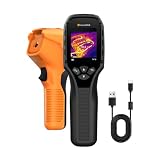
- 【Dual Mode Inspection】Combines thermal imaging with Center/Hot/Cold spot modes for real-time visual temperature display, and integrates thermometer mode for fast point-and-shoot readings with precise digital output. Full-screen thermal imaging enables continuous monitoring of moving targets,ensuring stable observation without loss of detail during dynamic inspections.
- 【User-Friendly Operation】 At just 240g, this compact thermal imager features a non-slip grip and balanced handheld design for comfortable long-duration inspections or mobile use. It offers intuitive button controls for power on/off, menu navigation, and image capture, and supports 7 selectable color palettes, enabling fast switching.
- 【Multi-Scenario Application】It supports a broad measurement range from -4°F to 1022°F with enhanced with adjustable emissivity and distance settings,making it suitable for applications.Equipped with a high-sensitivity sensor (NETD < 50mK), the thermal camera can detect extremely subtle temperature differences as small as 0.05°C.
- 【Quick Anomaly Detection with Alerts 】Featuring a 50° wide field of view, the device enables faster scanning of large surfaces and broader inspection coverage. It supports custom high/low temperature alarms for instant notification when abnormal thermal conditions are detected. Level and span adjustment functions make it easier to clearly identify localized issues.
- 【All-Day Battery Life】Built-in 2500mAh rechargeable battery provides up to 14 hours of continuous operation, supporting full-day inspection without frequent recharging. The device also includes a 1-year warranty, ensuring long-term reliability and peace of mind for using.
Choosing a method by camera availability
Problem: The project uses whichever camera or operator is available and then selects an ASTM label after the survey.
Correction: Define the enclosure question first, select the applicable practice, and procure personnel and equipment that meet that practice and the project plan.
Ignoring the registration date
Problem: The team assumes the February 2026 credit text applies automatically.
Correction: Verify the project’s registration date and current addenda before finalizing the commissioning scope or promising a point.
Decision examples for project teams
Framed exterior wall with suspected insulation gaps
The target is an insulated cavity in a framed wall, and the question is whether insulation is missing, thin, or malfunctioning. C1060 is the relevant named practice. The team plans a qualitative thermographic inspection, records the suspected areas, and independently validates the conditions before calling them confirmed findings.
Large low-slope roof with suspected wet insulation
The roof has insulation above the deck and in contact with waterproofing. The target is wet insulation rather than a generic “roof leak.” C1153 is the relevant named practice. The team schedules nighttime imaging, follows the practice’s meteorological and operator requirements, and uses invasive testing to verify the infrared data. The report does not claim that the scan alone identifies the water-entry point.
Non-frame wall with an unexplained thermal pattern
The image may still be useful diagnostically, but C1060’s scope is limited to frame construction. The team should not claim C1060 compliance for that observation without confirming that the assembly and objective fall within the practice. The enclosure-commissioning lead should document the selected method and its limits in the BECx plan.
What the one LEED point does not mean
Earning the Enhanced Commissioning for Building Enclosure point does not mean every concealed condition has been eliminated or that one infrared scan certifies the entire envelope. The credit requires a commissioning process, appropriate testing, validation, and documentation. Infrared imaging contributes evidence within that process; it is not a substitute for air-leakage testing, water-penetration testing, invasive verification, or corrective work identified by the commissioning team.
The most defensible submission is therefore assembly-specific and evidence-based: it names the governing LEED text, uses C1060 or C1153 for the condition each practice addresses, records the field context, validates suspected anomalies, and keeps conclusions within the methods’ stated limits.
Quick Recap
Product prices and availability are accurate as of the date/time indicated and are subject to change. Any price and availability information displayed on Amazon at the time of purchase will apply.

