Some links on this page are affiliate links: if you buy through them we may earn a commission, at no extra cost to you.
A ground-fault circuit interrupter (GFCI) helps prevent fatal electric shock by watching for a mismatch between current leaving on an energized conductor and current returning through the circuit. If some current leaks through wet equipment, damaged insulation, a grounded surface, or a person, the GFCI opens the circuit quickly and limits the time a person is exposed.
That protection reduces risk; it does not make electricity harmless or prevent every shock. Correct device selection, installation, testing, and compliance with the electrical code adopted by your local jurisdiction are still essential.
As an Amazon Associate I earn from qualifying purchases.
Quick wins for a faster PC:
Repair Windows errors before they cause bigger problemsFix Now →Fix the driver behind crashes, sound loss and screen glitchesFind Drivers →How a GFCI detects a dangerous fault
In a normal circuit, the current flowing out on the energized conductor should return through the intended circuit path. A GFCI continuously compares those currents. When the returning current is slightly lower than the outgoing current, the difference indicates that electricity has found another path.
That unintended path is a ground fault. Damaged insulation, water, a conductive building surface, or a person can provide a route from the power source to ground. If someone is touching energized equipment while also connected to ground, the body can become part of that route. The result can be a severe shock or electrocution.
Popular on Amazon

- 15 amp Non-Tamper Resistant Ground Fault Circuit Interrupter (GFCI) outlet receptacle for indoor use. Please kindly check if the depth of electrical box can fit our GFCI outlets before purchasing.
- The indicator light will turn On GREEN once the power is ON. Press the RESET button to restore power to the GFCI outlet. The LED indicator keeps GREEN no matter you press the RESET or TEST button.
- The ETL certification is a sign of a better quality product. This product has gone through many test procedures before getting its approval which makes it the safest GFCI.
- Back and side wired for easy installation. Decorator wall plate and screws included. Caution: Do not unscrew the terminal screws too far or with excessive force. Do not use power tools to loosen the terminal screws.
- 15A/125V/1875W. Wallplate Included, ETL Listed
The GFCI responds to the imbalance, not simply to the fact that a person touched an energized wire. A person can receive a shock before the device opens the circuit, and a fault that does not create the kind of current imbalance the device is designed to detect may not trip it. The safety benefit comes from interrupting power quickly and reducing the duration of exposure.
The Electrical Safety Foundation International describes the operating principle this way: “GFCIs prevent deadly shock by quickly shutting off power to the circuit if the electricity flowing into the circuit differs by even a slight amount from that returning.” That is an explanatory description, not a guarantee that every contact will be harmless. ESFI’s GFCI explainer provides the underlying explanation.
Why a ground fault can become an electrocution
Normal current versus leakage current
Under normal conditions, current stays within the designed conductors and connected equipment. Moisture or damaged insulation can let it leave that path. The leakage may travel through a metal enclosure, plumbing, a wet floor, a tool, or a worker who is simultaneously in contact with ground.
What changes when a person enters the path
The human body can conduct enough current to cause involuntary muscle contraction, burns, heart-rhythm disruption, or death. A GFCI cannot remove the danger at the instant of contact. Its contribution is to detect the resulting imbalance and disconnect the circuit rapidly, limiting how long the current can continue.
Also popular on Amazon
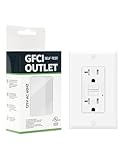
- Certified Safety with US Patent Protection. This GFCI outlet is UL 943 & UL 498 Certified, Class A Rated, ensuring the highest level of ground fault protection. With a 20A/125V/60Hz rating, it’s perfect for both residential and commercial use. Additionally, its US Patent Protected design guarantees unmatched reliability and safety.
- Smart LED for Real-Time Status Monitoring. Featuring a Multi-State LED Display, this outlet provides clear indicators for self-test status, normal operation, fault warnings, and end-of-life alerts. The integrated Test & Reset Buttons allow users to easily check wiring correctness and ensure proper functionality, making it a user-friendly and safety-focused choice.
- Tamper-Resistant and Weather-Resistant Design. Designed with TR & WR Ratings, this outlet protects children from electrical hazards and performs reliably in harsh environments. It has passed the UL Salt Spray Test, ensuring corrosion resistance for outdoor, bathroom, and kitchen use. With an operating range of -30°F to 150°F and up to 95% humidity, it’s built for durability in any condition.
- Advanced Chip for Enhanced Performance. Equipped with an Advanced Chip, this GFCI outlet delivers superior stability, fewer false trips, and faster response times. It detects ground faults at a threshold of less than 6mA and cuts power in under 25ms, providing reliable and efficient protection for your home or workplace.
- Premium Materials for Long-Lasting Reliability. Built with 0.81mm Thick Copper and 0.4mm Silver-Plated Contacts, this outlet ensures efficient current transmission and reduced heat buildup. Its robust construction minimizes plug failure and enhances durability, making it a safer and more reliable choice for everyday use.
What the device does not promise
- It does not make a live conductor safe to touch.
- It does not guarantee that no shock will occur.
- It does not replace sound wiring, dry work practices, equipment inspection, grounding and bonding, or lockout procedures.
- It must be working, correctly connected, and appropriate for the circuit to provide its intended protection.
Three forms of GFCI protection
GFCI protection is available at the outlet, in the electrical panel, or as a portable device. The right choice depends on where protection is needed, what equipment is supplied, the existing wiring, and the configuration required by the locally adopted code.
| Type | Where it is installed | What it can protect | Important conditions |
|---|---|---|---|
| GFCI receptacle outlet | In a standard outlet box, replacing a duplex receptacle | The face receptacle and, when wired correctly, downstream outlets on the branch circuit | Line/load connections must be correct, and the device’s instructions and required labels must be followed |
| GFCI circuit breaker | In the electrical panel | The branch-circuit wiring, outlets, and equipment supplied by that breaker | Panel work and compatibility with the panel and circuit should be handled by a qualified electrician |
| Portable GFCI | Plug-in adapter or extension cord | Connected portable tools and equipment where installed GFCI protection is impractical | It must remain connected and used according to its manufacturer’s instructions; it is not a substitute for required permanent protection |
The U.S. Consumer Product Safety Commission (CPSC) GFCI Fact Sheet identifies these three categories and explains their typical uses.
Recommended Free Tools
Receptacles can protect downstream outlets
A receptacle GFCI can protect both the outlet containing the device and additional outlets farther along the same branch circuit when the conductors are connected to the correct terminals. A wiring error can leave downstream outlets unprotected or prevent the device from operating as intended, so the protection should be verified after installation.
Replacing an ungrounded two-slot receptacle
The CPSC fact sheet notes that a receptacle GFCI may replace an older ungrounded two-slot receptacle. When that approach is used, the supplied “NO EQUIPMENT GROUND GFCI PROTECTED” label must be applied. The label communicates that the receptacle has GFCI protection but does not have an equipment grounding conductor.
Also popular on Amazon

- Designed to improve immunity for reduced High Frequency (HF) nuisance tripping. providing increased compatibility with appliances and other electronics
- Continuously protects against electric shock & electrocution by interrupting power if a ground-fault is detected
- Required by the NEC for areas around the home within a close proximity to a water source (kitchen, bathroom, laundry room, basement, garage/carport, pool area)
- Patented reset/lockout feature prevents reset if the GFCI is unable to respond to a ground-fault or if it isn't wired properly. Regularly conducts an automatic self-test to ensure safety
- LED indicator provides simple, intuitive feedback on power and protection status
Code requirements depend on your jurisdiction
The National Electrical Code (NFPA 70) is a model code. It becomes enforceable only when a state, municipality, or other authority adopts it, often with amendments. The edition in force and local exceptions can therefore change what locations, circuits, or equipment require GFCI protection.
Wet or damp work areas are common examples where GFCI protection may be relevant, but a national overview cannot establish the legally required configuration for a particular project. For a binding answer, check the electrical authority having jurisdiction (AHJ), the permit documents, and the code edition adopted where the work is located. The NFPA 70 code-development page describes the national code process; it is not a substitute for your locally adopted text.
The Tool Desk
Outbyte PC Repair FREERepair Windows errors before they cause bigger problemsFix Now →Outbyte Driver Updater FREEScan for outdated or missing drivers - takes under a minuteDriver Scan →On a construction project, coordinate the electrical plan with the general contractor, the electrical contractor, and the AHJ before rough-in. A portable adapter may be useful for temporary work, but it does not eliminate a requirement for permanent receptacle or breaker protection where the local code calls for it.
How to choose the practical configuration
Start with the protection boundary
- Choose a receptacle GFCI when protection is needed at a specific outlet and possibly the outlets downstream from it.
- Choose a GFCI breaker when the intent is to protect the entire branch circuit from the panel onward.
- Use a portable GFCI adapter or extension cord for temporary connected equipment when installed protection is impractical, while still meeting any permanent-protection requirement.
Verify circuit and equipment compatibility
Before selecting a device, identify the circuit conductors, panel or outlet-box configuration, connected load, and any existing protection. Follow the listing and manufacturer instructions. Do not assume that two devices are interchangeable because they have similar ratings or appearance.
Also popular on Amazon

- Advanced Ground Fault Protection – TG's GFCI outlet is engineered with fast-response ground fault protection, cutting power within milliseconds of detecting a fault to prevent electric shock. Built-in reset and test buttons offer simple manual control and reliable safety in bathrooms, kitchens, garages, and other wet or high-risk areas.
- Self-Test and LED Indicator – Features built-in self-testing to ensure proper operation. An intuitive LED indicator provides real-time feedback: solid green confirms correct wiring, blinking red indicates an open neutral, and solid or blinking red means the GFCI is tripped and needs to be reset.
- No-False-Trip Performance – Enhanced anti-interference design prevents unwanted tripping caused by electrical noise from motors, washers, or exhaust fans. Reliable protection in laundry rooms, kitchens, and utility areas.
- Quick and Easy Installation – Made from high-impact resistant thermoplastic. Tamper-resistant shutters meet 2017 NEC Article 406.12, protecting against insertion of foreign objects while maintaining easy plug-in access. Clamp-type back terminals allow faster and more secure installation compared to traditional wiring methods.
- Certified Safe and Reliable – Rated at 15A, 125V, 60Hz; Feed Through Rating 20A; ETL Listed, complies with Part 15 of the FCC Rules and NEC requirements. Comes complete with matching wall plate and a 3-year product support for added peace of mind.
Use more than price as a selection criterion
A sound comparison considers installation location, which outlets or equipment will be protected, compatibility with the existing circuit and wiring, the device listing, the manufacturer’s instructions, and the configuration required by local code. Price alone cannot establish that a device is suitable or that an installation is compliant.
How to test a GFCI
The CPSC recommends testing every GFCI after installation, at least once a month, after a power failure, and according to the manufacturer’s instructions. The agency’s fact sheet is an older publication, so use the instructions supplied with the installed device if they differ in detail.
Do these 3 things before closing this tab:
1Fix the driver behind crashes, sound loss and screen glitches2Repair Windows errors before they cause bigger problems3Scan for outdated or missing drivers - takes under a minute- Plug a small lamp into the protected receptacle and turn the lamp on.
- Press the receptacle’s TEST button. The lamp should go out as the GFCI interrupts power.
- Press RESET. The lamp should turn on again, showing that power has been restored.
- If the device protects downstream outlets, check those outlets as well, using the device instructions and a safe test load.
- Record the test date for recurring inspections on a construction or facilities-maintenance schedule.
For a breaker or portable unit, use the test control and sequence specified by that product’s instructions. Never open an electrical panel or remove a receptacle cover merely to perform a routine functional test.
Independent reader supportYour contribution helps us test, update, and keep practical guides available for everyone.What to do when the test fails
The TEST button does not interrupt power
If pressing TEST does not turn off the lamp or otherwise interrupt power, stop relying on that GFCI for protection. Do not continue using the outlet as though it were protected. Have a qualified electrician investigate the device, wiring, and circuit, or replace the device in accordance with applicable instructions.
Also popular on Amazon

- Designed to improve immunity for reduced High Frequency (HF) nuisance tripping. providing increased compatibility with appliances and other electronics
- Continuously protects against electric shock & electrocution by interrupting power if a ground-fault is detected
- Required by the NEC for areas around the home within a close proximity to a water source (kitchen, bathroom, laundry room, basement, garage/carport, pool area)
- Patented reset/lockout feature prevents reset if the GFCI is unable to respond to a ground-fault or if it isn't wired properly. Regularly conducts an automatic self-test to ensure safety
- LED indicator provides simple, intuitive feedback on power and protection status
RESET will not restore power
If RESET will not latch or power does not return, leave the device out of service and arrange for qualified troubleshooting. Possible causes include a continuing fault, a wiring problem, loss of supply power, or a failed device; identifying the cause requires safe electrical testing rather than repeated button presses.
A device trips repeatedly
Repeated trips are a warning, not an inconvenience to defeat. Disconnect equipment if it can be done safely, keep people away from wet or damaged components, and have the circuit and equipment checked. Never tape, block, or bypass the TEST/RESET mechanism.
Installation and replacement safety
The CPSC states that receptacle and breaker GFCIs may be installed by a qualified electrician. It allows consumer receptacle installation only when the person has adequate knowledge and skills to follow proper electrical wiring practices and the device instructions. If you are uncertain about conductor identification, line and load terminals, grounding, panel compatibility, or local requirements, use a qualified electrician.
After a receptacle replacement, confirm that the face outlet and any intended downstream outlets respond correctly to TEST and RESET. Keep all required markings visible, including the “NO EQUIPMENT GROUND GFCI PROTECTED” label where an ungrounded two-slot receptacle has been replaced under the permitted method. Do not remove labels simply to improve appearance.
Construction practices that support GFCI protection
- Inspect cords, plugs, tool housings, and temporary wiring before use; damaged insulation can create the leakage path the GFCI is meant to detect.
- Keep connections and portable equipment out of standing water and protect them from rain and construction wash-down.
- Use the portable GFCI form only as directed, and position it where workers can reach its controls for testing and reset.
- After a power failure, test the affected GFCI before returning equipment to service, as recommended by the CPSC.
- Coordinate temporary power, permanent receptacles, and inspections with the project’s electrical contractor and AHJ.
A practical decision checklist
Before energizing a new or altered circuit, confirm:
- The project location and the code edition adopted there are known.
- The selected form—receptacle, breaker, or portable—matches the protection boundary required.
- The device is listed for the circuit and installed according to its instructions.
- Line, load, neutral, and grounding conductors are identified and terminated correctly.
- Required labels remain in place and legible.
- TEST interrupts power and RESET restores it.
- Any failure, unexplained trip, damaged equipment, or uncertainty has been referred to a qualified electrician.
What GFCI protection ultimately changes
A ground fault can place a worker or occupant in the path of current with little visible warning. A functioning, correctly installed GFCI monitors for that leakage and opens the circuit quickly, reducing exposure time and the chance that a shock becomes fatal. It is one layer of an electrical-safety system—not permission to work on energized equipment, not a substitute for code compliance, and not a guarantee against every shock.
Free tools Windows power users keep installed
One-click scans. No signup required.
Quick Recap
Product prices and availability are accurate as of the date/time indicated and are subject to change. Any price and availability information displayed on Amazon at the time of purchase will apply.

