Do these 3 things before closing this tab:
1Clear out junk files and repair common Windows errors2Fix the driver behind crashes, sound loss and screen glitches3Repair Windows errors before they cause bigger problemsSome links on this page are affiliate links: if you buy through them we may earn a commission, at no extra cost to you.
Data centers stay cool through a chain of heat-management decisions: equipment transfers server heat into air or liquid, mechanical systems carry that heat away, and heat-rejection equipment releases it outdoors. The best arrangement depends on the IT load, climate, available water, reliability target, construction budget and how quickly capacity must come online.
A July 25, 2018 report in Building Design + Construction shows why there is no universal cooling winner. In one 30 MW Mexican project, loss of the owner’s water-use privileges forced a redesign around air-cooled chillers and integrated economizer cycles. The same report described liquid immersion cooling as an emerging option, but its comments on adoption and performance were forecasts made in 2018, not current market measurements.
As an Amazon Associate I earn from qualifying purchases.
What cooling a data center actually has to accomplish
Servers convert electrical power into heat continuously. Cooling design must remove that heat at the rack, transport it through the building and reject it outside while keeping temperatures and humidity within the operating range required by the IT equipment. A failure in any link can trigger equipment throttling, shutdowns or damage.
1. Capture heat at the equipment
Most facilities move heat from server electronics into air. Fans push warm air out of equipment racks into a hot aisle, while conditioned air is delivered through a cold aisle or another controlled distribution path. Separating supply and return air reduces mixing and makes the cooling plant more predictable.
Popular on Amazon

- Ventilation Fan: Designed to quietly ASUS GT/RT- AC5300 , cool Xboxs, CPU/ GPU, Playtations, Rokus, TVs, receivers, mondems, routers, DVRs, window fans ,network appliances, DIY aquarium cooling and other audio video electronics
- Variable Speed Control: 110V - 220V Fan power supply with speed control function, turn the knob to adjust the speed, 4V - 12V adjustable fan speed,and can turn off the fan . | Input: 100V - 240V 50/60Hz | Output: DC 3-12V 200-2000ma
- DIY Vertical Window Fan: Can both vertical and horizontal, provide efficient cooling and ventilation. Mining rigs rely on the cooling power of fans for optimal operation.Double Metal Protective, the fan is equipped with double metal protective net
- Easy to Install: Draw out air in refrigerators, provide ventilation in greenhouses, prevent amplifier overheating, and vent hot air from living room consoles like PS4. Y cable connects 2 fans, two fans can be 42cm/16.5 in far away from each other
- Dual Ball Bearing: 240mm x 240mm x 25mm / 9.45in(L) x 4.72in(W) x 1in(H) in in total. | Rated Voltage :12V | Rated Current: 0.93A at full speed | Airflow: (82CFM)x4 at 12V | Speed: 2500 RPMx4
Liquid systems capture heat closer to the chips. A liquid loop can carry more heat in a smaller flow path than air, but it adds pumps, heat exchangers, leak-management procedures and different maintenance skills. Immersion systems take a more radical approach by placing servers in a thermally conductive dielectric liquid.
2. Move heat through the mechanical plant
In a chilled-water design, chillers cool a circulating water loop, and air handlers or in-row units transfer heat from the data hall into that loop. In a direct-expansion arrangement, refrigerant removes heat at the air-handling equipment. Water-cooled plants may use cooling towers or other evaporative heat rejection; air-cooled chillers reject heat directly to outdoor air through condenser coils.
3. Reject heat without compromising uptime
Heat-rejection equipment, pumps, controls and electrical feeds are designed with enough capacity and redundancy to tolerate maintenance or a component failure. The cooling system is therefore part of the critical electrical and controls architecture, not a separate comfort system. Construction teams must coordinate chillers, generators, switchgear, piping, controls, fire protection, structural loads and access for replacement.
Why water availability can change the entire design
Water can support efficient heat rejection, but a facility may face a restricted supply, a high cost for new service, drought risk, discharge limits or a property covenant that prohibits process water. Robert Ioanna, PE, LEED AP, a senior principal at Syska Hennessy Group, summarized the 2018 concern this way: “Right now, the big trend is water.” His comment referred to operators examining environmental impact and to systems designed to use little or no water.
The Mexico redesign
The report described a planned 300,000-square-foot, 30 MW data center in Mexico. Water cooling was the initial plan, but the property owner later revoked water-use privileges. Syska Hennessy then changed the mechanical and electrical design to use air-cooled chillers with integrated economizer cycles.
Also popular on Amazon
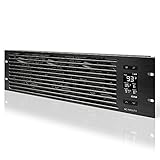
- An intelligent fan system designed for cooling audio video, DJ, server, network, and IT equipment racks.
- Protects rack-mount equipment from overheating, performance issues, and shortened lifespans.
- Programmable thermostat controller with automated speed control, alarm warnings, and backup memory.
- Premium anodized aluminum construction with CNC-machined detailing for a professional appearance.
- Size: 3U Rack Space | Design: Intake | Airflow: 60 to 300 CFM | Noise: 12 to 38 dBA | Bearings: Dual Ball
An economizer cycle allows the plant to use favorable outdoor conditions to reduce compressor operation. Depending on the design, the economizer can use outdoor air directly or use cool outdoor conditions on the heat-rejection side of a hydronic system. The Mexican project demonstrates that a change in water rights can affect chillers, electrical capacity, space planning and controls together; it does not prove that air cooling is the best solution for every site.
Can a data center be cooled without water?
Yes. Air-cooled chillers, dry coolers and other heat-rejection arrangements can avoid routine evaporative water use. The trade-off is site-specific: designers must evaluate outdoor temperatures, humidity, equipment efficiency, sound, footprint, electrical demand, maintenance access and the cost of adding redundant capacity. The 2018 account supplies no controlled measurements that rank water-cooled and air-cooled systems on energy, capital cost or reliability.
| Approach | Water dependence | Where it can help | Questions the project team must answer |
|---|---|---|---|
| Air-cooled chillers with economizer cycles | Can be designed with little or no routine process-water use | Sites with constrained water service or strong seasonal outdoor conditions | How will peak heat and hot-weather performance be handled? What extra plant and electrical capacity is required? |
| Water-cooled or evaporative heat rejection | Depends on the cooling-tower or evaporative configuration; exact consumption is not stated in the 2018 report | Projects where water service is dependable and the efficiency and footprint case is favorable | What are water rights, treatment, blowdown, drought and discharge requirements? |
| Liquid immersion cooling | Uses a dielectric fluid at the IT enclosure; the report does not establish facility-wide water consumption | High-density racks or deployments seeking lower fan power and higher allowable operating temperatures | How will servers, fluid handling, filtration, service procedures, fire protection and supply-chain compatibility be managed? |
This is a decision framework rather than a performance ranking. The 2018 source gives one project example and qualitative descriptions, not comparable test data.
What liquid immersion cooling means
In liquid immersion cooling, servers are submerged in a thermally conductive dielectric liquid. The fluid contacts components that would ordinarily be cooled by air, absorbs their heat and transfers it to a secondary heat-rejection loop or another exchanger.
Why designers considered it
Page principal John Major said immersion cooling typically did not require fans and allowed operation at hotter temperatures. Eliminating or reducing server fans can simplify airflow management and recover fan power. Higher allowable temperatures may also expand the conditions under which heat can be rejected without intensive mechanical chilling.
Also popular on Amazon

- [Adjustable] Adjustable temperature control helps ensure optimal performance for your rackmount such as network, server, music, and AV cabinets
- [Quiet and powerful] Equipped with three powerful 4” (120mm) noise control ball bearing fans capable of pumping 225 CFM of air, preventing overheating of expensive equipment
- [Optimal Airflow] This three fan cooling system will provide excellent cooling with its high-performance fans, which keep the hot air stream away from your setup with its top exhaust cool air system.
- [Compact Design] Device is standardized to mount to any 19" server rack or cabinet while taking only a single unit (1U) of space and has a wide variety of applications.
- [Programmable] Equipped with a programmable thermostat sensor controller for better temperature monitoring that will trigger fans based on your parameter configuration.
Those statements were a forecast in a 2018 article. The article did not provide adoption rates, lifecycle cost, measured energy savings, fluid-life data or a comparison with conventional chilled-water systems. Owners considering immersion must verify current equipment compatibility, warranty terms, fluid safety, leak detection, filtration, maintenance training and how technicians will remove and service submerged hardware.
Immersion is a facility system, not a tank purchase
A viable deployment needs an IT enclosure strategy, pumps or passive circulation, heat exchangers, controls, fluid management, spill containment and a plan for draining or isolating a tank during service. It also changes rack layouts, cable routing, lifting requirements and the way technicians handle failed servers. The mechanical engineer, electrical engineer, architect, commissioning agent and IT operator should agree on these interfaces before procurement.
Why scale and speed matter as much as cooling technology
The 2018 report placed cooling decisions in a rapidly expanding construction market. It attributed 583.5 MW of new data-center capacity absorbed across the United States, Canada, Europe and Asia Pacific in the preceding year to JLL, with at least 400 MW more under construction. Those are historical figures tied to the period before July 25, 2018, not current market estimates.
The article also reported that the top five contractors put in place $4.4 billion worth of mission-critical facilities in the preceding year. It attributed a separate finding to Site Selection Group: seven of the 13 biggest data centers under construction reportedly exceeded one million square feet. The dollar figure and the size count are secondhand attributions in the 2018 article and should not be treated as an independently verified present-day ranking.
PC Slower Than It Used to Be?
A free scan shows the junk files, broken settings and background clutter dragging Windows down - then fixes them in one click.Free scan · Windows 10 & 11Outdated Drivers Are Slowing You Down
One free scan finds every outdated or missing driver and matches the right update for your exact hardware.Free scan · exact hardware matchPhasing can reduce first cost and delivery time
John Major observed that “tranches of deployment have been scaled down dramatically to facilitate faster speed-to-market and lower first-tranche cost.” Instead of building every megawatt on day one, an owner can construct a shell, utility backbone and initial data hall, then add later modules as demand is contracted. That approach affects chiller staging, pipe headers, electrical rooms, generator yards, structural loading and the location of future equipment.
Also popular on Amazon

- Adjustable temperature control helps ensure optimal performance for rackmount such as network, server, music, and AV cabinets
- Noise controlled fans makes the cooling system useful for a quiet office or business space
- Compact design mounts to any 19" inch cabinet and takes up only 1 unit of space
- Simple and easy to use LCD display allows user to control temperature
- Air pumped through to the top exhaust system of the fan
Phasing is not simply a financial choice. A partially built plant still needs safe maintenance paths, tested controls, fire separation and enough redundancy for the live load. Commissioning should prove each stage without relying on equipment that belongs to a later phase.
Colocation and cloud demand drive different schedules
Ben Kaplan, senior vice president and general manager of Turner Construction’s Global Critical Facilities Group, said demand for colocation data centers “remains quite strong,” even as cloud providers build their own facilities. Colocation projects may need flexible suites, metering and customer turnover, while a single-tenant cloud campus may optimize for a repeatable prototype. Both models must align cooling capacity with the actual IT deployment schedule rather than the ultimate building envelope alone.
Project examples that show the broader design problem
QTS Project Joshua, Ashburn, Virginia
The report described QTS Project Joshua as a 445,000-square-foot greenfield facility with 32 MW of capacity. It included 180,000 square feet of raised-floor space and 60,000 square feet allocated to office and storage uses. Its walls were designed to withstand 125 mph winds.
The Tool Desk
Outbyte PC Repair FREEClear out junk files and repair common Windows errorsFree Scan →Outbyte Driver Updater FREEFix the driver behind crashes, sound loss and screen glitchesFind Drivers →The example illustrates that a data center is also a large industrial building. Structural criteria, loading docks, equipment yards, office areas, security zones and maintainable circulation must be planned alongside the cooling plant. Wind resistance does not replace cooling redundancy, but it shows how site hazards and building enclosure requirements enter the same early design decisions.
Raging Wire’s Garland, Texas, campus
The article reported a planned 42-acre campus with five buildings, one million square feet and 80 MW of IT load. The first phase, TX-1, measured 201,000 square feet and 16 MW and had been completed in June 2017.
Also popular on Amazon
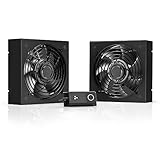
- A quiet fan kit designed for standard 19” racks, to be mounted on the roof or to replace existing fans.
- Features a speed controller utilizing PWM which can control the fan's speed without generating noise.
- Compatible with CLOUDPLATE series rack fans and can be linked to share the same programming.
- Heavy-Duty steel construction with spiral fan guards, mounting hardware, and power adapter.
- Size: Standard 120mm Rack Fans | Fans: 2 | Airflow 200 CFM | Noise: 26 dBA | Bearings: Dual Ball
Major noted that “Data centers aren’t typically workplaces,” explaining why the project included amenities. Even highly automated facilities need operators, security staff, maintenance technicians and commissioning teams. Break rooms, offices, storage and safe routes to mechanical equipment influence the usable program and the way a campus can be operated during an outage or maintenance event.
BBVA Technology Center, Atizapan, Mexico
The report described the BBVA Technology Center as a 31,025-square-meter Tier IV data center in an earthquake region. It said the design used progressive-collapse strategies and a foundation isolator.
Free tools Windows power users keep installed
One-click scans. No signup required.
Those are project details attributed to the 2018 report, not independent verification of the facility’s current rating or operation. They show why cooling cannot be separated from resilience: seismic movement, structural continuity, equipment anchorage and utility routing all affect whether a cooling plant remains available after a major event.
Independent reader supportYour contribution helps us test, update, and keep practical guides available for everyone.A practical design process for owners and construction teams
1. Establish the real IT load and deployment pattern
- Define current and ultimate IT megawatts, rack density, temperature limits and any high-density computing zones.
- Separate committed load from speculative future capacity so the plant can be staged without stranded equipment.
- Map the sequence of energization, commissioning and customer turnover.
2. Secure the site’s water and utility facts
- Confirm water rights, service capacity, drought restrictions, treatment requirements, discharge permits and the owner’s contractual conditions.
- Ask whether process-water use is allowed continuously, only seasonally or not at all.
- Verify electrical service, fuel storage, noise limits and space for heat-rejection equipment before selecting a cooling topology.
3. Model climate and operating conditions
Use the site’s design temperatures, humidity, dust and seasonal conditions to determine when economizers can operate and how much mechanical cooling is required during extremes. Check the transition controls carefully: a system that works efficiently in mild weather still needs stable operation during the hottest design day, a sensor failure or a blocked airflow path.
4. Compare options on the same basis
Evaluate water use, energy use, capital cost, maintainability, reliability, footprint, noise, construction schedule and replacement access together. Do not label one technology the winner using a single metric. The 2018 article provides no comparable measurements across those axes, so project-specific modeling and vendor documentation are essential.
5. Design for failure and maintenance
- Provide isolation valves, bypasses, spare capacity and safe access for pumps, chillers, heat exchangers, controls and air-handling equipment.
- Coordinate cooling redundancy with generator and switchgear redundancy; a mechanically redundant unit is not useful if its electrical source is a single point of failure.
- Plan leak detection, drainage and containment for hydronic or immersion systems, and document recovery procedures before live IT is installed.
- Commission controls under normal, peak, economizer and failure scenarios, then train the operations team on the exact sequences.
6. Protect the building and the people who operate it
Wind, seismic movement, fire, flood and security requirements should be reflected in structural design, equipment anchorage, pipe flexibility, fire separation and site grading. Provide clear routes for heavy replacements and enough workspace to service equipment without taking an entire cooling block offline.
Quick wins for a faster PC:
Fix the driver behind crashes, sound loss and screen glitchesFind Drivers →Clear out junk files and repair common Windows errorsFree Scan →What the 2018 evidence can—and cannot—tell you
The project accounts are useful examples of how owners respond to water constraints, growth, speed and hazards. They are not controlled comparisons. The article does not establish present-day adoption of immersion cooling, current equipment performance, current supplier availability or current market capacity. Its 583.5 MW, 400 MW, $4.4 billion and construction-size figures describe the period immediately before July 25, 2018.
For a new facility, the durable lesson is the decision method: lock down water and utility rights early, match cooling capacity to the actual deployment sequence, model the local climate, and integrate resilience and maintainability into the building and electrical design. Air-cooled chillers with economizer cycles solved a specific constraint in the reported Mexico project; immersion cooling was presented as a possible future direction; neither example removes the need for site-specific engineering.
Quick Recap
Key takeaways for a data-center project
- Cooling starts with heat capture at the rack and ends with reliable outdoor heat rejection.
- Water availability can force a redesign of mechanical, electrical and controls systems, as the reported 30 MW Mexico project demonstrates.
- Air-cooled, water-cooled and immersion approaches have different infrastructure, maintenance and risk profiles; the cited article does not rank them.
- Immersion cooling means submerging servers in dielectric liquid; the 2018 forecast about fewer fans and hotter operation requires current verification before adoption.
- Large campuses must solve phasing, structural hazards, staffing, access and commissioning in addition to cooling.
Product prices and availability are accurate as of the date/time indicated and are subject to change. Any price and availability information displayed on Amazon at the time of purchase will apply.

