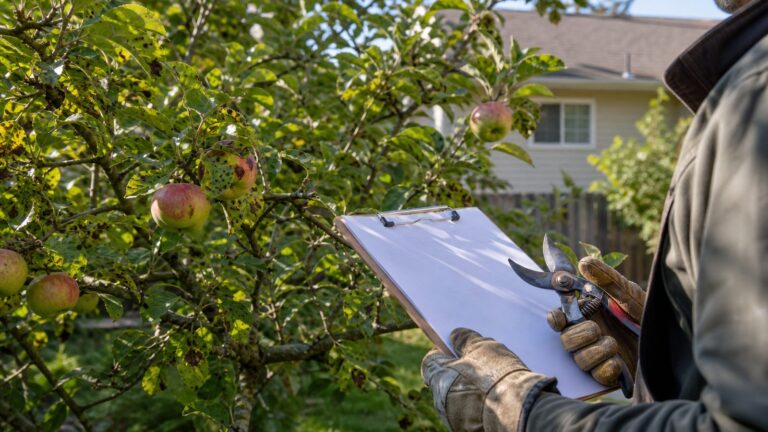
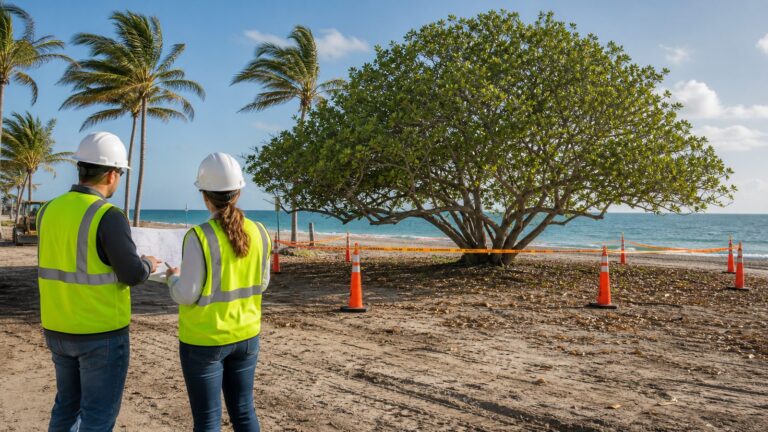
Construction can damage a tree even when its trunk is untouched. Excavation may sever roots, heavy equipment can compact the soil, and changes to grade or drainage can deprive roots of the conditions they need. Because most roots develop in the top 12 inches of soil and may extend beyond the branch spread, paving, trenching, or soil work near a tree can have consequences that are not visible at first. The safest approach is to involve an ISA Certified Arborist during planning, establish site-specific protection limits, and keep construction activity within those limits.
Why work near a tree can affect its health
A tree depends on a broad, shallow root system for water, oxygen, and physical support. The International Society of Arboriculture (ISA) says most tree roots develop in the top 12 inches (30 cm) of soil, and roots may extend beyond the spread of the branches. The visible trunk and canopy therefore do not show the full area that construction may affect.
As an Amazon Associate I earn from qualifying purchases.
That does not mean every tree needs the same setback from a building or work zone. A safe protection area depends on the individual tree and site. Species, condition, soil, proposed work, and stability all matter; there is no universal radius that guarantees construction will be harmless.
Quick wins for a faster PC:
Repair Windows errors before they cause bigger problemsFix Now →Fix the driver behind crashes, sound loss and screen glitchesFind Drivers →Clear out junk files and repair common Windows errorsFree Scan →Damage may involve the roots, the soil around them, or the parts of the tree above ground. A tree can be wounded or stressed without showing an immediate change, and the effects may emerge over time. ISA warns that construction damage can take many years to affect a tree and may ultimately be deadly.
#1 Best Overall

- Valued Carpenter Pencil Set: You will get 2 pcs solid carpenter pencils with 26 piece 2.8 mm refills, 1 replaceable sharpener, 1 plastic storage box.The complete carpenter pencils combination allows you to finish your work faster and more easily
- Deep Hole Marker Pencil: The deep-hole construction pencils adopts 45mm elongated tip design, which is more convenient to mark in the small hole or in other tight areas that other carpenter markers cannot reach
- Carpenter Pencils with Sharpener: The sharpener is screwed into the top of the work pencil, which won't get lost either. Built-in pencil sharpener that keep the lead with pointed and smooth to Improves line of sight in fine work
- Stronger Solid Lead: This work pencil is matched with a 2.8 mm thick lead , which is much thicker and stronger during the drawing process of construction work, it will not break or damage easily
- Marks on Various Surfaces: 3 colors solid construction pencil can marks on various surfaces,such as metal, plastic, wood, paper etc. Ideals for woodworkers, contractors, craftsmen, builders, merchants and masons
What construction activities can do to roots and soil
Excavation, trenching, grading, and paving
Digging for foundations or utilities can cut roots directly. Grading can remove soil containing roots or bury roots under added soil; paving can cover the root zone and change water movement. The same work can affect a tree differently depending on where it occurs and what the site is like, so the presence of a shallow trench does not by itself establish that an injury is minor.
Root damage can also affect support. If roots are cut or the surrounding soil is disturbed, the tree may become less stable, particularly if other site changes increase the forces on it. An arborist should assess structural concerns rather than relying on the tree’s appearance alone.
Heavy equipment and soil compaction
Repeated traffic or equipment weight presses soil particles closer together. Compacted soil is denser, which slows root growth and restricts both water penetration and the oxygen available to roots, according to ISA. Keeping equipment out of the designated protection area helps prevent this less-visible form of injury.
Recommended Free Tools
Rank #2

- Ergonomically Designed: Work in tight areas with a compact design that gets into tough spots
- Compact and Lightweight: Both tools are designed to fit into difficult to reach spaces. The 1/4" impact driver has a length of 5.55 in. and weighs just 2.8 lbs, while the 1/2" drill/driver measures only 7.5 in. and weighs 3.6 lbs
- Both the DEWALT impact driver and electric drill driver feature integrated LED work lights with a convenient 20-second delay, ensuring enhanced visibility in dimly lit or challenging work areas
- One-Handed Loading - Keep one hand free with a 1/4 in. hex chuck that accepts 1 in. bit tips
- Power drill cordless with 1/2" single sleeve ratcheting chuck provides tight bit gripping strength, making bit changes faster and more secure
Changes to soil level, drainage, and water conditions
Adding soil can cover roots and interfere with their access to air. Removing soil can expose or damage them. Either kind of grade change, as well as altered drainage, can change the water and oxygen conditions around the roots. A tree may be stressed by waterlogging or by reduced water availability, depending on how the work changes the site; preserving the existing grade and drainage is therefore an important planning consideration.
Wounds, spills, and changes around the tree
Equipment can strike trunks, root collars, and branches. Fuel spills or concrete-wash runoff can change soil chemistry and reduce root growth and function. These hazards call for site controls as well as care with excavation: a barrier will not help if materials are stored or spilled within the area it is meant to protect.
Removing nearby trees can also change conditions for those left standing. A previously sheltered tree may face more wind or sunlight, increasing stress or contributing to structural failure. The effect of clearing should be considered alongside direct damage from the construction footprint.
Rank #3

- 【Great Compatibility】This Katerk 1/4 inch hex shank bit holder is specifically designed for 1/4 inch hex shank drill bits. It's compatible with most 1/4 fast hex handles, hex sockets, various electric screwdrivers, and handheld screwdrivers. The bit holder makes it a valuable addition for any handyman.
- 【Secure and Safe】Built with a secure backup nut design, each drill bit holder securely locks onto your bits, ensuring they stay firmly in place. Additionally, our bit holder incorporates a high-quality steel ball rolling design that holds up to several kilograms of weight, ensuring your various drill bits don't fall off.
- 【Easy One-Handed Operation】The bit holder for impact driver allows you to change bits single-handedly, simplifying your workflow. Its multi-color design further allows for quick identification of the drill bit you need.
- 【Compact and Convenient】Thanks to its compact size, this 1/4 inch bit holder is easy to carry around. The bit holder allows for easy attachment to various tools, making this a convenient addition to your construction accessories. The Katerk bit holder is cast from high-quality alloy material, promising a long product lifespan. Despite its rugged strength, the bit holder remains lightweight, making it portable.
- 【Cool Christmas Gift For Men Stocking Stuffers】 This screwdriver bit holder, driver bit holder, impact bit holder, can be given as a gift to your loved one, especially for anyone involved in construction or electrical work. It's a must-have for stocking stuffers for men and women, tools gifts for dad, tech gadgets for men, gifts for dad, gifts for him, gifts for husband, gifts for boyfriend, cool gadgets for men, and cool gifts for dad.
How to protect trees before construction starts
Plan tree protection before equipment arrives or the work area is fixed. An ISA Certified Arborist can identify which trees are candidates for retention, assess their condition, and work with the builder to set a tree protection area and limits on activity. The plan should account for the actual work, including access, excavation, storage, fill, and utilities—not just the building’s footprint.
- Bring an arborist into project planning. Arrange an assessment while the layout and construction methods can still be adjusted. Ask the arborist to identify trees to retain and define the protection area and activities that must stay outside it.
- Coordinate the plan with the builder. Make the boundaries and restrictions clear to the people directing equipment and site work. Keep machinery, excavation, fill, and material storage out of the specified protected area.
- Review utility routes and other unavoidable work. If a utility must pass near roots, ask the project arborist and builder to assess a less damaging installation method. ISA notes that alternatives such as tunneling or different trenching methods exist; no method should be assumed harmless without evaluating the tree and site.
- Plan any necessary root cutting in advance. Root pruning near an excavation should be directed by an arborist before work begins. Where feasible, planned cuts can be made cleanly rather than leaving roots to be torn unpredictably by equipment.
- Set controls for above-ground and chemical hazards. Include measures to prevent impacts to trunks, root collars, and branches, and to keep fuel and concrete-wash runoff away from protected soil.
- Revisit the limits if the work changes. A changed route, excavation area, or construction method may create a new conflict with roots or drainage. Check the plan with the arborist rather than treating the original boundary as permission to disturb any newly affected area.
Protection is about controlling activity, not drawing a line that makes every project safe. The appropriate area and methods must be set for the particular tree and site. A tree protection barrier is useful only when the work plan and site practice respect it.
Choosing a lower-impact approach near roots
There is no single construction method that is best for every site. Compare proposed approaches by how much root disturbance and soil compaction they may cause, whether they preserve existing grade and drainage, whether they work with the utility or site constraints, and whether a qualified arborist has assessed the specific tree. The available ISA guidance does not set universal numeric thresholds for these comparisons.
Rank #4

- Long Nib and Deep Hole Marker: Our mechanical carpenter pencil with 45mm nib is designed for easy marking of deep holes or narrow areas. These construction pencils are the great choice for woodworking tools, construction tools, carpenter tools, contractor tools, wood carpentry tools and architect tools
- Extra Refills in 2 Colors for Versatile Marking: The construction mechanical pencil comes with 12 extra 2.8mm refills, including 6 red and 6 black refills. The black refill is suitable for light surfaces, while the red wax is perfect for dark surfaces. Our carpenter mechanical pencil makes sure that you'll have an ample supply for extended use
- Built-in Sharpener: Our construction pencil comes with a built-in sharpener to ensure the mechanical pencil tip is always sharp and ready for use. Never buy an extra pencil sharpener again. A great tool for any woodworker pencil, contractor pencils. The refill can easily be extended or retracted with a simple click of the pencils mechanical, allowing you to work more efficiently and accurately
- Portable Clip Design: Our deep hole construction pencil features a portable clip design, easy to carry and attach to your pocket or tool box, so that you can keep the carpenter pencils mechanical close at hand, making it a convenient tool to have on the go. Great gifts choice for carpenters
- Stronger Pencil Lead: The black refills are made of lead, sturdy and smooth. The red refills are made of wax, clear and light. These marking pencils are much thicker and stronger than normal pencils during the marking process of construction work, suitable for various surfaces, such as glasses, metal, boards, floors, walls, furniture, etc. The written marks can be easily wiped with a wet paper towel when needed
| Work approach or condition | What to weigh | Practical direction |
|---|---|---|
| Excavation or trenching near roots | Potential for roots to be cut, torn, or exposed; location and extent of disturbance. | Have the arborist review the route and limits before work. Where roots may be affected, plan the method rather than allowing equipment to determine the cut. |
| Tunneling or another utility route | Whether it can reduce disturbance at the root locations while remaining feasible for the site and utilities. | Discuss alternatives with the project arborist and builder; do not assume any method eliminates risk. |
| Equipment access or material storage | Potential for compaction and repeated disturbance to protected soil. | Keep traffic and storage out of the specified protection area and plan access routes before work starts. |
| Changing grade or drainage | Whether roots will be buried or exposed, and how the change may affect water and oxygen conditions. | Review the effects with the arborist and builder before changing soil levels or directing water differently. |
What to do if construction has already damaged a tree
Start with an arborist’s assessment of the tree’s viability and structural risk. A visible wound or decline does not by itself show how much of the root system remains functional, and a tree that looks normal immediately after work may still have been injured. The assessment should guide whether pruning, support, soil treatment, or another action is appropriate.
Address site conditions and basic care
Maintain adequate water, but do not overwater; correct poor drainage where it is contributing to stress. ISA describes a 2–4 inch layer of organic mulch over the root system as one possible treatment to condition soil, moderate temperature and moisture, and reduce competition from grass and weeds. Follow site-specific advice and keep mulch away from the trunk rather than piling it against the bark.
What’s actually slowing this PC down?
Pick the symptom - the matching free tool is one click away.
Root-zone aeration, including air excavation, may be considered in some cases, but it is not a universal fix. The arborist should determine whether it is suitable for the site and what problem it is intended to address. Mulch or aeration cannot restore roots that have been severed or make severe compaction harmless.
Best Value

- Milwaukee Ink all Fine Point Marker, Black, 4 Per Pack
- 4 per pack Features Clog Resistant Marker Tip Writes through Dusty, Wet and Oily Surfaces Durable Marker Tip for Writing on Concrete, OSB and Rough Surfaces
- Clog resistant tip writes on dusty, wet and oily surfaces and is optimized for rough surfaces such as OSB, cinderblock and concrete
- Hard hat clip- attaches for easy access
- Quick dry time with reduced smearing and marking
Be cautious with fertilizer
ISA advises against routine immediate fertilization after construction injury. Quick-release fertilizer salts can draw water from roots, while excess nitrogen can favor shoot growth over root growth. Fertilization after recovery should be based on the tree’s needs and appropriate testing, not used as an assumed treatment for construction damage.
Have pruning and support decisions professionally assessed
Depending on the arborist’s findings, care may include removing broken or dead branches or using a support system. Neither action is automatic: pruning and support should be selected for the tree’s condition and risk, not as a substitute for understanding what happened below ground.
Signs of decline and why timing matters
Monitor the tree over time for smaller or fewer leaves, crown dieback, and leaves changing color earlier than usual in fall. These signs can indicate stress, but they can have multiple causes; they are reasons to seek a diagnosis, not proof that construction is responsible. Because injury can take years to become apparent, a lack of immediate symptoms does not establish that the tree was unaffected.
Windows Errors? Fix Them Before They Spread
Repair common Windows errors and clear accumulated junk for a smoother, more stable PC - no reinstall needed.Free scan · no reinstallCrashes, No Sound, or Screen Glitches?
Random freezes, missing sound and display glitches usually trace back to one bad driver. Find and replace yours safely.Free scan · under a minuteTake particular care with suspected instability, major breakage, or a worsening canopy. Ask an arborist to assess structural risk and recommend next steps. Avoid making a safety decision from photographs or foliage symptoms alone when a tree’s stability is in question.
What a protection plan cannot promise
Arborist involvement and site controls reduce avoidable disturbance, but they cannot guarantee that a retained tree will remain healthy. The sources do not establish a universal safe distance, a percentage of roots that can be removed without harm, or a standard treatment that reverses construction injury. Each decision—where to place a barrier, how to route a utility, whether a damaged tree can remain—depends on the tree, the site, and the proposed work.
The practical standard is to make those decisions before construction, communicate them to the people doing the work, and have a qualified professional assess injury or risk when conditions change or symptoms appear.
Quick Recap
Product prices and availability are accurate as of the date/time indicated and are subject to change. Any price and availability information displayed on Amazon at the time of purchase will apply.
Do these 3 things before closing this tab:
1Clear out junk files and repair common Windows errors2Fix the driver behind crashes, sound loss and screen glitches3Repair Windows errors before they cause bigger problems