Recommended Free Tools
Some links on this page are affiliate links: if you buy through them we may earn a commission, at no extra cost to you.
Campus security now affects a university project before an architect draws the first floor plan. Decisions about entrances, card access, circulation, lighting, landscaping, sightlines, cameras, alarms and communications infrastructure can determine how a building meets the street, which users can enter each zone and how quickly staff can understand an incident.
The difficult part is balancing protection with the openness that makes a campus educational and civic space. A secure project is not simply a building with more locks or cameras. It is a coordinated design in which public safety, information technology, administrators, architects, engineers, contractors and facilities staff agree on risks, responsibilities, operating procedures and the experience the institution wants visitors, students and employees to have.
As an Amazon Associate I earn from qualifying purchases.
Security starts with the campus mission, not a hardware list
Universities combine classrooms, laboratories, residences, libraries, athletics venues, offices, medical or research spaces and public gathering places. Each has a different mix of users, hours, valuables, privacy requirements and consequences if access fails. A residence hall may need controlled entry while still allowing residents to receive visitors. A laboratory may require tighter authorization than a lecture hall. A public plaza may need visibility and emergency access rather than a perimeter that blocks normal circulation.
That variety makes a single security rule impractical. Planning should begin by mapping people, activities and assets across the site, then assigning an appropriate level of control to each space. The resulting decisions affect the building footprint, number and location of entrances, reception and security desks, door hardware, elevator or stair access, service routes, glazing, lighting and the pathways used by emergency responders.
Popular on Amazon

- AI Motion Detection 2.0 – Driving AI to the next level, human&vehicle detection and flexible detection area are more accurate than before. For quicker locating in crucial moments, human&vehicle smart searching in recordings offers you great help.
- Tried-and-True Safe Guard – This one-stop security solution can work with TVI, AHD, CVI, CVBS & IP cameras, the kit includes 1080P cams. The 8CH 3K lite DVR can hook up with 1080P@30fps or 3K/5MP@20fps cams. Therefore, you can also DIY it with other cameras in your home.
- Reliable 24/7 Continuous Recording – With a pre-installed 1TB HDD(Support up to 10TB HDD), providing 24/7 surveillance recording for you. Upgraded H.265+ saves more storage space and uses less bandwidth, recording videos longer and smoother viewing.
- Remote Access Anytime, Anywhere – Stay connected through the ANNKE Vision app. View live footage, play back recordings remotely, and check in on your property anytime, anywhere for convenient home security and greater peace of mind.
- Clear Night Vision and IP67 Weatherproof Protection – Built-in IR LEDs provide black-and-white night vision up to 100ft. With an IP67-rated design, these wired security cameras are built to withstand rain, dust, and changing weather conditions for reliable outdoor surveillance.
Frank Demes, who was interim chief of the Office of Safety and Security at George Washington University when the feature was published, summarized the responsibility this way: “Everything we build has a security component.” Treating security as a late equipment package can force expensive changes to walls, ceilings, power, data pathways and door schedules. Treating it as part of the building program allows the design team to resolve conflicts while the plan is still flexible.
Bring public safety, IT and the AEC team together early
Security decisions cross professional boundaries. Public safety staff understand patrols, incident response and access policy. IT teams understand networks, identity systems, radio coverage and data governance. Administrators set the institution’s priorities and tolerance for inconvenience. Architects and engineers translate those requirements into spaces, structure, lighting, power, communications and egress. Contractors and commissioning teams must install, test and document the result, while facilities staff operate it for years.
Free tools Windows power users keep installed
One-click scans. No signup required.
Early workshops should assign an owner for each decision and identify interfaces between systems. For example, a card reader is not only a door-hardware choice: it requires a location that supports queuing and accessibility, power and data, a credential policy, a method for unlocking during emergencies, and a maintenance plan. A camera is not only a device on a pole or ceiling: its field of view depends on architecture, landscaping, lighting, network capacity, retention policy and who reviews footage.
Joseph Collins, FAIA, NCARB, LEED AP, a ZGF Architects partner at the time, warned against treating buildings as isolated objects: “All too often, buildings on campus are thought of as islands in a stream. The trick is to approach site infrastructure, landscape, and design as an integrated process.” A project team can make that principle practical by reviewing the building and its surrounding routes together at programming, schematic design, design development, construction-document and commissioning milestones.
Access control changes the plan from the front door inward
Controlled access works best when the plan makes the intended sequence obvious. A visitor should be able to identify the public entrance, understand where to check in and avoid wandering into staff-only circulation. Residents, students, employees, service workers and emergency responders may need different routes or permissions. Separating those flows can reduce accidental access and make unusual movement easier to notice.
Choose entrance patterns that match the use
- Single monitored entrance: Concentrating arrivals at one staffed or monitored point can simplify screening, visitor assistance and camera coverage. It also requires careful planning for queues, deliveries, accessibility and after-hours operation.
- Multiple controlled entrances: Several card-controlled doors can support a large or distributed building, but each opening adds readers, communications, maintenance and a need for consistent policies.
- Layered entry: A public lobby can lead to card-controlled interior zones, allowing the institution to remain welcoming while protecting offices, residences, laboratories or collections.
The appropriate pattern depends on the sensitivity and function of each space rather than on a universal campus standard. Door locations should be checked against fire and life-safety requirements, inclusive access, egress capacity, deliveries and the hours when a desk is staffed. Security cannot justify blocking required exits or creating routes that people will bypass.
Do these 3 things before closing this tab:
1Repair Windows errors before they cause bigger problems2Scan for outdated or missing drivers - takes under a minute3Clear out junk files and repair common Windows errorsUse differentiated permissions
Card access can distinguish students, faculty, staff, contractors and visitors, and it can limit entry by building, floor, room or time. New York University was described in the 2015 feature as using different access levels, with card access for students and staff and added controls for sensitive areas. The design implication is that readers, doors and controlled zones must be located where the policy makes sense; placing readers deep inside a lobby or at an awkward turn can create tailgating, congestion or an incentive to prop doors open.
Also popular on Amazon

- 【Local & Remote Control】 The home security camera system support local view & control, no need WiFi, true play & plug. For remote control, support dual-band WiFi 2.4GHz/5GHz connectivity. WiFi pro technology offers 100ft installation distance, suitable for indoor/outdoor use.
- 【Corded Powered, 24/7 Recording】 Hiseeu security camera system, 24/7 wired power of cameras and NVR support 24/7 recording, no dropouts or battery hassles. 3 recording modes (24/7 recording, motion-triggered recording, or customized recording ), total flexibility.
- 【1TB Storage, No Monthly Fee】 Security camera system pre-installed in 1TB hard drive, massive local storage (No subscription fee!) offering over 45 days of continuous 24-hour recording. H.265+ bandwidth optimization Delivers 50% bandwidth reduction compared to H.264 while maintaining 4K/8MP resolution, enabling stable transmission even in low-bandwidth environments.
- 【Expand to 10CH & IP66 Waterproof 】 The NVR security camera system is coming with 4pcs 5MP cameras+1pc 4K NVR with 10" Monitor, it supported to expand to 10CH, scalability to secure large homes or businesses. Operates flawlessly in heavy snow, high winds, and sub-zero temperatures
- 【Motion Sensor/AI Human Detection】 Motion detection of the wireless wifi security camera system give you 24/7 uninterrupted protection. Smartly distinguishes people from false alarms (like pets or shadows), sending alerts only for real threats by AI human detection
A project brief should document who authorizes credentials, how lost cards are deactivated, which doors fail locked or unlocked under defined conditions, and how temporary access is handled. Those operating choices belong in the design conversation because they influence reception space, staff work areas, signage and wiring.
Apply CPTED through site, landscape and circulation decisions
Crime prevention through environmental design (CPTED) treats the physical environment as part of security. John Kleberg, a security-risk consultant quoted in the feature, described it as “design that incorporates interior and exterior security with territorial reinforcements that define the space.” In practice, that means people can recognize what an area is for, see who is approaching and tell which routes are public, semi-public or restricted.
Make visibility useful, not merely bright
Lighting should support faces, entrances, signs, paths, stairs, parking approaches and service areas without creating glare or deep contrast that hides movement. Fixture locations and maintenance access matter as much as initial illumination. Interior layouts can reinforce the same goal with transparent or partially glazed reception areas, straight approaches and fewer concealed corners. The feature specifically connected security with “good lighting” and clear sightlines, but it did not establish current lighting levels or a universal specification; those must be set for the project’s location, applicable codes and operational needs.
Shape planting and boundaries for observation
Landscaping can define ownership and guide people, but dense shrubs, tall walls or poorly placed trees can conceal an approach or obstruct a camera. Planting plans should be reviewed with the lighting, security and maintenance teams so mature growth does not erase visibility. Territorial cues can include paving changes, low planting, grade transitions, seating orientation, signs and gates that signal where public movement ends.
Kleberg captured the balance in another observation: “You don’t want the campus to be like a bank; you want it to be open.” A design that over-hardens every edge may discourage legitimate use, reduce natural observation and conflict with the institution’s relationship to its neighborhood.
Coordinate pedestrian and vehicle movement
Security review should trace a person from the public street or transit stop to the destination, and trace vehicles from service or parking areas to loading docks and emergency access points. Conflicts between pedestrians, deliveries and patrol vehicles can create blind spots and unsafe crossings. Clear routes, visible addresses and controlled service entries help responders and reduce the need for ad hoc barriers later.
Design cameras, alarms and communications as one operating system
Cameras can support live monitoring and later investigation, but they do not replace staffing, lighting, access policy or response procedures. A camera plan should state what event or area each device covers, how lighting changes at night, how footage is protected and who is responsible for reviewing an alert. Architectural elements, signs and vegetation should be checked from the camera’s actual viewpoint rather than from a plan symbol alone.
Also popular on Amazon
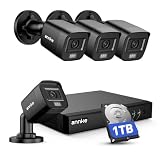
- 【AI Motion Detection 2.0】Driving AI to the next level, human&vehicle detection and flexible detection area are more accurate than before. For quicker locating in crucial moments, human&vehicle smart searching in recordings offers you great help.
- 【Tried-and-True Safe Guard】This one-stop security solution can work with TVI, AHD, CVI, CVBS & IP cameras, the kit includes 1080P cams. The 8CH 3K lite DVR can hook up with 1080P@30fps or 3K/5MP@20fps cams. Therefore, you can also DIY it with other cameras in your home.
- 【Reliable 24/7 Continuous Recording】With a pre-installed 1TB HDD(Support up to 10TB HDD), providing 24/7 surveillance recording for you. Upgraded H.265+ saves more storage space and uses less bandwidth, recording videos longer and smoother viewing.
- 【Remote Access Anytime, Anywhere】Stay connected to your home security system through your smartphone. View live footage and play back recordings remotely, keeping an eye on your property whenever and wherever you need.
- 【Clear Night Vision and IP67 Weatherproof Protection】Built-in IR LEDs provide black-and-white night vision up to 100ft. With an IP67-rated design, these wired security cameras are built to withstand rain, dust, and changing weather conditions for reliable outdoor surveillance.
Alarms, emergency call boxes, video intercoms, card readers and cameras are more useful when their events can be understood together. A forced-door alarm paired with a nearby camera view and a defined dispatch procedure is different from a door alarm that produces an unassigned notification. Radio or Wi-Fi repeaters may be needed where structure, below-grade spaces or dense construction weakens coverage. Their locations require coordination with ceilings, shafts, power, network rooms and testing access.
The feature’s historical example at the University of Pennsylvania described a residence hall under construction with one entrance and a requirement that new technology integrate with the university’s Software House security-management system. The lesson is about interface planning, not a current product recommendation: confirm the status, ownership, cybersecurity requirements and compatibility of any existing platform before relying on it in a new project.
Compare security options against the building’s real constraints
When a project team evaluates alternatives, a useful comparison considers more than purchase price. The following questions keep the discussion tied to design and operations.
| Decision area | Questions for the project team |
|---|---|
| Openness and visitors | Can legitimate visitors find and enter the public zone without confusion, while restricted areas remain clearly controlled? |
| Sensitivity and function | Does the control level match the space’s occupants, information, equipment, collections or research activity? |
| Monitoring and investigation | Will staff have useful sightlines, camera coverage, alarm context and a defined response? |
| Circulation and site context | Does the choice work with pedestrian routes, deliveries, accessibility, emergency access and the surrounding neighborhood? |
| Integration | Can the new equipment exchange the events and credentials the existing campus systems require? |
| Retrofit difficulty | Will a later change require opening walls, adding conduit, relocating doors or replacing network equipment? |
| Ongoing operations | Who issues credentials, watches alerts, repairs devices, updates software, trims landscaping and tests the system? |
A practical security workflow for a campus building project
- Define the mission and users. List public, academic, residential, research, administrative, service and emergency functions. Record hours, occupancy patterns and the consequences of unauthorized access.
- Map the site. Trace streets, transit approaches, parking, loading, pedestrian paths, neighboring properties, utilities and emergency routes. Mark locations where visibility, lighting or communications may be weak.
- Set access zones. Decide which spaces are public, supervised, card-controlled or restricted. Draw the expected visitor, resident, staff, service and responder paths before selecting hardware.
- Develop CPTED concepts. Test building orientation, entrances, landscape height, lighting, glazing, territorial cues and sightlines in daylight and at night. Include mature landscape conditions, not only the installation date.
- Write the system architecture. Identify readers, cameras, alarms, intercoms, call boxes, repeaters, networks, power, control rooms and data retention. Document interfaces with existing platforms and who receives each event.
- Coordinate life safety and accessibility. Reconcile security doors and checkpoints with egress, fire protection, accessible routes, queuing, deliveries and emergency unlocking. Obtain the reviews required for the jurisdiction and project.
- Detail and procure for maintainability. Provide pathways, spare capacity, equipment access, weather protection, labeling and replacement procedures. Specify performance and interoperability requirements rather than assuming a named product will remain available.
- Commission the whole sequence. Test normal entry, denied entry, lost credentials, alarms, camera views, intercom calls, emergency conditions, network loss and power failure. Train the staff who will operate the system and record as-built locations and settings.
What historical campus examples show—and what they do not
The source feature, published by Building Design + Construction on February 18, 2015, offered examples of design thinking at that time. They are useful illustrations, not evidence of current campus conditions or current system specifications.
Quick wins for a faster PC:
Clear out junk files and repair common Windows errorsFree Scan →Fix the driver behind crashes, sound loss and screen glitchesFind Drivers →| Institution | Example reported in 2015 | Design lesson |
|---|---|---|
| University of Pennsylvania | A residence hall then under construction was described as having a single entrance, with new technology required to integrate with the university’s Software House security-management system. | Entrance concentration and compatibility with an existing platform should be resolved during design. |
| New York University | The feature discussed differentiated access levels, card access for students and staff, added controls for sensitive areas and interest in clearer sightlines. | Permissions, zoning and visibility need to reinforce one another. |
| Virginia Commonwealth University | A residence-hall design was described as combining a gated card-access area monitored by cameras with a single staffed entrance. | A layered approach can pair a welcoming staffed point with controlled residential circulation. |
| Ohio State University | A security consultant said development of a unified security platform had taken five years. | Integration is a long-term governance and implementation effort, not a last-minute installation. |
Put historical crime figures in the right context
The feature cited U.S. Department of Education counts for 2013, which it identified as the most recent year available when published in 2015. Those figures are historical and should not be used as current crime rates or as a prediction for a particular campus.
| Reported offense | 2013 count cited by the feature | Attribution and qualification |
|---|---|---|
| Burglary | 23,913 | U.S. Department of Education data, as quoted by Building Design + Construction in 2015 |
| Robbery | 4,468 | U.S. Department of Education data, as quoted by Building Design + Construction in 2015 |
| Aggravated assault | 4,568 | U.S. Department of Education data, as quoted by Building Design + Construction in 2015 |
| Forcible sex offenses | 3,613 | U.S. Department of Education data, as quoted by Building Design + Construction in 2015 |
| Motor vehicle theft | 6,121 | U.S. Department of Education data, as quoted by Building Design + Construction in 2015 |
The same article cited an estimate of $10 billion–$11 billion in annual higher-education spending on new buildings, additions and renovations, attributed to College Planning & Management magazine. That was a period estimate, not current market sizing, and it should not be used to set a present-day project budget.
Common design failures and better remedies
Adding readers after the plan is fixed
Failure: Readers appear at leftover door locations, with no room for queues, visitors or accessible approach.
Also popular on Amazon

- AI Motion Detection 2.0: Driving AI to the next level, human&vehicle detection and flexible detection area are more accurate than before. For quicker locating in crucial moments, human&vehicle smart searching in recordings offers you great help
- 80% Storage Space Saving: With advanced H.265+ compression, this DVR records longer before overwriting older footage. Compared to H.264 systems, it saves up to 80% of storage space with less bandwidth usage and smoother local/remote viewing and playback.
- Reliable 24/7 Continuous Recording: With a NEW surveillance grade pre-installed 1TB HDD(Support up to 10TB HDD), this security camera system supports 24/7 continuous recording, helping you capture important footage around the clock and review recorded videos whenever needed.
- Unlimited Remote Access & IP67 Weatherproof: Connect the DVR to a router and use the ANNKE Vision App to control it remotely. Rated IP67, these wired cameras can brave all weather, and stand from cold to hot
- Tried-and-True Safe Guard: This one-stop security solution can work with TVI, AHD, CVI, CVBS & IP cameras, the kit includes 1080P cams. The 8CH 3K lite DVR can hook up with 1080P@30fps or 3K/5MP@20fps cams. Therefore, you can also DIY it with other cameras in your home
Remedy: Draw credentialed and uncredentialed journeys in the floor plan, then coordinate door hardware, reception, signage, power and data before construction documents.
The Tool Desk
Outbyte Driver Updater FREEFix the driver behind crashes, sound loss and screen glitchesFind Drivers →Outbyte PC Repair FREERepair Windows errors before they cause bigger problemsFix Now →Assuming cameras solve an observation problem
Failure: Cameras point at glare, dense planting or blank walls and generate alerts no one is assigned to handle.
Remedy: Validate views from actual mounting locations, pair coverage with lighting and sightlines, and write an owner and response for each alarm or analytic event.
Hardening the campus until it feels closed
Failure: Fences, opaque barriers and confusing checkpoints separate the institution from its community and push people toward uncontrolled paths.
Remedy: Use layered zoning, clear territorial cues, staffed public entrances and selective controls that protect sensitive functions without treating every edge like a bank.
What’s actually slowing this PC down?
Pick the symptom - the matching free tool is one click away.
Leaving integration to the end
Failure: New devices cannot exchange credentials or alarm events with the campus platform, or the network and power capacity is inadequate.
Remedy: Document interfaces and responsibilities in the basis of design, test them during commissioning and provide staff training and as-built records.
The construction decision that matters most
Security influences campus design most successfully when it is treated as a series of coordinated spatial and operational decisions: where people enter, how they move, what they can see, which areas are controlled, how systems share information and who responds when something changes. The 2015 examples show why universities need that conversation early, while the project can still adjust its site, plan and infrastructure. Current codes, standards, crime conditions and technology capabilities must be verified for each institution and jurisdiction, but the underlying design discipline remains clear: protect people and critical functions while preserving the campus’s role as an open place for learning and community life.
Quick Recap
Product prices and availability are accurate as of the date/time indicated and are subject to change. Any price and availability information displayed on Amazon at the time of purchase will apply.

