Do these 3 things before closing this tab:
1Fix the driver behind crashes, sound loss and screen glitches2Clear out junk files and repair common Windows errors3Scan for outdated or missing drivers - takes under a minuteBIG’s NASA Olympus is a lunar-habitat concept, not a completed base. It imagines four astronauts living for up to a month in a structure produced with ICON 3D-printing technology and lunar regolith. The central idea is to manufacture much of the protective habitat locally instead of launching every kilogram from Earth. BIG presents the project on its NASA Olympus project page.
That premise fits a broader direction in lunar planning: use robotic missions, imported pressure vessels and equipment, and locally processed soil to build capability in stages. ESA feasibility studies, SOM’s Moon Village proposal and NASA’s current South Pole program all explore different answers to the same practical question—how crews could survive, work and expand on the Moon without depending on an uninterrupted Earth supply line.
As an Amazon Associate I earn from qualifying purchases.
What BIG’s NASA Olympus concept actually proposes
NASA Olympus is best understood as an architectural and engineering concept for an early, short-duration lunar outpost. BIG describes a habitat designed for four astronauts for up to one month, using ICON’s large-scale 3D-printing approach together with lunar regolith, the loose soil and rock covering the Moon’s surface. Those are design specifications, not a report that the habitat has been built, delivered or occupied.
Windows Errors? Fix Them Before They Spread
Repair common Windows errors and clear accumulated junk for a smoother, more stable PC - no reinstall needed.Free scan · no reinstallOutdated Drivers Are Slowing You Down
One free scan finds every outdated or missing driver and matches the right update for your exact hardware.Free scan · exact hardware matchThe concept emphasizes in-situ resource utilization (ISRU): obtaining useful construction feedstock where it is needed. On the Moon, transporting mass is difficult and expensive because every structural component must survive launch, transit and landing. If a mission can use local material for shielding or other non-pressurized parts, Earth-launched hardware can be reserved for items that lunar soil cannot easily replace, such as pressure membranes, electronics, life-support equipment and specialized machinery.
#1 Best Overall
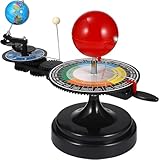
- 【Solar System】: DIY your own sun earth moon orbital rotation model with this creative kit. Seasonal plate that shows the names, order, and dates of the four seasons and the twenty-four solar terms in the traditional Chinese calendar. night, seasons, solar eclipse, lunar eclipse and moon phases .
- 【Usage Scenarios】: Great for Geology & Earth Sciences Teaching, School project also Great gift for your children over 6 years old, it cultivates children's interest in space science. Earth orbiting around the sun, and moon orbiting around the earth showing planetary orbit.
- 【To Demonstrate Seasons and Solar and Lunar Eclipses】: 1)Rotate the Earth to show how the Earth's rotation and orbit around the Sun create seasons; 2)To demonstrate a solar eclipse, move the Moon between the Earth and the Sun, blocking the Sun's light and casting a shadow on the Earth; 3)To demonstrate a lunar eclipse, move the Moon into the Earth's shadow, creating a tint on the Moon.
- 【Easy to Assemble 】: Updated Instruction 1)Wrench the connecting nut to the seasonal plate; 2) Insert the axe to the slot, put the two screws to the corresponding holes, then tighten the screws; 3) Get the “solar system” aligned correctly: Set the handle with the pointer on the summer solstice, adjust the position of the Earth so that the sun shines directly on its Tropic of Cancer; 4)Assemble the gears upper and underneath with the black peg;Put the sun’s metal wire in the hole on the lever.
- 【Size Information】100% brand new and high quality. Size(LxWxH): Approx. 38 x 20 x 28 cm / 15.20 x 7.87 x 11.02 inch.
BIG’s project page does not establish a flight schedule, a completed prototype, a tested crew-duration result or a permanent-settlement plan. “Four astronauts for up to a month” should therefore be read as the capacity the concept is designed around, not a validated operational limit.
Why lunar regolith could reduce dependence on Earth
A 2018 ESA project called URBAN investigated how 3D printing and material reuse might support a future Moon base. ESA described the goal as learning to “live off the land” as much as possible by printing structures, items and spares from lunar regolith, or by reusing material brought for the mission, rather than continuously relying on a long supply line from Earth. Read the project context in ESA’s Future Moon base description.
This does not mean a lunar settlement could immediately become self-sufficient. Regolith is abundant, but it is not automatically a usable building product. A real system would need to collect soil, move it, remove or tolerate unwanted particles, feed it into a printer and verify that each deposited layer has the required geometry and strength. Power, spare parts, control software and trained operators would still initially come from Earth.
Local material is most valuable where it replaces large volumes of relatively simple mass. A thick outer layer that blocks radiation and micrometeoroids is a more plausible early use than a printed substitute for every component of a pressurized room. The pressure boundary itself must retain breathable gas in a vacuum, while the printed regolith structure can act as a separate protective envelope.
Rank #2

- Visual Solar System Learning: This sun earth moon orbital model helps learners explore the spatial relationships among the sun, earth, and moon. The three-sphere design provides a visual way to introduce orbital motion and basic astronomy concepts, making science lessons more engaging and easier to understand
- Compact and Lightweight Design: Measuring approximately 8.26 x 6.69 x 4.13 inches, this solar system model features a compact, lightweight plastic construction for convenient handling and display. Its space-saving size makes it suitable for science demonstrations, study desks, classroom displays, and home learning areas
- Explore Earth, Moon and Sun Relationships: Use this earth moon sun model to introduce how the positions of the sun, earth, and moon relate to astronomical events. It provides a visual starting point for discussing solar and lunar eclipses, orbital relationships, and other foundational space science topics
- For Classroom and Home Education: Designed as a science teaching aid, this earth orbit model is suitable for astronomy lessons, science projects, homeschool activities, and educational displays. Teachers, students, parents, and beginner astronomy enthusiasts can use the model to support visual learning and spark curiosity about the solar system
- Educational Display and Gift Idea: Combining a colorful design with an educational purpose, this moon sun model can be displayed in a classroom, study room, or science learning space. It makes a thoughtful gift option for students, science enthusiasts, and learners interested in astronomy, space exploration, and the earth-moon-sun system
How a printed lunar habitat could be assembled
1. Land equipment and establish a work zone
A mission would first land power systems, communications, excavation or handling equipment, the printer and the initial crew habitat or pressure vessel. The printer cannot begin with an empty site: it needs a stable operating area, material-handling routes and enough power to run during construction. NASA’s current Moon Base program describes this kind of buildup as a phased process involving technology demonstrations, robotic missions and early experiments near the lunar South Pole. NASA says the approach is iterative rather than a single delivery of a finished settlement; see its Moon Base program page, last updated October 13, 2026.
2. Excavate and prepare regolith
Regolith would be gathered from the selected site and delivered to the printing system. The exact treatment depends on the printer and the material recipe. Lunar soil is abrasive and electrostatically troublesome, and it contains particles with a wide range of sizes. The available sources describe the objective and feasibility of printing, but they do not establish a flight-ready processing method or a production rate for BIG’s Olympus concept.
3. Print the protective structure
A robotic arm or gantry could deposit successive layers to form walls, arches or a dome around the crew volume. The printed shell would be valuable because it can be thick without imposing the full launch mass penalty of an Earth-built equivalent. It could also be shaped around equipment, access routes and service openings as the outpost grows.
Free tools Windows power users keep installed
One-click scans. No signup required.
4. Install or inflate the pressure habitat
Printing alone does not create a livable room. Astronauts need a sealed pressure vessel, environmental-control systems, power, communications, lighting and provisions. In several lunar concepts, the inflatable or rigid pressure module is transported from Earth and the locally made structure is added outside it. This division lets designers use regolith where bulk and shielding matter while keeping the gas-tight layer under tighter manufacturing control.
Rank #3

- Orbital planetarium model: the model is an excellent way to illustrate earth's rotation, the planet's revolution around the sun, the seasons of the year, and of our moon
- Sun earth moon orbital model classroom apparatus: with its advanced technology, users can witness the phenomenon of and in a captivating and immersive manner
- Solar system project kit: its engaging and interactive nature makes it an ideal instrument for family gatherings, where children and adults alike can at the wonders of the universe
- Planetarium project kit: with the three-sphere eclipse principle astronomy educational instrument, you can explore the wonders of the universe and deepen your understanding of the natural world
- Solar system model:Observe the motion trajectories of the sun, earth, and moon to deepen your knowledge of celestial movements and natural phenomena, ideal for educational purposes
5. Test before crew occupancy
Before people move in, the construction system would need inspections for geometry, bonding between layers, cracks and unexpected settling. The pressure volume would require leak checks and life-support verification. None of the cited project pages reports that BIG’s Olympus habitat has passed those tests; the concept should not be presented as a demonstrated living environment.
Protection is as important as the room itself
On the Moon, an attractive interior is only one part of the design problem. There is no protective atmosphere, temperatures vary sharply between sunlit and shadowed areas, and the surface is exposed to micrometeoroids and space radiation. Dust can damage seals, mechanisms and human lungs if it enters a cabin.
ESA’s earlier feasibility work with Foster + Partners illustrates one way to separate these hazards from the pressure shell. The 2013 project described a load-bearing “catenary” dome with a cellular structured wall, designed to shield a pressurized inflatable from micrometeoroids and radiation. ESA reported a 1.5-tonne building-block demonstration made from simulated lunar soil and a mobile D-Shape printing array with a six-metre frame. These were terrestrial feasibility demonstrations, not construction on the Moon. The historical project is documented in Building a lunar base with 3D printing.
That same ESA page recorded unresolved issues, including lunar dust and extreme temperature variation. A printed shell must therefore be judged as part of a complete system: pressure liner, thermal control, dust-management procedures, structural joints, access hatches and maintenance plans all matter. A strong wall that cannot be sealed, repaired or kept free of abrasive dust would not make a safe habitat.
Rank #4

- Engaging Educational Tool: The Great Explorations Phases of the Moon kit is an engaging and educational resource designed to teach children about the lunar phases in a fun and interactive way.
- Realistic Moon Replication: Featuring a highly detailed 3D model of the moon, this product offers a realistic representation of the lunar surface and its changing phases.
- Hands-On Learning: Encourage hands-on learning as children manipulate the moon model to understand how the moon's appearance changes throughout its cycle.
- Glow-in-the-Dark Feature: The moon model is made with a special glow-in-the-dark material, allowing kids to observe the moon's phases even in low light conditions, making it a captivating night-time learning experience.
- STEM-Focused: The Great Explorations Phases of the Moon kit promotes STEM (Science, Technology, Engineering, and Mathematics) education by fostering curiosity and scientific inquiry.
There is no single settled Moon-habitat design
BIG’s Olympus proposal is one design direction among several. The alternatives differ in how much structure is launched, how the pressure volume is protected and how a settlement could expand.
| Concept or program | Use of local material | Pressure and protective structure | Deployment or growth idea | Evidence status |
|---|---|---|---|---|
| BIG NASA Olympus | Uses lunar regolith in the concept with ICON 3D-printing technology. | Specific pressure-shell details are not established on the project page; the concept is designed around four astronauts for up to one month. | Presented as a habitat concept; construction sequence and expansion performance are not reported. | Architectural concept described by BIG, not an operational habitat. Source |
| ESA/Foster + Partners feasibility study (2013) | Printed simulated lunar-soil blocks; local regolith is the premise for future lunar construction. | A cellular, load-bearing catenary dome shields a pressurized inflatable. | Uses a mobile six-metre D-Shape printing frame in the demonstration. | Feasibility project and terrestrial demonstration, not a lunar deployment. Source |
| ESA URBAN (2018) | Investigates printing structures, items and spares from regolith and reusing mission materials. | The page frames a future habitat study rather than a finalized pressure-shell design. | Seeks to reduce reliance on repeated Earth deliveries as capability grows. | Research project led by an industrial consortium; not a completed base. Source |
| SOM Moon Village | Local resources are part of a later settlement-development vision, while initial modules are transported. | Separately transported inflatable modules use rigid composite perimeter frames. | Modules inflate on site and can be linked in different configurations; later stages add excavation, manufacturing, food production and science facilities. | Design proposal developed with ESA and MIT, not an inhabited settlement. Source |
| NASA Moon Base program | Supports demonstrations and experiments that can mature lunar-resource and construction capability. | No single habitat architecture is declared as the finished base. | Phased, iterative development using robotic missions, demonstrations, commercial industry, academia and international partners. | Current program framework, not proof of a permanent base. Source |
Why the lunar South Pole is a logical target
SOM’s Moon Village proposal places its envisioned settlement near Shackleton Crater at the lunar South Pole. The proposal identifies three linked advantages: access to sunlight for power, proximity to potentially useful resources and strong scientific interest. Terrain around a polar crater is also difficult, with steep slopes, long shadows and limited line-of-sight in some locations. The location therefore affects where a habitat, landing zone, solar arrays and resource-processing equipment can be placed.
NASA’s current Moon Base program likewise focuses on the South Pole region, but its page describes a phased development process rather than a selected, completed town. A polar site does not remove the need for imported systems. It changes the logistics problem by making power, communications, mobility and resource access central to site planning from the first robotic missions.
Recommended Free Tools
What “living” on the Moon would involve
A month-long crew stay would be a tightly managed expedition, not ordinary residential life. The habitat would need a reliable pressure volume, atmospheric monitoring, water and food management, waste handling, thermal control, power storage, communications and procedures for emergencies. Crew time would be divided between science, maintenance, surface operations and construction support.
Best Value

- Assemble & Explore 3-D Paper Models to Investigate Key Science Concepts
- Perfect for Use at Home or in the Classroom
- Includes Extensive, Illustrated Background Information & 1 Set of Model Templates
- Satisfies Next Generation Science Standards
The outer printed structure could make routine work safer by reducing radiation and micrometeoroid exposure, but it would not eliminate risk. Astronauts would still need suits and airlocks for every excursion. Dust brought inside after a surface walk could contaminate mechanisms and the pressure environment. A settlement that eventually supports manufacturing or food production would require additional modules and utilities; SOM presents those as later growth stages rather than capabilities available on day one.
The hardest unresolved engineering questions
Printer reliability and maintenance
A lunar printer must operate in vacuum, extreme temperature swings and abrasive dust while being serviced by a small crew or remotely. The cited projects establish that printing simulated regolith is feasible to study, but they do not provide a flight qualification, continuous operating duration or maintenance interval for a production lunar system.
Material quality and structural verification
Printed layers can contain voids, weak interfaces or geometry errors. Engineers would need inspection methods that work without a large terrestrial workshop. The 1.5-tonne ESA demonstration shows the scale of an early test block, not a guaranteed strength value for lunar construction.
What’s actually slowing this PC down?
Pick the symptom - the matching free tool is one click away.
Radiation, dust and temperature
Shielding requirements, thermal gradients and dust behavior interact. A thick shell may reduce radiation but complicate heat rejection, access and repairs. ESA specifically identified dust and temperature variation as conditions requiring further consideration in its feasibility work.
Supply-chain dependence
Using regolith can reduce launched mass, but it cannot instantly replace Earth supply. Electronics, seals, medical equipment, specialized tools and many life-support components would remain imported until local manufacturing becomes dependable. ESA’s “live off the land” language describes a goal of reducing logistical dependence, not a claim that a settlement can operate independently.
How to interpret the Olympus vision accurately
- Call NASA Olympus a concept designed for four astronauts for up to a month, not a built or occupied base.
- Describe regolith printing as a proposed way to reduce launched structural mass, not as proof of lunar self-sufficiency.
- Keep BIG’s design separate from ESA’s 2013 feasibility demonstration and ESA’s 2018 URBAN study; they inform the same problem but are different projects.
- Treat SOM’s Moon Village as a proposal for modular growth near Shackleton Crater, not an announced construction site.
- Use NASA’s Moon Base page to explain the current phased program context, not to imply that a permanent settlement already exists.
Taken together, these projects outline a plausible sequence: send robotic equipment and essential pressure hardware, demonstrate resource use and construction, protect expandable living modules with locally sourced material, and add capability only after each stage works. BIG’s contribution is an architectural expression of that strategy. Its significance lies less in a promise that people can move to the Moon now than in showing how design, additive manufacturing and local resources could be combined to make longer stays technically conceivable.
Quick Recap
Product prices and availability are accurate as of the date/time indicated and are subject to change. Any price and availability information displayed on Amazon at the time of purchase will apply.
The Tool Desk
Outbyte PC Repair FREERepair Windows errors before they cause bigger problemsFix Now →Outbyte Driver Updater FREEScan for outdated or missing drivers - takes under a minuteDriver Scan →
