Free tools Windows power users keep installed
One-click scans. No signup required.
Yes, an IKEA SYMFONISK bookshelf speaker can be repurposed into a networked DIY speaker system—but it is not a conventional stereo amplifier. The modification keeps the Sonos electronics, power supply, wireless networking and DSP, then uses the board’s separate woofer and tweeter outputs to drive a compatible two-way speaker.
The best candidates are speakers designed for bi-amping, with separate high- and low-frequency terminals. A normal two-terminal speaker usually requires bypassing its passive crossover, and the result still depends on undocumented DSP, crossover and power limitations. This is an interesting reuse project for an experienced maker, not a drop-in replacement for a Sonos Amp.
As an Amazon Associate I earn from qualifying purchases.
What the modification actually does
The original SYMFONISK bookshelf speaker combines a compact enclosure, a 1-inch tweeter, a 3-inch woofer, a tuned port and Sonos electronics. The project described by Make: removes the original drivers and enclosure while retaining the useful electronics:
- Sonos wireless networking and multiroom playback
- AirPlay 2 support on the relevant product generation
- App-based control
- The motherboard and digital amplifier section
- The internal power supply
- Front-panel controls and status-light board, if desired
- Wi-Fi antennas
What you are building is closer to a networked, DSP-controlled two-way active speaker platform than a generic power amplifier. One amplifier channel is intended for the tweeter and the other for the woofer. The two outputs must remain electrically separate.
#1 Best Overall

- Subwoofer Audio Amplifier Board: 100W+100W Bluetooth 5.0 wireless connection, Bluetooth, USB and AUX audio input, 2.0 channel stereo output, just a little sound distortion. Note: When using AUX mode, please confirm that the Bluetooth connection of this module has been disconnected;
- Treble and Bass Adjustment: This digital Amp board with independent treble and bass adjustment buttons,you can directly adjust the treble and bass through the module, without using the player or speaker;
- Perfect Sound Quality Experience: The audio power subwoofer amplifier module with powerful chip, AM interference suppression function, shielding power inductance, low noise front stage operational amplifier, let you enjoy a more perfect sound quality experience;
- With Protective Function: This Bluetooth Amp module is designed with over-voltage protection, under-voltage protection, over-heat protection, short-circuit protection, with case to protective it;
- Easy Installation and Use: The illustration of each interface is printed on the protective plate, making it easy to install and use even without instructions. Small size: 4.4 in*2.75 in*0.78 in, easy to carry;
The most important compatibility rule
Use a speaker with four terminals: separate positive and negative connections for its high-frequency and low-frequency sections. Such speakers usually have removable jumper bars linking the two sections for ordinary single-amplifier operation.
For this conversion:
- Remove the speaker’s jumper bars.
- Connect the SYMFONISK tweeter output to the speaker’s high-frequency terminals.
- Connect the SYMFONISK woofer output to the low-frequency terminals.
- Leave the speaker’s internal crossover sections in circuit if the manufacturer designed the terminals for bi-amping.
Do not assume that any speaker with four binding posts is automatically suitable. Confirm the terminal arrangement, impedance, sensitivity and manufacturer’s bi-amping guidance.
Conventional two-terminal speakers
A normal passive two-way speaker has one input pair and an internal crossover that divides the signal. It cannot usually be connected directly to both SYMFONISK amplifier outputs. Using it safely generally means opening the cabinet, identifying the crossover topology, and separating the woofer and tweeter paths.
Recommended Free Tools
There is no universal wiring diagram. Crossover layouts, driver impedances, protection components and terminal wiring vary between speakers. A mistake can send an unsuitable signal to the tweeter or connect the amplifier channels together.
Speakers to avoid
- Three-way speakers unless their design can genuinely be adapted to two amplifier bands
- Very low-impedance speakers
- Inefficient speakers intended for substantial amplifier power
- Speakers with complex impedance curves
- Speakers whose tweeters cannot safely accept the available high-pass signal
- Active speakers, unless the project is redesigned around line-level outputs
Power, crossover and DSP: the qualifications that matter
Do not describe the modified SYMFONISK as a 50-watt-per-channel amplifier without measurements. A Sonos community teardown discussion identifies a Texas Instruments TPA3116 amplifier chip and repeats the chip’s potential capability under particular conditions. That is not proof of the finished speaker’s real output.
Actual performance depends on supply voltage, load impedance, distortion target, thermal limits, DSP limiting and the specific hardware revision. The relevant engineering questions remain uncertain:
- What is the effective crossover frequency?
- How much woofer protection or bass limiting is applied?
- What output is available into your particular speaker load?
- How will the original driver-specific equalization interact with replacement drivers?
Start with efficient, reasonably benign loads. Use low volume initially and stop if you hear clipping, severe distortion or protection shutdown, or if the electronics become abnormally hot.
Rank #2

- Parameters: DROK audio amplifier board working voltage is DC 5V, output power is 5W (2Ω 5V)/3W (4Ω 5V) / 1.8W (8Ω 5V). Input method is monaural input.
- Artificial Material: this New-designed mini power amplifier is made of noble black immersion gold circuit board, imported KEMET speaker capacitor, large-capacity filter capacitor for channels. Besides, we customized black copper terminal blocks and gold-plated audio input terminal blocks for this new amplifier module.
- High Performance: the digital amplifier module is with high efficiency of over 90%, general harmonic distortion noise is less than 10%, low quiescent current and noise suppression.
- Safe Protection: the class D dual-channel amp board is designed with input reverse connection protection, short circuit protection, over heat protection; what's more, EMI is allowed to pass.
- Additional Function: it is available to connect amplifier type to choose different function (MODE: high electricity level is Type D, low electricity level is Type AB. Factory defaults high electricity level); available to add an external Shutdown (SD: the chip will be Shutdown at low electricity level, factory default high electricity level.
Trueplay is not a universal crossover designer
The original project reports that running Trueplay improved the replacement speaker and presents it as adapting the system to the new drivers. That may describe one successful build, but it should not be treated as a guaranteed function for every speaker, hardware revision or software version.
Trueplay-style room correction and speaker crossover design are different jobs:
- Room correction compensates for aspects of the speaker-and-room response at the listening position.
- A crossover divides frequencies and protects each driver.
- Driver-specific DSP may include equalization, limiting and protection designed around the original SYMFONISK drivers.
The community discussion linked above questions whether Trueplay changes the underlying crossover in the way the project claims. Run calibration only after the electronics and speakers are in their final locations, and regard the result as an optimization—not proof that an arbitrary driver combination is electrically or acoustically correct.
Tools and workshop preparation
The original build uses a #2 Phillips screwdriver, possibly a #1 Phillips screwdriver, needle-nose pliers and a spudger, pick or fingernail. A safer modern preparation also includes:
Do these 3 things before closing this tab:
1Clear out junk files and repair common Windows errors2Scan for outdated or missing drivers - takes under a minute3Repair Windows errors before they cause bigger problems- Multimeter
- ESD-safe work surface
- Insulated tools
- Heat-shrink tubing and suitable speaker connectors
- Speaker wire
- Nonconductive standoffs or mounting hardware
- Cable glands and strain relief
- Ventilated enclosure material
- Fuse and appropriately protected mains inlet hardware where required
- Camera, labels or bags for documenting connectors and screws
Mains warning: The SYMFONISK contains mains-powered circuitry. Unplug it before opening, allow time for capacitors to discharge, and do not probe exposed power-supply circuitry while energized. If you are not qualified to work around mains voltage, do not perform this modification. The finished enclosure must not expose mains conductors, rely on improvised insulation or use an unsupported power cord.
Disassembly walkthrough
Hardware revisions can differ, so treat the following as a careful route rather than a guarantee that every unit is identical. Photograph each stage before disconnecting anything.
1. Disconnect power
Unplug the speaker and place it on a stable, nonconductive work surface. Do not begin by testing live circuitry.
Rank #3

- Experience powerful sound with the ZK-502L Mini Stereo Bluetooth-Compatible 5.0 Amplifier Board, delivering a whopping 2X50W output for your DIY wireless speaker projects. Enjoy audio performance with this compact module
- Easily adjust volume and toggle power with the integrated knob on this amplifier board. The Bluetooth-Compatible 5.0 technology ensures a stable connection up to 15 meters, giving you the flexibility to set up your speakers anywhere you desire
- Safeguard your audio setup with built-in protections like self-recovery overheat and short circuit protection. The ZK-502L is compatible with a wide range of power adapters (DC5~24V) and speaker configurations (30W~200W, 4惟, 8惟)
- Take your DIY speaker projects to the next level with the ZK-502L's dual-channel stereo output, providing a rich and immersive audio experience. With dimensions of 55mm*38mm*17mm and weighing only 32g, this amplifier board is perfect for compact setups
- Elevate your audio setup with the ZK-502L Mini Stereo Bluetooth-Compatible 5.0 Amplifier Board, offering versatility and power in a small package. Unleash the full potential of your speakers with this high-performance module
2. Remove the grille
The fabric strip carrying the IKEA and Sonos logos acts as a pull tab for the grille. Remove it carefully rather than levering aggressively against the cabinet.
Quick wins for a faster PC:
Clear out junk files and repair common Windows errorsFree Scan →Scan for outdated or missing drivers - takes under a minuteDriver Scan →Repair Windows errors before they cause bigger problemsFix Now →3. Remove the inserts and screws
Use needle-nose pliers to extract the rubber inserts, then remove the four Phillips screws underneath. Threadlocker may resist at first, and the screws may release with a small pop.
4. Separate the front assembly
The front panel is held by a friction-fit foam seal. The original method pulls consistently through the bass-port opening instead of prying violently around the perimeter. The driver assembly remains connected to the motherboard, so do not pull the panel away suddenly.
5. Disconnect the driver leads
The driver leads use locking spade connectors. Pull back the clear heat-shrink covering, depress the locking tab and pull on the connector body—not the wire. The original project identifies different connector sizes; verify yours before forcing anything.
6. Disconnect the front-panel flex cable
Peel back or remove the foam covering, open the connector latch and gently remove the fragile eight-pin flex cable. Record its orientation. The Make: procedure notes that the contact pads face toward the circuit board when reinserted.
7. Remove the motherboard and heatsink
Remove the six motherboard screws, taking care around the screws nearest the cast-aluminum heatsink. Rotate the board diagonally to clear the enclosure ribs. Remove the heatsink cautiously so its thermal pads are not damaged, and reinstall the heatsink before powering the board for testing.
8. Preserve the antennas and controls
Wi-Fi antennas and the front control board can be relocated, but they need firm mechanical support. Do not sharply bend coaxial antenna leads, leave the AC connector unsupported or allow a metal enclosure to obstruct the antennas.
Rank #4

- Powerful 2 Channel Amplifier with Subwoofer Support: Deliver powerful, high-fidelity audio with 100W + 100W stereo output. This versatile Bluetooth amplifier features Bluetooth 5.0 and AUX inputs, making it a perfect bluetooth amplifier for speakers or a compact mini amp for DIY projects. Note: Please disconnect Bluetooth before using AUX mode
- Precision Sound Control with Bass & Treble Knobs: Easily fine-tune your sound directly on this mini bluetooth amplifier with dedicated knobs, no need to adjust your source device. Get the perfect audio balance for any use
- HiFi Performance with Premium Audio Components: This high-performance amplifier board is built with dual TPA3116D2 chips and advanced shielding for crisp, distortion-free sound. Enjoy premium audio from this powerful bluetooth amp anywhere
- Comprehensive Protection & Durable Housing: This reliable bluetooth amplifier board features over-voltage, short-circuit, and overheating protection. The included protective case makes this amp board durable and safe for any DIY installation
- DIY-Friendly Mini Amplifier with Clear Labels: All ports on this bluetooth board are clearly labeled for effortless setup. Its compact size makes this bluetooth mini amplifier ideal for integration into small spaces or portable projects
Connecting the replacement speaker
The Make: project reports these original harness colors:
| Function | Reported wires |
|---|---|
| Tweeter | Red positive, black negative |
| Woofer | Blue positive, white negative |
Verify the actual board and harness before connecting anything. Wire color is not a substitute for documentation or measurement.
Never bridge the outputs. Do not join the woofer and tweeter outputs, connect them to a common speaker input, or treat them as line-level signals. Do not feed them into an active speaker’s input. Incorrect connections can make the amplifier shut down and may damage the electronics.
Check polarity carefully. A reversed woofer or tweeter connection can make the drivers acoustically out of phase, producing weak bass or an uneven midrange.
First power-up and testing
- Inspect every connection for loose strands, shorts and reversed polarity.
- Confirm that the heatsink is attached and that the board cannot contact conductive hardware.
- Power the electronics only after the AC section is enclosed or otherwise protected.
- Test one output and one driver at low volume.
- Confirm that the board appears in the Sonos app and responds normally.
- Listen for clipping, crackling, excessive heat or protection shutdown.
- Only then complete the final enclosure and run Trueplay at the speaker’s final location.
Rehousing the electronics
A separate, ventilated electronics enclosure is usually easier to inspect and service than mounting the board inside a speaker cabinet. Whichever approach you choose, provide:
- Clearance and ventilation around the heatsink
- Insulating barriers around the AC section
- Strain relief for the mains and speaker cables
- Stable mounting that prevents the board from moving
- Protection against accidental contact with energized conductors
- Access to reset controls, status lights and service points
- Supported antenna placement away from unnecessary metal shielding
Putting the board inside a speaker cabinet may save space, but it complicates heat management, acoustic sealing, electrical isolation and future repairs.
Troubleshooting
No sound
- Confirm that the board boots and appears in the Sonos app.
- Check that the correct output is connected to the correct driver section.
- Remove the jumper bars on a bi-ampable speaker.
- Check that the speaker is not still connected through an incompatible single-input crossover.
- Check mute, volume-limiter and protection states.
The amplifier shuts down
Inspect for a short, a low-impedance load, a damaged driver, an output-channel connection error or thermal overload. Disconnect power, review the wiring and retest one output and one driver at low volume.
Best Value
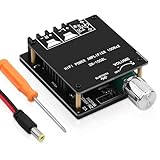
- 【Audio Power Amplifier Board】ZK-1002L with 100W+100W power output and Bluetooth 5.0 wireless connection function, Bluetooth5.0 input, 2.0 channel stereo output, just a little sound distortion. Treble and Bass control. More functions on the APP waiting for you to discover
- 【Perfect Sound Quality Experience】The audio power subwoofer amplifier module with powerful audio chip, AM interference suppression function, shielding power inductance, low noise front stage operational amplifier, clear treble and deep bass, let you enjoy a more perfect sound quality experience
- 【Bluetooth 5.0 Wireless Input】This 1002L digital Amp board is buetooth 5.0 wireless input, The name of Bluetooth is Wuzhi audio. The range of Bluetooth connection is 15m/49ft (The best range is within 10m, more than 10m, the Bluetooth signal is weak, which affects the effect of sound output), Notice: the Bluetooth connection can only be connected to the audio source devices, such as phones, tablets, MP3s, TVs, etc., and it can not be connected to Bluetooth speakers.
- 【Small Size & High Power Output】The size of this 1002L stereo mini power amplifier module is 86 x 53 x 23mm/3.4 x 2.09 x 0.9inch. 2.0 channel stereo output, with 100W+100W Rated power, suitable for passive speakers (50-300W, 4~8Ω), adaptable power adapter voltage range DC 5~24V
- 【With Protective Function】This Bluetooth Amp module is designed with over-voltage protection, under-voltage protection, over-heat protection, short-circuit protection, with case to protective it
Weak bass
Possible causes include reversed polarity, the woofer being connected to the wrong output, woofer limiting, an inefficient replacement driver, a poorly sealed cabinet or bass reduction intended for the original SYMFONISK enclosure.
Harsh or thin treble
Check tweeter sensitivity, polarity, crossover compatibility and the original DSP voicing. Avoid compensating for a fundamentally unsuitable tweeter with excessive EQ or volume.
Wireless instability
Inspect antenna connectors and cables. A relocated antenna may be poorly positioned, damaged or shielded by a metal enclosure.
What’s actually slowing this PC down?
Pick the symptom - the matching free tool is one click away.
Is this better than buying a Sonos Amp?
The answer depends on the goal. The hack is appealing if you already own a spare SYMFONISK, suitable bi-ampable speakers and the skills to build a safe enclosure. It can also be a rewarding way to reuse vintage speakers or learn about active loudspeaker design.
It is a poor choice when you need documented power, ordinary two-terminal speaker compatibility, warranty support, high-volume performance or a predictable installation.
Sonos currently lists its US Amp at $799 and specifies 125 watts per channel at 8 ohms. It provides standard passive-speaker connections, line-in, HDMI ARC, a subwoofer output, Wi-Fi and AirPlay 2. Those are not equivalent to the SYMFONISK’s split woofer/tweeter outputs.
If you already own an amplifier, the Sonos Port is the simpler streaming route, although it does not power passive speakers itself. A conventional AirPlay amplifier, a streamer paired with a class-D amplifier, a used AV receiver or an open-source streaming system may also be more appropriate when Sonos compatibility is not essential.
Crashes, No Sound, or Screen Glitches?
Random freezes, missing sound and display glitches usually trace back to one bad driver. Find and replace yours safely.Free scan · under a minutePC Slower Than It Used to Be?
A free scan shows the junk files, broken settings and background clutter dragging Windows down - then fixes them in one click.Free scan · Windows 10 & 11Cost and practical trade-offs
The donor’s historical low price should not be treated as a current universal price. Check the IKEA SYMFONISK range for your region and verify the hardware revision before buying.
The real project cost can include a donor speaker, one or two suitable passive speakers, enclosure materials, connectors, wiring, tools, insulation and considerable troubleshooting time. Destroying a working SYMFONISK also gives up its original enclosure and warranty.
For a dependable installation, the commercial amplifier is usually the better purchase. For an experimenter with appropriate speakers and a spare donor, the conversion can be worthwhile—but only if its limitations are accepted from the start.
Quick Recap
Product prices and availability are accurate as of the date/time indicated and are subject to change. Any price and availability information displayed on Amazon at the time of purchase will apply.
The Tool Desk
Outbyte Driver Updater FREEFix the driver behind crashes, sound loss and screen glitchesFind Drivers →Outbyte PC Repair FREERepair Windows errors before they cause bigger problemsFix Now →



