The correct electrical wiring depends on the load, voltage, conductor material, installation location, wiring method, overcurrent protection, termination ratings, and locally adopted code. There is no universal wire size or cable type that is right for every residential project.
This U.S.-oriented guide explains the differences among NM-B, UF-B, THHN/THWN-2, SER, conduit, and low-voltage cable, then shows how professionals evaluate ampacity, breakers, grounding, protection, and installation conditions. It is planning information—not permission to work inside energized electrical equipment.
As an Amazon Associate I earn from qualifying purchases.
Start with the application, not the wire gauge
The correct electrical wiring depends on the load, voltage, conductor material, installation location, wiring method, overcurrent protection, termination ratings, and locally adopted electrical code. There is no single “best” wire size for every outlet, light, appliance, feeder, or outdoor run.
Crashes, No Sound, or Screen Glitches?
Random freezes, missing sound and display glitches usually trace back to one bad driver. Find and replace yours safely.Free scan · under a minuteWindows Errors? Fix Them Before They Spread
Repair common Windows errors and clear accumulated junk for a smoother, more stable PC - no reinstall needed.Free scan · no reinstallThis guide is U.S.-oriented and intended for planning and identification—not for working inside energized equipment. The National Electrical Code (NEC), NFPA 70, is a model standard. Your state, county, or city may have adopted a different edition or added amendments. The 2026 NEC exists, but it is not automatically the law everywhere. Before work begins, confirm the edition adopted by your authority having jurisdiction (AHJ), permit requirements, inspection process, and utility rules.
#1 Best Overall

- Wire Specification: Solid Indoor 14/2 NMB cable 100ft coil; Coated in Cable Jacket for easier pulling; stripping; and installation
- Wire Application: Energeaster Type NM-B (non-metallic 90° C) Copper Building Wire is commonly applied in residential building wiring as a branch circuit for switches and outlets and indoor applications inside wall cavities and attics
- Wire Power Rating: The voltage rating of the cable is 600 volts
- Wire Caution: NM-B cable may be run in air voids of masonry block or tile walls where such walls are not wet or damp locations
- Durable & Safer: 2 conductor, 14 gauge solid construction has the insulated conductors (Black and White) parallel; The ground wire is wrapped with fire-retardant paper and laid parallel between the insulated conductors; Ground wire is 14 gauge solid also; The jacket is white on 14 gauge NM-B wire
Electrical wiring terminology
Understanding the terms prevents many purchasing and installation errors.
- Conductor: An individual current-carrying wire, usually copper or aluminum, covered by insulation where required.
- Cable: An assembly of insulated conductors and, depending on the cable type, an equipment grounding conductor under a common jacket or covering.
- Circuit: The complete electrical path, normally involving one or more ungrounded conductors, a grounded conductor or neutral where applicable, and an equipment grounding conductor.
- Ungrounded conductor: Often called the hot conductor. It delivers current from the source to the load.
- Grounded conductor: Commonly called the neutral in many 120-volt circuits. It normally carries return current and is not interchangeable with the equipment grounding conductor.
- Equipment grounding conductor: The safety path intended to carry fault current back to the source so the overcurrent device can operate. It is not a substitute for a neutral or for correct circuit design.
- Ampacity: The amount of current a conductor can safely carry under specified conditions.
- Raceway: A recognized enclosed wiring path, such as conduit, through which individual conductors may be installed.
What wire gauge means
Most residential wire sizes are identified by American Wire Gauge (AWG). The smaller the AWG number, the larger the conductor. For example, 10 AWG is larger than 12 AWG, and 12 AWG is larger than 14 AWG.
The Tool Desk
Outbyte PC Repair FREEClear out junk files and repair common Windows errorsFree Scan →Outbyte Driver Updater FREEFix the driver behind crashes, sound loss and screen glitchesFind Drivers →Gauge alone does not establish a circuit’s safe ampacity. The result also depends on conductor material, insulation rating, number of current-carrying conductors, ambient temperature, bundling, raceway conditions, termination temperature ratings, wiring method, and special rules for the equipment being served.
For orientation, familiar copper-conductor reference points in the 60°C ampacity column include:
| Conductor | Common reference point | Important qualification |
|---|---|---|
| 14 AWG copper | 15 amperes | Typical reference only; the complete circuit and applicable code rules still control. |
| 12 AWG copper | 20 amperes | Typical reference only; terminations, load, conditions, and special rules must be checked. |
| 10 AWG copper | 30 amperes | Often associated with this rating under suitable conditions, but not a universal permission. |
These figures are not a stand-alone wire-size chart. NFPA 70 Table 310.16 must be used with the rest of the applicable NEC requirements. A 90°C insulation marking does not automatically permit using the 90°C ampacity: equipment terminations and other circuit conditions may require a lower temperature column.
Aluminum and copper-clad aluminum conductors have different ampacity values and termination requirements from copper. They are common in some larger feeders and service-entrance applications, but every lug, connector, splice, and terminal must be listed for the conductor material and installed according to its instructions. Never place aluminum and copper together in an ordinary connector simply because they fit.
Free tools Windows power users keep installed
One-click scans. No signup required.
How cable markings are read
A marking such as 12/2 NM-B commonly means two insulated 12 AWG conductors in a nonmetallic-sheathed cable assembly. The equipment grounding conductor is commonly included in the assembly but is not counted in the “2.” Cable construction and packaging vary, so verify the complete product marking rather than relying only on a store search term.
A 12/3 cable generally has three insulated conductors, which may be needed for certain switch arrangements, multiwire circuits, or 120/240-volt applications. That does not mean every 12/3 cable is suitable for every such use. The circuit design, conductor identification, termination arrangement, and applicable code provisions still matter.
Rank #2
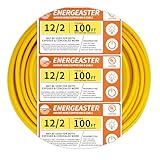
- Wire Specification: Solid Indoor 12/2 NMB cable 100ft coil; Coated in Cable Jacket for easier pulling; stripping; and installation
- Wire Application: Energeaster Type NM-B (non-metallic 90° C) Copper Building Wire is commonly applied in residential building wiring as a branch circuit for switches and outlets and indoor applications inside wall cavities and attics
- Wire Power Rating: The voltage rating of the cable is 600 volts
- Wire Caution: NM-B cable may be run in air voids of masonry block or tile walls where such walls are not wet or damp locations
- Durable & Safer: 2 conductor, 12 gauge solid construction has the insulated conductors (Black and White) parallel; The ground wire is wrapped with fire-retardant paper and laid parallel between the insulated conductors; Ground wire is 12 gauge solid also; The jacket is yellow on 12 gauge NM-B wire
Do not confuse line-voltage wiring with low-voltage or communications cable. Doorbell, thermostat, alarm, network, coaxial, speaker, and similar cables have different voltage ratings, insulation, separation, fire-rating, and installation requirements. Physical fit is not evidence that a cable is permitted for a particular circuit.
Common electrical wiring types
| Wiring type | Typical use | Do not assume |
|---|---|---|
| NM-B | Residential branch circuits for receptacles, switches, lighting, and other loads in normally dry locations. | It is not a direct-burial cable and is not the default choice for wet, damp, or outdoor locations. |
| UF-B | Outdoor branch circuits and feeders, including permitted runs to post lights, pumps, and similar loads; rated for direct burial when installed under the applicable rules. | It does not eliminate requirements for burial depth, physical protection, transitions, support, or correct termination. It is also more difficult to strip and terminate than NM-B. |
| THHN, THWN, and THWN-2 | Individual conductors pulled through conduit, raceway, or cable tray for branch circuits, feeders, and other applications. | A conductor marked THHN may have additional ratings, but the complete marking and installation environment determine which rating applies. |
| SER and other service-entrance or feeder cable | Service and distribution applications, including certain runs between service equipment and distribution equipment where permitted. | SER is not interchangeable with NM-B merely because both are jacketed cable. Exposure, support, termination, conductor size, and service-versus-load-side location matter. |
| Conduit and raceway | A protective wiring method used with individual conductors such as THHN/THWN-2. | Conduit is not a conductor type. Raceway material, location, fill, fittings, continuity, grounding, and physical-protection rules still apply. |
NM-B: common indoor residential cable
NM-B is widely used for residential branch circuits in normally dry locations. It typically contains insulated copper conductors and an equipment grounding conductor under a nonmetallic jacket. It can be installed exposed or concealed only where the installation conditions and adopted code permit.
For a permitted indoor circuit whose design has already been confirmed, a 12/2 NM-B cable with ground is a common product category associated with 12 AWG copper branch-circuit wiring. It is not automatically the correct choice for every 20-ampere circuit: load calculations, wiring method, termination ratings, cable routing, box fill, and local requirements still have to be satisfied.
Likewise, 14/2 NM-B cable with ground is commonly associated with ordinary indoor 15-ampere branch circuits. The product should not be used as a shortcut for deciding the breaker size, and an existing circuit should not be upgraded merely by replacing a 15-ampere breaker with a larger one.
UF-B: outdoor and direct-burial applications
UF-B is designed for applications where a more moisture- and burial-capable cable is needed. It is commonly considered for outdoor lighting, pumps, and other permitted outdoor branch circuits or feeders. Direct burial does not mean “bury it anywhere”: the run may require specific depth, protection, transition, support, and termination methods, and local rules may add requirements.
A UF-B direct-burial cable can be a more appropriate product category than NM-B for an outdoor or underground project, but the cable’s listing and the complete installation design must be checked first. UF-B is tougher to strip and terminate, so choosing it for an ordinary dry interior solely because it appears more durable may create unnecessary installation difficulty.
Recommended Free Tools
THHN, THWN, and THWN-2 in conduit
THHN is an individual building-wire conductor commonly installed in a recognized raceway. Many products carry multiple markings, such as THHN/THWN-2. THHN identifies a dry-location rating; THWN or THWN-2 markings are important where moisture exposure is part of the installation environment. The complete marking, product listing, and actual location control.
THHN/THWN-2 individual copper conductors are appropriate to consider when a project uses conduit or another recognized raceway system. They are not a generic replacement for NM-B. Conduit sizing, conductor fill, pulling space, bends, support, derating, wet-location requirements, terminations, and grounding or bonding all remain part of the design.
SER and service-entrance cable
SER and related service-entrance or feeder products are used for service and distribution applications where the product and local rules permit. Their permitted use depends on construction, conductor size, exposure, sunlight or moisture conditions, support, termination, and whether the cable is on the service side or load side of the equipment.
Do not select SER simply because it has a jacket or because it appears heavier than NM-B. Service equipment, meter bases, utility connections, and panel modifications are high-consequence work that generally belongs with a qualified electrician and may require utility coordination, permits, and inspection.
Conduit is a system, not just a tube
Conduit protects conductors and provides a route for individual wires, but the complete raceway system includes the conduit body, fittings, boxes, connectors, supports, conductors, grounding or bonding arrangements, and terminations. Selection changes with indoor or outdoor placement, underground use, moisture, corrosion, physical damage, temperature, and occupancy.
Metal raceways and enclosures must have the required electrical continuity and bonding. Nonmetallic raceways may require a separate equipment grounding conductor. The correct answer depends on the wiring method and adopted code, not on whether the conduit looks sturdy.
How to select wire size safely
Use this sequence as a design and review framework. It is not a substitute for the adopted NEC, engineering calculations, equipment instructions, or an electrician’s evaluation.
Rank #3

- Low Voltage Wire : 16/2 gauge black and red speaker wire is ideal for low voltage applications such as 12V/24V DC circuit connections, home or car speakers, home appliances, single color LED light strip, lamps, automotive, boat etc
- Benefits of CCA Wire : CCA 12 volt wire combines the high conductivity of copper with the lightweight property of aluminum, offering a lighter and more flexible option; It is more cost-effective than copper wire, helping you save costs while delivering the similar functionality and reliability as copper wire
- Premium PVC Insulation : The PVC jacket of the 16 AWG 2-conductor wire is durable yet flexible, making it suitable for wiring in tight spaces; It boasts excellent anti-aging, moisture-resistant, and corrosion-resistant properties, along with heat and cold resistance, operating within a temperature range of -35°C to 105°C
- Wide Selection : In addition to 16 gauge, we also offer ultra-flexible 2 conductor parallel cables for 10 gauge,12 gauge,14 gauge,18 gauge,20 gauge Wire; You can purchase them with confidence
- Packet Includes : The extension led wire comes in 100ft/spool (100ft red and 100ft black) We're committed to top-notch customer service for your pleasant shopping experience. For questions or assistance, contact us directly. Your satisfaction is our priority.
- Identify the circuit. Establish the voltage, phase, supply arrangement, circuit type, equipment, and location. A 120-volt lighting circuit, a 240-volt appliance circuit, and a feeder are not interchangeable design problems.
- Determine the load. Account for the expected operating load, continuous loads, motor starting characteristics, and appliance or manufacturer requirements. Do not size from the breaker already installed if the existing design is unknown.
- Choose the wiring method. Decide whether the conditions call for NM-B, UF-B, individual conductors in conduit, SER, or another listed method. Wet, damp, outdoor, underground, corrosive, hot, and physically exposed locations need particular attention.
- Select conductor material and insulation. Copper, aluminum, and copper-clad aluminum are not interchangeable at terminations. Check the complete insulation and product markings, not just a marketing name.
- Find allowable ampacity. Use the applicable ampacity table and rules. Consider the conductor size, material, insulation rating, wiring method, and conditions of use.
- Apply correction and adjustment factors. Ambient temperature, bundling, the number of current-carrying conductors, raceway conditions, and other factors can reduce allowable ampacity.
- Check terminations. The equipment, breaker, panel, disconnect, receptacle, lug, or connector may limit the usable temperature rating or conductor type. Follow the equipment listing and installation instructions.
- Evaluate voltage drop. Long runs, substantial loads, motors, sensitive electronics, and manufacturer instructions can make voltage drop important. A conductor can meet a basic ampacity check and still produce unacceptable performance over a long distance.
- Coordinate overcurrent protection. The breaker or fuse must protect the conductors and equipment under the applicable rules. Increasing breaker size because a circuit trips is unsafe unless the entire circuit has been evaluated and the change is permitted.
- Check the physical installation. Review box fill, conduit fill, bend space, cable support, securing, protection from fasteners and abrasion, connector compatibility, penetrations, separation, grounding, bonding, and accessibility.
- Confirm approval before closing the work. Verify permits, inspection timing, AHJ requirements, and utility requirements before walls are closed or equipment is energized.
Why wire size and breaker size are not the same thing
People often reduce electrical design to “wire size equals breaker size.” That is incomplete. The overcurrent device must protect the conductors from excessive current, but the permitted relationship depends on conductor ampacity, equipment ratings, load calculations, installation conditions, and special code provisions.
Quick wins for a faster PC:
Scan for outdated or missing drivers - takes under a minuteDriver Scan →Clear out junk files and repair common Windows errorsFree Scan →Fix the driver behind crashes, sound loss and screen glitchesFind Drivers →For example, 14 AWG copper is commonly associated with a 15-ampere reference point, and 12 AWG copper with a 20-ampere reference point under stated conditions. Those examples do not authorize changing a breaker, extending an unknown circuit, or assuming that every cable with the same gauge has the same rating. A 90°C insulation rating also does not override a lower-rated termination or other limiting rule.
If a breaker trips, investigate the cause. Possible issues include overload, a defective appliance, a short circuit, ground-fault protection operation, damaged wiring, or an incorrectly designed circuit. Do not solve repeated tripping by installing a larger breaker.
Installation practices that matter
Plan the route before pulling cable
Map the route and identify every box, transition, fitting, penetration, and termination before material is installed. Keep wiring away from fasteners, sharp edges, excessive heat, water, chemicals, moving parts, and locations where it could be crushed or abraded. Use listed boxes, fittings, cable clamps, raceways, and connectors.
Where conductors pass through framing or other materials, provide the required protection from nails, screws, abrasion, and physical damage. Do not route electrical wiring through prohibited ducts or spaces simply because the path is convenient. Keep incompatible systems separated where the applicable rules require it.
What’s actually slowing this PC down?
Pick the symptom - the matching free tool is one click away.
Seal penetrations correctly
Wiring penetrations through walls, ceilings, and floors can undermine both energy performance and fire resistance. Use cleanly sized openings and compatible air-sealing materials around wiring and electrical boxes where an air barrier is required. Fire-rated assemblies require compatible fire-stopping methods; ordinary caulk or expanding foam is not automatically an acceptable substitute.
Use approved boxes and accessible splices
Splices and terminations belong in approved, accessible boxes or other locations specifically permitted by the adopted code. Do not bury an unapproved splice behind drywall, insulation, flooring, or a finished ceiling.
Use a connector listed for the conductor material, conductor size, number of conductors, and application. Tape is not a replacement for a listed connector. Copper and aluminum must not be joined with an ordinary wire connector; use a connector specifically listed for that combination and follow its preparation and torque instructions.
When buying listed wire connectors and electrical boxes, check the complete listing, wire range, conductor combination, box volume, environmental rating, and installation instructions. A product that physically accepts a wire is not necessarily certified or suitable for the circuit.
Verify product listings and markings
Inspect the packaging and complete product markings. A simple UL symbol or the letters UL printed on a wire surface, by itself, is not proof that the particular product is UL Listed. Look for the complete certification mark, ratings, listing information, conductor material, insulation type, and permitted application.
Rank #4

- Wire Specification: Solid Indoor 12/2 NMB cable 50ft coil; Coated in Cable Jacket for easier pulling; stripping; and installation
- Wire Application: Energeaster Type NM-B (non-metallic 90° C) Copper Building Wire is commonly applied in residential building wiring as a branch circuit for switches and outlets and indoor applications inside wall cavities and attics
- Wire Power Rating: The voltage rating of the cable is 600 volts
- Wire Caution: NM-B cable may be run in air voids of masonry block or tile walls where such walls are not wet or damp locations
- Durable & Safer: 2 conductor, 12 gauge solid construction has the insulated conductors (Black and White) parallel; The ground wire is wrapped with fire-retardant paper and laid parallel between the insulated conductors; Ground wire is 12 gauge solid also; The jacket is yellow on 12 gauge NM-B wire
Grounding, bonding, and polarity
Grounding and bonding are related but distinct. Bonding connects conductive parts so they remain at a similar electrical potential and helps create a dependable fault-current path. The equipment grounding conductor and bonding connections are intended to help an overcurrent device operate when a fault energizes exposed metal.
The neutral normally carries return current in a 120-volt branch circuit. The equipment grounding conductor normally should not carry current during ordinary operation. Reversing polarity, omitting the grounding path, or connecting a neutral to a grounding terminal where that connection is not permitted can create a shock hazard.
Conductors must be identifiable and grounding terminals must be used only for grounding functions as required by the applicable rules. Do not assume a two-slot receptacle, an old cable, or a metal box proves that a modern equipment grounding path is present. Evaluation and correction of older or altered wiring should be handled by a qualified electrician.
Do these 3 things before closing this tab:
1Fix the driver behind crashes, sound loss and screen glitches2Clear out junk files and repair common Windows errors3Scan for outdated or missing drivers - takes under a minuteGFCI and AFCI protection
GFCI protection
Ground-fault circuit-interrupter protection is designed to reduce shock and electrocution risk by responding to certain current imbalances. Residential locations and retrofit requirements depend on the adopted NEC edition, local amendments, the equipment, and the specific circuit.
A GFCI receptacle or AFCI protection device should never be selected solely by appearance. It must match the panel or circuit, voltage, wiring arrangement, load, listing, and local requirements. Installation or troubleshooting can involve line/load identification, grounding, neutral arrangements, and panel compatibility; call an electrician if those conditions are not already known.
AFCI protection
Arc-fault circuit-interrupter protection addresses fire risks associated with unwanted arcing and sparking. Exact required locations, exceptions, combination arrangements, and retrofit rules vary with the adopted code edition and jurisdiction. Treat AFCI selection as a code-and-equipment compatibility question rather than a universal receptacle upgrade.
Independent reader supportYour contribution helps us test, update, and keep practical guides available for everyone.A practical planning and purchasing checklist
- Confirm the locally adopted NEC edition, amendments, permit rules, inspection requirements, and utility requirements.
- Identify the circuit voltage, phase, load, equipment instructions, and expected operating conditions.
- Choose a listed wiring method appropriate for dry, damp, wet, outdoor, underground, corrosive, hot, or physically exposed locations.
- Confirm conductor material, AWG size, insulation markings, temperature ratings, and complete product listing.
- Match connectors, terminals, boxes, fittings, and raceways to the conductor material, size, number, environment, and application.
- Account for ampacity, derating, ambient temperature, bundling, conduit fill, voltage drop, and equipment limitations.
- Plan cable support, bend space, protection from fasteners, accessible boxes, and transitions between wiring methods.
- Provide the required grounding, bonding, polarity, GFCI, and AFCI arrangements.
- Air-seal compatible penetrations and use approved fire-stopping materials in fire-rated assemblies.
- Schedule inspection before closing walls or concealing wiring.
For permitted, de-energized preparation work, an electrical wire stripper cutter may be a useful electrician’s hand tool, but the tool does not make an unqualified person competent to design or install a circuit. Use the tool only for the conductor types and sizes for which it is designed, and do not work on energized wiring.
A non-contact voltage tester can be useful as a preliminary screening tool, but it is not definitive proof that a circuit is de-energized. It can fail to detect voltage, respond to nearby circuits, or give misleading results depending on the wiring and conditions. Safe de-energization requires an appropriate procedure and verification with suitable test equipment by a qualified person. Turning off one breaker does not prove that an entire panel or box is dead.
When to stop and call an electrician
Professional electrical help is the prudent choice for:
- Service equipment, meter bases, utility-side conductors, and service changes.
- Panel modifications, feeder work, subpanels, and unknown or damaged wiring.
- Aluminum-wiring evaluation or remediation.
- Any energized work or work where the circuit cannot be positively identified and safely de-energized.
- Multiwire circuits, three-phase systems, and complex switching arrangements.
- Generators, transfer equipment, solar photovoltaic systems, batteries, and energy-storage equipment.
- Electric-vehicle charging equipment and other high-demand dedicated loads.
- Wet locations, underground work, concealed fire or water damage, and wiring exposed to chemicals or severe heat.
- Projects requiring load calculations, voltage-drop analysis, specialized grounding or bonding, or utility coordination.
- Any installation requiring a permit or inspection that you are not qualified to perform.
When hiring, verify licensing and insurance where required, obtain written estimates, and use a written contract that identifies the scope, materials, permits, inspections, and payment terms. A qualified electrician can also determine whether existing wiring is suitable before a remodel adds load or closes access to old connections.
Common electrical wiring mistakes
- Using NM-B outdoors or underground. NM-B is primarily a dry-location wiring method; outdoor and direct-burial projects generally require a different listed method and additional protection.
- Increasing the breaker after nuisance tripping. This can leave undersized conductors unprotected and create a fire hazard.
- Treating 90°C insulation as a universal 90°C ampacity. Terminations and other applicable rules may impose a lower limit.
- Joining copper and aluminum casually. Use only connectors and terminations listed for the specific combination and follow their instructions.
- Hiding splices. An inaccessible or unapproved splice is difficult to inspect and may violate the adopted code.
- Confusing neutral and ground. They serve different functions and cannot be substituted for each other wherever convenient.
- Buying unlisted or incomplete products. Verify the complete listing, markings, ratings, and application—not just a familiar brand-like name or a symbol printed on the jacket.
- Ignoring physical installation details. Box fill, conduit fill, bend radius, support, cable protection, penetration sealing, and bonding are part of a safe wiring system.
- Assuming the newest NEC is automatically applicable. The AHJ determines which adopted edition and amendments govern a project.
- Working on service or utility equipment without authorization. These systems present serious hazards and may require coordination beyond a homeowner permit.
Final code and inspection reminder
Electrical wiring is a system: the conductor, insulation, cable or raceway, load, breaker, boxes, connectors, grounding and bonding, protection devices, and installation environment must work together. Choosing a larger-looking wire or a familiar cable name does not make an installation compliant or safe.
Recommended Free Tools
Before purchasing materials or opening a wall, identify the project’s location and load, verify the locally adopted code and permit process with the AHJ, read the product instructions, and have a qualified electrician handle service work, uncertain conditions, and any task that could expose you to energized electrical parts.
Best Value
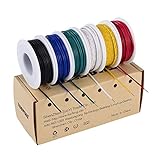
- 6-COLOR, 180 FT KIT: Includes red, black, white, blue, green, and yellow wire, 30 ft per color, for organized circuit identification and fewer wiring mistakes
- SOLID TINNED COPPER CONDUCTOR: Single-core conductor holds clean bends, inserts into breadboards without loose strands, and accepts solder for PCB and electronics work
- 22 AWG DIMENSIONS: Approximately 0.64 mm conductor diameter and 1.55 mm overall diameter help provide a practical fit for breadboards, perfboards, and terminals
- PVC INSULATION RATING: Rated 300 V and up to 80C for fixed electronics wiring. The jacket strips cleanly when used with a properly sized wire stripper
- VERSATILE APPLICATION: Use for breadboards, microcontroller projects, PCB soldering, guitar electronics, STEM builds, and other fixed internal wiring
Standards note: This U.S.-oriented overview draws on the safety and wiring principles published by NFPA, OSHA, CPSC, UL, DOE Building Science, and FTC consumer guidance. Those resources do not replace the code legally adopted for your project or the judgment of a qualified electrical professional.
Frequently Asked Questions
Is a higher wire gauge number a thicker wire?
No. A smaller AWG number indicates a larger conductor, so 10 AWG is larger than 12 AWG and 12 AWG is larger than 14 AWG. Safe ampacity also depends on material, insulation, temperature, bundling, terminations, installation method, load, and code requirements.
Can NM-B cable be used outside or underground?
NM-B is primarily for permitted residential branch-circuit work in normally dry locations. It is not the default cable for wet, damp, outdoor, or direct-burial installations. A different listed wiring method, such as UF-B or individual conductors in an appropriate raceway, may be required.
The Tool Desk
Outbyte Driver Updater FREEScan for outdated or missing drivers - takes under a minuteDriver Scan →Outbyte PC Repair FREEClear out junk files and repair common Windows errorsFree Scan →Can I choose a breaker based only on wire size?
Not automatically. The familiar reference points are 14 AWG copper at 15 amperes and 12 AWG copper at 20 amperes under stated conditions, but the complete circuit design controls. A breaker must be coordinated with conductor ampacity, load, terminations, equipment, and applicable exceptions.
Does a 90°C wire rating mean I can always use the 90°C ampacity?
No. A 90°C insulation rating does not automatically allow the circuit to use the 90°C ampacity. Termination temperature ratings and other code rules may limit the allowable ampacity.
What is the difference between GFCI and AFCI protection?
A GFCI helps reduce shock and electrocution risk from certain ground faults. An AFCI addresses fire risks associated with unwanted arcing and sparking. Whether either is required, where it must be installed, and which device is compatible depends on the adopted code, circuit, equipment, and local amendments.
When should a homeowner hire an electrician?
Usually, yes. Service equipment, utility connections, panel modifications, unknown or damaged wiring, aluminum-wiring remediation, energized work, generators, transfer equipment, EV chargers, solar and batteries, wet locations, and complex circuits should be handled by a qualified electrician. Permit and inspection requirements also vary by jurisdiction.
Free tools Windows power users keep installed
One-click scans. No signup required.
The Bottom Line
The right wire is determined by the complete circuit design—not gauge alone. Select a listed wiring method for the environment, calculate ampacity under the actual installation conditions, coordinate the breaker and terminations, and provide the required grounding, bonding, GFCI, AFCI, boxes, and physical protection.
Because code adoption and site conditions vary, verify requirements with the local AHJ before work begins. Leave service equipment, panel modifications, unknown wiring, energized work, and specialized systems to a qualified electrician.
Quick Recap
Product prices and availability are accurate as of the date/time indicated and are subject to change. Any price and availability information displayed on Amazon at the time of purchase will apply.

