Windows Errors? Fix Them Before They Spread
Repair common Windows errors and clear accumulated junk for a smoother, more stable PC - no reinstall needed.Free scan · no reinstallOutdated Drivers Are Slowing You Down
One free scan finds every outdated or missing driver and matches the right update for your exact hardware.Free scan · exact hardware matchElectrical work in concrete succeeds or fails before the concrete arrives. Raceway routes, boxes, sleeves, penetrations, supports, reinforcement conflicts, and interfaces with other trades must be resolved on the approved drawings and checked in the field before a pour. The correct method depends on whether the raceway is embedded in a building element, passes through a planned opening, or forms part of an underground concrete-encased duct bank.
This guide explains how to choose and coordinate each method without treating one project detail as a universal rule. Conduit sizes, spacing, concrete cover, bends, grounding, firestopping, sealing, and code requirements must follow the adopted jurisdictional code, project specifications, engineered design, manufacturer instructions, and authority having jurisdiction (AHJ).
As an Amazon Associate I earn from qualifying purchases.
What “electrical installation in concrete” includes
Electrical installation in concrete is not one technique. It covers several different construction conditions that require different detailing, inspections, and sequencing:
Free tools Windows power users keep installed
One-click scans. No signup required.
- Embedded raceway: conduit and boxes cast inside a wall, slab, beam, or other building element.
- Planned sleeves and penetrations: coordinated openings through concrete for conduit, cable, busway, or later-installed services.
- Concrete-encased underground duct bank: multiple conduits arranged in a designed underground route and surrounded by concrete.
- Post-pour work: surface raceway, approved core drilling, or other modifications made after concrete placement. These require design review because drilling or cutting can affect reinforcement, structural capacity, waterproofing, and fire-resistance ratings.
The installation method is part of the building design, not merely an electrician’s routing choice. A conduit that fits physically may still clash with reinforcement, reduce concrete consolidation, block another service, compromise a rated assembly, or leave no workable pulling path. Treat every concealed raceway and opening as a coordinated construction element.
#1 Best Overall

- Liquid Tight Conduit Kit: Our liquid-tight conduits are made of antioxidant PVC material, featuring a smooth interior for easier wire pulling. Length: 25 feet, Comes with 4 straight and 3 90-degree conduit connectors
- Safety and Reliability: Our electrical conduits resist corrosion, wear, oil, water, acid, and metal chips, making them ideal for harsh environments. They offer excellent tensile and compressive strength and are suitable for outdoor, UV-resistant, and direct burial applications
- Easy Installation: No disassembly required, simplifying wire installation. Just push the conduit onto the ferrule and tighten the dome sealing nut. Easily cut to the desired length with a utility knife or PVC cutter
- Flexible and Light: Our non metalic liquid tight conduits are suitable for tight spaces, lightweight, 50% lighter than metal conduits, more flexible and lightweight,and lower installation costs
- Wide Application: Liquid-tight electrical conduits are suitable for AC equipment, machine tools, marine equipment, motors and controls, printing equipment, pumps, refrigeration systems, transformer connections, and outdoor lighting
Choose the method for the concrete application
Embedded raceway in cast-in-place walls, floors, and slabs
Embedded raceway is installed during rough-in and remains inside the concrete. The approved construction documents should identify approximate routes, box locations, endpoint elevations, sleeves, and penetrations. Before installation, verify those locations against structural drawings, reinforcing steel, formwork, plumbing, HVAC, fire-protection systems, and architectural finishes.
A public project specification from the City of Albuquerque (Sections 26 0500 and 26 0533, associated with a 2025 project document) illustrates this coordination approach. It calls for examining receiving conditions, verifying approximate box and raceway locations before rough-in, coordinating with the structure and other work, and installing complete raceway and box systems. It is an example project specification, not a national installation rule.
Do not place a desired raceway anywhere inside a structural member. If the route conflicts with reinforcement, post-tensioning, embeds, minimum cover, or concrete placement, obtain a design resolution through the project’s review process. Never move reinforcing steel or enlarge an opening in the field without the responsible structural designer’s approval.
The Tool Desk
Outbyte Driver Updater FREEScan for outdated or missing drivers - takes under a minuteDriver Scan →Outbyte PC Repair FREERepair Windows errors before they cause bigger problemsFix Now →Planned sleeves and penetrations
A sleeve is a deliberate opening or insert that allows a service to pass through concrete. It can simplify later installation and reduce the need for drilling, but its location, material, diameter, fire rating, water sealing, and structural treatment are project-specific. Coordinate sleeves with structural details, waterproofing, the building envelope, fire-rated assemblies, and the trade that will install the service.
Drawings should identify the sleeve centerline, elevation, orientation, and required projection or flush condition. Confirm whether the sleeve is to remain, be removed, or receive a separate conduit. A penetration through a foundation wall has different sealing requirements from a penetration through an interior rated wall; do not substitute a generic sealant or firestop detail.
Concrete-encased underground duct banks
A duct bank groups several conduits in a common underground route, often with concrete encasement for mechanical protection, alignment, and long-term serviceability. It is a distribution system rather than a single building-wall rough-in.
The 2013 course document Introduction to Exterior Electrical Power Distribution by J. Paul Guyer, P.E., distributed through CED Engineering, describes PVC conduits, interlocking plastic spacers, and example clearances in concrete-encased duct banks. Those dimensions are instructional examples from that document; they are not universal code minima and must not be copied into another project without engineering approval.
What’s actually slowing this PC down?
Pick the symptom - the matching free tool is one click away.
Duct-bank design must address electrical load and heat dissipation, the number of conduits and spare capacity, separation and alignment, route and bend geometry, burial and external loading, access structures, pulling tension, concrete placement, and coordination with civil utilities. The engineered design controls the actual dimensions and materials.
Rank #2

- Liquid Tight Conduit Kit: Our liquid-tight conduits are made of antioxidant PVC material, featuring a smooth interior for easier wire pulling. Length: 100 feet. Comes with 6 straight and 5 90-degree conduit connectorsconnectors.
- Safety and Reliability: Our electrical conduits resist corrosion, wear, oil, water, acid, and metal chips. They offer excellent tensile and compressive strength and are suitable for outdoor, UV-resistant, and direct burial applications
- Easy Installation: No disassembly required, simplifying wire installation. Just push the conduit onto the ferrule and tighten the dome sealing nut. Easily cut to the desired length with a utility knife or PVC cutter
- Flexible and Light: Our non-metalic liquid tight conduits are suitable for tight spaces, lightweight, 50% lighter than metal conduits, more flexible and lightweight, and lower installation costs
- Wide Application: Liquid-tight electrical conduits are suitable for AC equipment, machine tools, marine equipment, motors and controls, printing equipment, pumps, refrigeration systems, transformer connections, and outdoor lighting
Information to resolve before a pour
Confirm the governing requirements
Start with the project’s contract documents, approved submittals, structural and architectural drawings, and the electrical code adopted by the project jurisdiction. The phrase “current NEC” in a specification does not identify the edition adopted in every state, city, or special jurisdiction. Verify the adopted edition, local amendments, permit conditions, and AHJ interpretations.
Federal OSHA construction rules apply to worker safety, but they do not replace the adopted electrical code or project design. State-plan OSHA programs, local electrical requirements, and owner standards may add obligations.
Build a coordinated routing plan
Mark each raceway path from source to destination. Show box centerlines, elevations, stub-ups, stub-outs, pull points, sleeves, and transitions from concrete to accessible raceway. Check that:
- boxes remain reachable after form removal and finishes;
- conduit bends allow the planned conductor pull;
- raceways do not occupy reinforcement, tendon, embed, or anchor zones;
- openings do not compromise structural or fire-rated assemblies;
- other trades can install and service their systems; and
- the concrete crew can place and consolidate concrete around the rough-in.
Use coordinated drawings or a formally controlled field layout. A sketch on formwork is not a substitute for an approved change when the route differs from the documents.
Select raceway and boxes for the environment
Raceway, fittings, and boxes must match the exposure and the approved system. The Albuquerque specification uses PVC conduit joined with manufacturer-recommended cement as one example and also identifies metal raceway options. It distinguishes box selection for dry, damp, wet, and other stated conditions. These are project-specific examples, not permission to use one raceway type everywhere.
Evaluate moisture, corrosive agents, sunlight before encasement, physical damage, temperature, concrete chemistry, and transition points. Select fittings that are listed or approved for the raceway and environment. Where a metal system is used, include the bonding and grounding details required by the design and adopted code.
Design duct banks as systems
For an underground duct bank, resolve these design axes before excavation:
Do these 3 things before closing this tab:
1Scan for outdated or missing drivers - takes under a minute2Repair Windows errors before they cause bigger problems3Fix the driver behind crashes, sound loss and screen glitches- Capacity: conductor load, expected heat, number of active conduits, and future spares.
- Geometry: route, horizontal and vertical bends, pull-box or manhole locations, and maximum practical pulling sections.
- Arrangement: conduit alignment, separation, spacers, supports, end bells, and identification.
- External conditions: burial depth, traffic or equipment loading, groundwater, frost, corrosion, and other utility conflicts.
- Concrete work: specified mix, placement sequence, vibration access, construction joints, and required encasement.
- Interfaces: civil grading, drainage, structures, property-line transitions, utility crossings, and building entries.
Do not infer conduit spacing, encasement thickness, or cover from a sample detail. The 2013 Guyer document is useful background, but the current engineered drawings and project specifications control.
Rank #3

- Premium Liquid-Tight Conduit: Length: 100Ft,ID: 0.63inch,OD: 0.83inch,Thick: 2.5mm. The flexible liquid tight electrical conduit kit is constructed with resists corrosion PVC, featuring a smooth interior for easier wire pulling, to ensure quality and service life
- Complete Accessories: 1/2 inch 100ft flexible electrical conduit with 5 straight and 3 90-degree conduit connector fittings. Whether you are setting up outdoor lighting, security systems, or any other electrical project, this conduit is the perfect choice
- Safety & Sturdiness: Our pvc conduit resists to corrosion, water, oil, abrasion, acid, metal shavings and rough environment. They offer excellent tensile and compressive strength and are suitable for outdoor, UV-resistant, and direct burial applications
- Easy to Install: You can simply tighten the dome sealing nut by pushing the conduit or pipe onto the ferrule, only one person can complete the work in a few minutes. Flexible conduit connector is safe to use and does not require any tools
- Wide Application: PVC electrical conduit is widely used in HVAC equipment, machine tools, marine equipment, motors and controls, printing equipment, pumps, refrigeration equipment, transformer connections, outdoor lighting etc
Materials, joining, supports, and boxes
PVC raceway
PVC electrical conduit can be used for embedded building raceway or concrete-encased duct banks when the approved design permits it. Use the compatible fittings and the manufacturer’s joining method; the cited project specification identifies manufacturer-recommended cement joining. Keep joints clean, fully seated, and protected from concrete or debris entering the raceway.
Confirm the allowable temperature, sunlight exposure before encasement, impact resistance, bend limitations, and transition details. A PVC system does not provide the same metallic continuity as a metal raceway, so grounding and bonding must follow the design and adopted code.
Metal raceway
Metal conduit may be selected where the project requires mechanical protection, grounding continuity, or a particular environmental rating. Use listed fittings and provide bonding jumpers or other continuity measures where required. Protect threads and openings from damage during placement, and prevent concrete from locking fittings in a way that makes later maintenance impossible.
Boxes and fittings
Choose box material, enclosure rating, covers, hubs, couplings, and connectors for the location and raceway system. Confirm that the box has adequate volume for the planned conductors and devices under the adopted code. Keep box faces at the specified finish line and install extensions or adapters only where the approved detail allows them.
Supports and protection during placement
Secure conduits and boxes so they cannot float, rotate, collapse, or shift when reinforcing steel, workers, pumps, or vibrators move around them. Use supports and spacers approved for the system and compatible with concrete placement. Cap or otherwise protect open raceway ends against slurry and foreign material. Do not use reinforcement as an improvised support unless the structural and electrical details expressly permit that method.
Step-by-step pre-pour rough-in workflow
- Review the controlled documents. Compare electrical, structural, architectural, civil, fire-protection, and mechanical drawings with the specifications and approved submittals. Record the adopted code edition, amendments, permit requirements, and any detail that controls a penetration or rated assembly.
- Walk the receiving conditions. Inspect forms, reinforcement, embeds, sleeves, blockouts, and previously installed services. Verify that the concrete element is ready for the planned rough-in and report conflicts before installing conduit.
- Lay out routes and boxes. Mark raceway centerlines, box locations, elevations, stub-ups, stub-outs, and sleeve coordinates. Verify approximate locations in the field, as the Albuquerque specification requires for its project example.
- Resolve conflicts formally. If the route hits reinforcement, a tendon, a structural opening limit, another service, or an inaccessible location, stop and obtain a documented resolution. Do not conceal an unapproved field change.
- Install the approved raceway system. Cut and join conduit according to the manufacturer’s instructions. Maintain the designed bend geometry, install compatible fittings, and provide transitions to exposed or accessible raceway.
- Set and secure boxes and sleeves. Fix boxes to forms or approved supports at the required elevation and orientation. Seal or cap openings as the detail requires, while leaving the intended passage clear.
- Protect the rough-in during the pour. Recheck supports, caps, box covers, sleeves, and pull paths immediately before concrete placement. Coordinate with the concrete crew so hoses, pumps, reinforcing operations, and vibrators do not dislodge the work.
- Hold a documented inspection. Photograph concealed work, record locations and deviations, and obtain the project’s required sign-off before the raceway is inaccessible. The reviewed specifications require examination and coordination but do not provide one universal checklist for every project.
- Verify after placement. Once forms are removed and the concrete has cured enough for safe access, check that boxes are reachable, openings are usable, and raceways are not blocked. Perform any project-required proving or cleaning procedure before conductors are installed.
How to install a concrete-encased duct bank
Prepare the route and trench
Set out the engineered alignment and elevations. Confirm utility locates, excavation support, groundwater controls, bedding, access structures, and transitions into buildings or equipment pads. Keep the trench stable and clean so the conduit assembly is not forced out of alignment during placement.
Assemble conduits with designed spacers
Lay out conduits in the specified pattern and use the approved interlocking spacers or supports. Spacers maintain alignment while concrete flows around the assembly; they do not establish a universal spacing requirement. Check that couplings, bends, end bells, and spare conduits match the drawings and pulling plan.
Control bends and pulling sections
Confirm that the route’s total bend and length are compatible with the conductor installation method. Coordinate pull-box, handhole, and manhole locations before the duct bank is buried. Place pull strings or other provisions only when required by the project documents, and protect them from displacement or concrete contamination.
Rank #4

- Complete Accessories:3/4 liquid tight conduit, 25 ft flexible electrical conduit with 5 straight and 3 90-degree conduit connector fittings.Flexible electrical conduit length:25ft,,Id:0.813inch(20.6mm,Od:1.03 inch(26.4mm),thick: 2.5mm,fittings install directly onto conduit for waterproof joints
- Safety and Sturdiness:Ansgery liquid tight conduit 3/4 resists to corrosion,water,oil,abrasion,acid,metal shavings and rough environment;Resistance to pulling and crushing;Fully adaptable to outdoor environments such as direct sunlight,direct burial.Stays flexible in extreme hot and cold temperatures
- Premium Liquid-Tight Conduit:3/4 flexible conduit made from anti-oxidation virgin PVC.Smooth inside for easier wire pulling,no hazardous sharp edges or burrs.Integral rigid and flexible PVC construction will not damage conductors,and 50% lighter than metallic conduits.Costs less to install
- Effortless Installation:3/4 flex conduit fits is fast,length can be cut to size,only one person can complete the work in a few minutes.flexible conduit connector is safe to use and does not require any tools.You can simply tighten the dome sealing nut by pushing the conduit or pipe onto the ferrule
- Wide Applications:PVC electrical conduit has very good durable, pulling and squeezing;Flex conduit 3/4 widely used in HVAC equipment, machine tools,marine equipment,motors and controls,printing equipment,pumps, refrigeration equipment,transformer connections,outdoor lighting
Place and consolidate concrete
Use the specified concrete mix and placement sequence. Prevent the conduit assembly from floating or separating as concrete is placed. Consolidate concrete sufficiently to eliminate voids without damaging conduit, spacers, or end fittings. Record the pour location, date, mix information, and any approved construction joint or cold-joint treatment.
Identify and verify each duct
After the encasement reaches the project’s required condition, verify duct openings, labels, elevations, and continuity through the route. The project may require a specific mandrel, brush, rope, or other proving method; follow that written requirement rather than assuming one test applies everywhere. Repair or document blocked ducts before backfill.
Sleeves, penetrations, firestopping, and water sealing
Coordinate every penetration with the assembly it crosses. A sleeve through a foundation, exterior wall, wet area, fire barrier, or smoke partition can require different materials and seals. Confirm:
- the sleeve or opening size and tolerance;
- the required annular space around the conduit;
- waterproofing and drainage details;
- fire-resistance and smoke-seal listings;
- movement, vibration, and seismic allowances where applicable;
- the sequence for installing the service and closing the opening; and
- inspection records for concealed sealing work.
The reviewed material does not establish universal penetration dimensions, firestop systems, or water-sealing products. Use the project’s tested/listed assembly and the manufacturer’s installation instructions.
Independent reader supportYour contribution helps us test, update, and keep practical guides available for everyone.OSHA safety requirements that affect concrete rough-in
Federal OSHA’s construction regulation, 29 CFR 1926.405(a)(1)(i), states: “Metal raceways, cable armor, and other metal enclosures for conductors shall be metallically joined together into a continuous electric conductor and shall be so connected to all boxes, fittings, and cabinets as to provide effective electrical continuity.” This is regulatory text issued by OSHA, not a quotation from a named individual.
The same OSHA section requires protection against abrasion where conductors enter boxes, cabinets, or fittings, and requires openings to be effectively closed. Unused openings must also be closed. Pull boxes, junction boxes, and fittings require covers; metal covers must be grounded. Outlet boxes in energized installations require covers, faceplates, or fixture canopies.
These provisions matter during and after a concrete pour. Damaged bushings, missing covers, open knockouts, and discontinuous metal raceway can create hazards before conductors are energized. Correct them as soon as they are found, and keep the area controlled while repairs are made.
Quick wins for a faster PC:
Fix the driver behind crashes, sound loss and screen glitchesFind Drivers →Clear out junk files and repair common Windows errorsFree Scan →Temporary construction wiring is regulated separately. OSHA requires temporary wiring to be removed immediately when construction is complete or when the purpose for which it was installed is complete. Do not leave temporary feeders, receptacles, or extensions embedded or abandoned in a completed installation.
Best Value
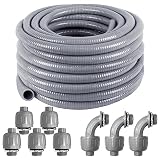
- 𝐏𝐫𝐞𝐦𝐢𝐮𝐦 𝐋𝐢𝐪𝐮𝐢𝐝 𝐓𝐢𝐠𝐡𝐭 𝐂𝐨𝐧𝐝𝐮𝐢𝐭: 1 inch flexible conduit made from anti-oxidation virgin PVC.Smooth inside for easier wire pulling,no hazardous sharp edges or burrs.Integral rigid and flexible PVC construction will not damage conductors,and 50% lighter than metallic conduits.Costs less to install
- 𝐒𝐚𝐟𝐞𝐭𝐲 𝐚𝐧𝐝 𝐒𝐭𝐮𝐫𝐝𝐢𝐧𝐞𝐬𝐬: Ansgery 1 inch liquid tight conduit resists to corrosion,water,oil,abrasion,acid,metal shavings and rough environment;Resistance to pulling and crushing;Fully adaptable to outdoor environments such as direct sunlight,direct burial.Stays flexible in extreme hot and cold temperatures
- 𝐂𝐨𝐦𝐩𝐥𝐞𝐭𝐞 𝐀𝐜𝐜𝐞𝐬𝐬𝐨𝐫𝐢𝐞𝐬: 1/2 inch 50ft flexible electrical conduit with 5 straight and 3 90-degree conduit connector fittings.Flexible electrical conduit length:50 ft,id:1inch,od:1.1 inch,thick: 3 mm,fittings install directly onto conduit for waterproof joints
- 𝐄𝐟𝐟𝐨𝐫𝐭𝐥𝐞𝐬𝐬 𝐈𝐧𝐬𝐭𝐚𝐥𝐥𝐚𝐭𝐢𝐨𝐧:Liquid-tight conduit fits is fast,length can be cut to size,only one person can complete the work in a few minutes.Flexible conduit connector is safe to use and does not require any tools.You can simply tighten the dome sealing nut by pushing the conduit or pipe onto the ferrule
- 𝐖𝐢𝐝𝐞 𝐀𝐩𝐩𝐥𝐢𝐜𝐚𝐭𝐢𝐨𝐧𝐬: PVC electrical conduit has very good durable, pulling and squeezing;Widely used in HVAC equipment, machine tools,marine equipment,motors and controls,printing equipment,pumps, refrigeration equipment,transformer connections,outdoor lighting
OSHA rules are not a complete substitute for the electrical code. State-plan requirements, local adoption, permit conditions, project specifications, and AHJ instructions can impose additional requirements.
Inspection, records, and handover
Concealed electrical work is difficult to prove after concrete placement, so documentation is part of the installation. Keep a controlled record of:
- approved drawings and revisions used for layout;
- raceway, box, sleeve, and duct-bank locations;
- material submittals and manufacturer joining instructions;
- pre-pour inspection approvals;
- photographs with recognizable gridlines, dimensions, or reference points;
- approved deviations and repaired conflicts;
- concrete placement records for encased duct banks; and
- post-pour verification and blocked-raceway corrections.
At handover, provide updated locations so future drilling, coring, anchoring, and renovation work can avoid concealed raceways and ducts. Coordinate the record with the owner’s as-built and facility-maintenance requirements.
Recommended Free Tools
Common failures and how to correct them
| Failure | Why it happens | Better response |
|---|---|---|
| Box is buried behind a finish or inaccessible after the pour | Layout was not checked against formwork, finishes, or clearances. | Verify box centerline and elevation before rough-in; obtain an approved relocation before concrete placement. |
| Raceway shifts, floats, or separates | Inadequate supports, unsuitable ties, or interference during reinforcing and concrete work. | Use approved supports and spacers, inspect immediately before the pour, and coordinate pump and vibrator movement. |
| Conduit is blocked after placement | Open ends were uncapped, joints were incomplete, or concrete entered during placement. | Protect openings, inspect after stripping, and prove or clean the raceway using the project-required method before pulling conductors. |
| Route conflicts with reinforcement or another service | Electrical layout was developed without current structural or coordination drawings. | Stop work, document the conflict, and obtain a structural or multi-trade resolution; never cut reinforcement without authorization. |
| Wrong raceway or box for the environment | Dry-location materials were carried into damp, wet, corrosive, or exposed areas. | Match the approved system to the environmental classification and replace noncompliant materials before concealment. |
| Metal raceway lacks effective continuity | Loose couplings, incompatible fittings, damaged threads, or omitted bonding connections. | Repair the listed connection and verify continuity before energizing, following the adopted code and project testing requirements. |
| Duct-bank pull is impractical | Route, bend geometry, access spacing, or conduit arrangement was not checked against the conductor pull. | Revisit the engineered pulling plan before encasement; add an approved access point or revise the route rather than forcing the installation. |
| Penetration leaks or loses its rating | Generic sealant was used without the assembly’s water, fire, or movement detail. | Install the specified listed or engineered sealing system and document the concealed work. |
Comparing the main installation approaches
| Approach | Best fit | Primary coordination issue | Key inspection point |
|---|---|---|---|
| Embedded raceway | Cast-in-place walls, slabs, and floors with known outlet and equipment locations | Reinforcement, formwork, box access, and other concealed services | Verify route, box elevation, supports, and clear openings before the pour |
| Planned sleeve or penetration | Services crossing concrete elements where the final conduit may be installed later | Structural opening limits, fire rating, waterproofing, and movement | Confirm sleeve coordinates and the complete sealing detail before concrete placement |
| Concrete-encased duct bank | Underground distribution with multiple conduits and planned access points | Thermal behavior, pulling geometry, civil utilities, burial, and concrete placement | Inspect conduit pattern, spacers, bends, end fittings, and duct continuity before backfill |
| Post-pour installation or modification | Approved surface routing or specifically engineered alterations | Structural scanning, reinforcement, waterproofing, dust, and rated-assembly restoration | Obtain design approval and verify the finished repair or penetration |
What cannot be specified universally
A practical guide can establish the workflow, but it cannot responsibly assign one value to every project. Confirm these items in the project documents and adopted requirements:
- conduit trade size and wall thickness;
- raceway fill, conductor count, and derating;
- minimum spacing between conduits;
- concrete cover, embedment, and reinforcement clearance;
- maximum bend count or pulling length;
- duct-bank width, height, and encasement dimensions;
- grounding and bonding details;
- firestop, smoke-seal, and waterproofing systems;
- concrete mix, placement, and curing requirements; and
- inspection, testing, and acceptance procedures.
Those values vary with voltage, conductor type, structural system, environment, utility requirements, adopted code edition, engineering calculations, and the AHJ. A dimension shown in a 2013 educational document or a 2025 public specification should be treated as context for its stated project, not as a universal minimum.
Practical decision checklist
Before releasing electrical rough-in for a concrete pour, the responsible contractor or construction manager should be able to answer yes to each applicable question:
- Are the current coordinated drawings and approved submittals in the field?
- Is the adopted electrical code edition and local amendment set confirmed?
- Have raceway routes, boxes, sleeves, and penetrations been checked against structural and reinforcing drawings?
- Are materials and joining methods approved for the actual environment?
- Are supports, spacers, caps, and covers sufficient to survive reinforcement and concrete operations?
- Can every required box, pull point, and transition be reached after the pour?
- Has the duct-bank route been checked for thermal, pulling, access, utility, and burial requirements?
- Are firestop, waterproofing, and movement details identified for each penetration?
- Has the pre-pour inspection been documented, including approved deviations?
- Is there a post-pour plan to verify usable raceways before conductors are installed?
If any answer is no, resolve the issue through the project’s review process before concrete conceals the work. Early coordination is cheaper and safer than coring, demolition, or undocumented field repair.
Quick Recap
Product prices and availability are accurate as of the date/time indicated and are subject to change. Any price and availability information displayed on Amazon at the time of purchase will apply.

