Some links on this page are affiliate links: if you buy through them we may earn a commission, at no extra cost to you.
Short answer: U.S. outlet requirements depend on the electrical and residential codes adopted by your state or local authority having jurisdiction (AHJ). Those rules cover outlet placement, kitchen work surfaces, GFCI and AFCI protection, tamper resistance, wet locations, garages, bathrooms, outdoor receptacles, and replacement of old ungrounded outlets. The NEC and IRC are model codes; the locally adopted edition and amendments control what is enforceable.
Why local code matters
There is no single outlet rule that applies identically in every U.S. home. Your project may be governed by an adopted edition of the National Electrical Code (NEC), the residential provisions of the International Residential Code (IRC), state or municipal amendments, and the AHJ’s interpretation.
As an Amazon Associate I earn from qualifying purchases.
Before adding, relocating, or replacing receptacles, confirm:
- Which NEC or IRC edition your jurisdiction has adopted
- Whether local amendments apply
- Whether a permit or inspection is required
- Whether the work involves a new circuit, panel changes, wet locations, or structural remodeling
The requirements below describe common U.S. residential provisions, including measurements cited in 2024 IRC materials. They are a planning guide, not a substitute for the locally adopted code or an electrician’s evaluation.
Popular on Amazon

- REPAIR OR REPLACE WITH CONFIDENCE — Grounding duplex receptacle upgrades or replaces outlets for bedrooms, kitchens, offices and workshops, delivering reliable performance for contractors and DIY installations
- FAST DIY INSTALLATION — Self-grounding clip enables quick installs in properly grounded metal boxes, while a reinforced yoke and heavy-duty construction ensure long-lasting durability and consistent performance
- CLEAN WHITE FINISH — Neutral white outlet design blends seamlessly with existing décor, making it an ideal match for new builds or simple outlet upgrades throughout the home
- POWER EVERYDAY DEVICES SAFELY — 125VAC/15A rating supports lamps, small appliances, tools, laptops, tablets and mobile devices, with screw terminal wiring for 14AWG or 12AWG copper wire
- CERTIFIED SAFETY YOU CAN TRUST — UL-listed duplex receptacle meets industry safety standards and undergoes strict testing, backed by a 90-day hassle-free replacement policy for dependable use
How many outlets are required in a room?
In general living areas, receptacles are placed according to wall-space rules rather than a simple “one outlet per room” formula. The purpose is to make power available without relying on extension cords.
The calculation considers qualifying wall space, breaks in the wall, doorways, fixed cabinets, fireplaces, and similar features. Because the exact measurement and exceptions vary by adopted code edition, do not calculate compliance from room size alone. A plan that satisfies the general wall-spacing rule may still need additional receptacles for countertops, appliances, bathrooms, garages, basements, or outdoor areas.
Do these 3 things before closing this tab:
1Fix the driver behind crashes, sound loss and screen glitches2Clear out junk files and repair common Windows errors3Scan for outdated or missing drivers - takes under a minuteOutlet spacing is not the same as outlet count
When someone asks, “How far apart do electrical outlets have to be?” the answer depends on how the code defines usable wall space and the applicable exceptions. Receptacles are intended to be close enough that a typical appliance cord does not require an extension cord, but the enforceable spacing must be taken from the code edition adopted in your jurisdiction.
Dedicated appliance receptacles are considered separately. A refrigerator, dishwasher, garbage disposal, range, oven, microwave, HVAC system, or other dedicated load may have its own circuit, disconnect, GFCI, AFCI, and installation requirements. These devices should not be counted as a substitute for general-purpose wall receptacles unless the adopted code specifically permits it.
Kitchen outlet requirements
Kitchens, pantries, breakfast rooms, dining rooms, and similar areas receive separate treatment for receptacles serving countertops and other work surfaces.
Countertops and work surfaces
The cited 2024 IRC material treats qualifying work surfaces that are at least 12 inches (305 mm) wide separately from general wall receptacles. Countertop and work-surface receptacles do not simply replace the general receptacles required elsewhere in the room.
Free tools Windows power users keep installed
One-click scans. No signup required.
Kitchen planning should address:
- Continuous countertop areas and breaks in the counter
- Islands and peninsulas
- Countertops near sinks or other wet areas
- GFCI protection for countertop receptacles
- AFCI requirements for the supplying circuit
- Dedicated circuits for major appliances
- Accessible placement that does not conflict with cabinets, backsplashes, or appliances
The exact number, spacing, island treatment, and permitted receptacle locations depend on the adopted code edition. A kitchen remodel should be laid out before cabinets and countertops are installed, because moving a receptacle afterward can require opening finished surfaces.
Dedicated kitchen appliances
Do not treat every kitchen outlet as interchangeable. Refrigerators, dishwashers, disposals, microwaves, ranges, and ovens may require dedicated circuits or special protection. The appliance instructions, panel capacity, circuit rating, and locally adopted code all matter.
GFCI outlet requirements
A ground-fault circuit-interrupter (GFCI) protects against a dangerous ground-fault condition, especially where electricity may come into contact with water, grounded surfaces, or damp materials. GFCI protection is location-driven and has expanded or changed across code editions.
Also popular on Amazon

- Terminal screws accept up to no.12 and quickwire accept no.14 copper or copper clad wire
- Double wipe power contacts for maximum conductivity and plug retention
- Heavy gauge, rust resistant steel mounting strap
- Shallow design for maximum wiring room
- Break off tabs allow easy two circuit conversion
Common residential areas where GFCI protection is required or commonly encountered include:
Recommended Free Tools
- Bathrooms
- Kitchen countertop and work-surface receptacles
- Garages
- Outdoor receptacles
- Laundry areas
- Unfinished basements
- Receptacles near sinks and other wet or damp locations
Do not reduce the rule to “only outlets near water need GFCI.” Depending on the adopted edition, the requirement may be based on the receptacle’s location, the circuit, the equipment, or the type of installation. The exact coverage also depends on exceptions and local amendments.
GFCI receptacle versus GFCI breaker
A GFCI receptacle protects itself and, when wired correctly, downstream receptacles connected to its load terminals. A GFCI circuit breaker protects the branch circuit from the panel. The correct method depends on the wiring arrangement, accessibility, circuit design, and adopted code.
A GFCI receptacle does not automatically provide AFCI protection. A circuit may require GFCI protection, AFCI protection, or both.
AFCI requirements for residential outlets
An arc-fault circuit interrupter (AFCI) addresses hazardous electrical arcing, which is a different risk from the ground-fault condition addressed by a GFCI.
Many 120-volt, 15- and 20-ampere dwelling-unit circuits serving living and utility areas require AFCI protection under commonly adopted residential code provisions. Coverage can include numerous habitable rooms and utility areas, but the precise list, exceptions, circuit ratings, and permitted installation methods depend on the NEC edition adopted by the AHJ.
For example, a kitchen countertop circuit may require GFCI protection because of its location and AFCI protection because of the circuit and area it serves. A GFCI receptacle alone should not be described as AFCI protection for the entire branch circuit.
Bathroom outlet requirements
A bathroom generally must have at least one receptacle. Bathroom receptacles also generally require GFCI protection under the cited residential guidance.
Receptacles cannot be installed inside the tub or shower area. The cited 2024 IRC devices-and-luminaires material describes a 3-foot (914 mm) horizontal exclusion zone measured from the outside edge of the tub or shower stall. Because wording and exceptions can vary, verify the exact measurement in the locally adopted code.
Also popular on Amazon
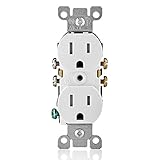
- Shutter mechanism inside the receptacle blocks access to the contacts unless a two-prong plug is inserted, helping ensure hairpins, keys, etc., will be locked out
- TR symbol on residential receptacles assures they meet the 2008 NEC requirement
- Ultrasonic heavy-duty construction offers long, trouble-free service life
- Heavy-gauge, rust-resistant steel mounting strap
- Shallow design for maximum wiring room
Bathroom receptacle planning should check:
- GFCI protection
- Distance from the tub or shower
- Placement near the basin without entering a prohibited zone
- Tamper-resistant requirements
- Box fill, circuit capacity, and wiring method
- Whether the device is listed and suitable for the installation environment
Do not place a receptacle where splashing, condensation, or a cord’s position creates an unsafe installation even if the location appears outside the basic exclusion zone.
Garage and basement receptacles
Garages
The cited 2024 IRC material requires a receptacle in each vehicle bay of qualifying attached garages and powered detached garages or accessory buildings. It cites a maximum height of 5.5 feet (1,676 mm) above the floor for the garage-bay receptacle.
Garage receptacles commonly require GFCI protection. The adopted code determines the precise scope, including how the rule applies to attached garages, detached structures, unfinished areas, and equipment.
Unfinished basements
A receptacle is required in each separate unfinished portion of a basement under the cited 2024 IRC material. Unfinished basements may also fall within GFCI and AFCI requirements, depending on the receptacle, circuit, and adopted edition.
Basement remodeling can change the applicable requirements. Once walls, finished flooring, laundry equipment, or living space are added, additional receptacle and circuit rules may apply.
Laundry areas and outlets near sinks
Laundry areas are among the residential locations commonly covered by GFCI requirements. Receptacles near sinks and other wet areas may also require GFCI protection even when they are not in a bathroom or kitchen.
Do not use distance from a sink as the only compliance test. The code may classify the location based on the room, use, equipment, or installation conditions. Confirm the applicable rule before installing a receptacle near a laundry sink, utility sink, bar sink, or similar fixture.
Outdoor and damp-location receptacles
Outdoor receptacles require suitable equipment and weatherproofing. A receptacle in a damp or wet location must use a weatherproof enclosure or faceplate assembly that provides a watertight connection with the finished surface, according to the cited 2024 IRC devices-and-luminaires material.
What’s actually slowing this PC down?
Pick the symptom - the matching free tool is one click away.
“Weather-resistant receptacle” and “weatherproof cover” are not interchangeable descriptions:
Also popular on Amazon

- Large-Head Terminal Screws, Backed out and Staked, Accept 0 Copper or Copper-Clad Wire
- Heavy-Duty Brass Power Contacts for Maximum Conductivity and Plug Retention
- Heavy-Gauge, Rust-Resistant Steel Mounting Strap
- Shallow Design for Maximum Wiring Room in Box
- Captive Mounting Screws for Fast Installation Where Applicable
- The receptacle itself must be listed and suitable for the location.
- The box, enclosure, faceplate, and cover must be compatible with the finished surface and exposure.
- The cover arrangement may need to maintain weather protection while a cord remains plugged in.
- GFCI protection is commonly required for outdoor receptacles.
Use products specifically listed for the environment rather than assuming that an indoor receptacle with a decorative cover is acceptable outdoors.
Independent reader supportYour contribution helps us test, update, and keep practical guides available for everyone.Are tamper-resistant receptacles required?
Tamper-resistant receptacles use internal shutters that help prevent objects from being inserted into only one slot. They are a standard residential safety feature and are required in specified residential locations under the applicable code.
Eaton identifies NEC Article 406.12 as the relevant tamper-resistant-receptacle provision. The cited 2024 IRC material applies the requirement to specified listed 15- and 20-ampere, 125- and 250-volt nonlocking receptacles.
Crashes, No Sound, or Screen Glitches?
Random freezes, missing sound and display glitches usually trace back to one bad driver. Find and replace yours safely.Free scan · under a minuteWindows Errors? Fix Them Before They Spread
Repair common Windows errors and clear accumulated junk for a smoother, more stable PC - no reinstall needed.Free scan · no reinstallThe requirement has a defined scope and exceptions; it does not mean that every receptacle in every structure is identical. When replacing devices, match the receptacle’s amperage, voltage, configuration, listing, box capacity, and location requirements.
Replacing an old two-prong outlet
Do not replace a two-prong receptacle with a three-prong receptacle merely because the new device fits. The grounding slot on a three-prong receptacle does not create an equipment-grounding conductor.
OSHA describes a pathway for replacing a nongrounding receptacle with a grounding-type receptacle when the replacement is supplied through GFCI protection. Under that pathway, the replacement must be marked:
- “GFCI Protected”
- “No Equipment Ground”
This approach provides GFCI shock protection but does not create a grounding path for equipment. It also does not automatically make every connected appliance suitable for use, and it does not correct other wiring defects.
The Tool Desk
Outbyte Driver Updater FREEFix the driver behind crashes, sound loss and screen glitchesFind Drivers →Outbyte PC Repair FREEClear out junk files and repair common Windows errorsFree Scan →What should be checked first?
An electrician should evaluate the existing wiring and installation, including:
- Whether a grounding conductor is present
- Grounding continuity and bonding
- Polarity
- Metal box and cable conditions
- Box fill and device compatibility
- Branch-circuit rating
- Panel condition and capacity
- Permit and inspection requirements
Professional evaluation is especially appropriate when the work involves new cable, panel modifications, rewiring, wet locations, inspection corrections, or wiring of uncertain age or condition.
Practical outlet-compliance checklist
- Identify the jurisdiction. Ask the building department or AHJ which NEC and IRC editions and amendments apply.
- Map every room and special area. Include general wall space, countertops, islands, bathrooms, garages, basements, laundry areas, outdoor locations, and dedicated appliances.
- Separate general and dedicated receptacles. Do not count an appliance outlet as a general-purpose receptacle without confirming the code treatment.
- Mark GFCI locations. Check bathrooms, kitchens, garages, outdoors, unfinished basements, laundry areas, and receptacles near sinks or wet locations.
- Check AFCI coverage. Review the circuit type, rating, area served, adopted edition, and exceptions.
- Select the correct device. Verify tamper resistance, weather resistance, GFCI function, voltage, amperage, configuration, listing, and box compatibility.
- Inspect existing wiring before replacement. Never assume a three-prong device is grounded.
- Confirm permits and inspection. Local requirements can apply even when the work appears to be a simple device replacement.
Common mistakes to avoid
- Using a national code summary as though it were the local law
- Counting kitchen countertop receptacles as the room’s general receptacles
- Assuming every kitchen or bathroom receptacle has identical requirements
- Installing a three-prong receptacle on ungrounded wiring without following a permitted replacement pathway and applying the required markings
- Assuming a GFCI receptacle provides AFCI protection
- Using an indoor device or ordinary cover outdoors
- Ignoring dedicated appliance circuits and manufacturer instructions
- Replacing devices without checking box fill, wiring condition, polarity, or circuit rating
For a new circuit, panel work, rewiring, wet-location installation, or uncertain existing wiring, contact the AHJ or a locally licensed electrician before work begins.
Quick Recap
Product prices and availability are accurate as of the date/time indicated and are subject to change. Any price and availability information displayed on Amazon at the time of purchase will apply.
Quick wins for a faster PC:
Repair Windows errors before they cause bigger problemsFix Now →Scan for outdated or missing drivers - takes under a minuteDriver Scan →Clear out junk files and repair common Windows errorsFree Scan →
