Some links on this page are affiliate links: if you buy through them we may earn a commission, at no extra cost to you.
The correct drill-press speed is determined by more than bit diameter. Use the HSS chart below for conservative starting RPM, then verify the tool manufacturer’s data, your machine’s speed range, coolant requirements, and workholding before drilling.
The practical drill press speed chart
There is no single “correct” drill-press speed for every bit. Safe starting RPM depends on the drill diameter, workpiece material, bit construction and geometry, coolant, and the maximum and minimum speeds available on your machine.
As an Amazon Associate I earn from qualifying purchases.
For common HSS drills, the chart below is a conservative starting reference. It is not a universal specification: follow the drill, accessory, and drill-press manufacturers’ instructions whenever they differ.
Conservative starting RPM for HSS drills
These values are manufacturer-published starting points for typical manual or self-feed operations using HSS tooling. Some values assume appropriate coolant, and actual recommendations can vary by alloy, tool coating, hole depth, feed rate, and workpiece condition.
Popular on Amazon
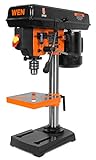
- Features a 2.3A induction motor, an 8-inch swing, and a 2-inch spindle travel
- Includes a 1/2-inch keyed chuck and onboard key storage
- Operates at 5 different speeds: 750, 1100, 1500, 2100, or 3200 RPM
- 6.5 by 6.5 inch height adjustable worktable bevels up to 45 degrees in each direction
- Measures in at 23 inches tall with a 7 by 11-inch base
| Drill diameter | Aluminum | Brass | Cast iron | Low-carbon steel | Stainless steel | Plastic/wood |
|---|---|---|---|---|---|---|
| 1/16 in | 10,000 | 10,000 | 6,000 | 4,300 | 3,200 | 7,000 |
| 1/8 in | 6,000 | 6,000 | 3,000 | 2,150 | 1,550 | 4,000 |
| 3/16 in | 4,000 | 4,000 | 2,000 | 1,450 | 1,025 | 2,700 |
| 1/4 in | 3,000 | 2,400 | 1,450 | 1,100 | 775 | 2,000 |
| 5/16 in | 2,400 | 1,800 | 1,150 | 900 | 620 | 1,600 |
| 3/8 in | 2,000 | 1,500 | 975 | 750 | 510 | 1,400 |
| 1/2 in | 1,500 | 1,200 | 725 | 550 | 400 | 1,000 |
| 5/8 in | 1,200 | 900 | 600 | 450 | 310 | 800 |
| 3/4 in | 1,000 | 750 | 500 | 360 | 260 | 700 |
| 7/8 in | 875 | 675 | 438 | 318 | 215 | 625 |
| 1 in | 750 | 600 | 375 | 275 | 170 | 550 |
RPM values are starting points, not guarantees. “Plastic/wood” combines materials with very different drilling behavior; use the specific bit manufacturer’s woodworking or plastics guidance where available.
How to use the chart
- Identify the actual drill diameter, not the shank diameter.
- Identify the workpiece material and, for metals, its grade or alloy if known.
- Confirm that the chart applies to your tool. The table above is for HSS drills; it is not automatically suitable for cobalt, carbide, titanium-coated, Forstner, spade, hole-saw, annular, milling, honing, or abrasive-wheel tools.
- Check the drill-press manual for its available spindle speeds and belt or pulley positions.
- Select the nearest available setting that does not exceed the tool or machine recommendation.
- Start with secure workholding and observe the chips, heat, sound, and finish. Stop if the setup chatters, smokes, grabs, or shows other signs of trouble.
For example, if a 1/2-inch HSS drill is being used in low-carbon steel, this table suggests about 550 RPM. If your machine offers 500 and 600 RPM, choose 500 RPM rather than exceeding the starting value. A lower speed may be usable when a small bit’s calculated speed is higher than the drill press can provide, but that does not mean every low-speed setting is ideal for every bit.
A general-purpose HSS drill-bit set can be useful when you need several diameters covered by a chart like this. The set does not make one RPM correct for every material: use the diameter-specific and material-specific guidance for each bit.
The calculation behind the chart
When a tool manufacturer provides a recommended cutting speed in surface feet per minute (SFM), calculate spindle speed with:
RPM = SFM × 3.82 ÷ D
- RPM is spindle revolutions per minute.
- SFM is the recommended cutting speed for the material and tool.
- D is the drill diameter in inches.
The inverse relationship is:
SFM = RPM × D ÷ 3.82
For a 1/2-inch drill with a manufacturer-recommended cutting speed of 80 SFM:
80 × 3.82 ÷ 0.5 = approximately 611 RPM
Because a belt-driven drill press may not offer exactly 611 RPM, select the closest available speed that stays within the tool and machine limits. The formula is a way to convert manufacturer data; it is not permission to exceed the drill press’s rated spindle speed.
Free tools Windows power users keep installed
One-click scans. No signup required.
Also popular on Amazon
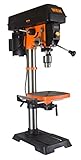
- Features a 6.2-amp induction motor, a 12-inch swing, and a 3-1/8-inch spindle travel
- Adjust the mechanical variable speed anywhere from 580 to 3100 RPM
- Digital speed readout displays current RPM of the machine for maximum precision
- Measures in at 16.8 by 13.5 by 36.6 inches in size with a weight of 85 pounds
- Includes a class IIIA 2.5mW laser, overhead light, adjustable depth stop, table roller extension, beveling 9-1/2 by 9-1/2-inch work table, 5/8-inch capacity keyed chuck, a chuck key with onboard storage, and a two-year warranty
Why larger drills need lower RPM
The outside edge of a larger drill travels farther during every revolution. At the same RPM, it therefore has a higher surface speed and generates more heat at the cutting edge. That is why the recommended RPM falls as diameter increases.
The same relationship explains why a 1/2-inch HSS drill in low-carbon steel is listed at about 550 RPM while a 1-inch drill is listed at about 275 RPM. Material also changes the allowable cutting speed: aluminum and brass generally permit higher speeds than stainless steel, cast iron, and tougher steels, assuming suitable tooling and chip control.
Wood and plastic: use the accessory-specific recommendation
Woodworking charts are not interchangeable with metal-drilling charts. A Forstner bit, brad-point bit, spade bit, hole saw, and ordinary twist drill have different cutting geometries and chip-clearance requirements. A woodworking reference such as WOOD Magazine’s chart is useful because it separates multiple drill-bit and accessory types instead of assigning one RPM to every operation.
Plastic can melt, smear, or deform when heat accumulates. Use a sharp bit, keep the tool moving rather than dwelling at the bottom of the hole, and choose a speed appropriate to the particular plastic. The plastic/wood column above ranges from 7,000 RPM for a 1/16-inch tool to 550 RPM for a 1-inch tool, but that combined column should not replace instructions for a specific plastic or accessory.
Material-specific guidance
Aluminum and brass
Aluminum generally supports higher RPM than steel, but alloy, bit geometry, lubrication, and chip evacuation still matter. Brass can behave differently from aluminum and may require a more conservative setting. The table gives 1,500 RPM for a 1/2-inch HSS drill in aluminum and 1,200 RPM in brass.
Also popular on Amazon

- Powerful Drill Press: Swing: 10 in. 3.2A induction motor ensures plenty of power to drill through various materials, such as metal, wood, etc. It meets your processing and DIY needs.
- Precise Drilling: Our benchtop drill press drills precise holes without offset, with high locking strength and higher accuracy.
- 5-speed Adjustment: Our bench drill press feature 5 speeds, so you can easily adjust the speed from 650 to 3100 RPM (650 RPM,1050 RPM, 1800 RPM, 2350 RPM, and 3100 RPM).
- Excellent Durability: The bench top drill press variable speed has a perfect heat dissipation system, dissipating heat quickly and operating for a longer time, effectively extending the machine's life.
- Complete Accessories: We provide 2 x Hex Wrenches, 1 x Table Assembly, 1 x Base, 1 x Column Assembly, 1 x Table Crank Handle, 3 x M8*16 Hex Bolts, 3 x Feed Handles, 1 x Worm Gear, 1 x Table Lock Handle, 1 x Chuck, 1 x Chuck Key.
Low-carbon steel
For a 1/2-inch HSS drill, approximately 550 RPM is a conservative starting point from the table. For a 1-inch drill, the starting point falls to approximately 275 RPM. Use an appropriate cutting fluid when the tool manufacturer permits it, feed firmly enough to cut rather than rub, and clamp the workpiece securely.
Stainless steel
Stainless steel retains heat and can work-harden if a dull tool rubs against the surface. The table lists approximately 400 RPM for a 1/2-inch HSS drill and 170 RPM for a 1-inch drill. Keep the drill sharp, avoid prolonged dwelling, and follow the bit manufacturer’s recommendations for the particular stainless grade and coating.
A cobalt drill-bit set may be appropriate for some stainless-steel work, but cobalt does not make an incorrect speed, inadequate feed, poor chip evacuation, or unsafe workholding safe. Use the specific cobalt-bit manufacturer’s speed and feed data.
Recommended Free Tools
Cast iron
Cast iron produces abrasive chips and can often be drilled dry in some operations, but the tool and workpiece condition should determine whether coolant is suitable. The table lists approximately 725 RPM for a 1/2-inch HSS drill and 375 RPM for a 1-inch drill.
Coolant, heat, and chip control
Some published metal-drilling values assume appropriate coolant. Drilling metal without coolant is possible in some operations, but it is not automatically the best choice. One manufacturer’s guidance recommends substantially reducing RPM for many metals when coolant is unavailable and being especially conservative with stainless steel because it does not dissipate heat easily. Treat that as manufacturer-specific guidance, not a universal percentage for every alloy and tool.
A metalworking cutting fluid can help with heat and chip control when it is compatible with the workpiece, tool, finish, cleanup requirements, and manufacturer instructions. Do not assume one lubricant is suitable for every material or operation.
Troubleshooting speed problems
| Symptom | Likely causes | What to check |
|---|---|---|
| Bit becomes too hot, smokes, or loses its edge | RPM too high, dull bit, insufficient feed, poor chip clearing, or unsuitable coolant | Reduce speed within the tool’s limits, replace or sharpen the bit, use an appropriate feed, and clear chips safely with the machine stopped. |
| Stainless steel stops cutting and the surface becomes harder | Rubbing or dwelling has caused work-hardening | Use a sharp bit, avoid light rubbing contact, follow the manufacturer’s feed and speed data, and do not simply keep polishing the hardened spot. |
| Chatter or a rough, oversized hole | Loose workholding, excessive tool extension, damaged bit, incorrect speed, or poor alignment | Clamp the work, reduce unsupported length, inspect the chuck and bit, and verify the belt setting. |
| Long strings or packed chips | Insufficient chip evacuation, unsuitable feed, or drilling too deeply without clearing | Use the bit manufacturer’s pecking or chip-clearing procedure. Stop the spindle before removing chips. |
| Workpiece catches or spins | The material was held by hand or inadequately clamped | Stop the machine and improve workholding before continuing. Never try to restrain a rotating workpiece by hand. |
Safety beside the speed chart
A correct RPM does not make an unsafe setup safe. Drill-press hazards include the rotating chuck and drill, flying or hot swarf, exposed belts and pulleys, and workpieces that catch and rotate.
Also popular on Amazon
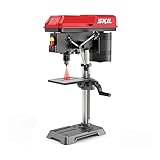
- POWERFUL 6.2 AMP INDUCTION MOTOR—Power through wood, metal, and other materials
- 5-SPEED SYSTEM—Take advantage of 5 speeds from 610 to 2800 RPM for different material types
- LASER ALIGNMENT SYSTEM—Precisely execute drilling maneuvers
- ADJUSTABLE DEPTH STOP—Ensures accurate and consistent depth during drilling
- ADJUSTABLE TABLE HEIGHT—Provides easy depth control
- Clamp the workpiece to the drill-press table or bed; do not hold it by hand, especially when drilling metal, large stock, or anything that could catch.
- Keep belts and pulleys guarded, and use a suitable point-of-operation guard where appropriate for the machine.
- Do not wear gloves, jewelry, or loose clothing while operating the drill press. Secure long hair.
- Remove the chuck key before starting the spindle and keep the area clear of tools and loose material.
- Stop the spindle before measuring, clearing chips, changing belts, adjusting the table, or applying lubricant.
- Use eye protection appropriate to the operation and follow your workplace’s required controls and training.
A drill-press vise or clamp set is a workholding aid, not a substitute for checking that the vise, table, fasteners, and stock are properly secured. OSHA specifically recommends clamping material to the drill-press bed rather than holding it by hand.
Do not apply this chart to an abrasive wheel, honing tool, router bit, milling cutter, or other accessory unless that accessory’s manufacturer provides compatible drill-press guidance. An accessory operated above its rated speed can fail violently; an improper-speed honing device has been involved in a fatal workplace incident.
Machine speed limitations
Many consumer drill presses have a practical speed range of roughly 2,000 to 3,600 RPM at the top end. That is far below the nominal speed shown for many very small drills in aluminum, brass, wood, and plastic. Use the highest permissible speed your machine actually provides without exceeding the tool’s limits, while recognizing that the result may be slower than the ideal cutting speed.
Other machines have a much lower minimum speed. A representative five-speed drill press, for example, may offer 620, 1,000, 1,720, 2,340, and 3,100 RPM, with the selected speed determined by belt and pulley positions. Do not assume those settings apply to your model: read the label or manual, disconnect power before changing belt positions, and replace the guard before operation.
PC Slower Than It Used to Be?
A free scan shows the junk files, broken settings and background clutter dragging Windows down - then fixes them in one click.Free scan · Windows 10 & 11Crashes, No Sound, or Screen Glitches?
Random freezes, missing sound and display glitches usually trace back to one bad driver. Find and replace yours safely.Free scan · under a minuteQuick decision checklist
- What are you drilling? Identify the material and its condition.
- What tool are you using? Match the chart to the bit or accessory type.
- What diameter is cutting? Use the cutting diameter, not merely the shank size.
- What does the manufacturer specify? Prefer tool-specific SFM, RPM, feed, and coolant instructions.
- What can your drill press actually provide? Choose an available setting at or below the applicable limit.
- Is the work secured? Clamp the work and guard the rotating parts before starting.
- Are the chips and heat normal? Stop and correct the setup if the bit rubs, overheats, chatters, smokes, or grabs.
Frequently Asked Questions
It depends on the material and bit. The conservative HSS starting points in this chart are 1,500 RPM for aluminum, 1,200 for brass, 725 for cast iron, 550 for low-carbon steel, 400 for stainless steel, and 1,000 for plastic/wood. Check the bit manufacturer’s data and your drill press’s available settings first.
What RPM should I use for a 1/2-inch drill bit?
Use RPM = SFM × 3.82 ÷ D, where SFM is the manufacturer’s recommended surface feet per minute and D is the drill diameter in inches. Select the closest available machine speed without exceeding the tool or drill press limits.
How do I calculate drill-press RPM?
Generally, yes, because a smaller drill travels a shorter distance at the same RPM. However, the correct speed still depends on the material, bit construction, geometry, machine capability, and the manufacturer’s limits.
Should I use a higher speed for a smaller drill?
Not automatically. Forstner bits, hole saws, spade bits, annular cutters, abrasive wheels, and other accessories have different speed recommendations. Use the accessory manufacturer’s guidance.
Can I use this chart for Forstner bits or hole saws?
Stainless steel retains heat and can work-harden when a dull bit or inadequate feed rubs against it. Conservative RPM, a sharp compatible bit, proper feed, chip control, and manufacturer-approved coolant help control the operation.
Why is stainless steel drilled at a lower speed?
The Bottom Line
Use the chart as a conservative starting point for HSS drills, not as a universal answer. Larger drills need lower RPM; stainless steel and other heat-sensitive materials need particularly careful speed, feed, tooling, and coolant decisions. When manufacturer instructions conflict with a generic chart, the manufacturer’s instructions take priority—and the workpiece must be clamped before the spindle starts.
Quick Recap
Product prices and availability are accurate as of the date/time indicated and are subject to change. Any price and availability information displayed on Amazon at the time of purchase will apply.

