Do these 3 things before closing this tab:
1Fix the driver behind crashes, sound loss and screen glitches2Repair Windows errors before they cause bigger problems3Scan for outdated or missing drivers - takes under a minuteYes—but there is no single “lower-carbon” behavior. Concrete made with portland-limestone cement, slag cement, fly ash, calcined clay, calcined shale, or combinations of these can set at a different rate and gain strength differently from a conventional portland-cement mixture. The direction and size of the change depend on the binder chemistry, replacement level, admixtures, water-to-binder ratio, temperature, and the complete mixture.
A slower set or slower early-strength gain can move the timing of finishing, saw cutting, opening to traffic, stripping forms, and protection against drying or freezing. It does not automatically require a special curing method. The curing plan should be based on the proposed mixture, expected weather, specified performance, and measured strength development—not on the phrase “low-carbon” alone.
As an Amazon Associate I earn from qualifying purchases.
What “lower-carbon cement” can mean
Lower-carbon concrete is an umbrella term rather than a single material. Carbon reduction may come from replacing part of the clinker with another cementitious constituent, reducing the clinker content of a blended cement, improving kiln efficiency, or combining several approaches. For setting and curing decisions, the actual binder composition matters more than the environmental label.
Free tools Windows power users keep installed
One-click scans. No signup required.
Common binder routes
| Binder or constituent | What it changes in the mixture | Typical early-age tendency reported in guidance |
|---|---|---|
| Portland-limestone cement, including ASTM C595 Type IL | Contains limestone blended with portland cement; the American Cement Association describes Type IL as containing 5% to 15% limestone. | Performance must be established for the particular cement and mixture; a lower-clinker label does not by itself predict set time. |
| Class F fly ash | Pozzolanic material that reacts more gradually than clinker. | Often longer setting time and slower early-strength development, with lower heat generation. |
| Class C fly ash | Generally more chemically self-cementing than Class F ash, but properties vary widely by source. | Less predictable; it can retard set, have little effect, or contribute to compatibility and early-setting problems. |
| Slag cement | Latent hydraulic material used as a partial cement replacement. | Often slower early strength and increased set time, especially at low temperatures. |
| Calcined clay or calcined shale | Thermally activated aluminosilicate materials that replace part of the clinker. | FHWA summaries associate these blends with increased setting time and reduced heat, but the result depends on dosage and chemistry. |
| Multiple supplementary cementitious materials (SCMs) | Combines effects that may reinforce or offset one another. | No reliable general prediction; use trial-batch and supplier data. |
ASTM C595 blended-cement categories include IL, IS, IP, and IT. The American Cement Association reported that blended cements represented roughly two-thirds of the United States cement market as of August 2025. That market figure describes adoption, not a guaranteed setting or curing performance for any project.
#1 Best Overall

- COLD WEATHER CURING: Hold in the heat your slab generates so hydration keeps working when temperatures drop. The closed-cell foam core traps warmth against fresh concrete and slows moisture loss, helping late-season pours, footings, and repairs develop strength instead of stalling out. Roll it over the surface once finishing is done, leave it in place through the cure window, then lift it, shake it off, and roll it back up for the next placement.
- FOAM CORE CONSTRUCTION: A coated woven poly tarpaulin wraps a closed-cell PE foam core measuring 3/16 inch thick, giving you real insulating mass rather than a thin plastic sheet. The 8 x 8 weave outer shell sheds dirt and shrugs off the grit of a working jobsite, and the sealed foam will not soak up water the way a batt or a moving pad does. The result is an insulated tarp light enough at 14 pounds for one person to handle.
- DURABLE BUILD: Double-stitched seams and reinforced hems keep the edges from fraying after repeated drag-and-drop handling, and factory grommets let you stake, tie, or weight the blanket down so wind does not peel it off the work overnight. The outer shell is water resistant, tear resistant, and UV resistant, so it keeps performing through rain, snow, and long hours of sun instead of going brittle after a single season.
- TRUE JOBSITE SIZE: Covers a generous footprint for driveways, sidewalks, pads, and stem walls, and lays flat enough to overlap with a second blanket on larger placements. Tarp dimensions are industry-standard cut sizes, so the finished blanket measures roughly 11 feet 10 inches by 23 feet 10 inches; plan your overlap accordingly. It folds down small enough to store on a shelf or in a truck box between jobs.
- MORE THAN CONCRETE: Contractors and rental yards reach for these insulated blankets well beyond the pour, covering stockpiled aggregate, shielding pipes and equipment from freeze, screening off a work area, or keeping ground workable ahead of excavation. Commercial grade construction and a plain, no-frills design make it an easy addition to the stack of jobsite tarps you pull out every winter.
How setting time can change
Setting is the transition from plastic concrete to a material that has begun to become rigid. Initial set is important for finishing operations; final set indicates that the paste has lost most of its plasticity. Neither point is the same as the strength required for traffic, saw cutting, form removal, or service.
SCMs that commonly delay set
FHWA reviews report that cements containing Class F fly ash, slag cement, calcined shale, or calcined clay tend to have increased setting times. A 2006 FHWA curing report says delays for most fly ashes in the sources it reviewed ranged from less than one hour to several hours. That is a range from historical literature, not a prediction for every modern mixture.
The same general trend can be useful in hot weather because a longer open time can make placement and finishing easier. At a cool placement temperature, however, the added time may postpone finishing, texturing, joint sawing, or protection. Class C fly ash requires particular caution: its setting response varies substantially with its material properties and with admixture compatibility. Some Class C mixtures have shown early-setting problems rather than a simple delay.
Factors that can move the set point
- Temperature: Low concrete and ambient temperatures slow hydration; high temperatures accelerate it. A blend that performs acceptably at 24°C may behave very differently near freezing.
- Replacement level: Increasing the proportion of an SCM can increase the effect, but the relationship is not necessarily linear.
- Cement and SCM chemistry: Fineness, sulfate balance, glass content, alkali content, and other properties differ by supplier and shipment.
- Admixtures: Water reducers, retarders, accelerators, air-entraining agents, and their combinations can either offset or amplify a binder’s effect.
- Mixture proportions: Water-to-binder ratio, paste volume, aggregate temperature, and total cementitious content affect both workability and hydration.
- Placement conditions: Wind, sun, slab thickness, substrate temperature, and evaporation can change the practical finishing window even when laboratory set times are similar.
Setting time is not the same as early strength
A concrete mixture can reach initial set on schedule yet gain compressive strength more slowly than a conventional mixture. Conversely, a mixture can set relatively early but still lack the strength needed for a project milestone. Schedule decisions therefore need separate information about set behavior and strength development.
Rank #2

- Maximum Concrete Strength: this concrete curing blanket slows water evaporation, allowing even curing and full compressive strength development; The fabric retains water and blocks rapid drying, preventing cracks, shrinkage, and surface defects
- Heavy Duty Burlene: made with sturdy burlene fabric and a waterproof polyethylene backing, this heavy duty insulated concrete blanket withstands harsh weather, UV exposure, and heavy construction use; The rugged material resists tearing, stretching, and degradation for long term performance on demanding sites
- Good Size: this concrete curing blanket roll measures about 6 x 50 ft (1.8 x 15 m), providing 300 sq ft of coverage for highways, bridge decks, retaining walls, foundations, and flatwork; Easy to unroll and position over fresh concrete, reducing installation time and labor costs on any construction site
- Job Site Durability: engineered for commercial construction demands, this blanket is reusable and easy to clean; The strong burlene outer layer protects the PE backing from punctures, while the waterproof inner layer keeps water in and rain out for consistent curing conditions across multiple uses
- Practical Note: each concrete curing blanket roll is hand cut, so minor dimensional variations may occur; This allows flexible trimming to fit custom project layouts, making it suitable for standard and irregular concrete surfaces
Why early strength may be slower
Class F fly ash and slag commonly contribute to slower early-strength development because their principal reactions proceed more gradually than the initial hydration of portland cement. Reduced heat of hydration often accompanies that slower reaction. The later-age strength can still meet the design requirement, but the time to reach an early threshold may be longer.
Class C fly ash is more variable. Its chemistry can produce useful early reaction in some mixtures, while other combinations show compatibility issues, unexpected heat behavior, or early-setting difficulties. Calcined materials and blended cements also require mixture-specific confirmation rather than assumptions based on material names.
Milestones affected by strength gain
- Opening a pavement or floor to construction traffic.
- Removing forms or reshoring when the specification is strength-based.
- Saw cutting joints before uncontrolled cracking occurs.
- Applying finishes, coatings, overlays, or waterproofing that require a defined substrate condition.
- Allowing freeze-thaw exposure or de-icing chemicals.
FHWA notes that lower heat and longer set can be advantageous in hot weather but problematic at low placement temperatures. In late-season paving, slow strength gain can delay joint sawing and leave concrete vulnerable if it is exposed to freezing before it has developed adequate resistance.
Does lower-carbon concrete require different curing?
Curing is the management of moisture and temperature after placement so hydration can continue and the concrete can develop its required properties. A delayed set does not, by itself, prove that a different curing product or method is necessary. The practical change may instead be the time at which curing begins and the length of time protection must remain in place.
Rank #3
- TRAPS CURING HEAT Fresh concrete gives off heat as it sets, and this insulated concrete curing blanket holds that warmth against the slab so hydration keeps working when jobsite temperatures drop. The foam core puts a thermal barrier between your pour and cold air, wind, and overnight chill, which helps crews place and finish flatwork through late fall, winter, and early spring instead of waiting on the weather to cooperate.
- CLOSED CELL FOAM A coated woven poly tarpaulin wraps a closed-cell PE foam core measuring 3/16 inch thick, giving this curing blanket genuine insulating body instead of the single thin layer you get from an ordinary poly tarp. The outer shell is built on an 8 x 8 weave that stands up to being dragged across gravel, rebar, and rough forms, so the same thermal tarp holds its shape and its insulating value through repeated pours.
- BUILT FOR JOBSITES Double stitched seams and reinforced hems keep the edges together under wind load and repeated folding, and included grommets let you stake, rope, or weight the blanket down so it stays where you put it overnight. The shell is water resistant, tear resistant, and UV resistant, which keeps this insulated tarp serviceable through rain, sun exposure, and the rough handling a working crew gives it.
- EASY TO HANDLE Tarp sizes are listed as cut sizes, the industry standard, so this 6 by 24 foot blanket finishes at 5 feet 10 inches by 23 feet 10 inches and covers long runs of flatwork. At roughly 6.5 pounds it stays light enough for one person to roll out, reposition, and roll back up, and several blankets overlap edge to edge to cover wider slabs, driveways, and sidewalk pours without leaving cold gaps.
- WORKS EVERY SEASON Concrete finishers, masons, general contractors, rental yards, and property crews use this commercial grade construction blanket over slabs, footings, driveways, patios, sidewalks, and block walls, and it doubles as an insulated cover for equipment, materials, and supplies staged outdoors. Roll it up and store it dry between jobs and it goes straight back to work on the next pour.
Moisture retention
FHWA guidance states that normal curing practices may be adequate for Class F fly-ash concrete, although moisture may need to be retained longer to allow strength development. That means the curing compound, wet covering, sheet, or other approved system may be the same one used on comparable work, while the required duration is extended by the specification or project engineer.
Do not apply a curing compound merely because a mixture is called low-carbon, and do not stop curing when the surface looks dry or when a nominal number of hours has elapsed. Follow the governing specification, which may define curing by elapsed time, concrete temperature, achieved strength, maturity, or another performance criterion.
Temperature control
Lower heat generation can reduce thermal cracking risk in massive placements, but it also means the concrete may not warm itself enough in cold weather. Protection against freezing is a separate requirement from moisture curing. FHWA identifies insulation as one possible cold-weather temperature-management method; the appropriate blanket, enclosure, duration, and monitoring plan are project-specific.
What’s actually slowing this PC down?
Pick the symptom - the matching free tool is one click away.
At the other extreme, hot, dry, or windy conditions can cause surface moisture loss before the binder has developed enough structure. A mixture with a longer set may be especially vulnerable because finishing and the start of curing are later. Coordinate evaporation control, finishing windows, and curing application rather than treating set delay as permission to leave the surface unprotected.
Rank #4

- 【High-Quality】: Construction Concrete Curing Blanket is designed with a high-quality PE foam core that offers excellent insulation properties. It effectively maintains a controlled curing environment by minimizing heat loss and temperature fluctuations.
- 【Funtion】: Insulated concrete blankets is widely used on construction sites, highways, self-built houses. It is one of the effective materials for protecting buildings in winter. Use the ball bungee cords to connect the other tarp.
- 【Dimension】: The concrete blanket sie is 6x25Ft, about 72x300inch. And the thinkness is about 3.6mm/0.15inch. The R value of this product is 0.2 approximately(R=D/K). If you found the R is low , you could use two or more to solve.
- 【Features】: The curing blanket is weatherproof and durable in winter. After that, you can continue working next year. Built-in UV protection prevents degradation from sunlight exposure.
- 【Design】: Maintains consistent temperature, promoting uniform concrete curing. We hope that the design of our products will add to your joy of life.
A project procedure for setting the schedule
Use the following sequence whenever a lower-carbon mixture will control a critical schedule or be placed in difficult weather.
- Identify the binder precisely. Obtain the cement type, SCM names, source, replacement percentages, fineness or other available material data, and the proposed admixture system from the concrete supplier. “Blended” or “low-carbon” is not enough information.
- Ask for condition-specific data. Request setting-time and early-strength results at temperatures representative of placement. Ask how the data were obtained and whether they apply to the proposed aggregate, water, admixtures, and air content.
- Check the specification. Determine whether the contract controls curing by a fixed duration, temperature history, compressive strength, maturity, or another criterion. Confirm requirements for opening, saw cutting, form removal, and cold-weather protection.
- Run a trial batch when the risk is material. A trial using the actual cement, SCMs, admixtures, aggregates, and planned temperature can reveal incompatibility or an impractical finishing window that generic tables cannot.
- Plan operations around measured set behavior. Provide crews with an expected initial and final set range, a finishing sequence, and a saw-cut decision rule. Include a contingency for a later set in cool or cloudy weather.
- Define curing and protection before placement. Select the approved moisture-retention method, identify when it can be applied, and specify how temperature will be monitored. If insulation is needed, document the product and installation rather than relying on an informal blanket plan.
- Agree on the milestone evidence. For critical work, the engineer, contractor, and supplier should agree whether cylinders, field-cured specimens, maturity, or another test establishes readiness for traffic, stripping, or other operations.
Using maturity to estimate in-place strength
The maturity method relates a concrete temperature history to strength development. It can help avoid unnecessary waiting or unsafe early opening, but it is not a universal conversion factor. FHWA guidance emphasizes that development rates vary with materials, proportions, and temperature.
Before relying on maturity for a lower-carbon mixture, calibrate the maturity-strength relationship with that mixture and the intended strength test. Use the same cementitious materials, aggregate, admixtures, and curing conditions as the field placement as closely as practical. Continue to follow the project specification; a maturity estimate cannot waive a required test or acceptance condition.
Cold-weather and hot-weather decisions
When temperatures are low
- Expect slower hydration and potentially later set when the mixture contains Class F fly ash, slag, calcined clay, or calcined shale.
- Protect against freezing until the concrete has achieved the strength or temperature condition required by the project.
- Discuss joint-sawing and opening dates with the engineer before placement; calendar-based assumptions are unreliable when strength gain is slow.
- Use insulation, heated enclosures, or other approved measures only as required by the weather plan and specification, with temperature monitoring.
When temperatures are high
- A longer set may provide additional finishing time and lower heat may reduce thermal stress in some placements.
- High concrete temperature can still accelerate hydration and shorten the working time, so verify actual batch and placement temperatures.
- Control evaporation and begin curing as soon as the surface permits; a delayed set does not eliminate the risk of plastic-shrinkage cracking.
How to compare lower-carbon options
There is no universal ranking in which one lower-carbon binder is always faster, slower, stronger, or easier to cure. Compare candidate mixtures against the same project requirements.
Best Value
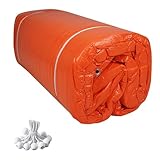
- 【High-Quality】: Construction Concrete Curing Blanket is designed with a high-quality PE foam core that offers excellent insulation properties. It effectively maintains a controlled curing environment by minimizing heat loss and temperature fluctuations.
- 【Funtion】: Insulated concrete blankets is widely used on construction sites, highways, self-built houses. It is one of the effective materials for protecting buildings in winter. Use the ball bungee cords to connect the other tarp.
- 【Dimension】: The concrete blanket sie is 12x24Ft, about 141x288inch. And the thinkness is about 3.6mm/0.15inch. The R value of this product is 0.2 approximately(R=D/K). If you found the R is low , you could use two or more to solve.
- 【Features】: The curing blanket is weatherproof and durable in winter. After that, you can continue working next year. Built-in UV protection prevents degradation from sunlight exposure.
- 【Design】: Maintains consistent temperature, promoting uniform concrete curing. We hope that the design of our products will add to your joy of life.
| Decision axis | Questions to ask |
|---|---|
| Binder composition | Does the mixture use limestone, Class F or Class C fly ash, slag, calcined clay, calcined shale, or multiple SCMs? At what percentages? |
| Setting | What initial and final set ranges were measured at the actual placement temperature? |
| Early strength | When does the mixture reach the strength needed for saw cutting, form removal, traffic, or other milestones? |
| Heat and temperature | Is reduced heat desirable for the placement, or could it make cold-weather protection more difficult? |
| Workability | How long can the crew place and finish the concrete, and what admixture adjustments are proposed? |
| Curing and protection | What moisture-retention duration and temperature controls are required by the specification and the mixture data? |
| Verification | Which field tests or maturity calibration will demonstrate readiness for each schedule milestone? |
FHWA’s trend summaries are useful for screening options, but they are not a mixture-design chart. The final selection should use current jurisdictional specifications, supplier information, and evidence from the actual proposed mixture.
Troubleshooting common field problems
| Observed problem | Likely issue to investigate | Practical response |
|---|---|---|
| Concrete remains plastic beyond the planned finishing window | Low temperature, a retarding admixture, high SCM replacement, or cement-admixture incompatibility. | Record concrete and air temperatures, verify batch materials and doses, notify the supplier and engineer, and revise the finishing plan rather than adding water. |
| Surface dries before curing can be applied | Evaporation, wind, sun, or a delayed set. | Use the approved evaporation-control and curing procedure, protect the surface, and do not wait for a nominal clock time if the specification permits an earlier compliant action. |
| Joint sawing is late or cuts ravel | Strength development does not match the calendar; the concrete may be too weak or too hard at the planned time. | Use the agreed strength or maturity criterion, make a controlled trial cut where allowed, and coordinate the revised sequence with the engineer. |
| Early strength is below the required milestone | Slow SCM reaction, cold concrete, altered water content, or an admixture/material change. | Compare field-cured results with the approved mixture, verify temperatures and proportions, maintain protection, and obtain engineering direction before opening or stripping. |
| Unexpected early set | Class C fly ash variability, incompatibility, high temperature, or dosing error. | Stop treating the mixture as a generic blended cement; investigate material certificates, admixture compatibility, and batch records with the supplier. |
Bottom line for specifications and field crews
Lower-carbon cementitious systems can alter both setting time and early-strength development, but the effect is determined by the specific binder and conditions. Class F fly ash, slag, calcined shale, and calcined clay often lengthen set and slow early strength; Class C fly ash is less predictable. Use supplier data and, when the schedule is critical, a trial batch at the expected temperature.
Curing is not automatically a new procedure. Normal methods may be sufficient, while moisture retention or cold-weather protection may need to continue longer. Set the schedule from measured performance and the governing specification, calibrate maturity estimates to the actual mixture, and treat “lower-carbon” as a reason to verify the concrete—not as a substitute for verification.
The Tool Desk
Outbyte PC Repair FREERepair Windows errors before they cause bigger problemsFix Now →Outbyte Driver Updater FREEScan for outdated or missing drivers - takes under a minuteDriver Scan →Quick Recap
Product prices and availability are accurate as of the date/time indicated and are subject to change. Any price and availability information displayed on Amazon at the time of purchase will apply.

