Free tools Windows power users keep installed
One-click scans. No signup required.
Not just because your home uses a private well. Test the water first. If results show a contaminant or other issue, choose treatment designed for that specific problem and test again afterward. A filter may improve taste or reduce particular contaminants, but no single system addresses every well-water concern.
Why a private well needs a different approach
Private wells are not covered by the federal drinking-water rules that apply to public water systems. That means the household is responsible for checking its well water; state and local requirements can differ. EPA explains the distinction in its drinking-water technologies overview, and CDC provides private-well safety guidance.
As an Amazon Associate I earn from qualifying purchases.
This does not mean every private well is unsafe, or that every home needs a filter. It means you cannot rely on public-system monitoring to tell you whether your own well water is safe. EPA reports that about 15 percent of the U.S. population—more than 43 million people—relies on private wells. EPA also summarizes a USGS study of 2,100 private wells in which about one in five had at least one contaminant above a human-health benchmark. That is a study finding, not a claim about every well; the EPA page does not specify the year for either figure. See EPA’s private-well overview.
Do not treat EPA maximum contaminant levels for public water systems as automatically enforceable standards for private wells. Requirements can vary by state and locality. Your local health or environmental department can explain the rules that apply where you live and help identify location-specific concerns.
#1 Best Overall

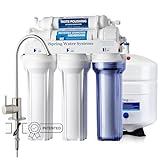
- PATENTED DESIGN – The top-mounted fastener allows for easy countertop installation entirely from above, eliminating the hassle of tightening the nut from underneath the sink.
- MINERAL BOOST – The patent-pending natural mineral AK stage delivers spring water with a balanced, healthy pH and multiple essential minerals.
- SEE WHAT’S CAUGHT – The transparent first-stage filter housing makes it easy to monitor contaminant buildup, ensuring timely filter changes.
- NSF 58 CERTIFIED RO SYSTEM – Unlike other brands that lack NSF certification or full system certification, our RCC7AK is certified to NSF/ANSI 58 standards for the entire water filtration system.
- EFFECTIVE FILTRATION – Reduces TDS (93-98%), PFAS (96-99%), Chlorine (95-99%), Asbestos (>99.7%), Barium (>98.4%), Cadmium (>98.8%), Chromium (>99.2%), Copper (>97.8%), Fluoride (>97.4%), Lead (>98.9%), Selenium (>99.0%), and over 1,000 other contaminants.
Start with a water test, not a filter
EPA and CDC recommend testing well water at least once a year for total coliform bacteria, nitrates, total dissolved solids (TDS), and pH. Use a state-certified laboratory for drinking-water testing. EPA’s Protect Your Home’s Water guidance says to use certified laboratories; CDC gives further direction in its well-water testing guidance.
Ask your local health department which additional tests make sense for your well. The right panel depends on local geology, nearby land use and activities, and—in some cases—household plumbing. Possible concerns include arsenic, lead, pesticides, volatile organic compounds (VOCs), and radionuclides. Those are examples to discuss with local officials, not a universal list that every household must order.
| What to consider | Why it matters for choosing tests | What to do |
|---|---|---|
| Annual baseline | EPA and CDC recommend annual checks for total coliform bacteria, nitrates, TDS, and pH. | Ask a state-certified laboratory how to collect and submit samples for this panel. |
| Local geology and land use | Agriculture, mining, nearby fuel or industrial sites, salty water, and local contamination history can point to additional concerns. | Ask local health or environmental officials which contaminants are relevant to your well’s location. |
| Household plumbing | Plumbing corrosion can make a plumbing-related contaminant such as lead worth investigating. | Discuss the plumbing and sampling location with local officials or the lab rather than assuming a single sample answers every question. |
| A change or incident | Flooding, well work, nearby land disturbance, or a change in water quality can warrant testing outside the annual schedule. | Contact the local health department for advice on what to test and whether to use another water source while you wait. |
Testing is useful only when the lab knows what you want to investigate and the sample is collected as directed. Before sampling, ask the laboratory what container to use, where to take the sample, and how quickly it must be returned. Do not substitute a home screening device or a visual inspection for the certified lab testing recommended by EPA and CDC.
Rank #2
- EFFECTIVELY REDUCES CONTAMINANTS - The iSpring RO system delivers clean, pure, and great-tasting drinking water by removing up to 99% of over 1,000 harmful contaminants, including PFAS, chlorine, fluoride, lead (up to 98%), arsenic, asbestos, calcium, and sodium. It also reduces TDS by 80-90% and reduces hard water minerals that cause scale buildup.
- CERTIFIED TO NSF/ANSI 58 - Produced to strict American quality standards, this iSpring reverse osmosis system is NSF/ANSI 58 certified. For over 15 years, it has provided American families with unlimited, crisp, and refreshing water, superior to bottled water
- LOW MAINTENANCE & LEAK-FREE DESIGN - Engineered with premium components for long-term reliability and minimal upkeep. The transparent first-stage filter housing allows for quick inspections. This compact system fits under most kitchen sinks, requires no power source, and features a check valve to prevent backflow, ensuring safety and leak prevention. The AS-material filter housing offers impact resistance while making filter condition checks effortless.
- HIGH-QUALITY DESIGN & GREAT TASTE - Enjoy clean, safe, and fresh-tasting water with the iSpring under sink RO system. It includes a 100% lead-free designer faucet and food-grade tubing, ensuring crystal-clear ice cubes, fresher tea and coffee, better-tasting food, and healthier baby formula. The system’s advanced filtration reduces contaminants down to 0.0001 microns, while a fine GAC filter provides final polishing for exceptional water quality.
- 100% CUSTOMER SATISFACTION - The RCC7-BN is one of America’s highest-rated under sink reverse osmosis systems. It comes with a 1-year limited manufacturer warranty upon registration, lifetime personalized support from GA, USA, and premium-quality components to deliver bottled-quality drinking water for years to come—helping reduce plastic waste
When to test sooner than once a year
Arrange additional testing after flooding, a known local contamination problem, nearby land disturbance or waste disposal activity, or repair or replacement of a well component. Test if water develops a new change in appearance, taste, or odor. CDC also identifies pregnancy and a child joining the household as reasons to test. The CDC testing guidance and EPA well-water guidance describe when to consider additional checks.
A change in taste, color, or smell is a reason to investigate, but it cannot tell you whether water is safe. Clear, pleasant-tasting water can still contain harmful germs or chemicals that you cannot see, taste, or smell. Conversely, some harmless substances can cause unpleasant taste or odor. Do not use appearance or taste as a safety test; use lab results.
If contamination is suspected or results show harmful germs or chemicals, CDC advises using bottled water or another safe source while you contact your local health department for guidance. Follow local advice about which uses to avoid and what testing or treatment is appropriate. Boiling should not be treated as a general solution: it does not remove chemical contaminants.
Rank #3

- 𝗘𝗳𝗳𝗶𝗰𝗶𝗲𝗻𝘁 𝗣𝘂𝗿𝗶𝗳𝗶𝗰𝗮𝘁𝗶𝗼𝗻, 𝗣𝗲𝗮𝗰𝗲 𝗼𝗳 𝗠𝗶𝗻𝗱: The DREO 7‑in‑1 RO water filter filters out 99.9% of possible contaminants in water including PFOA, PFOS, chlorine, fluoride and more. It was tested by SGS meeting NSF/ANSI 58 Standards.
Choose treatment for the contaminant the test found
Match any treatment system to the lab result and to the exact contaminant reduction claim for the model you are considering. Check whether the system treats one tap or most or all water entering the home. CDC calls these point-of-use and point-of-entry systems, respectively. A whole-home installation is not automatically preferable: the appropriate scope depends on the result, intended use, and treatment design.
| Need identified | Possible treatment approach | Important limitation |
|---|---|---|
| Taste or odor | Activated carbon or a system certified for the relevant taste-and-odor claim may help. | A taste filter should not be assumed to remove pathogens or unrelated chemicals. |
| Microorganisms | Ultraviolet (UV) systems disinfect. Some membrane filters reduce particular germs, depending on pore size and product claims. | Pre-filtration improves UV performance. UV does not remove chemicals; verify the exact system’s germ-reduction claim. |
| Specified dissolved chemicals or minerals | Reverse osmosis (RO) can reduce some specified substances. | The exact system label must name the contaminant; RO is not proof that every chemical concern is addressed. |
| Hardness and scale | A water softener addresses calcium and magnesium that cause scale. | Softening is not germ treatment and should not be chosen as a substitute for disinfection. |
| Complex or serious contamination | Get advice from the health department and a qualified water-treatment professional. | Depending on the contaminant and well condition, treatment may not be sufficient; another water source or a new well may sometimes be needed. |
These are categories, not endorsements of a particular product. CDC’s overview of home water treatment systems describes their general functions. Its guidance for treating well water is direct: “No single treatment type will protect against all problems.”
Check the exact model’s claim and plan for follow-up
Do not choose a system based only on a broad label such as “water filter,” “whole house,” or a certification mark. CDC says certification information can help identify what a particular product is certified to reduce. Read the exact model’s label and look up that product in the certification database. A general certification mark does not mean the device removes every contaminant.
Rank #4

- [Trusted certifications]: Waterdrop G3P600 reverse osmosis system is certified against NSF/ANSI 58 for TDS reduction and NSF/ANSI 372 certified for lead-free material. Also it has been tested and certified against NSF 42 to reduce chlorine, bad taste and odor. The tankless reverse osmosis system is also certified by the Federal Communications Commission. Besides, it meets the EU Standards and UKCA Standards for safety
- [8-stage filtration]: Tested by official third-party laboratory (SGS), the reverse osmosis system can effectively reduce TDS, chromium, PFAS, radium, fluoride, arsenic salt, iron, calcium, particles, chloride, chlorine and radioactive substances in your tap water. And our RO water filter system can reduce chemicals such as vinyl chloride, ethylhexyl acrylate, isobutylene, ethylene glycol, according to the reverse osmosis membrane technical manual
- [Smart display faucet]: The tankless reverse osmosis system is built with a smart display faucet. For instance, the TDS monitor tells you the quality of your filtered water, while the filter life tracker shows how soon you need to replace your filter
- [High capacity, 2:1 low drain ratio]: As an upgraded reverse osmosis system, this reverse osmosis water system produces 600 gallons of filtered water per day. By its low drain ratio, this system can produce only one cup of waste water for every two cups of pure water produced. Furthermore, with a fast and stable water flow rate, this RO system fills a 8 oz cup of water in 8 seconds, which is ideal for drinking and washing vegetables
- [Tankless design]: Waterdrop G3P600 reverse osmosis system has a stylish look. This tankless design saves 70% under sink space. You can change a filter in 3 seconds without moving the system or using any tools. Note: This reverse osmosis system requires under-sink electricity
For a contaminant-specific decision, compare the lab report with the reduction claim for the precise model and configuration. A claim for one substance does not establish reduction of another, and claims for one unit should not be assumed to apply to a different model in the same product line. CDC recommends testing the water and choosing a system that removes the harmful chemicals or germs of concern in its home-treatment overview.
Ask the installer or manufacturer how the system is maintained and what would indicate that maintenance is due. Follow the model’s instructions, including any stated replacement or service schedule. A system that is incorrectly installed, poorly maintained, or not designed for the contaminant may fail to deliver the expected result. After treatment is installed or adjusted, test the water again to check that it worked. CDC’s well-treatment guidance recommends follow-up testing.
Quick wins for a faster PC:
Clear out junk files and repair common Windows errorsFree Scan →Fix the driver behind crashes, sound loss and screen glitchesFind Drivers →A practical decision sequence for a well owner
- Find the relevant local advice. Contact your local health or environmental department to ask about known contamination issues, local geology, and any state or local testing requirements.
- Order the annual baseline panel. Use a state-certified laboratory and test for total coliform bacteria, nitrates, TDS, and pH at least annually. Follow the laboratory’s sampling instructions.
- Add tests that fit your circumstances. Ask about additional analytes based on nearby agriculture, mining, fuel or industrial sites, salty water, plumbing corrosion, local contamination history, and other location-specific conditions.
- Respond to the result, not the marketing category. If a result identifies a concern, ask the lab or health department how to interpret it and what treatment options address that specific contaminant. For complicated or serious results, consult a qualified water-treatment professional.
- Verify the product before buying or installing. Check the exact model’s stated reduction claim and certification information. Decide whether the treatment needs to serve one tap or most or all water entering the home.
- Retest after treatment. Use lab testing to check whether the system reduced the identified contaminant. Continue annual testing and arrange extra tests after significant changes or incidents.
If a result is difficult to interpret, ask the laboratory or local health department what it means for your household before choosing equipment. This is especially useful when a report identifies more than one concern: separate treatments may be needed, and a single device may not address them all.
Best Value
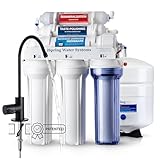
- ALKALINE FILTRATION WITH SLEEK BLACK FAUCET - This advanced 6-stage RO system restores natural alkalinity and essential minerals, delivering better-tasting water compared to standard 5-stage systems. The included black RO faucet enhances your kitchen’s style with a modern, sophisticated touch.
- EFFICIENT IMPURITY REDUCTION - Reduces up to 99% of over 1,000 harmful contaminants, including sediment, vinyl chloride, chlorine, fluoride, lead (98%), arsenic, PFAS, asbestos, calcium, and sodium, ensuring clean, pure drinking water.
- LOW MAINTENANCE - Features a transparent first-stage filter housing for quick visual inspection. Three pre-filters protect the RO membrane, which filters contaminants down to 0.0001 microns, while a fine GAC filter provides a finishing touch. The AK filter restores minerals and alkalinity for fresh, great-tasting water.
- DIY INSTALLATION WITH LEAK PROTECTION - Designed for hassle-free installation with all necessary parts included. Backed by a clear manual, instructional videos, and lifetime technical support. Quick-fitting connectors ensure a leak-free setup without the need for threading pipes. Note: Please check under-sink space before purchasing.
- 100% SATISFACTION GUARANTEED - Register for a 1-year limited manufacturer warranty and enjoy dedicated support from our team in GA, USA. Built with premium components for a long-lasting supply of bottled-quality drinking water, promoting a plastic-free future.
What a filter can—and cannot—tell you
A filter is a treatment device, not a substitute for knowing what is in the water. It may improve a noticeable quality such as taste, or reduce a named contaminant if the product is designed and verified for that claim. It cannot certify the rest of the water as safe, and a filter intended for one purpose should not be assumed to handle a different one.
Testing and treatment also solve different problems. A test identifies what was present in the sample; treatment is an intervention chosen in response. Retesting checks whether that intervention achieved the intended reduction. Keeping those steps separate helps avoid two common mistakes: buying equipment before establishing a need, and assuming that installing equipment proves the water is safe.
For homeowners planning well or plumbing work, include water testing in the project plan rather than treating the filter as an automatic finishing item. A new installation or repair can be a reason to test, and treatment needs can depend on both the water result and the condition of the well. Have a qualified professional assess complex contamination or questions about the well itself.
Crashes, No Sound, or Screen Glitches?
Random freezes, missing sound and display glitches usually trace back to one bad driver. Find and replace yours safely.Free scan · under a minutePC Slower Than It Used to Be?
A free scan shows the junk files, broken settings and background clutter dragging Windows down - then fixes them in one click.Free scan · Windows 10 & 11Quick Recap
Product prices and availability are accurate as of the date/time indicated and are subject to change. Any price and availability information displayed on Amazon at the time of purchase will apply.




