Windows Errors? Fix Them Before They Spread
Repair common Windows errors and clear accumulated junk for a smoother, more stable PC - no reinstall needed.Free scan · no reinstallOutdated Drivers Are Slowing You Down
One free scan finds every outdated or missing driver and matches the right update for your exact hardware.Free scan · exact hardware matchA good DIY irrigation system does three things: it puts water where roots can use it, it runs at a pressure the parts can handle, and it shuts off before the garden turns soggy. For most home gardens, that means choosing between a watering wand, soaker hoses, drip tubing, micro-sprays, a rain-barrel setup, or simple sprinkler zones.
The best choice depends on garden size, plant spacing, soil type, water pressure, local backflow rules, and how much maintenance you are willing to do. A $40 hose-end setup can be right for a small raised bed. A larger lawn and garden combination may need several zones, a controller, backflow protection, and professional trenching.
As an Amazon Associate I earn from qualifying purchases.
On our job sites, we treat irrigation like any other water system: measure the supply first, protect the potable water line, keep the layout serviceable, and build in a way that can be drained before freezing weather. The sections below compare six practical DIY irrigation systems and show where each one fits.
Quick wins for a faster PC:
Repair Windows errors before they cause bigger problemsFix Now →Fix the driver behind crashes, sound loss and screen glitchesFind Drivers →Quick Comparison: 6 DIY Garden Irrigation Options
If you are trying to decide fast, start with garden size and plant type. Vegetable beds and shrubs usually do best with drip or soaker irrigation. Lawns, seed, and large groundcover areas often need spray coverage. Containers and irregular beds may need micro-sprays or bubblers.
#1 Best Overall
- Comprehensive 108-piece kit for flower beds, gardens and landscaped areas; eliminates hand watering, saves time and money
- Ultimate watering efficiency for all plants, shrubs and trees; up to 80% water savings
- Simple 3-step installation: connect to faucet, insert fittings into tubing, attach watering devices
- Includes 3 differnet types of watering devices: drippers, micro-bubblers and micro sprays
- Pressure-compensating technology ensures all plants receive same amount of water
| Method | Best For | Typical DIY Cost | DIY Difficulty | Maintenance Level | When to Call a Pro |
|---|---|---|---|---|---|
| Watering wand with timer reminders | Containers, small beds, new plantings | $20-$80 | Easy | High, because you do the watering | Usually not needed unless adding hose bibs |
| Soaker hose | Rows, raised beds, shrubs, foundation plantings | $25-$150 per small zone | Easy | Moderate | If tying into buried water lines or complex zones |
| Drip irrigation kit | Vegetables, raised beds, mixed plantings | $10-$200 for common kits; many complete kits around $60-$70 | Moderate | Moderate | If adding multiple permanent zones or trenching |
| Micro-sprays and bubblers | Containers, irregular beds, grouped plants | $50-$250 depending on emitters and tubing | Moderate | Moderate to high | If pressure balancing is difficult |
| Rain-barrel gravity-fed system | Small gardens, containers, low-pressure drip | $80-$250 typical; barrels often $36-$394 | Moderate | Moderate | If roof drainage or overflow affects the foundation |
| Hose-end or in-ground sprinkler zones | Lawns, seed, larger mixed yards | $50-$300 hose-end; $1,600-$3,600 typical in-ground professional range | Easy to hard | Moderate | For in-ground systems, backflow devices, permits, and trenching |
Before buying parts, test your faucet flow. Put a 5-gallon bucket under the spigot, open the valve fully, and time how many seconds it takes to fill. The formula is simple: 300 divided by seconds equals gallons per minute. If the bucket fills in 30 seconds, you have about 10 gallons per minute at that hose bib. Design each irrigation zone below that available flow instead of using every gallon on paper.
Also check pressure. Drip tubing commonly operates at low pressure, often around 6-12 psi for some tubing, while many retail garden kits use regulators around 25 psi. Match the pressure regulator to the tubing and emitter rating. Too much pressure can pop fittings loose or make emitters flow unevenly. Too little pressure leaves the far end of the line dry.
1. Watering Wand and Timer Reminders
A watering wand is the simplest garden irrigation system, and for very small gardens it may be the best one. A quality wand with a shutoff valve, a gentle shower head, and a hose timer reminder can keep containers, herbs, and new transplants alive without installing tubing across the yard.
This works best for gardens under about 50-100 square feet, patio containers, window boxes, and newly planted shrubs that need close attention for the first few weeks. The cost is modest: about $15-$40 for a good watering wand, $10-$25 for hose washers and quick-connects, and $20-$60 for a basic hose-end timer if you want reminders or timed shutoff.
Where It Works Well
Hand watering gives you control. You can soak a tomato transplant, skip a damp corner, rinse soil off a walkway, and inspect leaves for pests while you work. For small gardens, that human inspection is valuable.
The downside is consistency. In hot weather, containers can need water daily. A raised bed in full sun may need deep watering every 2-3 days depending on soil, mulch, and rainfall. If you travel or miss a few evenings in July, plants can decline fast.
Builder Tips for Better Hand Watering
Use a wand with a breaker or shower pattern rather than a hard jet. Water at the soil line, not over the foliage, when possible. Early morning watering reduces evaporation and gives leaves time to dry if they do get wet. Add 2-3 inches of mulch around vegetables and shrubs to stabilize soil moisture.
Do these 3 things before closing this tab:
1Repair Windows errors before they cause bigger problems2Fix the driver behind crashes, sound loss and screen glitches3Clear out junk files and repair common Windows errorsFor new plantings, we usually check moisture with a trowel rather than judging by the surface. Soil can look dry on top and still be damp 2 inches down. The reverse also happens in mulched beds after a light shower.
2. Soaker Hose Loops for Rows and Beds
A soaker hose is porous tubing that seeps water along its length. It is one of the easiest upgrades from hand watering because it connects to a normal hose bib and can snake through rows, raised beds, or shrub lines.
A basic 50-foot soaker hose is a low-cost DIY option. For a more reliable setup, budget for a hose timer, Y-splitter, pressure reducer, hose washers, landscape staples, and end caps. A small bed zone commonly lands around $25-$150 depending on hose length and timer quality.
Best Uses
Soaker hoses are useful for straight vegetable rows, rectangular raised beds, foundation shrubs, and narrow planting strips. They apply water low and slowly, which reduces evaporation compared with overhead sprinklers. Covering the hose with mulch protects it from sun exposure and keeps moisture more even.
For raised beds, do not rely on one perimeter loop if the bed is wide. Run parallel lines through the planting area. In a 4-foot-wide raised bed, two or three parallel runs usually water more evenly than one hose around the edge.
Spacing and Soil
Soil type changes the layout. Sandy soil drains quickly and does not spread water sideways as far, so lines often need closer spacing. Loam and clay spread water more laterally, so wider spacing can work.
Rank #2

- Quick Connect Design: Newly Upgraded Quick Connect Irrigation System Say Goodbye to Complicated Settings! Our upgraded 4-way connectors, tees, and nozzles can now be easily connected directly to 1/4 "irrigation pipes. No more trouble with heating or softening - just plug and play!
- A brand new drip irrigation kit: ABAKUKU drip irrigation system, equipped with multiple components to meet all your garden watering needs. Including basic components such as 197 foot 1/4 inch irrigation pipe, 33 foot 1/2 inch irrigation pipe, 1/2 inch locking barbed tee connector, drip emitter flow, vortex emitter, blue mist nozzle, quick connect tee, faucet connector, etc.
- Multifunctional Applicability: Whether it is a small home garden or a large plantation, this drip irrigation system can provide even moisture distribution and is suitable for a variety of plants such as vegetables, flowers, fruit trees, etc., ensuring the healthy growth of plants.
- Four kinds of irrigation systems: the irrigation device includes four kinds of drip emitters, which can adjust different irrigation modes, such as micro drop, spray, watering, etc. A precise watering system can solve the watering problem of plants in different locations, and the amount of water sprayed can be adjusted separately according to the settings and needs.
- Easy to install and use: The set contains all the necessary components, and is easy to install without professional tools. Users can freely adjust the location of the drip irrigation tubes according to the garden layout to meet the irrigation needs of different plants.
For wide beds, drip line spacing of about 18-24 inches is commonly appropriate, but coarse sandy soils may need spacing closer to 9-12 inches. Use that same thinking with soaker hoses: tighter spacing for fast-draining soil, wider spacing for heavier soil that holds moisture.
Common Mistakes
The biggest soaker hose mistakes are running too much hose on one zone, using high pressure, and burying the hose where it cannot be inspected. Keep runs short enough that the far end still weeps. If the first 20 feet are soaked and the last 20 feet are dry, split the bed into two shorter runs or add a separate zone.
Flush the hose at the start of the season and check for plugged sections. A timer helps, but verify the first two weeks manually with a trowel. Timed watering is only useful if the water is actually reaching the root zone.
3. Drip Irrigation Kits for Raised Beds and Mixed Plantings
Drip irrigation is the most precise DIY option for most gardens. It uses tubing and emitters to deliver water directly to the root zone. For vegetable gardens, raised beds, shrubs, and containers, drip is usually more efficient than spray irrigation because less water is lost to wind, evaporation, overspray, and runoff.
Retail DIY drip kits commonly cost about $10-$200. Many complete garden kits fall around $60-$70, with costs increasing as you add tubing length, emitters, filters, pressure regulation, timers, and extra zones. Installed residential drip irrigation averages around $520 nationally, with a typical range of about $310-$815. Larger or complex systems can reach roughly $2,850.
Parts You Actually Need
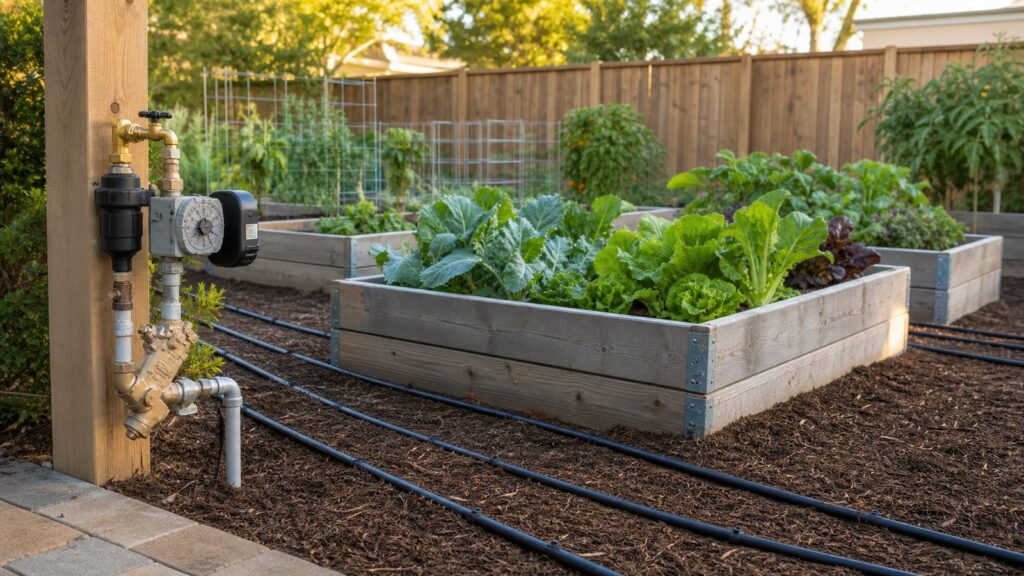
A hose-end drip setup normally includes a backflow preventer, filter, pressure regulator, mainline tubing, dripline or emitters, fittings, stakes, end caps, and a timer. Unless the kit manufacturer specifies a different order, a common hose-end assembly near the water source is backflow device, filter, then pressure regulator.
Free tools Windows power users keep installed
One-click scans. No signup required.
The filter matters. Drip emitters clog from sediment, mineral scale, and organic material. A 200-mesh filter is a common best-practice spec for garden drip systems. Install it where you can clean it without crawling through plants.
Pressure regulation matters just as much. Some drip tubing operates around 6-12 psi, while many retail garden kits use regulators around 25 psi. Check the emitter rating printed on the package. A $10-$40 inline pressure regulator is cheap compared with replacing blown fittings or unevenly watered beds.
Emitter and Line Spacing
Built-in emitter spacing varies. Common 1/4-inch tubing spacing includes 6, 12, or 24 inches. Common 1/2-inch dripline spacing includes 9, 12, 18, 24, 36, or 48 inches. For vegetable beds, 12-inch emitter spacing is a practical starting point for many soils, with closer spacing for sandy beds and wider spacing for shrubs or heavier soils.
In raised beds, run parallel drip lines down the bed, not just around the outside. In a 4-by-8-foot bed, three lines running the 8-foot direction often give better coverage than a perimeter loop. Keep the tubing accessible under mulch so you can inspect it, repair chew damage, and flush the ends.
What’s actually slowing this PC down?
Pick the symptom - the matching free tool is one click away.
Zoning by Plant Need
Do not zone only by what is easiest to connect. Zone by water need and sun exposure. Tomatoes, peppers, and cucumbers in full sun should not be on the same schedule as established rosemary, lavender, or foundation shrubs in partial shade. A shaded bed on the north side of a fence may need half the runtime of a south-facing bed in July.
A simple hose timer with two outlets can be enough for two garden zones. Larger systems may need a multi-zone controller. A smart or Wi-Fi irrigation controller can add about $50-$300, and it is most valuable when rain delay, seasonal adjustment, and zone programming are set correctly.
4. Micro-Sprays and Bubblers for Containers and Irregular Beds
Micro-sprays, bubblers, and small adjustable emitters are useful when plants are not laid out in neat rows. They work well for container groups, annual beds, small ornamental areas, and mixed plantings where each plant needs a different pattern.
Rank #3

- Convenient and portable storage kit contains 102 professional grade universal Drip irrigation parts
- Plastic pouch neatly stores an included 100' of self-dispensing 1/4" blank distribution tubing
- Individual bags inside kit hold commonly needed parts such as: emitters, connectors, plugs, couplings, and stakes
- Rain Bird's patented Emitter Installation/Removal Tool makes it easy to work with emitters and 1/4" fittings
- High-quality pressure compensating, self-piercing emitters
Expect a typical DIY setup to cost about $50-$250 depending on how many emitters, stakes, fittings, and tubing runs you need. The parts are small, but the count adds up quickly. Ten containers can require ten emitters, ten stakes, several tees, 1/4-inch tubing, a filter, a pressure regulator, and a timer.
Recommended Free Tools
Micro-Spray vs Bubbler
Micro-sprays throw a small fan, circle, or strip pattern. They are helpful for dense annuals or groundcovers, but they lose more water to wind and evaporation than true drip. Bubblers deliver a small stream or gentle flood near one plant, making them better for larger containers, shrubs, and trees.
Use micro-sprays where coverage matters more than pinpoint accuracy. Use bubblers where individual root balls need dependable water. For containers, secure tubing so it does not pull out when someone moves a pot or drags a hose past it.
Pressure and Overspray
Micro fittings are sensitive to pressure. If pressure is too high, the spray pattern can mist, drift, or overshoot the bed. If pressure is too low, the last emitters may barely run. Keep similar emitter types on the same zone whenever possible. Mixing dripline, bubblers, and micro-sprayers on one long run can make balancing difficult.
After installation, run the system while standing in the garden. Look for water hitting siding, fences, mulch paths, or pavement. Adjust the heads before plants grow around them. On our projects, we would rather spend 15 minutes tuning spray patterns than have water staining a wall or washing mulch onto a walk.
5. Rain-Barrel Gravity-Fed Drip or Soaker Systems
A rain barrel can irrigate a small garden, but it is not a high-pressure water source. Gravity-fed systems work best with low-pressure drip products, short soaker runs, and containers close to the barrel. They do not work well with standard lawn sprinklers that need higher pressure and flow.
Rain barrel costs vary widely. Typical retail pricing runs around $163, with common ranges from about $36-$394. Many 50-55 gallon barrels are around $116-$190, and diverter kits may add about $32. Add cost for a stable base, overflow piping, mosquito screening, fittings, and low-pressure irrigation tubing.
Pressure Reality
Water pressure from a barrel depends on height. Raising the barrel helps, but even a barrel several feet above the garden produces far less pressure than a municipal hose bib. Keep tubing runs short, use low-pressure components, and avoid tiny emitters that clog easily.
Elevate the barrel on a stable, level base that can handle the load. One gallon of water weighs about 8.34 pounds, so a full 55-gallon barrel holds roughly 459 pounds of water before counting the barrel itself. Do not put that load on a weak deck, loose blocks, or an unstable stand.
The Tool Desk
Outbyte Driver Updater FREEScan for outdated or missing drivers - takes under a minuteDriver Scan →Outbyte PC Repair FREEClear out junk files and repair common Windows errorsFree Scan →Drainage and Foundation Protection
Route overflow away from the foundation. A rain barrel that spills against the house during a storm can create the moisture problem you were trying to avoid. Use a diverter that sends excess water back to the downspout or pipe overflow to a safe discharge area.
Rain barrels also need screening and periodic cleaning. Keep mosquitoes out, remove leaves, and flush sediment. If you use captured roof water on edible gardens, follow local guidance and use common sense about roof materials, debris, and application. Many homeowners use rain barrels for ornamental beds and containers to keep the risk profile simple.
6. Hose-End or In-Ground Sprinkler Zones
Sprinklers are the right tool when you need overhead coverage: lawns, new seed, wide groundcover, or a large bed where drip layout would be impractical. They are usually not the best choice for mature vegetable gardens because wet leaves can increase disease pressure and overspray wastes water.
A hose-end sprinkler zone can be as simple as a quality sprinkler, hose, and timer for $50-$300. An in-ground sprinkler system is a much larger project. Current 2026 national averages cluster around $2,539-$2,549, with typical ranges around $1,600-$3,600. Large or complex lawns can exceed $10,000.
Rank #4

- 【Upgraded Tube Design & Water Saving】 Our adjustable garden watering system is upgraded to 1/2” diameter to support high water pressure. The 1/2” tee connector in the package so you can easily set up 2 drip irrigation systems as needed. Garden watering systems minimize stage water loss by recharging water directly to plant roots. While traditional irrigation often results in wasted water, this drip irrigation system saves up to 70% of water, no need for manual watering, saves water.
- 【Easy Installation & Quick Connection Technology】 The 4-way connector and emitter connect directly to 1/4" irrigation tubing easily, making installation a breeze. Our garden irrigation system features an innovative quick connect design that makes installing drip irrigation kits a breeze, with no heating or softening required, just plug and play. No tools or special skills are required, saving time and effort while ensuring a solid installation that won't fall off or leak.
- 【Wide Applications】 Drip irrigation system is perfect for lawn irrigation, gardens, patios, vegetables, plant greenhouses, flower beds, agriculture and raised beds, etc., one system can meet the irrigation needs of a wide variety of plants for different growing environments. Designed for all kinds of indoor and outdoor watering, the drip irrigation kit is designed for above ground or raised installation, and can be used all year round to keep your plants hydrated and save water.
- 【Premium Quality & Durable】 High quality adjustable drip irrigation sprinkler heads are removable and easy to clean, no need to worry about irrigation sprayer stake damage and clogged drip heads. The sharp bottom of the sprinkler stake can be easily fixed on the ground. The drip irrigation kit includes 3 types of heads such as stream, vortex and misting. Each sprinkler head can be easily adjusted by rotating the cap for precise water replenishment, making gardening less tedious!
- 【Comprehensive Drip Irrigation Kit】 Garden watering system comes with a variety of components to meet your garden watering needs. Includes 10 Drip Stream Emitter, 10 Drip Vortex Emitter, 20 Misting Nozzle(10 orange with dripper stake +10 blue), 33 FT durable 1/2“ Main Line, 197 FT 1/4” Drip Line, 6 Four Way Couplers, 1/2” Barb Tee and more. Watering plants accurately and efficiently is no longer a chore with our high quality and complete drip irrigation kits!
Cost per square foot varies by scope. Some sprinkler systems price around $0.20-$1.00 per square foot of coverage, while other market ranges land around $0.90-$1.70 per square foot. Yard size, number of zones, water pressure, soil hardness, trenching difficulty, slope, controller type, head quality, backflow device, permits, and turf restoration all affect the final number.
When Sprinklers Make Sense
Use sprinklers where overhead watering is necessary. A newly seeded lawn needs consistent surface moisture. A large turf area needs even head-to-head coverage. A temporary hose-end sprinkler can also help establish a cover crop or new bed before switching to drip.
For permanent systems, layout matters. Heads should be spaced so spray from one head reaches the next head. Poor spacing leaves dry arcs and soggy corners. Nozzle selection matters too; matched precipitation nozzles help each part of the zone receive water at a similar rate.
Backflow, Permits, and Tie-Ins
Any irrigation system connected to potable water can create a backflow risk. Local rules vary, but many jurisdictions require approved backflow prevention for lawn irrigation systems, and some require permits, inspections, or annual testing. This is especially common for in-ground systems tied into the domestic water line.
Do these 3 things before closing this tab:
1Fix the driver behind crashes, sound loss and screen glitches2Clear out junk files and repair common Windows errors3Scan for outdated or missing drivers - takes under a minuteFor a simple hose-end garden kit, use the backflow device specified by the product and your local code. For a permanent system, check city or county requirements before trenching. Backflow rules are not paperwork theater; they protect the drinking water supply from fertilizer, soil organisms, and stagnant irrigation water.
How to Plan a DIY Garden Irrigation System
A reliable irrigation layout starts with measurement, not parts. Sketch the beds, hose bibs, slopes, sunny areas, shaded areas, and plant groups. Mark containers separately because they dry faster than ground beds. Then test flow at the water source with the 5-gallon bucket method and check pressure if you have a gauge.
Divide the garden into zones by water need. A practical small yard might have one drip zone for vegetables, one soaker zone for shrubs, and one hose-end sprinkler for a patch of lawn. A larger property might have separate zones for sunny lawn, shaded lawn, raised beds, foundation shrubs, and containers.
Basic Water-Use Math
The goal is to apply enough water to wet the root zone without runoff. Many vegetable gardens need roughly 1 inch of water per week from rain and irrigation, though heat, wind, soil, mulch, and plant maturity can change that. One inch of water over 100 square feet equals about 62 gallons.
If a bed is 4 by 8 feet, it is 32 square feet. One inch of water over that bed is about 20 gallons. If your drip zone applies 1 gallon per minute total, that bed would need about 20 minutes to apply the rough equivalent of 1 inch, assuming even distribution and no rainfall. Real-world verification still matters, so check soil moisture after the first few runs.
WaterSense and Smarter Scheduling
Outdoor residential water use in the United States is nearly 8 billion gallons per day, much of it for landscape irrigation. A large share can be wasted through overwatering and inefficient systems. Smart scheduling helps, but only after the hardware is laid out correctly.
A WaterSense labeled controller can reduce overwatering by watering only when plants need it. Older EPA materials estimate that replacing a basic clock timer can save an average home nearly 8,800 gallons per year. For hose-end gardens, a timer with rain delay is still useful, but walk the system during the first two weeks and verify soil moisture with a probe or trowel.
Independent reader supportYour contribution helps us test, update, and keep practical guides available for everyone.Maintenance, Winterization, and Troubleshooting
Every irrigation system needs maintenance. Drip and soaker systems are simple, but they are not install-and-forget. Filters clog, emitters plug, tubing shifts, rodents chew lines, mulch hides leaks, and timers fail.
At startup, flush the system before installing end caps or closing flush valves. Clean the filter. Run each zone and check the far end for flow. Midseason, inspect for leaks, clogged emitters, dry plant stress, and timer drift. Before winter, shut off the water, remove battery timers from hose bibs, drain exposed tubing where possible, and store parts that can freeze and crack.
Best Value

- Be a Gardening Master with the help of our superior and complete Drip Irrigation Kit: 50ft flexible & durable PVC 5/16" Irrigation Tubing + 50ft 1/4" Drip Distribution Tubing + 2 x Female Thread Water Connectors for 5/16" Mainline + 20 Barbed Drip Emitters Stream + 10 Barbed Drip Emitters Vortex + 4 x 1-Way, 6 x 2-Way and 2 x 4-Way Barbed Splitters from 5/16" to 1/4" + 5 x 1/4" Tubing Tee Splitters + 2 x 5/16" Mainline End Plugs + 5 x 1/4" Distribution Tubing End Plugs
- Make your own garden irrigation system kit easier than ever: run a 3/4 connection from your water source to the watering area. Use the 5/16 irrigation tubing as the mainline. Branch off with the 1/4 drip irrigation tubing and connect a maximum of 30 drip irrigation emitters. Stick the dripper stake into the soil, adjust the desired irrigation spray, and feed your plants with your own drip irrigation system. Designed to work with between 20 - 45 PSI and a maximum output of 60 gallons/hour/emitter
- Enjoy taking care of your garden with high quality adjustable spray emitters and forget about broken irrigation sprayer stakes and clogged drip heads. With a length of 7.5 inch and a sharp bottom, the irrigation bubbler stake can be easily fixed into the ground and stays still even in loose soil. Perfect for long time application, the drip irrigation emitter heads are detachable and easy to clean so you don’t worry about clogging. Make gardening less of a chore!
- Spend less, get more - UV resistant and designed for underground or above-ground installation, the Carpathen 1/4 inch drip irrigation tubing will last year-round in any weather. Use the 4 ways/2 ways/1 way couplers to create the perfect branch for your plants. Season after season the distribution tubing part of the irrigation drip system will keep your plants hydrated with minimal waste from evaporation. Choose to cut down your water bills!
- Save Your Time with Carpathen Garden Irrigation System. Our automatic drip watering system minimizes water loss by directly hydrating the roots of your plants. Easily adjust the drip emitters by rotating the cap for precise hydration. Designed for up to 3 raised garden beds, this irrigation system for the garden is ideal as a garden starter kit for healthy vegetables, an automatic watering system for potted plants, a raised garden bed watering system, or a reliable garden grid watering system
Build flush points into drip laterals from the beginning. End caps that can be opened are inexpensive and save frustration. Flush at startup, midseason, and before winter shutdown. In freezing climates, design for draining with accessible valves and removable timers. Compressed-air blowout should only be used where appropriate for the system and pressure-rated components.
Common Symptoms
If the first plants are soaked and the last plants are dry, the run may be too long, the pressure may be too low, or the zone may exceed available flow. If fittings pop apart, pressure may be too high or tubing may not be seated. If emitters stop flowing, clean the filter, flush the line, and check for mineral buildup or debris.
If plants look stressed even though the timer runs, dig before increasing runtime. You need to know whether the root zone is dry, saturated, or uneven. More minutes on the controller can make a drainage problem worse.
When to DIY vs. When to Hire a Pro
DIY is a good fit for hose-end drip kits, soaker hoses, micro-irrigation for containers, small rain-barrel systems, and temporary hose-end sprinklers. These systems can usually be installed with hand tools, a tubing cutter, stakes, and a weekend of careful layout. For many homeowners, a $60-$200 drip kit plus a timer solves the garden problem without trenching or permits.
Hire a pro when the project involves tying into a main water line, installing a code-required backflow assembly, trenching across established turf or hardscape, boring under sidewalks, managing several automatic zones, or integrating lawn sprinklers with drip zones. Also bring in help if pressure and flow are marginal, the yard has steep slopes, or the system must be winterized with a formal blowout setup.
Professional garden drip installation commonly averages around $520, with many projects falling between $310 and $815. In-ground sprinkler systems typically cost much more, often around $1,600-$3,600 for common residential installations and $7,000-$13,000 for some one-acre systems. That price difference is why we like to keep vegetable and shrub irrigation simple when the site allows it.
The right DIY irrigation system is the one you can maintain. A simple soaker hose that gets checked twice a month will outperform an elaborate drip layout with clogged filters and mismatched emitters. Measure your water supply, zone by plant need, protect the drinking water line, mulch over low-volume tubing, and verify soil moisture before trusting the timer completely.
Quick wins for a faster PC:
Clear out junk files and repair common Windows errorsFree Scan →Fix the driver behind crashes, sound loss and screen glitchesFind Drivers →Frequently Asked Questions
What is the cheapest way to irrigate a garden?
For a very small garden, a watering wand and hose timer reminder is usually cheapest at about $20-$80. For beds and rows, a soaker hose setup often costs about $25-$150 per small zone.
Is drip irrigation better than a soaker hose for vegetable gardens?
Drip irrigation is usually more precise because emitter spacing and flow rates are easier to control. Soaker hoses are cheaper and simpler, but they can water unevenly on long runs or under higher pressure.
How much does a DIY garden irrigation system cost in 2026?
A DIY drip irrigation kit commonly costs about $10-$200, with many complete garden kits around $60-$70. Larger systems cost more as you add timers, filters, pressure regulators, extra tubing, and multiple zones.
Do I need a permit or backflow preventer for a garden irrigation system?
Rules vary by city and county. Hose-end kits often use a simple backflow device, while permanent in-ground irrigation systems may require approved backflow prevention, permits, inspections, or annual testing.
What’s actually slowing this PC down?
Pick the symptom - the matching free tool is one click away.
Can a rain barrel run a drip irrigation system?
Yes, but only with the right expectations. Rain barrels provide low gravity pressure, so they work best with short runs of low-pressure drip or soaker tubing, not standard lawn sprinklers.
How often should I flush a drip irrigation system?
Flush drip lines at startup, midseason, and before winter shutdown. Clean the filter at the same time and inspect the far ends of the lines to confirm water is reaching the whole zone.
Quick Recap
Product prices and availability are accurate as of the date/time indicated and are subject to change. Any price and availability information displayed on Amazon at the time of purchase will apply.

